
Disparities and Trends in Polycythemia Vera–Related Mortality in U.S. Adults Aged ≥45 Years from 1999 to 2023
DOI:
https://doi.org/10.71079/ASIDE.IM.092725233Abstract
Background: Polycythemia vera (PV) is a rare myeloproliferative neoplasm characterized by excessive red blood cell production, leading to increased risk of thrombosis and other complications. Despite its clinical significance, trends in PV mortality across demographic groups in the US remain understudied.
Methods: Nationwide mortality records were obtained from the CDC-WONDER database from 1999 to 2023 among U.S. adults aged ≥45 with PV. Age-adjusted mortality rates (AAMRs) per 100,000 population were calculated for variables. Joinpoint regression analysis was utilized to evaluate annual percent changes (APCs).
Results: From 1999 to 2023, a total of 24,236 deaths occurred among adults with PV in the U.S. The overall AAMR decreased from 1.15 in 1999 to 0.73 in 2023 (AAPC: -1.96; 95% CI: -2.28 to -1.73; p < 0.001). The AAMR for men decreased from 1.38 in 1999 to 0.87 in 2023 (AAPC-1.88; 95% CI: -2.36 to -1.37; p < 0.001), and for women decreased from 1 in 1999 to 0.62 in 2023 (AAPC: -2.03; 95% CI: -2.66 to -1.43; p < 0.001). Across racial/ethnic groups, AAMR was highest in non-Hispanic White (0.93 per 100,000). Overall, AAMRs were highest in the Midwest (0.95). The majority of deaths occurred in medical facilities (39.36%). Rural areas had a higher overall AAMR (0.91) compared to urban areas (0.82).
Conclusion: Trends in (PV) mortality declined overall from 1999 to 2023—higher trends observed in men, rural areas, the Midwest region, and NH White.
Keywords:
Polycythemia Vera, Mortality, Trends, Myeloproliferative NeoplasmsFull Text
Introduction
Polycythemia Vera (PV) is derived from a Latin origin and means “true increase in multiple blood cells”. It is a part of a greater category of pathologies called Myeloproliferative Neoplasms (MPN). It is characterized by an increase in the production of red blood cells, granulocytes, and platelets through stimulating multipotent progenitor cells [1]. This exclusively happens without any identifiable physiologic triggers. Triggers such as dehydration and diuretics could cause hemoconcentration and, in turn, relative erythrocytosis. Also, hypoxia, sleep apnea, high altitudes, renal disease, and certain drugs could be among the causes of absolute erythrocytosis [2]. On the other hand, PV is mainly associated with mutations in JAK2 V617F and JAK2 exon 12 to a lesser extent. These mutations are known to cause halting of the autoinhibitory mechanisms in the JAK-STAT signaling pathway, resulting in an uncontrolled hematopoiesis [3].
The incidence of PV was reported to be 1.57 cases per 100,000 person-years in the United States between 2002 and 2016 in a study using the Surveillance, Epidemiology, and End Results (SEER) database [4]. In a Cohort study between two large health plans in the USA between 2008 and 2010, prevalence was estimated to be 44-57 per 100,000 persons [5]. Although it has been challenging to obtain a true and consistent estimate of PV prevalence, recent improvements in diagnostic methods and improvements in survival have made it possible.
PV usually manifests by causing headaches, visual changes, thrombotic events, splenomegaly, and many other vascular complications as a result of blood hyperviscosity [6]. Erythromelalgia, which is redness and burning pain in the extremities, is often part of PV’s clinical findings. It’s thought to be due to ongoing erythrocytosis and thrombocytosis [7]. More importantly, PV can turn into more dreadful complications, like myelofibrosis or acute leukemia, especially in patients with previous exposure to cytotoxic agents or radiation [8].
PV is often an incidental finding when elevated hemoglobin/hematocrit is found in the lab work. Aquagenic pruritus is a hallmark finding in PV and can often be an eye-opener to help clinicians pursue diagnostic routes to confirm PV. Based on the revised WHO Classification of Hematolymphoid tumors in 2022, the three major criteria to diagnose PV are: elevated hemoglobin/hematocrit levels, accompanied by trilineage hyperplasia (panmyelosis), with pleomorphic mature megakaryocytes in the bone marrow, and JAK2 V617F or JAK2 exon 12 mutations. The minor criterion is subnormal serum erythropoietin levels, indicating negative feedback. To diagnose PV, you need to have the three aforementioned major criteria combined, or two major criteria along with the minor criterion [9].
The mainstay of PV treatment is frequent phlebotomies with a goal to reduce red blood cell mass and get hematocrit to 45%, which in turn reduces hyperviscosity and helps create an iron-deficient state to slow down the process of erythropoiesis. It is reported that patients older than 60 years old or with a history of thrombosis seem to have a higher risk of developing PV-related thrombosis compared to those who are younger than 60 and those with no history of thrombosis. Low-dose Aspirin has been shown to be effective in reducing thrombotic events in all risk groups, with some nuances related to the use of twice-daily Aspirin or anticoagulation in patients with a previous thrombosis history. Cytoreductive agents such as Hydroxyurea are also used to decrease the risk of thrombosis in high-risk groups, or pegylated interferon- in Hydroxyurea-resistant cases or cases where Hydroxyurea was not well tolerated [10].
The data on PV mortality trends and disparities remain scarce compared to how much we know about its clinical features. In this study, using the CDC WONDER database for adults between 1999 and 2023, we investigate mortality trends and disparities, aiming to understand the behavior of the disease and its trends based on certain parameters like age, sex, ethnicity, and geographical differences. Understanding this will hopefully allow us to observe certain biases and factors that might help us in early detection and overcoming disparities related to PV.
Methods
Study Setting and Population
In this retrospective cohort study, we analyzed temporal trends in mortality using death certificate data retrieved from the CDC WONDER (Centers for Disease Control and Prevention Wide-Ranging Online Data for Epidemiologic Research) database and analyzed data for adults aged 45 and older between 1999 and 2023 to assess outcomes of Polycythemia Vera-related mortality. Diagnostic coding was employed using the International Statistical Classification of Diseases and Related Health Problems-10th Revision (ICD-10) to identify Polycythemia Vera on death certificates by using the code D45. The primary outcome of this study was Polycythemia Vera (PV)-related mortality. This was identified using publicly available Multiple Cause-of-Death mortality data from the CDC WONDER database. Deaths were included if Polycythemia Vera (ICD-10 code D45) was listed anywhere on the death certificate, either as the underlying cause of death or as one of the contributing causes of death. This comprehensive approach ensures the capture of all deaths where PV played a documented role, regardless of its position on the death certificate [11,12]. This age threshold was carefully chosen after a thorough assessment of data availability and reliability within the CDC WONDER database. Specifically, preliminary explorations revealed that mortality data for individuals under 45 years often exhibited significant suppression due to small cell counts across various demographic and geographic variables. Including these suppressed data points would have led to unreliable estimates and incomplete trend analyses, particularly for assessing disparities. By focusing on the age group, we ensured the statistical robustness and completeness of the dataset for our comprehensive analyses of PV-related mortality trends and disparities. Those aged 45 or older have been identified in similar studies related to Polycythemia Vera or Myeloproliferative Neoplasms [13,11]. Furthermore, data of Institutional review board approval was not required for this study as it used de-identified public use data provided by the government and adhered to the STROBE (Strengthening the Reporting of Observational Studies in Epidemiology) guidelines for reporting [14].
Data Abstraction
Data for population size, year, and demographics such as sex, age, race, region, and state were extracted. Place of death was categorized into medical facilities, hospice, home, and nursing Home/Long-Term care facilities. Racial and ethnic categories were classified as non-Hispanic (NH) white, NH Black or African American, Hispanic or Latino, NH American Indian or Alaskan Native, and NH Asian or Pacific Islander. Racial/ethnic groups (Hispanic, NH American Indian/Alaska Native, NH Asian/Pacific Islander) were omitted from trend analysis due to small numbers and data suppression. The National Center for Health Statistics Urban-Rural Classification Scheme was used to assess the population by urban (large metropolitan area [population 1 million], medium/small metropolitan area [population 50,000–999,999]) and rural (population ) counties per the 2013 U.S. census classification. It is important to note that urban-rural data were consistently available and analyzed only for the period 1999–2020 due to historical limitations in WONDER stratifications [15]. Regions were stratified into Northeast, Midwest, South, and West according to the U.S. Census Bureau definitions [16]. Age groups were divided into 2 groups (45–64 and 65).
Statistical Analysis
Crude and age-adjusted mortality rates (AAMRs) per 100,000 population from 1999 to 2023 by year, sex, race/ethnicity, state, and urban-rural status for the years 1999-2020 with 95% CIs were calculated, using the 2000 U.S. population as the standard [17]. Crude mortality rates were determined by dividing the number of Polycythemia Vera deaths by the corresponding U.S. population of that year. Joinpoint Regression Program (Joinpoint V 5.4.0.0, National Cancer Institute) was employed to analyze trends in AAMR over time [18]. This method identifies points where the rate of change of the trend is statistically significant (joinpoints) and estimates the Annual Percent Change (APC) for each segment. The model selection procedure utilized permutation tests to determine the optimal number of joinpoints, with a maximum of three joinpoints allowed. Once the final model was selected, t-tests were applied to assess whether the APC for each segment was significantly different from zero. The Average Annual Percent Change (AAPC) was calculated to summarize the overall trend across the entire study period. Results are presented with 95% Confidence Intervals.
Results
Overall Trends
Throughout the study timeframe, from 1999 to 2023, a total of 24,236 deaths occurred among adults with polycythemia vera. The AAMR observed an overall notable decrease during the study period, from 1.15 in 1999 to 0.73 in 2023, with an AAPC of -1.97 (95% CI: -2.29 to -1.73; p < 0.000001).
From 1999 to 2014, AAMR showed a significant drop, from 1.15 to 0.64 (APC: -3.83; 95% Cl: -5.22 to -2.36; p = 0.020). This was followed by a minute yet non-significant increase to 0.68 in 2018 (APC: 0.92; 95% CI: -4.25 to 2.97; p = 0.880), a notable rise to 0.83 in 2021 (APC: 7.36; 95% Cl: 4.28 to 9.86; p = 0.001), and a significant decrease to 0.73 in 2023 (APC: -6.81; 95% Cl: -10.60 to -2.35; p = 0.001) (Supplemental Table 1, 2, 3) Figure 1.
Gender Trends
From 1999 to 2023, women exhibited higher mortality than men (12,207 vs. 12,029 deaths). In 1999, the AAMR for men was 1.38 compared to 1 in women. These values decreased to 0.87 and 0.62 by the year 2023. Accordingly, men exhibited a less negative AAPC of -1.88 (95% Cl: -2.36 to -1.37; p < 0.000001), compared to women with an AAPC of -2.03 (95% Cl: -2.66 to -1.43; p < 0.000001).
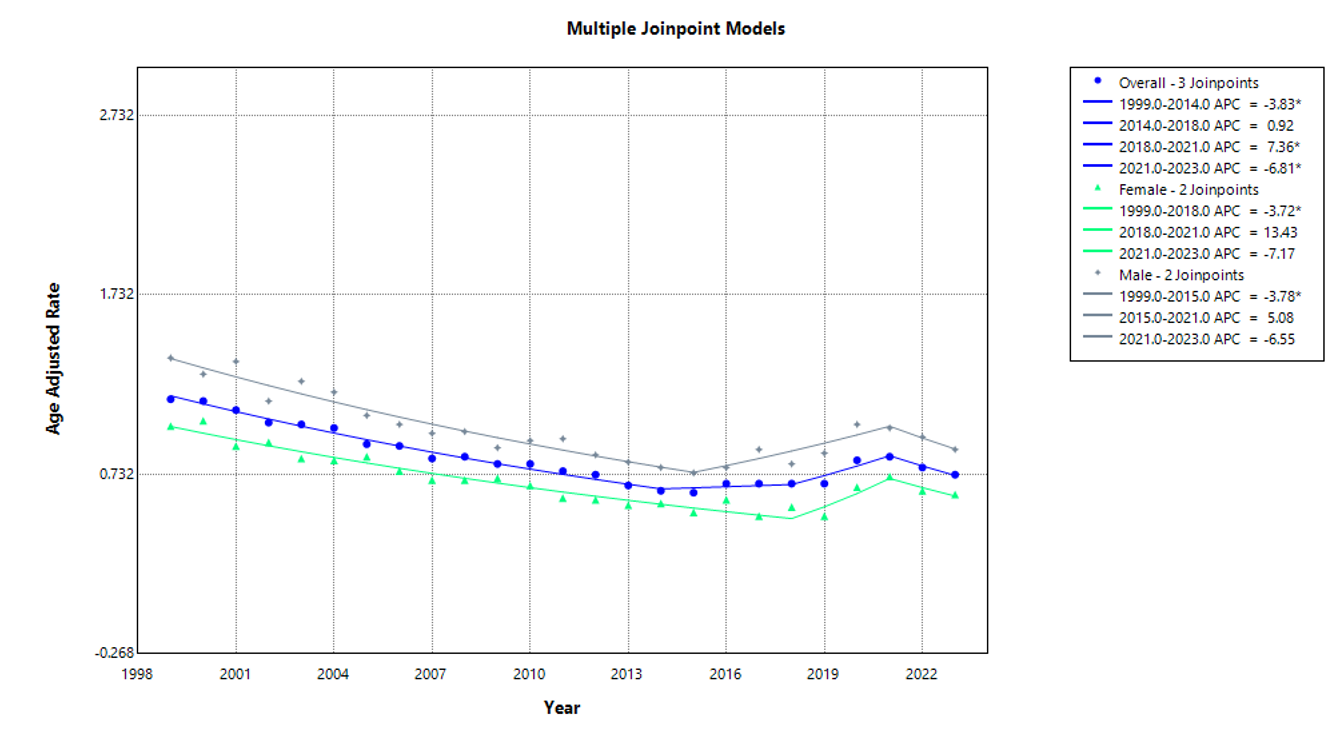
AAMR among women saw a notable decline, from 1 in 1999 to 0.55 in 2018 (APC: -3.72; 95% Cl: -4.42 to -3.17; p = 0.020), followed by a non-significant rise to 0.72 in 2021 (APC: 13.42; 95% CI: -4.46 to 17.36; p = 0.120), and a non-significant decrease to 0.62 in 2023 (APC: -7.16; 95% CI: -14.71 to 5.47; p = 0.154). Among men, AAMR exhibited a significant decline from 1.38 in 1999 to 0.74 in 2015 (APC: -3.78; 95% Cl: -4.52 to -3.06; p = 0.016). This was followed by a non-significant rise to 0.99 in 2021 (APC: 5.07; 95% CI: -4.19 to 11.04; p = 0.097), and a non-significant decrease to 0.87 in 2023 (APC: -6.54; 95% CI: -12.63 to 2.72; p = 0.131) (Supplemental Table 1, 2, 3) Figure 1.
Racial Trends
When stratified by race, NH White individuals exhibited a higher mortality as compared to NH Black/African American individuals (21,963 vs 1,072 deaths). Deaths among other predefined racial/ethnic groups (Hispanic, NH American Indian/Alaska Native, NH Asian/Pacific Islander) were omitted from trend analysis due to small numbers and data suppression.
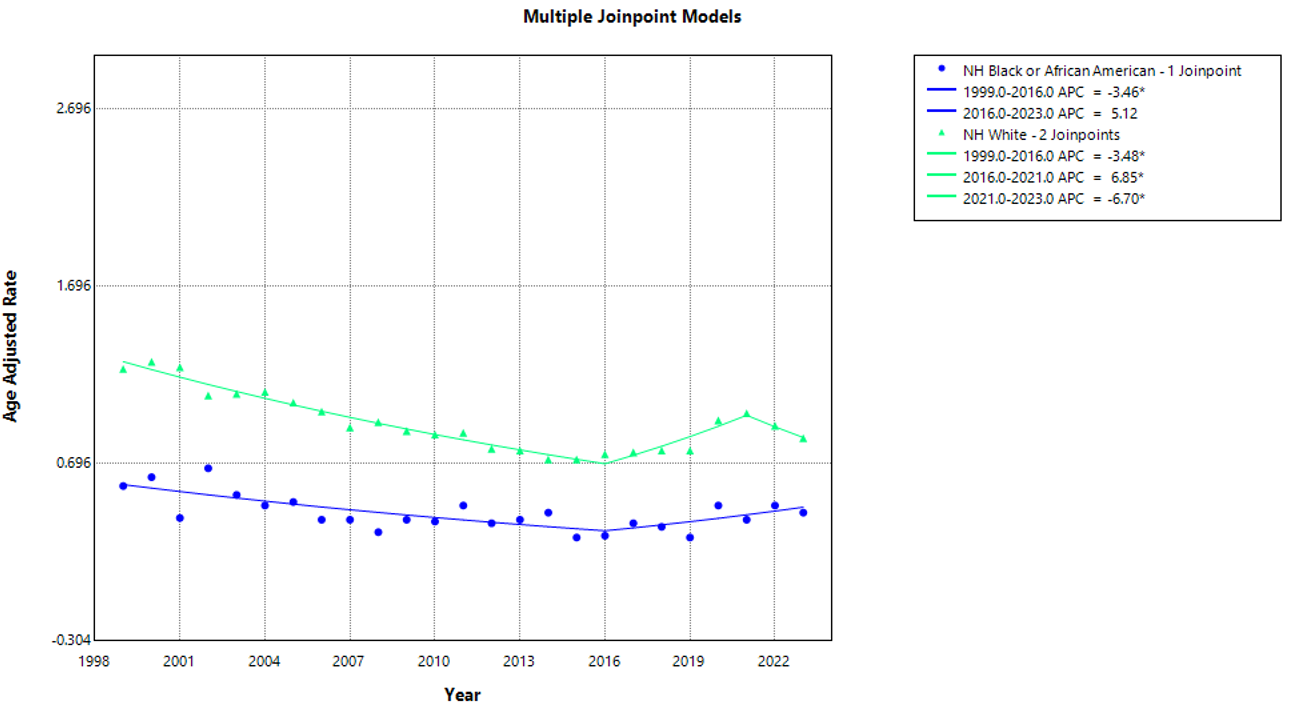
Consequently, NH White individuals demonstrated a greater overall AAMR as compared to NH Black/African American individuals (0.93 vs 0.42). NH White individuals showed a greater overall decline in AAMR from 1.23 in 1999 to 0.84 in 2023 (AAPC: -1.69; 95% Cl: -2.15 to -1.37; p < 0.000001), as compared to NH Black/African American individuals, which showed a non-significant decrease from 0.57 in 1999 to 0.42 in 2023 (AAPC: -1.03; 95% Cl: -2.61 to 0.28; p = 0.128).
In brief, NH Black/African American individuals showed a significant decrease in AAMR, from 0.57 in 1999 to 0.29 in 2016 (APC: -3.46; 95% CI: -11.40 to -1.79; p = 0.020), followed by a non-significant increase, reaching 0.42 in 2023 (APC: 5.12; 95% Cl: -0.71 to 26.87; p = 0.098). NH White individuals saw a significant decrease from 1.23 in 1999 to 0.75 in 2016 (APC: -3.48; 95% Cl: -3.97 to - 3.07; p = 0.004), a significant rise to 0.98 in 2021 (APC: 6.85; 95% Cl: 4.63 to 12.75; p = 0.018), and a steady yet significant drop to 0.84 in 2023 (APC: -6.70; 95% Cl: -12.22 to -0.43; p = 0.035) (Supplemental Table 1, 2, 4) Figure 2.
Age-specific Trends
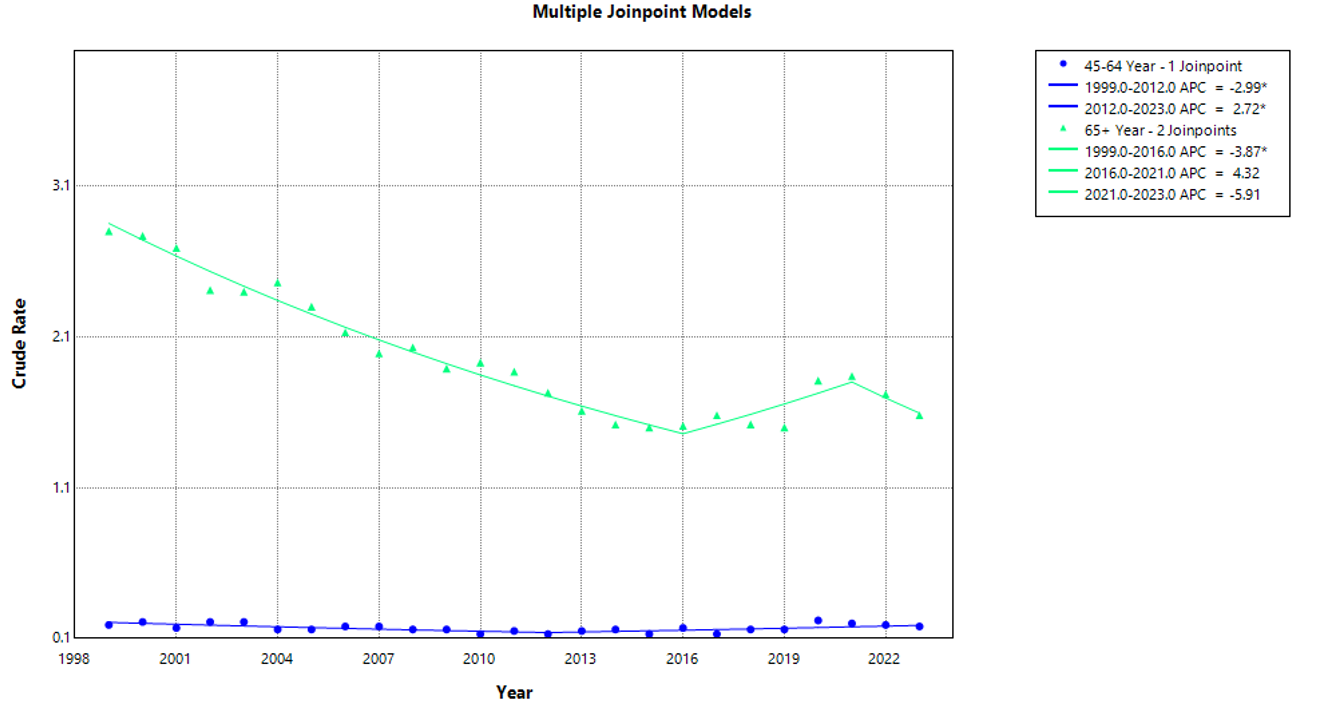
Between 1999 and 2023, older adults experienced a higher mortality than middle-aged adults (20,960 vs 3,276 deaths). Overall, CMR was higher among older adults (1.96) as compared to middle-aged adults (0.17). CMR among older adults saw a steeper decline throughout the study timeframe, from 2.80 in 1999 to 1.58 in 2023 (AAPC: -2.39; 95% CI: -2.81 to -1.98; p < 0.000001), as compared to CMR among middle-aged adults, which fell from 0.19 in 1999 to 0.18 in 2023 (AAPC: -0.41; 95% Cl: -1.48 to 0.67; p = 0.457).
CMR among middle-aged adults observed a significant decrease from 0.19 in 1999 to 0.13 in 2012 (APC: -2.99; 95% CI: -9.48 to -0.90; p = 0.010), subsequently rising significantly to 0.18 in 2023 (APC: 2.72; 95% CI: 0.51 to 9.80; p = 0.019). CMR among older adults showed a notable decrease from 2.80 in 1999 to 1.51 in 2016 (APC: -3.87; 95% Cl: -4.51 to -3.25; p = 0.022), followed by a non-significant rise to 1.84 in 2021 (APC: 4.32; 95% Cl: -4.97 to 9.81; p = 0.129), and a non-significant drop to 1.58 in 2023 (APC: -5.91; 95% Cl: -11.24 to 1.68; p = 0.137) (Supplemental Table 2, 5) Figure 3.
Regional Trends
Between 1999 and 2023, the Southern region reported the highest number of deaths (7,254), followed by the Midwest (6,283), the West (5,829), and the Northeast (4,870). Overall, AAMRs were highest in the Midwest (0.95), the West (0.93), the Northeast (0.83), and the South (0.69).
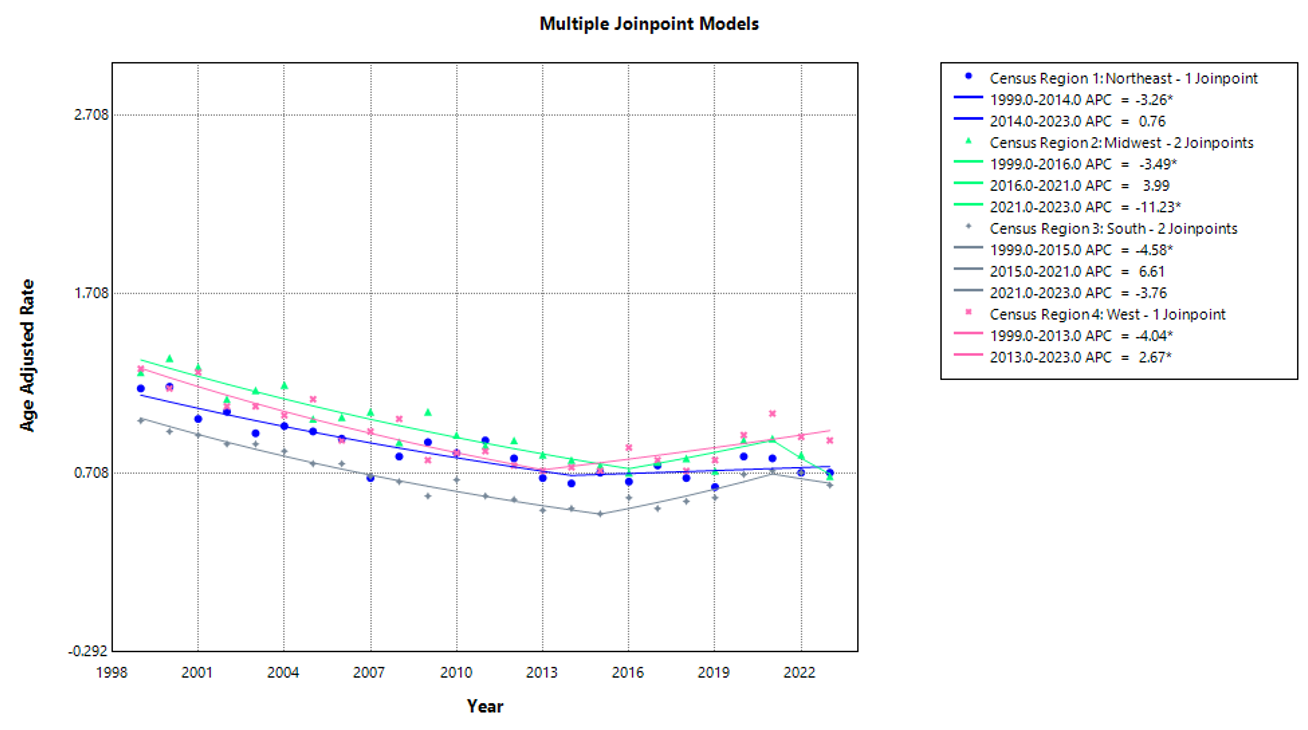
All regions demonstrated an overall decrease in AAMR between 1999 and 2023. In the Northeast, AAMR decreased from 1.18 to 0.71 (AAPC: -1.77; 95% CI: -2.53 to - 1.09; p < 0.000001), while the Midwest saw a decrease from 1.27 to 0.69 (AAPC: -2.66; 95% CI: -3.24 to -2.06; p < 0.000001). The South experienced a drop from 1.0 to 0.64 (AAPC: -1.83; 95% Cl: -2.30 to -1.26; p < 0.000001) over the same period. The West experienced a drop from 1.29 to 0.89 (AAPC: -1.30; 95% Cl: -1.91 to -0.67; p < 0.000001). AAMR in the Northeast exhibited a notable decline, from 1.18 in 1999 to 0.65 in 2014 (APC: -3.26; 95% Cl: -7.75 to -2.25; p = 0.007), followed by a non-significant rise to 0.71 in 2023 (APC: 0.76; 95% Cl: -1.45 to 8.90; p = 0.471). In the Midwest, AAMR declined significantly from 1.27 in 1999 to 0.71 in 2016 (APC: -3.49; 95% Cl: -4.22 to -2.87; p = 0.012), followed by a non-significant rise to 0.90 in 2021 (APC: 3.99; 95% CI: -3.40 to 10.45; p = 0.068), and a significant decrease to 0.69 in 2023 (APC: -11.23; 95% CI: -18.39 to - 0.06; p = 0.049).
In the Southern region, AAMR decreased significantly from 1.0 in 1999 to 0.48 in 2015 (APC: -4.58; 95% Cl: -5.82 to - 2.98; p = 0.032), followed by a non-significant rise, reaching 0.72 in 2021 (APC: 6.61; 95% CI: -7.18 to 12.86; p = 0.197), and a non-significant drop to 0.64 in 2023 (APC: -3.76; 95% Cl: -9.65 to 4.65; p = 0.471). The Western region saw a notable decrease in AAMR from 1.29 in 1999 to 0.72 in 2013 (APC: -4.04; 95% Cl: -6.06 to -2.84; p < 0.000001), subsequently rising significantly to 0.89 in 2023 (APC: 2.67; 95% Cl: 0.84 to 6.16; p = 0.007). (Supplemental Table 2, 6) Figure 4
Place of Death
Between 1999 and 2023, place of death data were available for 24,228 cases. The majority of deaths occurred in medical facilities (39.36%), followed by decedents’ residences (34.12%), nursing homes/long-term care facilities (18.45%), and hospice facilities (3.88%). A small proportion of deaths (0.20%) occurred in unspecified locations, while the remaining proportion of deaths (4.01%) occurred in other locations (Supplemental Table 7).
Urbanization Trends
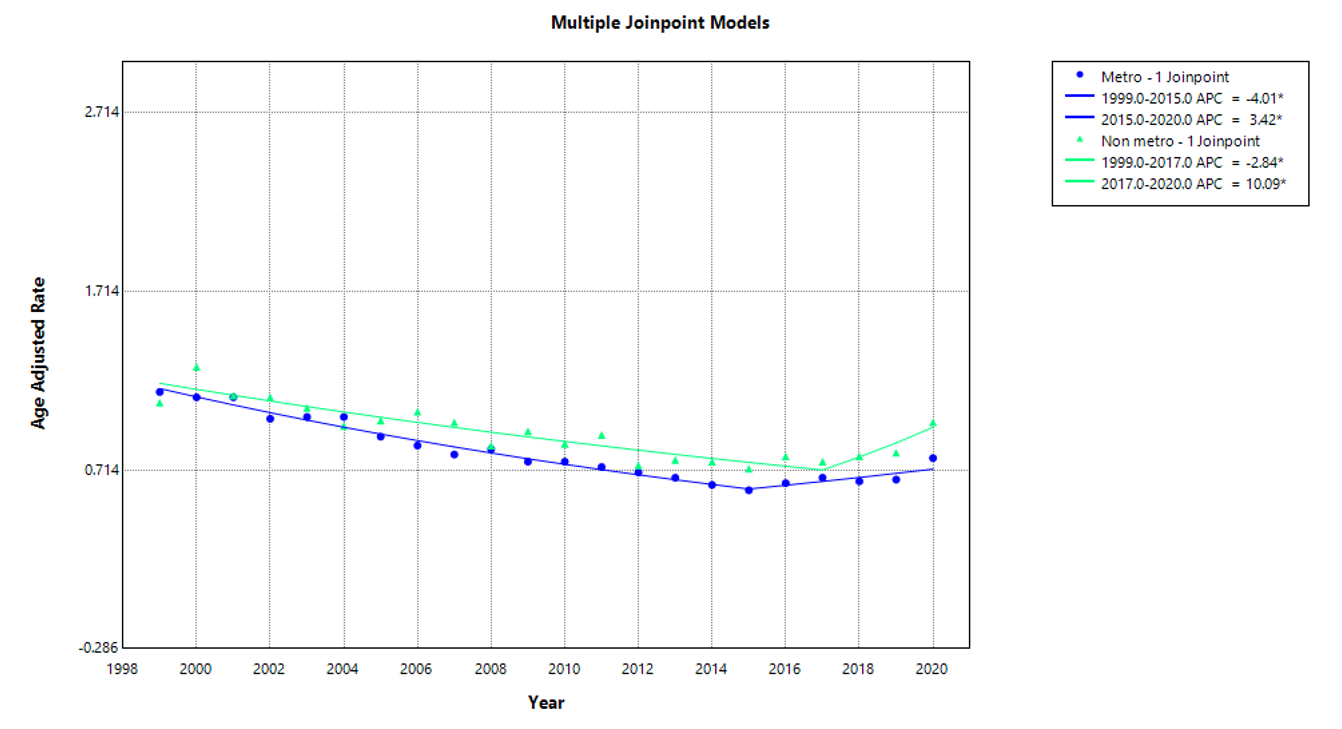
Urbanization data is available between 1999 and 2020; metropolitan areas accounted for a higher mortality (16,690 deaths) compared to non-metropolitan areas (4,154). However, the overall AAMR remained higher in non-metropolitan areas (0.91) relative to metropolitan areas (0.82). From 1999 to 2020, both metropolitan and non-metropolitan areas observed a drop in AAMR; 1.15 to 0.78 (AAPC: -2.29; 95% CI: -2.63 to -1.96; p < 0.000001), compared to non-metropolitan areas, which observed a decrease from 1.09 to 0.98 (AAPC: -1.09; 95% CI: -1.90 to -0.56; p < 0.000001).
Metropolitan regions saw a notable decrease in AAMR from 1.15 in 1999 to 0.60 in 2015 (APC: -4.01; 95% CI: -4.52 to -3.60; p < 0.000001), followed by a significant increase to 0.78 in 2020 (APC: 3.42; 95% CI: 1.30 to 7.24; p = 0.002). AAMR dropped significantly from 1.09 in 1999 to 0.76 in 2017 (APC: -2.84; 95% CI: -3.75 to -2.25; p = 0.001), followed by a notable increase to 0.98 in 2020 (APC: 10.09; 95% CI: 2.02 to 21.43; p = 0.015) (Supplemental Table 2, 8) Figure 5.
Discussion
The study reveals that, nationwide, deaths attributable to polycythemia vera have steadily decreased from 1999 to 2023. Although the trend has variations across sex, race, geography, and urban-rural divisions, the absolute death counts were greater among women, and men had consistently increased AAMRs. The analyses of different races show that the non-Hispanic White patients experienced higher rates, whereas the non-Hispanic Black/African American patients exhibited smaller, less stable downward shifts in mortality. Regional disparities are also noted as the Midwest and Western states report elevated AAMRs, in contrast to persistently lower mortality rates from the Southern states, indicating the differences in healthcare accessibility and patient care. The non-metropolitan regions show higher AAMRs, consistent with the hypothesis that structural inequalities are responsible for mortality risk. Age stratification identifies older patients aged 65 years and above as the principal pool of mortality burden, thus reflecting a decline in organ system function, biological frailty, and the prevalence of multiple comorbidities. These results collectively highlight the necessity of interventions that concurrently address demographic, geographic, and systemic healthcare differences in order to control the death rates.
PV predominantly presents around the age of sixties, yet cases appear at nearly every age [19]. Between fifty and sixty, the incidence climbs sharply; the most pronounced acceleration begins at seventy-five. [20,21,22] Older populations bear heavier symptom burdens, heightened by the malignancy’s innate aggressiveness and the aggregation of other underlying diseases. Guideline-driven treatment presently stratifies vascular hazard along age and past thrombosis, labelling everyone beyond sixty as a high-risk cohort warranting cytoreductive intervention [23,21,24]. Age also connects to a growing failure or intolerance to hydroxyurea, complicating care and possibly escalating PV-driven mortality [25].
Throughout the period of 1999-2023, women had more deaths than men. However, men consistently experienced higher AAMRs. Both males and females had their mortality rates significantly reduced over time, but men followed with a less steep decrease compared to women. Moreover, recent reductions after 2018 were not significant. These observed disparities in mortality rates by sex may be partly explained by underlying biological and clinical differences in PV progression. Women develop PV less frequently, and at the time of diagnosis, the prevalence of the homozygous JAK2 mutation is modest (61% versus 80% in men) [26]. Long-term studies indicate that JAK2 allele burden diverges, a difference that may foster heightened rates of mitotic recombination and clonal evolution into homozygous expansions, which in turn correlate with virulent disease [27,26,28]. Additional evidence shows that men more frequently harbour adverse co-mutations, specifically ASXL1, SRSF2, U2AF1, EZH2, IDH1, and IDH2, while women bear comparatively few secondary lesions [29]. These genetic features translate into different clinical landscapes; men experience a higher burden of cardiovascular sequelae and show markedly elevated frequencies of myocardial infarction and peripheral arterial occlusion, whereas women tend to manifest a more indolent disease course [30]. The interplay of somatic, clinical, and sex-related factors ultimately elevates PV-specific mortality in the male cohort.
Our analysis also notes racial and ethnic differences in PV-related mortality, with trends generally highest in non-Hispanic White and non-Hispanic Black populations. These disparities may stem from complex socioeconomic, systemic, and healthcare access factors, as observed in other hematologic malignancies. For instance, studies in related conditions have highlighted substantially reduced access to stem cell transplantation among Black patients, even after adjusting for socioeconomic factors [31,32,33]. Such observations suggest the potential influence of structural impediments or disparate treatment pathways at the provider or institutional level. Similarly, delayed receipt of chemotherapy, suboptimal treatment adherence, and missed follow-up visits, as documented in broader oncological contexts, could contribute to diminished survival among minority populations [34,35,32,36]. While the exact impact of these factors on PV-related mortality specifically requires further research, their documented influence in other cancers suggests they warrant consideration. Additionally, the persistent underrepresentation of minority patients in clinical trials may limit the generalizability of treatment guidelines, potentially exacerbating disparities by failing to adequately address the needs of diverse populations [37,38,39].
Mortality rates remained elevated in thinly populated districts, with both metropolitan and rural certainties initially declining, then later regaining upward inflexions, thereby underscoring a persistent, geographic, therapeutically related disparity. Understanding how rurality intersects with insurance features, coverage limits, co-insurance, co-pays, and the delivery of cancer care still needs thorough examination [40]. Few previous studies show that rural areas tend to attract fewer commercial plans under the Medicare Advantage marketplace, which results in decreased overall coverage rates among older adults with cancer living in rural areas. Meanwhile, the persistent obstacles of distance to reach healthcare facilities from their homes and unreliable transportation continue to affect timely care. Although due to the COVID-19 pandemic, there was an adoption of telehealth strategies, telecolposcopy, remote genetic risk evaluations, and teledermatology. However, certain rural patients still face major hurdles, including limited broadband access, uncertainty about which modality preference, and a lack of knowledge and data on how different visit types affect clinical outcomes [41,42,43]. Even traditional travel to regional oncology clinics and the influence of variable health literacy have received far too little attention [44,45]. Equally consequential, lifestyle risk profiles, namely rural-urban gradients in smoking, obesity, physical inactivity, and dietary patterns, remain under-studied in the cancer literature [46]. Strategic structural interventions, combined with transplant teams and primary oncology teams in multidisciplinary venues, prove to be promising pathways for narrowing the persistent disparities in cancer outcomes between rural and urban patients [47].
During the study period, distinct regional patterns emerged, illustrating a broad, albeit oscillating, decline in PV-attributed AAMR. The Northeast, Midwest, and Southern tiers first reflected sizable drops, later followed by erratic ascents and final stable plateaus. The West recorded the steepest early descent, yet it later exhibited a pronounced upswing ending in 2023.
Limitations
This analysis has a number of important limitations. First, mortality data derived from death certificates have the risk of misclassification of polycythaemia vera-related deaths, partly due to inconsistent coding and variations in cause-of-death documentation, which may hide the true epidemiological burden. Second, the absence of clinical parameters such as therapy regimens, resistance profiles, comorbidities, and molecular characterisations prevents the clarification of present-day trends from the effects of underlying biological and treatment-related determinants. For instance, differences in resistance to hydroxyurea, the frequency of phlebotomy, and access to targeted agents such as ruxolitinib remain unevaluated. Third, suppressed data of races other than Non-Hispanic Whites and African Americans in the national mortality databases may lead to biased subgroup assessments. Similarly, comparisons made between different regions and urban-rural stratifications may fail to characterise heterogeneity at deeper geographic levels. Lastly, while the long-term secular trends observed are robust, the possibility of confounding by socioeconomic factors, healthcare accessibility, and lifestyle and behavioral factors persists. These shortcomings emphasise the critical need for parallel, registry-based, prospective investigations that collect detailed clinical, molecular, genetic, and sociodemographic data to interpret observed mortality trends accurately.
Conclusion
The mortality attributed to PV decreased substantially from 1999 to 2023, yet outcome inequalities persisted across sex, race, region, and age. AAMRs for men exceeded those for women, and the patients aged above 65 had increased death rates as compared to the younger cohort. NH Whites experienced higher absolute mortality compared to NH Black/African Americans, and midwestern and western states showed elevated rates; similarly, deaths in rural areas exceeded those in metropolitan regions. However, progression was heterogeneous as a few age, sex, and geographic cohorts recently reported increasing rates, which could be due to developments in management and treatment that may not have reached all populations. This epidemiological study highlights the importance of reducing demographic and structural inequities, accelerating early identification, personalising treatment regimens, and expanding access to subspecialty care.
Conflicts of Interest
The authors declare no competing interests that could have influenced the objectivity or outcome of this research.
Funding Source
The authors declare that no specific grant or funding was received for this research from any public, commercial, or not-for-profit funding agency.
Acknowledgments
None
Institutional Review Board (IRB)
No ethical approval was required for the study.
Large Language Model
None
Authors Contribution
AAI contributed to conceptualization, writing-original draft, and writing-review & editing. MFH contributed to writing-review & editing, validation, and supervision. MH contributed to formal analysis, writing-original draft, and writing-review & editing. MS, MRF, FK, ES, MT, and AHM contributed to writing the original draft. KP contributed to data extraction and writing the original draft. Amro Ali contributed to writing the original draft. Amr Arafa contributed to writing, review, and editing.
Data Availability
The data that support the findings of this study are openly available in CDC‐WONDER at https://wonder.cdc.gov/. The data supporting the findings of this study were obtained from the CDC WONDER online database (Centers for Disease Control and Prevention Wide‐ranging Online Data for Epidemiologic Research). Further inquiries can be directed to the corresponding author.
References
- Barbui T., Barosi G., Birgegard G., Cervantes F., Finazzi G., Griesshammer M., Harrison C., Hasselbalch H. C., Hehlmann R., Hoffman R., Kiladjian J. J., Kroger N., Mesa R., McMullin M. F., Pardanani A., Passamonti F., Vannucchi A. M., Reiter A., Silver R. T., Verstovsek S., Tefferi A., European LeukemiaNet. Philadelphia-negative classical myeloproliferative neoplasms: critical concepts and management recommendations from European LeukemiaNet. J Clin Oncol. 2011;29(6):761-70. doi:10.1200/JCO.2010.31.8436 PMID: 21205761 PMCID: PMC4979120
- Mithoowani S., Laureano M., Crowther M. A., Hillis C. M.. Investigation and management of erythrocytosis. CMAJ. 2020;192(32):E913-E918. doi:10.1503/cmaj.191587 PMID: 32778603 PMCID: PMC7829024
- Mustjoki S., Borze I., Lasho T. L., Alitalo R., Pardanani A., Knuutila S., Juvonen E.. JAK2V617F mutation and spontaneous megakaryocytic or erythroid colony formation in patients with essential thrombocythaemia (ET) or polycythaemia vera (PV). Leuk Res. 2009;33(1):54-9. doi:10.1016/j.leukres.2008.07.008 PMID: 18760472
- Verstovsek S., Yu J., Scherber R. M., Verma S., Dieyi C., Chen C. C., Parasuraman S.. Changes in the incidence and overall survival of patients with myeloproliferative neoplasms between 2002 and 2016 in the United States. Leuk Lymphoma. 2022;63(3):694-702. doi:10.1080/10428194.2021.1992756 PMID: 34689695
- Mehta J., Wang H., Iqbal S. U., Mesa R.. Epidemiology of myeloproliferative neoplasms in the United States. Leuk Lymphoma. 2014;55(3):595-600. doi:10.3109/10428194.2013.813500 PMID: 23768070
- Pemmaraju N., Gerds A. T., Yu J., Parasuraman S., Shah A., Xi A., Kumar S., Scherber R. M., Verstovsek S.. Thrombotic events and mortality risk in patients with newly diagnosed polycythemia vera or essential thrombocythemia. Leuk Res. 2022;115:106809. doi:10.1016/j.leukres.2022.106809 PMID: 35220060
- Ma J. E., Lee J. U. J., Sartori-Valinotti J. C., Rooke T. W., Sandroni P., Davis M. D. P.. Erythromelalgia: A Review of Medical Management Options and Our Approach to Management. Mayo Clin Proc. 2023;98(1):136-149. doi:10.1016/j.mayocp.2022.08.005 PMID: 36470753
- Khanal N., Giri S., Upadhyay S., Shostrom V. K., Pathak R., Bhatt V. R.. Risk of second primary malignancies and survival of adult patients with polycythemia vera: A United States population-based retrospective study. Leuk Lymphoma. 2016;57(1):129-33. doi:10.3109/10428194.2015.1071492 PMID: 26159045
- Khoury J. D., Solary E., Abla O., Akkari Y., Alaggio R., Apperley J. F., Bejar R., Berti E., Busque L., Chan J. K. C., Chen W., Chen X., Chng W. J., Choi J. K., Colmenero I., Coupland S. E., Cross N. C. P., De Jong D., Elghetany M. T., Takahashi E., Emile J. F., Ferry J., Fogelstrand L., Fontenay M., Germing U., Gujral S., Haferlach T., Harrison C., Hodge J. C., Hu S., Jansen J. H., Kanagal-Shamanna R., Kantarjian H. M., Kratz C. P., Li X. Q., Lim M. S., Loeb K., Loghavi S., Marcogliese A., Meshinchi S., Michaels P., Naresh K. N., Natkunam Y., Nejati R., Ott G., Padron E., Patel K. P., Patkar N., Picarsic J., Platzbecker U., Roberts I., Schuh A., Sewell W., Siebert R., Tembhare P., Tyner J., Verstovsek S., Wang W., Wood B., Xiao W., Yeung C., Hochhaus A.. The 5th edition of the World Health Organization Classification of Haematolymphoid Tumours: Myeloid and Histiocytic/Dendritic Neoplasms. Leukemia. 2022;36(7):1703-1719. doi:10.1038/s41375-022-01613-1 PMID: 35732831 PMCID: PMC9252913
- Tefferi A., Barbui T.. Polycythemia vera and essential thrombocythemia: 2017 update on diagnosis, risk-stratification, and management. Am J Hematol. 2017;92(1):94-108. doi:10.1002/ajh.24607 PMID: 27991718
- Hemida Mohamed Fawzi, Ibrahim Alyaa Ahmed, Mohamed Abdelrahman, Patel Krish, Qadri Maria. MPN-1260: Disparities and Trends in Polycythemia Vera Mortality in Elderly Adults From 1999 to 2020. Clinical Lymphoma Myeloma and Leukemia. 2025;25. doi:10.1016/s2152-2650(25)02165-2
- Saleem Muhammad Asjad, Khan Muzamil, Lal Amar, Rath Shree, Hamed Belal Mohamed, Pakkam Madona, Aziz Nouman, Nabi Waseem, Bhat Adnan. Analyzing trends and disparities in polycythemia vera mortality in the U.S. from 1999 to 2020. Journal of Clinical Oncology. 2025;43(16_suppl). doi:10.1200/JCO.2025.43.16_suppl.e18587
- Hemida Mohamed Fawzi, Ibrahim Alyaa Ahmed, Mohamed Abdelrahman, Jairamani Sahil. MPN-1385: Trends and Disparities in Renal Disease-Related Mortality Among Adults With Myeloproliferative Neoplasms in the US. Clinical Lymphoma Myeloma and Leukemia. 2025;25:S694-S695. doi:10.1016/s2152-2650(25)02173-1
- von Elm E., Altman D. G., Egger M., Pocock S. J., Gotzsche P. C., Vandenbroucke J. P., STROBE Initiative. The Strengthening the Reporting of Observational Studies in Epidemiology (STROBE) statement: guidelines for reporting observational studies. J Clin Epidemiol. 2008;61(4):344-9. doi:10.1016/j.jclinepi.2007.11.008 PMID: 18313558
- Aggarwal R., Chiu N., Loccoh E. C., Kazi D. S., Yeh R. W., Wadhera R. K.. Rural-Urban Disparities: Diabetes, Hypertension, Heart Disease, and Stroke Mortality Among Black and White Adults, 1999-2018. J Am Coll Cardiol. 2021;77(11):1480-1481. doi:10.1016/j.jacc.2021.01.032 PMID: 33736831 PMCID: PMC8210746
- Ingram D. D., Franco S. J.. 2013 NCHS Urban-Rural Classification Scheme for Counties. Vital Health Stat 2. 2014:1-73. PMID: 24776070
- Anderson R. N., Rosenberg H. M.. Age standardization of death rates: implementation of the year 2000 standard. Natl Vital Stat Rep. 1998;47(3):1-16, 20. PMID: 9796247
- Surveillance Research Program. Joinpoint Regression Program. Joinpoint Trend Analysis Software [Internet]. 2025.
- Landolfi R., Di Gennaro L., Nicolazzi M. A., Giarretta I., Marfisi R., Marchioli R.. Polycythemia vera: gender-related phenotypic differences. Intern Emerg Med. 2012;7(6):509-15. doi:10.1007/s11739-011-0634-3 PMID: 21660494
- Cartwright R. A., Gurney K. A., Moorman A. V.. Sex ratios and the risks of haematological malignancies. Br J Haematol. 2002;118(4):1071-7. doi:10.1046/j.1365-2141.2002.03750.x PMID: 12199787
- Deadmond M. A., Smith-Gagen J. A.. Changing incidence of myeloproliferative neoplasms: trends and subgroup risk profiles in the USA, 1973-2011. J Cancer Res Clin Oncol. 2015;141(12):2131-8. doi:10.1007/s00432-015-1983-5 PMID: 25968903 PMCID: PMC11824035
- McNally R. J. Q., Rowland D., Roman E., Cartwright R. A.. Age and sex distributions of hematological malignancies in the U.K. Hematological Oncology. 1997;15(4):173-189. doi:10.1002/(sici)1099-1069(199711)15:4<173::Aid-hon610>3.0.Co;2-k
- Barbui T., Tefferi A., Vannucchi A. M., Passamonti F., Silver R. T., Hoffman R., Verstovsek S., Mesa R., Kiladjian J. J., Hehlmann R., Reiter A., Cervantes F., Harrison C., Mc Mullin M. F., Hasselbalch H. C., Koschmieder S., Marchetti M., Bacigalupo A., Finazzi G., Kroeger N., Griesshammer M., Birgegard G., Barosi G.. Philadelphia chromosome-negative classical myeloproliferative neoplasms: revised management recommendations from European LeukemiaNet. Leukemia. 2018;32(5):1057-1069. doi:10.1038/s41375-018-0077-1 PMID: 29515238 PMCID: PMC5986069
- Vannucchi A. M., Barbui T., Cervantes F., Harrison C., Kiladjian J. J., Kroger N., Thiele J., Buske C., ESMO Guidelines Committee. Philadelphia chromosome-negative chronic myeloproliferative neoplasms: ESMO Clinical Practice Guidelines for diagnosis, treatment and follow-up. Ann Oncol. 2015;26 Suppl 5:v85-99. doi:10.1093/annonc/mdv203 PMID: 26242182
- Alvarez-Larran A., Kerguelen A., Hernandez-Boluda J. C., Perez-Encinas M., Ferrer-Marin F., Barez A., Martinez-Lopez J., Cuevas B., Mata M. I., Garcia-Gutierrez V., Aragues P., Montesdeoca S., Burgaleta C., Caballero G., Hernandez-Rivas J. A., Duran M. A., Gomez-Casares M. T., Besses C., Grupo Espanol de Enfermedades Mieloproliferativas Filadelfia Negativas. Frequency and prognostic value of resistance/intolerance to hydroxycarbamide in 890 patients with polycythaemia vera. Br J Haematol. 2016;172(5):786-93. doi:10.1111/bjh.13886 PMID: 26898196
- Pemmaraju N., Moliterno A. R., Williams D. M., Rogers O., Spivak J. L.. The quantitative JAK2 V617F neutrophil allele burden does not correlate with thrombotic risk in essential thrombocytosis. Leukemia. 2007;21(10):2210-2. doi:10.1038/sj.leu.2404755 PMID: 17507997
- Passamonti F., Randi M. L., Rumi E., Pungolino E., Elena C., Pietra D., Scapin M., Arcaini L., Tezza F., Moratti R., Pascutto C., Fabris F., Morra E., Cazzola M., Lazzarino M.. Increased risk of pregnancy complications in patients with essential thrombocythemia carrying the JAK2 (617V>F) mutation. Blood. 2007;110(2):485-9. doi:10.1182/blood-2007-01-071068 PMID: 17426257
- Stein B. L., Williams D. M., Wang N. Y., Rogers O., Isaacs M. A., Pemmaraju N., Spivak J. L., Moliterno A. R.. Sex differences in the JAK2 V617F allele burden in chronic myeloproliferative disorders. Haematologica. 2010;95(7):1090-7. doi:10.3324/haematol.2009.014407 PMID: 20133898 PMCID: PMC2895032
- Karantanos T., Chaturvedi S., Braunstein E. M., Spivak J., Resar L., Karanika S., Williams D. M., Rogers O., Gocke C. D., Moliterno A. R.. Sex determines the presentation and outcomes in MPN and is related to sex-specific differences in the mutational burden. Blood Adv. 2020;4(12):2567-2576. doi:10.1182/bloodadvances.2019001407 PMID: 32542392 PMCID: PMC7322953
- Stein B. L., Rademaker A., Spivak J. L., Moliterno A. R.. Gender and Vascular Complications in the JAK2 V617F-Positive Myeloproliferative Neoplasms. Thrombosis. 2011;2011:874146. doi:10.1155/2011/874146 PMID: 22084670 PMCID: PMC3200304
- Fiala M. A., Wildes T. M.. Racial disparities in treatment use for multiple myeloma. Cancer. 2017;123(9):1590-1596. doi:10.1002/cncr.30526 PMID: 28085188 PMCID: PMC5400674
- Kirtane K., Lee S. J.. Racial and ethnic disparities in hematologic malignancies. Blood. 2017;130(15):1699-1705. doi:10.1182/blood-2017-04-778225 PMID: 28724539 PMCID: PMC5639484
- Lussana F., Rambaldi A., Finazzi M. C., van Biezen A., Scholten M., Oldani E., Carobbio A., Iacobelli S., Finke J., Nagler A., Volin L., Lamy T., Arnold R., Mohty M., Michallet M., de Witte T., Olavarria E., Kroger N.. Allogeneic hematopoietic stem cell transplantation in patients with polycythemia vera or essential thrombocythemia transformed to myelofibrosis or acute myeloid leukemia: a report from the MPN Subcommittee of the Chronic Malignancies Working Party of the European Group for Blood and Marrow Transplantation. Haematologica. 2014;99(5):916-21. doi:10.3324/haematol.2013.094284 PMID: 24389309 PMCID: PMC4008110
- Dominick K. L., Golightly Y. M., Bosworth H. B.. Racial differences in analgesic/anti-inflammatory medication adherence among patients with osteoarthritis. Ethn Dis. 2005;15(1):116-22. PMID: 15720058
- Flowers C. R., Fedewa S. A., Chen A. Y., Nastoupil L. J., Lipscomb J., Brawley O. W., Ward E. M.. Disparities in the early adoption of chemoimmunotherapy for diffuse large B-cell lymphoma in the United States. Cancer Epidemiol Biomarkers Prev. 2012;21(9):1520-30. doi:10.1158/1055-9965.EPI-12-0466 PMID: 22771484 PMCID: PMC4155492
- Schweizer R. T., Rovelli M., Palmeri D., Vossler E., Hull D., Bartus S.. Noncompliance in organ transplant recipients. Transplantation. 1990;49(2):374-7. doi:10.1097/00007890-199002000-00029 PMID: 2305467
- Brady A. K., Fu A. Z., Earl M., Kalaycio M., Advani A., Saunthararajah Y., Sobecks R., Copelan E., Sekeres M. A.. Race and intensity of post-remission therapy in acute myeloid leukemia. Leuk Res. 2011;35(3):346-50. doi:10.1016/j.leukres.2010.07.020 PMID: 20696474
- Costa L. J., Hari P. N., Kumar S. K.. Differences between unselected patients and participants in multiple myeloma clinical trials in US: a threat to external validity. Leuk Lymphoma. 2016;57(12):2827-2832. doi:10.3109/10428194.2016.1170828 PMID: 27104965
- Hamel L. M., Penner L. A., Albrecht T. L., Heath E., Gwede C. K., Eggly S.. Barriers to Clinical Trial Enrollment in Racial and Ethnic Minority Patients With Cancer. Cancer Control. 2016;23(4):327-337. doi:10.1177/107327481602300404 PMID: 27842322 PMCID: PMC5131730
- Dressler L. G., Deal A. M., Owzar K., Watson D., Donahue K., Friedman P. N., Ratain M. J., McLeod H. L.. Participation in Cancer Pharmacogenomic Studies: A Study of 8456 Patients Registered to Clinical Trials in the Cancer and Leukemia Group B (Alliance). J Natl Cancer Inst. 2015;107(10). doi:10.1093/jnci/djv188 PMID: 26160883 PMCID: PMC5758036
- Barker A., Nienstedt L., Kemper L., McBride T., Mueller K.. Comparing Rural and Urban Medicare Advantage Beneficiary Characteristics. Rural Policy Brief. 2019;2019(1):1-4. PMID: 30995707
- Hitt W. C., Low G., Bird T. M., Ott R.. Telemedical cervical cancer screening to bridge medicaid service care gap for rural women. Telemed J E Health. 2013;19(5):403-8. doi:10.1089/tmj.2012.0148 PMID: 23600410 PMCID: PMC3678580
- Hitt W. C., Low G. M., Lynch C. E., Gauss C. H., Magann E. F., Lowery C. L., Eswaran H.. Application of a Telecolposcopy Program in Rural Settings. Telemed J E Health. 2016;22(10):816-820. doi:10.1089/tmj.2015.0260 PMID: 27128600
- Mette L. A., Saldivar A. M., Poullard N. E., Torres I. C., Seth S. G., Pollock B. H., Tomlinson G. E.. Reaching high-risk underserved individuals for cancer genetic counseling by video-teleconferencing. J Community Support Oncol. 2016;14(4):162-8. doi:10.12788/jcso.0247 PMID: 27152515
- Ward M. M., Ullrich F., Matthews K., Rushton G., Tracy R., Bajorin D. F., Goldstein M. A., Kosty M. P., Bruinooge S. S., Hanley A., Lynch C. F.. Access to chemotherapy services by availability of local and visiting oncologists. J Oncol Pract. 2014;10(1):26-31. doi:10.1200/JOP.2013.001217 PMID: 24443731 PMCID: PMC3889218
- Gruca T. S., Nam I., Tracy R.. Trends in medical oncology outreach clinics in rural areas. J Oncol Pract. 2014;10(5):e313-20. doi:10.1200/JOP.2013.001350 PMID: 25052498
- Ray M. A., Faris N. R., Fehnel C., Derrick A., Smeltzer M. P., Meadows-Taylor M. B., Ariganjoye F., Pacheco A., Optican R., Tonkin K., Wright J., Fox R., Callahan T., Robbins E. T., Walsh W., Lammers P., Satpute S., Osarogiagbon R. U.. Survival Impact of an Enhanced Multidisciplinary Thoracic Oncology Conference in a Regional Community Health Care System. JTO Clin Res Rep. 2021;2(8):100203. doi:10.1016/j.jtocrr.2021.100203 PMID: 34590046 PMCID: PMC8474211
References
1. Barbui T, Barosi G, Birgegard G, Cervantes F, Finazzi G, Griesshammer M, Harrison C, Hasselbalch HC, Hehlmann R, Hoffman R, Kiladjian JJ, Kroger N, Mesa R, McMullin MF, Pardanani A, Passamonti F, Vannucchi AM, Reiter A, Silver RT, Verstovsek S, Tefferi A, European L. Philadelphia-negative classical myeloproliferative neoplasms: critical concepts and management recommendations from European LeukemiaNet. J Clin Oncol. 2011: 761 [PMID: 21205761, https://doi.org/10.1200/JCO.2010.31.8436]
2. Mithoowani S, Laureano M, Crowther MA, Hillis CM. Investigation and management of erythrocytosis. CMAJ. 2020: E913 [PMID: 32778603, https://doi.org/10.1503/cmaj.191587]
3. Mustjoki S, Borze I, Lasho TL, Alitalo R, Pardanani A, Knuutila S, Juvonen E. JAK2V617F mutation and spontaneous megakaryocytic or erythroid colony formation in patients with essential thrombocythaemia (ET) or polycythaemia vera (PV). Leuk Res. 2009: 54 [PMID: 18760472, https://doi.org/10.1016/j.leukres.2008.07.008]
4. Verstovsek S, Yu J, Scherber RM, Verma S, Dieyi C, Chen CC, Parasuraman S. Changes in the incidence and overall survival of patients with myeloproliferative neoplasms between 2002 and 2016 in the United States. Leuk Lymphoma. 2022: 694 [PMID: 34689695, https://doi.org/10.1080/10428194.2021.1992756]
5. Mehta J, Wang H, Iqbal SU, Mesa R. Epidemiology of myeloproliferative neoplasms in the United States. Leuk Lymphoma. 2014: 595 [PMID: 23768070, https://doi.org/10.3109/10428194.2013.813500]
6. Pemmaraju N, Gerds AT, Yu J, Parasuraman S, Shah A, Xi A, Kumar S, Scherber RM, Verstovsek S. Thrombotic events and mortality risk in patients with newly diagnosed polycythemia vera or essential thrombocythemia. Leuk Res. 2022: 106809 [PMID: 35220060, https://doi.org/10.1016/j.leukres.2022.106809]
7. Ma JE, Lee JUJ, Sartori-Valinotti JC, Rooke TW, Sandroni P, Davis MDP. Erythromelalgia: A Review of Medical Management Options and Our Approach to Management. Mayo Clin Proc. 2023: 136 [PMID: 36470753, https://doi.org/10.1016/j.mayocp.2022.08.005]
8. Khanal N, Giri S, Upadhyay S, Shostrom VK, Pathak R, Bhatt VR. Risk of second primary malignancies and survival of adult patients with polycythemia vera: A United States population-based retrospective study. Leuk Lymphoma. 2016: 129 [PMID: 26159045, https://doi.org/10.3109/10428194.2015.1071492]
9. Khoury JD, Solary E, Abla O, Akkari Y, Alaggio R, Apperley JF, Bejar R, Berti E, Busque L, Chan JKC, Chen W, Chen X, Chng WJ, Choi JK, Colmenero I, Coupland SE, Cross NCP, De Jong D, Elghetany MT, Takahashi E, Emile JF, Ferry J, Fogelstrand L, Fontenay M, Germing U, Gujral S, Haferlach T, Harrison C, Hodge JC, Hu S, Jansen JH, Kanagal-Shamanna R, Kantarjian HM, Kratz CP, Li XQ, Lim MS, Loeb K, Loghavi S, Marcogliese A, Meshinchi S, Michaels P, Naresh KN, Natkunam Y, Nejati R, Ott G, Padron E, Patel KP, Patkar N, Picarsic J, Platzbecker U, Roberts I, Schuh A, Sewell W, Siebert R, Tembhare P, Tyner J, Verstovsek S, Wang W, Wood B, Xiao W, Yeung C, Hochhaus A. The 5th edition of the World Health Organization Classification of Haematolymphoid Tumours: Myeloid and Histiocytic/Dendritic Neoplasms. Leukemia. 2022: 1703 [PMID: 35732831, https://doi.org/10.1038/s41375-022-01613-1]
10. Tefferi A, Barbui T. Polycythemia vera and essential thrombocythemia: 2017 update on diagnosis, risk-stratification, and management. Am J Hematol. 2017: 94 [PMID: 27991718, https://doi.org/10.1002/ajh.24607]
11. Saleem MA, Khan M, Lal A, Rath S, Hamed BM, Pakkam M, Aziz N, Nabi W, Bhat A. Analyzing trends and disparities in polycythemia vera mortality in the U.S. from 1999 to 2020. Journal of Clinical Oncology. 2025: https://doi.org/10.1200/JCO.2025.43.16_suppl.e18587]
12. Hemida MF, Ibrahim AA, Mohamed A, Patel K, Qadri M. MPN-1260: Disparities and Trends in Polycythemia Vera Mortality in Elderly Adults From 1999 to 2020. Clinical Lymphoma Myeloma and Leukemia. 2025: https://doi.org/10.1016/s2152-2650(25)02165-2]
13. Hemida MF, Ibrahim AA, Mohamed A, Jairamani S. MPN-1385: Trends and Disparities in Renal Disease-Related Mortality Among Adults With Myeloproliferative Neoplasms in the US. Clinical Lymphoma Myeloma and Leukemia. 2025: S694 https://doi.org/10.1016/s2152-2650(25)02173-1]
14. von Elm E, Altman DG, Egger M, Pocock SJ, Gotzsche PC, Vandenbroucke JP, Initiative S. The Strengthening the Reporting of Observational Studies in Epidemiology (STROBE) statement: guidelines for reporting observational studies. J Clin Epidemiol. 2008: 344 [PMID: 18313558, https://doi.org/10.1016/j.jclinepi.2007.11.008]
15. Aggarwal R, Chiu N, Loccoh EC, Kazi DS, Yeh RW, Wadhera RK. Rural-Urban Disparities: Diabetes, Hypertension, Heart Disease, and Stroke Mortality Among Black and White Adults, 1999-2018. J Am Coll Cardiol. 2021: 1480 [PMID: 33736831, https://doi.org/10.1016/j.jacc.2021.01.032]
16. Ingram DD, Franco SJ. 2013 NCHS Urban-Rural Classification Scheme for Counties. Vital Health Stat 2. 2014: 1 [PMID: 24776070,
17. Anderson RN, Rosenberg HM. Age standardization of death rates: implementation of the year 2000 standard. Natl Vital Stat Rep. 1998: 1 [PMID: 9796247,
18. Surveillance Research Program. Joinpoint Regression Program, Joinpoint Trend Analysis Software [Internet]. 2025.
19. Landolfi R, Di Gennaro L, Nicolazzi MA, Giarretta I, Marfisi R, Marchioli R. Polycythemia vera: gender-related phenotypic differences. Intern Emerg Med. 2012: 509 [PMID: 21660494, https://doi.org/10.1007/s11739-011-0634-3]
20. McNally RJQ, Rowland D, Roman E, Cartwright RA. Age and sex distributions of hematological malignancies in the U.K. Hematological Oncology. 1997: 173 https://doi.org/10.1002/(sici)1099-1069(199711)15:4<173::Aid-hon610>3.0.Co;2-k]
21. Cartwright RA, Gurney KA, Moorman AV. Sex ratios and the risks of haematological malignancies. Br J Haematol. 2002: 1071 [PMID: 12199787, https://doi.org/10.1046/j.1365-2141.2002.03750.x]
22. Deadmond MA, Smith-Gagen JA. Changing incidence of myeloproliferative neoplasms: trends and subgroup risk profiles in the USA, 1973-2011. J Cancer Res Clin Oncol. 2015: 2131 [PMID: 25968903, https://doi.org/10.1007/s00432-015-1983-5]
23. Vannucchi AM, Barbui T, Cervantes F, Harrison C, Kiladjian JJ, Kroger N, Thiele J, Buske C, Committee EG. Philadelphia chromosome-negative chronic myeloproliferative neoplasms: ESMO Clinical Practice Guidelines for diagnosis, treatment and follow-up. Ann Oncol. 2015: v85 [PMID: 26242182, https://doi.org/10.1093/annonc/mdv203]
24. Barbui T, Tefferi A, Vannucchi AM, Passamonti F, Silver RT, Hoffman R, Verstovsek S, Mesa R, Kiladjian JJ, Hehlmann R, Reiter A, Cervantes F, Harrison C, Mc Mullin MF, Hasselbalch HC, Koschmieder S, Marchetti M, Bacigalupo A, Finazzi G, Kroeger N, Griesshammer M, Birgegard G, Barosi G. Philadelphia chromosome-negative classical myeloproliferative neoplasms: revised management recommendations from European LeukemiaNet. Leukemia. 2018: 1057 [PMID: 29515238, https://doi.org/10.1038/s41375-018-0077-1]
25. Alvarez-Larran A, Kerguelen A, Hernandez-Boluda JC, Perez-Encinas M, Ferrer-Marin F, Barez A, Martinez-Lopez J, Cuevas B, Mata MI, Garcia-Gutierrez V, Aragues P, Montesdeoca S, Burgaleta C, Caballero G, Hernandez-Rivas JA, Duran MA, Gomez-Casares MT, Besses C, Grupo Espanol de Enfermedades Mieloproliferativas Filadelfia N. Frequency and prognostic value of resistance/intolerance to hydroxycarbamide in 890 patients with polycythaemia vera. Br J Haematol. 2016: 786 [PMID: 26898196, https://doi.org/10.1111/bjh.13886]
26. Pemmaraju N, Moliterno AR, Williams DM, Rogers O, Spivak JL. The quantitative JAK2 V617F neutrophil allele burden does not correlate with thrombotic risk in essential thrombocytosis. Leukemia. 2007: 2210 [PMID: 17507997, https://doi.org/10.1038/sj.leu.2404755]
27. Passamonti F, Randi ML, Rumi E, Pungolino E, Elena C, Pietra D, Scapin M, Arcaini L, Tezza F, Moratti R, Pascutto C, Fabris F, Morra E, Cazzola M, Lazzarino M. Increased risk of pregnancy complications in patients with essential thrombocythemia carrying the JAK2 (617V>F) mutation. Blood. 2007: 485 [PMID: 17426257, https://doi.org/10.1182/blood-2007-01-071068]
28. Stein BL, Williams DM, Wang NY, Rogers O, Isaacs MA, Pemmaraju N, Spivak JL, Moliterno AR. Sex differences in the JAK2 V617F allele burden in chronic myeloproliferative disorders. Haematologica. 2010: 1090 [PMID: 20133898, https://doi.org/10.3324/haematol.2009.014407]
29. Karantanos T, Chaturvedi S, Braunstein EM, Spivak J, Resar L, Karanika S, Williams DM, Rogers O, Gocke CD, Moliterno AR. Sex determines the presentation and outcomes in MPN and is related to sex-specific differences in the mutational burden. Blood Adv. 2020: 2567 [PMID: 32542392, https://doi.org/10.1182/bloodadvances.2019001407]
30. Stein BL, Rademaker A, Spivak JL, Moliterno AR. Gender and Vascular Complications in the JAK2 V617F-Positive Myeloproliferative Neoplasms. Thrombosis. 2011: 874146 [PMID: 22084670, https://doi.org/10.1155/2011/874146]
31. Lussana F, Rambaldi A, Finazzi MC, van Biezen A, Scholten M, Oldani E, Carobbio A, Iacobelli S, Finke J, Nagler A, Volin L, Lamy T, Arnold R, Mohty M, Michallet M, de Witte T, Olavarria E, Kroger N. Allogeneic hematopoietic stem cell transplantation in patients with polycythemia vera or essential thrombocythemia transformed to myelofibrosis or acute myeloid leukemia: a report from the MPN Subcommittee of the Chronic Malignancies Working Party of the European Group for Blood and Marrow Transplantation. Haematologica. 2014: 916 [PMID: 24389309, https://doi.org/10.3324/haematol.2013.094284]
32. Fiala MA, Wildes TM. Racial disparities in treatment use for multiple myeloma. Cancer. 2017: 1590 [PMID: 28085188, https://doi.org/10.1002/cncr.30526]
33. Kirtane K, Lee SJ. Racial and ethnic disparities in hematologic malignancies. Blood. 2017: 1699 [PMID: 28724539, https://doi.org/10.1182/blood-2017-04-778225]
34. Flowers CR, Fedewa SA, Chen AY, Nastoupil LJ, Lipscomb J, Brawley OW, Ward EM. Disparities in the early adoption of chemoimmunotherapy for diffuse large B-cell lymphoma in the United States. Cancer Epidemiol Biomarkers Prev. 2012: 1520 [PMID: 22771484, https://doi.org/10.1158/1055-9965.EPI-12-0466]
35. Dominick KL, Golightly YM, Bosworth HB. Racial differences in analgesic/anti-inflammatory medication adherence among patients with osteoarthritis. Ethn Dis. 2005: 116 [PMID: 15720058,
36. Schweizer RT, Rovelli M, Palmeri D, Vossler E, Hull D, Bartus S. Noncompliance in organ transplant recipients. Transplantation. 1990: 374 [PMID: 2305467, https://doi.org/10.1097/00007890-199002000-00029]
37. Brady AK, Fu AZ, Earl M, Kalaycio M, Advani A, Saunthararajah Y, Sobecks R, Copelan E, Sekeres MA. Race and intensity of post-remission therapy in acute myeloid leukemia. Leuk Res. 2011: 346 [PMID: 20696474, https://doi.org/10.1016/j.leukres.2010.07.020]
38. Hamel LM, Penner LA, Albrecht TL, Heath E, Gwede CK, Eggly S. Barriers to Clinical Trial Enrollment in Racial and Ethnic Minority Patients With Cancer. Cancer Control. 2016: 327 [PMID: 27842322, https://doi.org/10.1177/107327481602300404]
39. Costa LJ, Hari PN, Kumar SK. Differences between unselected patients and participants in multiple myeloma clinical trials in US: a threat to external validity. Leuk Lymphoma. 2016: 2827 [PMID: 27104965, https://doi.org/10.3109/10428194.2016.1170828]
40. Dressler LG, Deal AM, Owzar K, Watson D, Donahue K, Friedman PN, Ratain MJ, McLeod HL. Participation in Cancer Pharmacogenomic Studies: A Study of 8456 Patients Registered to Clinical Trials in the Cancer and Leukemia Group B (Alliance). J Natl Cancer Inst. 2015: [PMID: 26160883, https://doi.org/10.1093/jnci/djv188]
41. Barker A, Nienstedt L, Kemper L, McBride T, Mueller K. Comparing Rural and Urban Medicare Advantage Beneficiary Characteristics. Rural Policy Brief. 2019: 1 [PMID: 30995707,
42. Hitt WC, Low G, Bird TM, Ott R. Telemedical cervical cancer screening to bridge medicaid service care gap for rural women. Telemed J E Health. 2013: 403 [PMID: 23600410, https://doi.org/10.1089/tmj.2012.0148]
43. Hitt WC, Low GM, Lynch CE, Gauss CH, Magann EF, Lowery CL, Eswaran H. Application of a Telecolposcopy Program in Rural Settings. Telemed J E Health. 2016: 816 [PMID: 27128600, https://doi.org/10.1089/tmj.2015.0260]
44. Mette LA, Saldivar AM, Poullard NE, Torres IC, Seth SG, Pollock BH, Tomlinson GE. Reaching high-risk underserved individuals for cancer genetic counseling by video-teleconferencing. J Community Support Oncol. 2016: 162 [PMID: 27152515, https://doi.org/10.12788/jcso.0247]
45. Ward MM, Ullrich F, Matthews K, Rushton G, Tracy R, Bajorin DF, Goldstein MA, Kosty MP, Bruinooge SS, Hanley A, Lynch CF. Access to chemotherapy services by availability of local and visiting oncologists. J Oncol Pract. 2014: 26 [PMID: 24443731, https://doi.org/10.1200/JOP.2013.001217]
46. Gruca TS, Nam I, Tracy R. Trends in medical oncology outreach clinics in rural areas. J Oncol Pract. 2014: e313 [PMID: 25052498, https://doi.org/10.1200/JOP.2013.001350]
47. Ray MA, Faris NR, Fehnel C, Derrick A, Smeltzer MP, Meadows-Taylor MB, Ariganjoye F, Pacheco A, Optican R, Tonkin K, Wright J, Fox R, Callahan T, Robbins ET, Walsh W, Lammers P, Satpute S, Osarogiagbon RU. Survival Impact of an Enhanced Multidisciplinary Thoracic Oncology Conference in a Regional Community Health Care System. JTO Clin Res Rep. 2021: 100203 [PMID: 34590046, https://doi.org/10.1016/j.jtocrr.2021.100203]
Data Availability Statement
The data that support the findings of this study are openly available in CDC‐WONDER at https://wonder.cdc.gov/. The data supporting the findings of this study were obtained from the CDC WONDER online database (Centers for Disease Control and Prevention Wide‐ranging Online Data for Epidemiologic Research). Further inquiries can be directed to the corresponding author.
License
Copyright (c) 2025 Alyaa Ahmed Ibrahim, Mohamed Fawzi Hemida, Mirna Hussein, Maryam Saghir, Mohammad Rayyan Faisal, FNU Kritika, Krish Patel, Amro Ali, Eshal Saghir, Mahmoud Tablawy, Abdelrhman H. Mohamed, Amr Arafa

This work is licensed under a Creative Commons Attribution 4.0 International License.
Copyright and Licensing
All articles published in ASIDE Internal Medicine are open access and freely available online immediately upon publication, without embargo.
This journal applies the terms of the Creative Commons Attribution 4.0 International License (CC BY 4.0). Under this license, anyone may copy, redistribute, remix, transform, and build upon the material for any purpose, even commercially, provided that proper credit is given to the original author(s), a link to the license is provided, and any changes made are indicated.
-
License link: https://creativecommons.org/licenses/by/4.0/
-
Machine-readable license metadata is embedded in each article and its DOI record.
Copyright Holder
Copyright in all articles remains with the author(s). ASIDE Internal Medicine is published and owned by the American Society for Inclusion, Diversity, and Equity in Healthcare (ASIDE). By submitting a manuscript, authors agree to grant the publisher a non-exclusive license to publish, distribute, and archive the work under the terms of the CC BY 4.0 license.
Third-party Material
Any material (e.g., images, figures, or tables) not covered by CC BY 4.0 will be clearly indicated in the article. Users must obtain permission directly from the copyright holder for reuse of such third-party material.
Author Rights and Self-Archiving
Authors are permitted to deposit all versions of their work (preprint, author’s accepted manuscript, and version of record) in institutional or subject repositories of their choice immediately upon publication, without embargo, provided that the DOI and license information are included.

Additional Files
Published
Issue
Section
Categories
How to Cite
Article history
- Received
- 24 Aug 2025
- Received in revised form
- 3 Sep 2025
- Accepted
- 12 Sep 2025
- Published
- 27 Sep 2025