- Make a submission
- Double-anonymous peer review
- No fees at any stage
- Crossref DOI on every article
- Authors retain copyright
Articles
Vol. 3 No. 2: Issue 2 Online First / Ahead of Print
Vol. 3 No. 1: Issue 1 Online First / Ahead of Print
Vol. 2 No. 4 (2026): Issue 4 Online First / Ahead of Print
Vol. 2 No. 3 (2026): Issue 3 Online First / Ahead of Print
Vol. 2 No. 2 (2026): Issue 2
Vol. 2 No. 1 (2026): Issue 1
Vol. 1 No. 2 (2025): Issue 2
ASIDE Case Reports at a glance
- What does it publish?
- Case reports from across the full spectrum of clinical medicine and its subspecialties.
- Does it cost anything?
- No. No submission fee, no article processing charge and no publication fee, at any stage.
- How is peer review done?
- An editor screens each manuscript for scope, ethics, reporting standards and similarity; then at least two independent reviewers assess it under a double-anonymous model.
- Is it open access?
- Yes. Every article is free to read on publication under a CC BY 4.0 licence, with a Crossref DOI.
- Where is it indexed?
- Not yet listed in DOAJ, PubMed or Scopus. ISSN 3066-7232.
- How do I submit?
- Read the author guidelines, then submit online. Questions? Our Help Center starts here.
About the Journal
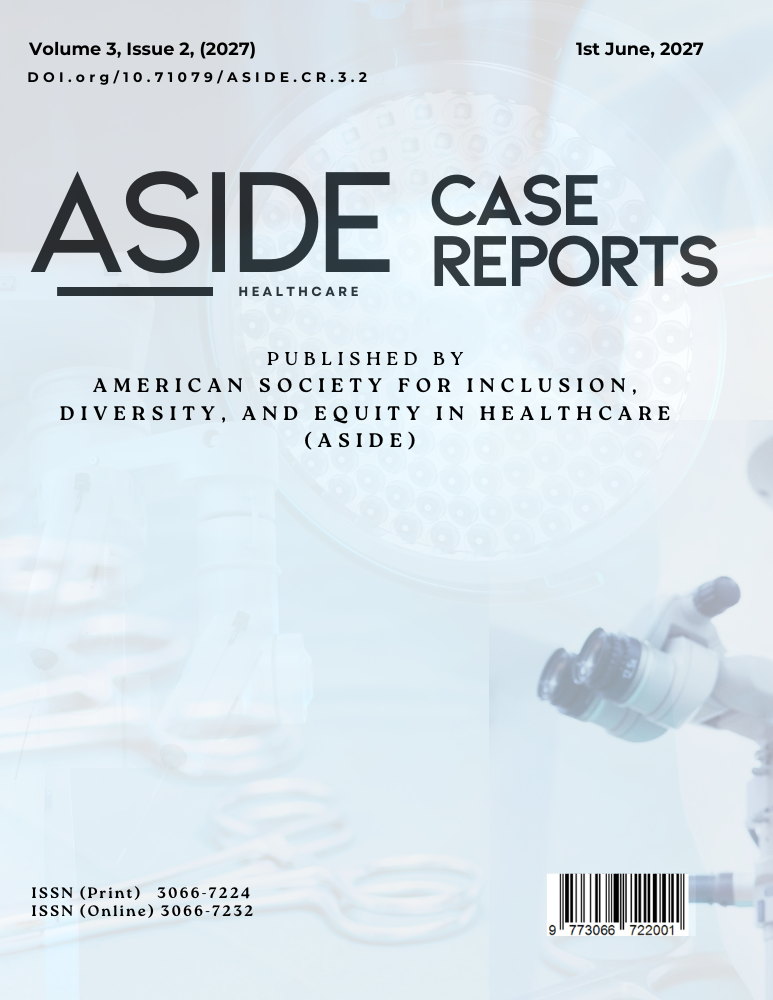
ASIDE Case Reports is a peer-reviewed, open-access journal published and owned by PubPorta Publishing LLC, 16192 Coastal Highway, Lewes, Delaware 19958, USA. Academic oversight and scholarly guidance are provided by the American Society for Inclusion, Diversity, and Equity in Healthcare (ASIDE). The journal is dedicated to advancing clinical knowledge through the publication of high-quality case reports, case series, and clinical observations across medicine and its subspecialties. It promotes diversity, equity, inclusion, and accessibility in healthcare by highlighting innovative clinical approaches, the influence of social determinants of health, and strategies to improve care for underserved and marginalized populations. It serves as an international platform for clinicians, researchers, and educators to share insights that strengthen patient care, support medical education, and contribute to more equitable healthcare practice and policy.