Safety and Efficacy of Sodium Alginate and Mesna in Endoscopic Submucosal Dissection: A Systematic Review and Meta-analysis
DOI:
https://doi.org/10.71079/ASIDE.GI.04222537Abstract
Background: Sodium hyaluronate, commonly used in ESD, has drawbacks such as high cost and potential tumorigenesis. Sodium alginate (Na alginate) and Mesna offer promising alternative solutions with their viscoelastic and mucolytic properties. In this review we aimed to evaluate the safety and efficacy of Na alginate and Mesna solutions in ESD.
Methods: A systematic search was conducted across multiple databases. Inclusion criteria were randomized controlled trials and observational studies assessing Na alginate and Mesna in ESD. Primary outcome included en-bloc resection rates. Secondary outcomes included adverse events such as perforation and delayed bleeding, and procedural time.
Results: Eight studies involving 255 patients were included in this analysis. Overall en-bloc resection rate for sodium alginate was 97% [95% CI (93%-99%); I2:0%]. En-bloc resection subgroup analysis revealed 97% [95% CI (93%-99%); I2:0%] for 0.6% sodium alginate and 95% [95% CI (70%-99%); I2: 0%] for 0.4% sodium alginate. Moreover, En-bloc resection rate for Mesna was 98% [95%CI: 92%-100%); I2: 0%]. Delayed bleeding rates for sodium alginate were 5% [95% CI (1%-20%); I2: 65.2%]; however, after subgroup analysis delayed bleeding was 2% [95% CI (1%-6%); I2: 0%] for 0.6% sodium alginate and 22% [95% CI (8%-49%); I2:0%] for 0.4% sodium alginate. Perforation rate for 0.6% sodium alginate was 1% [95% CI (0%-5%); I2: 0%].
Conclusion: Na alginate (0.6%) and Mesna are effective and safe alternatives to sodium hyaluronate for submucosal injection in ESD. These solutions offer potential cost-effective and safer options for clinical practice, with Na alginate (0.6%) showing particularly low adverse event rates.
Keywords:
Endoscopic submucosal dissection, Solutions, Sodium Alginate, Na alginate, MesnaFull Text
Introduction
The burden of gastrointestinal tumors is rapidly increasing worldwide and is associated with significant morbidity and mortality. Colorectal cancer ranks third in incidence and second in mortality worldwide, with esophageal cancer ranking as the eighth most diagnosed cancer [1,2]. Endoscopic submucosal dissection (ESD) has gained increasing acceptance as a suitable approach for gastrointestinal cancers due to its low rate of local recurrence compared to endoscopic mucosal resection [3,4,5].
The submucosal injection is a critical step in ESD, as it forms a submucosal cushion fluid that facilitates the elevation and separation of the lesion from the muscularis propria. This enhances en bloc resection and decreases the risk of complications by creating a physical barrier protecting deep tissues [6,7,8]. The ideal submucosal injection solution should fulfill the following criteria: (1) Ensure an adequately thick submucosal fluid cushion; (2) it should be capable of long-term retention under the mucosa, minimizing the need for frequent submucosal injections; (3) It should be affordable, readily accessible, simple to store, and administer; (4) Minimizing the occurrence of adverse events during ESD, such as hemorrhage and perforation, and maintaining the integrity of excised specimens to ensure accurate pathological results [6]. Currently, sodium hyaluronate is one of the most common solutions used for ESD. However, it has been confirmed that it may stimulate tumor growth after ESD [9].
Mensa is a thiol compound commonly used as prophylaxis against some chemotherapy drugs to prevent hemorrhagic cystitis. Additionally, Mensa exhibits a mucolytic effect, which is utilized to facilitate sputum expectoration during respiratory distress. Due to its unique chemical property, Mesna can break down disulfide bonds that connect polypeptide chains, which soften connective tissue fibers between different anatomical planes. Several clinical surgical studies have shown that applying an aqueous solution of Mesna directly to the surgical area helped in smoother blunt dissection and led to shorter operation times, decreasing the risk of hemorrhage [10,11,12,13,14].
Na alginate (SA) has excellent water retention and viscoelastic properties. It is used in clinical settings to treat peptic ulcers or as a hemostatic agent [15,16,17]. SA has been used in Japan for more than 60 years as a protective agent for the digestive mucosa, typically at a 5% concentration. This extensive use has established the efficacy and safety of SA [18]. In 2018, Japan approved 0.6% SA for use as a submucosal injection solution in ESD [19]. We conducted this meta-analysis to evaluate the feasibility and safety of Na alginate and Mesna before endoscopic submucosal dissection.
Methods
Search Strategy and Data Extraction
A systematic search of relevant literature was conducted across multiple databases, including Embase, Scopus, Web of Science, Medline/PubMed, and Cochrane, from their inception to April 17, 2034. The search strategy utilized Boolean operators to combine terms related to "endoscopic submucosal dissection" or "submucosal dissection" or "ESD" AND "Mesna" AND "Na alginate". The search aimed to identify studies investigating the efficacy and safety of those two solutions for submucosal injection during endoscopic submucosal dissection (ESD) in patients with gastrointestinal adenomas and early-stage neoplastic lesions eligible for ESD treatment. Two independent reviewers screened titles, abstracts, and full-text articles for inclusion based on predefined eligibility criteria. Any discrepancies were resolved through discussion or consultation with a third reviewer. Data extraction was conducted independently by two co-authors using a standardized form, with discrepancies resolved through consensus. Our research adhered to the recommended guidelines for reporting systematic reviews and meta-analyses. The Preferred Reporting Items for Systematic Reviews and Meta-Analyses (PRISMA) checklist was followed to ensure transparency and completeness in reporting. Furthermore, we conducted systematic reviews and meta-analyses following the Cochrane criteria and the PRISMA checklist [20,21]
Inclusion Criteria and Study Outcomes
Studies eligible for inclusion in this systematic review and meta-analysis were randomized controlled trials (RCTs) and observational studies focusing on patients with gastrointestinal adenomas and early-stage neoplastic lesions eligible for ESD treatment. The intervention of interest was the use of Mesna or Na alginate for submucosal injection during ESD procedures. Comparisons with other solutions were not applicable in this case. The primary outcomes of interest included procedural time, while secondary outcomes included en bloc complete dissection rate, amount of solution injected, and adverse events associated with those submucosal injection solutions. Procedural time refers to the duration of the ESD procedure. En bloc complete dissection rate indicates the proportion of cases where the lesion was completely removed in one piece. Adverse events encompass any undesirable effects related to the use of submucosal injection solutions, which include perforation, intra-operative bleeding, and post-operative delayed bleeding, which is defined as any bleeding after the patient leaves the operating room till one month later. Exclusion criteria comprised studies not written in English or with inadequate translation, case reports, editorials, letters, or conference abstracts without full-text availability, animal studies, or studies conducted on non-human subjects. Additionally, studies involving patients with contraindications or specific conditions that could significantly impact outcomes were excluded.
Risk of Bias Assessment
Two authors independently assessed the risk of bias and methodological quality of included studies. The Cochrane risk-of-bias tool for randomized trials (ROB 2) was used for RCTs, while for non-randomized clinical trials, the ROBINS-I tool was employed [22,23]. Any discrepancies are resolved through discussion or consultation with a third reviewer.
Statistical Analysis
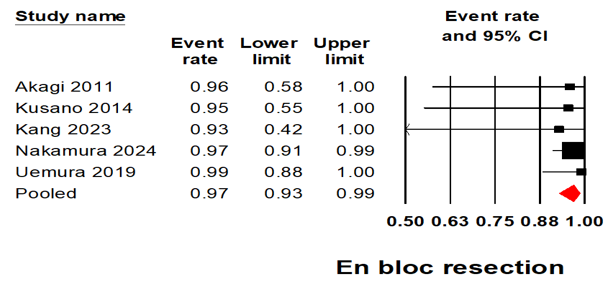
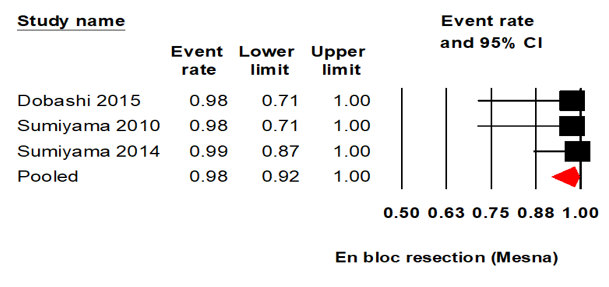
The forest plots illustrate the rates (shown by the black square) and 95% confidence interval (CI) shown by a horizontal line from non-comparative studies. The area of the black square is proportional to the specific study weight in the overall meta‐analysis. The overall pool is visible in the middle of the red diamond shape representing the overall rate, and its width indicates the pooled 95% CI. For comparative studies, proportional variables were analyzed and mean differences (MD) with the corresponding 95% CI. All analyses were performed using Comprehensive Meta-analysis software [24].
Results
Study and patient characteristics
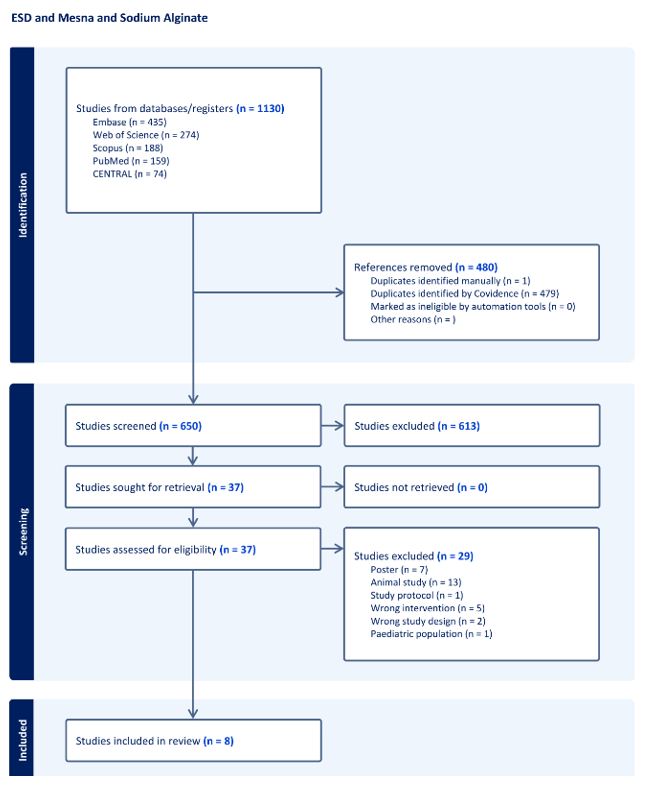
We ran a systematic search in our databases and identified 1130 studies, of which eight studies were included in our analysis [25,26,27,28,29,30,31,19]. Detailed information about the selection of studies is shown in the PRISMA flow diagram Figure 1. A total of 415 patients were included in our analysis. 63% were men and 37% were women. The mean age ranged from 53 to 69 years Table 1.
Quality of included studies
Quality assessment of our included studies was assessed using the Cochrane RoB 2 tool for four RCTs. Two studies had a total low risk of bias status, and the other two had a Moderate risk of bias status. Non-randomized studies were assessed using the ROBINS-I tool. The four studies had a moderate risk of bias Table 2.
| Author | Country | Study design | Total participants (n) | ESD group Gender (female) N (%) | Used solution | Procedure location | Size of lesion (Mean ± SD), mm |
|---|---|---|---|---|---|---|---|
| Akagi, 2011 [25] | Japan | Clinical trial | 11 | 2 (18) | 0.4% Sodium alginate | Stomach | 15.5±5.3 |
| Kusano, 2014 [28] | Japan | Clinical trial | 10 | 2 (20) | 0.6% Sodium alginate | Stomach | 16.21±5.8 |
| Kang, 2023 [27] | Taiwan | RCT | 12 | 8 (66) | 0.4% Sodium alginate | Stomach, colon & esophagus | 30.0±5.5 |
| Nakamura, 2024 [29] | Japan | Cohort | 100 | 40 (40) | 0.6% Sodium alginate | Rectum and colon | 20.89±8.8 |
| Uemura, 2019 [19] | Japan | RCT | 122 | 13 (21.7) | 0.6% Sodium alginate | Stomach and esophagus | NA |
| Dobashi, 2015 [26] | Japan | RCT | 40 | 1 (5) | Mesna | Esophagus | 23.33±9.9 |
| Sumiyama, 2010 [30] | Japan | Prospective cohort | 20 | NA | Mesna | Stomach | 21.7±12.14 |
| Sumiyama, 2014 [31] | Japan | RCT | 100 | 9 (18) | Mesna | Stomach | 19.49±11.74 |
RCT, Randomized Controlled Trial; ESD, Endoscopic Submucosal Dissection; SD, Standard Deviation; NA, Not Available; mm, Millimeter.
En-bloc resection
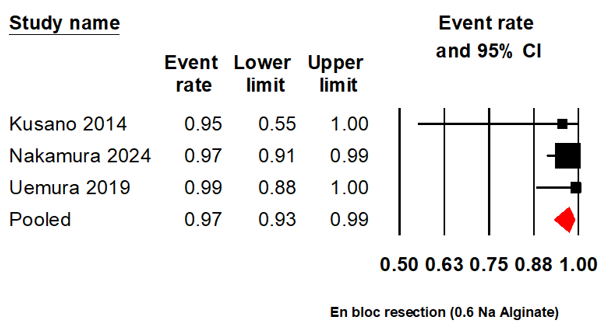
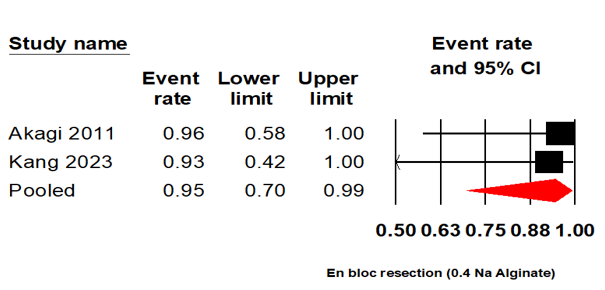
Five studies were pooled to evaluate the rates of en-bloc resection using 0.4% and 0.6% Na alginate, with an overall rate of 97% [95% CI (93%-99%); I2: 0%] Figure 2. Subgroup analysis with three studies pooled for the rates of en-bloc resection using Na alginate 0.6% with an overall rate of 97% [95% CI (93%-99%); I2: 0%] Figure 3. Two studies were pooled for the rates of en-bloc resection using Na alginate 0.6% with an overall rate of 95% [95% CI (70%-99%); I2: 0%] Figure 4. Three studies were pooled to evaluate the rates of en-bloc resection using Mesna with an overall rate of 98% [95% CI (92%-100%); I2: 0%] Figure 5.
Perforation, delayed bleeding, and procedural time
Two studies were pooled for the rates of Perforation for 0.6% Na Alginate with an overall rate of 1% [95% CI (0%-5%); I2: 0%] (Supplementary figure 1). Five studies were pooled for the rates of Delayed bleeding using Na alginate 0.6% and 0.4% with an overall rate of 5% [95% CI (1%-20%); I2: 65.21%] (Supplementary figure 2). Three studies were pooled for the rates of Delayed bleeding using 0.6% Na alginate, with an overall rate of 2% [95% CI (1%-6%); I2: 0%] (Supplementary Figure 3). Two studies were pooled for the rates of Delayed bleeding using Na alginate 0.4% with an overall rate of 22% [95% CI (8%-49%); I2: 0%] (Supplementary figure 4).
| Author name, year | Study design | Tool used | Overall ROB |
|---|---|---|---|
| Akagi, 2011 [25] | Clinical trial | ROBINS-I | Moderate |
| Kusano, 2014 [28] | Clinical trial | ROBINS-I | Moderate |
| Kang, 2023 [27] | RCT | Cochrane RoB 2 | Low |
| Nakamura, 2024 [29] | Cohort | ROBINS-I | Moderate |
| Uemura, 2019 [19] | RCT | Cochrane RoB 2 | Moderate |
| Dobashi, 2015 [26] | RCT | Cochrane RoB 2 | Moderate |
| Sumiyama, 2010 [30] | Prospective cohort | ROBINS-I | Moderate |
| Sumiyama, 2014 [31] | RCT | Cochrane RoB 2 | Low |
RCT, Randomized Controlled Trial; ROB, Risk of Bias.
Five studies were pooled to evaluate the mean Procedure time in minutes using Na alginate 0.4% and 0.6% [(Mean 60.86, 95% CI: 45.06 to 76.67); I2: 85.8%] (Supplementary figure 5). Three studies were pooled to evaluate the mean Procedure time in minutes using Na alginate 0.6% [(Mean = 45.77, 95% CI: 32.94 to 58.59); I2: 80.7%] (Supplementary figure 6). Two studies were pooled to evaluate the mean Procedure time in minutes using Na alginate 0.4% [(Mean = 85.38, 95% CI: 61.29 to 109.47); I2: 24.8%] (Supplementary figure 7). Three studies were pooled to evaluate the mean Procedure time in minutes using Mesna [(Mean = 28.54, 95% CI: 13.39 to 43.71); I2: 96.39%] (Supplementary figure 8). The pooled results from two studies comparing Mesna and normal saline reporting the procedure time showed no significant difference between the two groups, [(MD: -6.55, 95% CI: -13.42 to 0.33; P=0.06); I2: 0%], as shown in (Supplementary figure 9)
Discussion
The high cost and potential tumorigenesis associated with sodium hyaluronate (SH) [25,9], a widely used ESD submucosal injection solution, prompted the search for an alternative. In the early 2010s, Akagi et al. proposed Sodium alginate (SA) as a safe and effective submucosal injection solution. SA is a non-toxic natural polysaccharide polymer isolated from brown seaweed [25]. In addition to its low cost, SA is known for its safety, having been used in the treatment of peptic ulcer disease due to its protective and hemostatic properties on the mucosal membrane [15]. Lastly, the viscosity of SA helps in achieving reliable submucosal lift [9]. An early clinical experience with 3% SA in ESD was reported on 11 patients with early gastric cancer. The overall endoscopic en bloc resection rate was 100%. No major complications occurred with no tumor recurrence after a mean follow-up of 28 months [25]. Later, the formulation of SA was improved to 0.6% to enhance injectability and facilitate uniform mucosal elevation [28].
A randomized controlled trial (RCT) compared the efficacy and safety of 0.6% SA to 0.4% SH in ESD for esophageal and gastric lesions. Efficacy was based on the en bloc complete resection rate in ESD and the formation and maintenance of mucosal elevation upon injection. SA was found to be non-inferior to SH. In addition, the mucosal resection time was similar between the two groups [19].
The primary utility of Mesna is to facilitate submucosal dissection by dissolving disulfide bonds, thereby softening the connective tissue fibers [30]. This also allows for less or no electrosurgical dissection, theoretically reducing the risk of perforation. In a pilot study, chemically assisted ESD with submucosal injection of Mesna led to a 100% en-bloc resection rate with a mean operation time of 21.17 ± 11.6 minutes [30]. Subsequently, a double-blind RCT comparing Mesna to saline submucosal injection in ESD for gastric cancer found no difference in submucosal dissection time between the two groups [31]. However, there were fewer time-consuming cases (more than 30 minutes) in the Mesna group (P=0.049). Additionally, the subjective difficulty of ESD was significantly lower in the Mesna group. Both groups had similar en-bloc resection rates (Mesna: 100%, Controls: 98.08%) and perforation rates (Mesna: 0%, Controls: 1.92%) [31].
As for the adverse events, we found that, in the aspect of perforation incidence, Na alginate was slightly safer than the standard used solution, sodium hyaluronate (1% in the Na alginate cases vs. 3% in the sodium hyaluronate in previous trials) [32]. When we compared the incidence of delayed bleeding between sodium hyaluronate and Na alginate solutions, it was found that Na alginate (with a pooled incidence of 5% for both 0.4% and 0.6% concentrations) is not as safe as sodium hyaluronate (with a pooled incidence of 1%). However, if we compare the two concentrations of Na alginate, the concentration of (0.6% Na Alginate) is much safer than (0.4% Na Alginate) (adverse event rates are 2% and 22%, respectively). This detail should guide future studies to focus more on the safer (0.6%) concentration in trials, maximizing the benefits of the new solution while minimizing the risk of adverse events. Our study has some limitations. First, it includes a small number of single-arm studies without comparative ones. Additionally, there are some variations in results during subgroup analysis. This persistent heterogeneity is likely attributable to differences in endoscopist skill levels and procedural efficiency across centers rather than the intervention itself. Variations in technique, experience, and procedural protocols at different institutions inherently contribute to the observed discrepancies in procedure duration, making it a challenging factor to standardize across studies. Finally, all the studies are conducted in Asia with small sample sizes, which may limit the generalizability of our results. We suggest conducting randomized controlled trials to guide future directions, choices, and careful interpretation of results. Future enhancements should prioritize expanding network diversity, improving data validation mechanisms, and developing more sophisticated tools for bias mitigation.
Conclusion
Our study revealed that both Na alginate, especially Na alginate (0.6%), and Mesna are effective and safe alternatives to sodium hyaluronate for submucosal injection in endoscopic submucosal dissection. Na alginate (0.6%) achieved high en-bloc resection rates with notably low adverse event rates, making it a particularly promising option. Mesna also showed excellent en bloc resection rates and significantly reduced procedural times, highlighting its efficiency in ESD procedures. Both solutions offer cost-effective and safer options for clinical practice, addressing the limitations associated with sodium hyaluronate, such as high cost and potential tumorigenic risk. Future studies should focus on further validating these findings through larger randomized controlled trials and exploring the optimal concentrations and formulations for enhanced safety and efficacy.
Key finding
Na alginate (0.6%) and Mesna are effective and safe alternatives to sodium hyaluronate for submucosal injection in ESD. These solutions offer potential cost-effective and safer options for clinical practice, with Na alginate (0.6%) showing particularly low adverse event rates.
From the authors' abstract.
中文摘要
海藻酸钠与美司钠(Mesna)在内镜黏膜下剥离术中的安全性与疗效:系统综述与荟萃分析
背景:透明质酸钠(Sodium hyaluronate)是内镜黏膜下剥离术(ESD)中常用的注射液,但其成本高且可能诱发肿瘤。海藻酸钠(Na alginate)和Mesna凭借其黏弹性和黏液溶解特性,提供了有前景的替代方案。本综述旨在评估Na alginate和Mesna在ESD中的安全性与疗效。
方法:在多数据库中进行系统检索。纳入标准为评估Na alginate和Mesna在ESD中的随机对照试验和观察性研究。主要结局为全块切除率(en‑bloc resection rate)。次要结局包括穿孔、延迟出血等不良事件以及手术时间。
结果:本分析纳入了8项研究,共255名患者。Na alginate的总体全块切除率为97% [95% CI (93%-99%);I²:0%]。亚组分析显示,0.6% Na alginate的全块切除率为97% [95% CI (93%-99%);I²:0%],0.4% Na alginate为95% [95% CI (70%-99%);I²:0%]。Mesna的全块切除率为98% [95% CI (92%-100%);I²:0%]。Na alginate的延迟出血率为5% [95% CI (1%-20%);I²:65.2%];亚组分析后,0.6% Na alginate的延迟出血率为2% [95% CI (1%-6%);I²:0%],0.4% Na alginate为22% [95% CI (8%-49%);I²:0%]。0.6% Na alginate的穿孔率为1% [95% CI (0%-5%);I²:0%]。
结论:Na alginate(0.6%)和Mesna是安全有效的替代透明质酸钠,用于ESD中的黏膜下注射液。这些溶液为临床实践提供了潜在的成本效益和更安全的选项,其中Na alginate(0.6%)显示出特别低的不良事件率。
本中文摘要为机器辅助翻译,仅供参考;以英文摘要为准。 Machine-assisted Chinese translation of the English abstract; the English abstract is the version of record.
References
1. Sung H, Ferlay J, Siegel RL, Laversanne M, Soerjomataram I, Jemal A, Bray F. Global Cancer Statistics 2020: GLOBOCAN Estimates of Incidence and Mortality Worldwide for 36 Cancers in 185 Countries. CA Cancer J Clin. 2021;71(3):209-49. [PMID: 33538338, https://doi.org/10.3322/caac.21660].
2. Taylor PR, Abnet CC, Dawsey SM. Squamous dysplasia–the precursor lesion for esophageal squamous cell carcinoma. Cancer Epidemiol Biomarkers Prev. 2013;22(4):540-52. [PMID: 23549398, PMCID: PMC3681095, https://doi.org/10.1158/1055-9965.EPI-12-1347].
3. Cao Y, Liao C, Tan A, Gao Y, Mo Z, Gao F. Meta-analysis of endoscopic submucosal dissection versus endoscopic mucosal resection for tumors of the gastrointestinal tract. Endoscopy. 2009;41(9):751-7. [PMID: 19693750, https://doi.org/10.1055/s-0029-1215053].
4. Higuchi K, Tanabe S, Azuma M, Katada C, Sasaki T, Ishido K, Naruke A, Katada N, Koizumi W. A phase II study of endoscopic submucosal dissection for superficial esophageal neoplasms (KDOG 0901). Gastrointest Endosc. 2013;78(5):704-10. [PMID: 23680178, https://doi.org/10.1016/j.gie.2013.04.182].
5. Isomoto H, Yamaguchi N, Minami H, Nakao K. Management of complications associated with endoscopic submucosal dissection/ endoscopic mucosal resection for esophageal cancer. Dig Endosc. 2013;25 Suppl 1(S1):29-38. [PMID: 23368404, https://doi.org/10.1111/j.1443-1661.2012.01388.x].
6. Castro R, Libanio D, Pita I, Dinis-Ribeiro M. Solutions for submucosal injection: What to choose and how to do it. World J Gastroenterol. 2019;25(7):777-88. [PMID: 30809079, PMCID: PMC6385015, https://doi.org/10.3748/wjg.v25.i7.777].
7. Jung YS, Park DI. Submucosal injection solutions for endoscopic mucosal resection and endoscopic submucosal dissection of gastrointestinal neoplasms. Gastrointestinal Intervention. 2013;2(2):73-7. [https://doi.org/10.1016/j.gii.2013.09.003].
8. Uraoka T, Saito Y, Yamamoto K, Fujii T. Submucosal injection solution for gastrointestinal tract endoscopic mucosal resection and endoscopic submucosal dissection. Drug Des Devel Ther. 2009;2:131-8. [PMID: 19920900, PMCID: PMC2761197, https://doi.org/10.2147/dddt.s3219].
9. Matsui Y, Inomata M, Izumi K, Sonoda K, Shiraishi N, Kitano S. Hyaluronic acid stimulates tumor-cell proliferation at wound sites. Gastrointest Endosc. 2004;60(4):539-43. [PMID: 15472675, https://doi.org/10.1016/s0016-5107(04)01890-5].
10. Benassi L, Benassi G, Kaihura CT, Marconi L, Ricci L, Vadora E. Chemically assisted dissection of tissues in laparoscopic excision of endometriotic cysts. J Am Assoc Gynecol Laparosc. 2003;10(2):205-9. [PMID: 12732773, https://doi.org/10.1016/s1074-3804(05)60300-3].
11. Benassi L, Lopopolo G, Pazzoni F, Ricci L, Kaihura C, Piazza F, Vadora E, Zini C. Chemically assisted dissection of tissues: an interesting support in abdominal myomectomy. J Am Coll Surg. 2000;191(1):65-9. [PMID: 10898185, https://doi.org/10.1016/s1072-7515(00)00296-9].
12. Denaro V, Di Martino A, Longo UG, Costa V, Papalia R, Forriol F, Denaro L. Effectiveness of a mucolythic agent as a local adjuvant in revision lumbar spine surgery. Eur Spine J. 2008;17(12):1752-6. [PMID: 18839224, PMCID: PMC2587676, https://doi.org/10.1007/s00586-008-0802-y].
13. Reinhart WH, Baerlocher GM, Cerny T, Owen GR, Meiselman HJ, Beer JH. Ifosfamide-induced stomatocytosis and mesna-induced echinocytosis: influence on biorheological properties of blood. Eur J Haematol. 1999;62(4):223-30. [PMID: 10227455, https://doi.org/10.1111/j.1600-0609.1999.tb01751.x].
14. Vincenti V, Mondain M, Pasanisi E, Piazza F, Puel JL, Bacciu S, Quaranta N, Uziel A, Zini C. Cochlear effects of mesna application into the middle ear. Ann N Y Acad Sci. 1999;884(1):425-32. [PMID: 10842611, https://doi.org/10.1111/j.1749-6632.1999.tb08659.x].
15. Daigo K, Wada Y, Yamada C, Yamaji M, Okuda S, Okada M, Miyazato T. [Pharmacological studies of sodium alginate. I. Protective effect of sodium alginate on mucous membranes of upper-gastrointestinal tract]. Yakugaku Zasshi. 1981;101(5):452-7. [PMID: 6793708, https://doi.org/10.1248/yakushi1947.101.5_452].
16. Daigo K, Yamaji M, Yamada C, Wada Y, Okuda S, Okada M, Miyazato T. [Pharmacological studies of sodium alginate. III. Acceleration of fibrin formation by sodium alginate]. Yakugaku Zasshi. 1981;101(5):464-9. [PMID: 7288587, https://doi.org/10.1248/yakushi1947.101.5_464].
17. Diago K, Yamada C, Yamaji M, Nakagiri N, Okada M, Komiya H, Horiuchi Y, Miyazato T. [Pharmacological studies of sodium alginate. V. Effect of sodium alginate on platelet aggregation]. Yakugaku Zasshi. 1985;105(2):171-82. [PMID: 4009424, https://doi.org/10.1248/yakushi1947.105.2_171].
18. Daigo K, Yamada C, Wada Y, Yamaji M, Okuda S, Okada M, Miyazato T. [Pharmacological studies of sodium alginate. II. Hemostatic effect of sodium alginate on gastrointestinal bleeding]. Yakugaku Zasshi. 1981;101(5):458-63. [PMID: 6974775, https://doi.org/10.1248/yakushi1947.101.5_458].
19. Uemura N, Oda I, Saito Y, Ono H, Fujisaki J, Matsuhashi N, Ohata K, Yahagi N, Yada T, Satoh M, Tajiri H, Inomata M, Kitano S. Efficacy and safety of 0.6% sodium alginate solution in endoscopic submucosal dissection for esophageal and gastric neoplastic lesion: A randomized controlled study. Dig Endosc. 2019;31(4):396-404. [PMID: 30667557, PMCID: PMC6850280, https://doi.org/10.1111/den.13352].
20. Cumpston M, Li T, Page MJ, Chandler J, Welch VA, Higgins JP, Thomas J. Updated guidance for trusted systematic reviews: a new edition of the Cochrane Handbook for Systematic Reviews of Interventions. Cochrane Database Syst Rev. 2019;10(10):ED000142. [PMID: 31643080, PMCID: PMC10284251, https://doi.org/10.1002/14651858.ED000142].
21. Moher D, Liberati A, Tetzlaff J, Altman DG, Group P. Preferred reporting items for systematic reviews and meta-analyses: the PRISMA statement. Int J Surg. 2010;8(5):336-41. [PMID: 20171303, https://doi.org/10.1016/j.ijsu.2010.02.007].
22. Sterne JAC, Savovic J, Page MJ, Elbers RG, Blencowe NS, Boutron I, Cates CJ, Cheng HY, Corbett MS, Eldridge SM, Emberson JR, Hernan MA, Hopewell S, Hrobjartsson A, Junqueira DR, Juni P, Kirkham JJ, Lasserson T, Li T, McAleenan A, Reeves BC, Shepperd S, Shrier I, Stewart LA, Tilling K, White IR, Whiting PF, Higgins JPT. RoB 2: a revised tool for assessing risk of bias in randomised trials. BMJ. 2019;366:l4898. [PMID: 31462531, https://doi.org/10.1136/bmj.l4898].
23. Sterne JA, Hernan MA, Reeves BC, Savovic J, Berkman ND, Viswanathan M, Henry D, Altman DG, Ansari MT, Boutron I, Carpenter JR, Chan AW, Churchill R, Deeks JJ, Hrobjartsson A, Kirkham J, Juni P, Loke YK, Pigott TD, Ramsay CR, Regidor D, Rothstein HR, Sandhu L, Santaguida PL, Schunemann HJ, Shea B, Shrier I, Tugwell P, Turner L, Valentine JC, Waddington H, Waters E, Wells GA, Whiting PF, Higgins JP. ROBINS-I: a tool for assessing risk of bias in non-randomised studies of interventions. BMJ. 2016;355:i4919. [PMID: 27733354, PMCID: PMC5062054, https://doi.org/10.1136/bmj.i4919].
24. Wallace BC, Lajeunesse MJ, Dietz G, Dahabreh IJ, Trikalinos TA, Schmid CH, Gurevitch J, Poisot TE. OpenMEE: Intuitive, open‐source software for meta‐analysis in ecology and evolutionary biology. Methods in Ecology and Evolution. 2017;8(8):941-7. [https://doi.org/10.1111/2041-210x.12708].
25. Akagi T, Yasuda K, Tajima M, Suzuki K, Inomata M, Shiraishi N, Sato Y, Kitano S. Sodium alginate as an ideal submucosal injection material for endoscopic submucosal resection: preliminary experimental and clinical study. Gastrointest Endosc. 2011;74(5):1026-32. [PMID: 22032316, https://doi.org/10.1016/j.gie.2011.07.042].
26. Dobashi A, Goda K, Sumiyama K, Kobayashi M, Ohya TR, Kato M, Toyoizumi H, Kato T, Matsushima M, Tajiri H. A feasibility study of chemically assisted endoscopic submucosal mechanical dissection using mesna for superficial esophageal squamous cell carcinomas. Surg Endosc. 2015;29(11):3373-81. [PMID: 25515984, https://doi.org/10.1007/s00464-014-4031-7].
27. Kang JW, Chen PJ, Chen CY, Riley G, Wang YS, Kuo HY, Chuang CH. Development of a hybrid hydrogel for submucosal injection in endoscopic resection of gastrointestinal neoplasm: From laboratory to clinical trial. Endosc Int Open. 2023;11(11):E1026-34. [PMID: 38835638, PMCID: PMC11148844, https://doi.org/10.1055/a-2161-2100].
28. Kusano T, Etoh T, Akagi T, Ueda Y, Shiroshita H, Yasuda K, Satoh M, Inomata M, Shiraishi N, Kitano S. Evaluation of 0.6% sodium alginate as a submucosal injection material in endoscopic submucosal dissection for early gastric cancer. Dig Endosc. 2014;26(5):638-45. [PMID: 24655031, https://doi.org/10.1111/den.12268].
29. Nakamura H, Morita R, Ito R, Sakurada A, Tomita N, Hirata Y, Kanari Y, Komatsu Y, Takanashi K, Anbo T, Katsuki S. Feasibility and safety of 0.6% sodium alginate in endoscopic submucosal dissection for colorectal neoplastic lesion: A pilot study. DEN Open. 2024;4(1):e313. [PMID: 37927953, PMCID: PMC10625103, https://doi.org/10.1002/deo2.313].
30. Sumiyama K, Tajiri H, Gostout CJ, Kawamura M, Imazu H, Ohya TR, Ikeda K, Goda K, Saito S, Kato T. Chemically assisted submucosal injection facilitates endoscopic submucosal dissection of gastric neoplasms. Endoscopy. 2010;42(8):627-32. [PMID: 20552541, https://doi.org/10.1055/s-0029-1244223].
31. Sumiyama K, Toyoizumi H, Ohya TR, Dobashi A, Hino S, Kobayashi M, Goda K, Imazu H, Kawakita Y, Kato T, Tajiri H. A double-blind, block-randomized, placebo-controlled trial to identify the chemical assistance effect of mesna submucosal injection for gastric endoscopic submucosal dissection. Gastrointest Endosc. 2014;79(5):756-64. [PMID: 24238308, https://doi.org/10.1016/j.gie.2013.09.027].
32. Iwashita C, Sakamoto H, Miura Y, Shinozaki S, Hayashi Y, Ino Y, Osawa H, Tamba M, Morita K, Lefor AK, Yamamoto H. Esophageal endoscopic submucosal dissection using sodium hyaluronate is safe and effective. Minim Invasive Ther Allied Technol. 2018;27(3):171-6. [PMID: 28749205, https://doi.org/10.1080/13645706.2017.1356735].
Data Availability Statement
Data Availability Statement: This review article does not contain any new primary data. All information discussed is derived from previously published sources and publicly available databases, as cited in the manuscript.
License
Copyright (c) 2025 Hazem Abosheaishaa, Abdallfatah Abdallfatah, Imad Samman Tahhan, Abdelmalek Abdelghany, Iyiad Alabdul Razzak, Mohamed A. M. Amer, Ahmed Y. Azzam, Muhammed Amir Essibayi, Mahmoud Nassar, Omar Abdelhalim, Sherif Andrawes

This work is licensed under a Creative Commons Attribution 4.0 International License.
Copyright and Licensing
All articles published in ASIDE Gastroenterology are open access and freely available online immediately upon publication, without embargo.
This journal applies the terms of the Creative Commons Attribution 4.0 International License (CC BY 4.0). Under this license, anyone may copy, redistribute, remix, transform, and build upon the material for any purpose, even commercially, provided that proper credit is given to the original author(s), a link to the license is provided, and any changes made are indicated.
-
License link: https://creativecommons.org/licenses/by/4.0/
-
Machine-readable license metadata is embedded in each article and its DOI record.
Copyright Holder
Copyright in all articles remains with the author(s). ASIDE Gastroenterology is published and owned by PubPorta Publishing LLC. By submitting a manuscript, authors agree to grant the publisher a non-exclusive license to publish, distribute, archive, and identify itself as the original publisher of the work under the terms of the CC BY 4.0 license.
Academic oversight and scholarly guidance are provided by the American Society for Inclusion, Diversity, and Equity in Healthcare (ASIDE). Copyright and licensing arrangements are administered by the publisher.
Third-party Material
Any material (e.g., images, figures, or tables) not covered by CC BY 4.0 will be clearly indicated in the article. Users must obtain permission directly from the copyright holder for reuse of such third-party material.
Author Rights and Self-Archiving
Authors are permitted to deposit all versions of their work (preprint, author’s accepted manuscript, and version of record) in institutional or subject repositories of their choice immediately upon publication, without embargo, provided that the DOI and license information are included.
Additional Files
Published
Issue
Section
How to Cite
Article history
- Received
- 2 Feb 2025
- Received in revised form
- 20 Apr 2025
- Accepted
- 11 Mar 2025
- Published
- 22 Apr 2025