The Impact of Vonoprazan on Tacrolimus Blood Levels in Transplant Recipients: A Systematic Review and Meta-Analysis
DOI:
https://doi.org/10.71079/ASIDE.GI.121725125Abstract
Background: Tacrolimus is essential for immunosuppression in transplant recipients but presents risks of toxicity and rejection due to its narrow therapeutic window. Vonoprazan, increasingly replacing proton pump inhibitors (PPIs) in these patients, may alter tacrolimus blood levels, but its impact remains unclear.
Objective: To assess how switching from PPIs to vonoprazan affects tacrolimus through concentration and concentration-to-dose ratio, and to summarize related liver and kidney safety markers in transplant recipients.
Methods: A systematic review was conducted of four Japanese studies (140 kidney or liver transplant recipients) evaluating tacrolimus-based immunosuppression before and after conversion to vonoprazan. The synthesis used exploratory meta-analyses and narrative interpretation, with clinically meaningful changes prespecified, while emphasizing study limitations.
Results: Across studies, a trend toward higher tacrolimus levels was seen after switching to vonoprazan. However, the magnitude and consistency of these changes varied substantially between studies, and most results did not surpass thresholds for clinical concern. Liver and kidney safety signals were generally small and inconsistent. High risk of bias, considerable heterogeneity, and absence of pooled clinical endpoints prevent drawing firm conclusions from quantitative data. Pooled estimates are reported as exploratory only.
Conclusions: There is low-certainty evidence that vonoprazan may increase tacrolimus exposure in transplant recipients, but the clinical significance is unclear due to small, regionally focused studies with major methodological limitations. Therapeutic drug monitoring during and after conversion is prudent, and well-controlled trials in diverse populations are needed before definitive recommendations can be made.
Keywords:
Transplantation, Drug-Drug Interaction, Immunosuppression, Calcineurin Inhibitors, Acid SuppressantsFull Text
Introduction
Tacrolimus is central to maintenance immunosuppression after solid-organ transplantation. Still, its narrow therapeutic index necessitates tight therapeutic drug monitoring to avoid toxicity from supratherapeutic exposure or rejection with subtherapeutic levels. It functions as an immunosuppressive agent in allograft transplantation and is usually given alongside mycophenolate mofetil and corticosteroids [1]. When therapeutic levels of tacrolimus are exceeded, it can cause drug-related toxicities such as hyperglycemia, kidney injury, and infections. Conversely, levels below the therapeutic range may lead to rejection episodes and graft-versus-host disease in transplant recipients [1,2]. Tacrolimus is mainly metabolized by the enzymes CYP3A4 and CYP3A5. Therefore, taking drugs that affect the CYP system can change the blood levels of tacrolimus [3]. Proton pump inhibitors (PPIs) are prescribed to transplant recipients to prevent upper gastrointestinal problems [4]. The concurrent use of PPIs with tacrolimus has been linked to drug interactions that increase blood tacrolimus levels, especially in individuals with CYP2C19*2 and *3 genetic variants [5,6]. Rabeprazole is a commonly used PPI in transplant patients. A retrospective study showed that it does not significantly affect tacrolimus blood levels, regardless of CYP2C19 gene variation [7]. Vonoprazan, a new acid suppressant, is increasingly used in renal transplant recipients as an alternative to PPIs. Unlike PPIs, it remains stable in acidic conditions and does not require acid activation, allowing for faster and longer-lasting gastric acid suppression [8]. Co-administration of vonoprazan with tacrolimus may result in drug interactions because both drugs are metabolized via the CYP3A4/5 pathway in the liver [9]. Our study examined changes in blood tacrolimus concentrations after switching from rabeprazole to vonoprazan in kidney transplant recipients on tacrolimus-based immunosuppression.
Methods
Protocol Registration
This review is registered in PROSPERO under ID CRD420251007444 and follows the PRISMA (Preferred Reporting Items for Systematic Reviews and Meta-Analyses) guidelines [10] and the Cochrane Handbook for Systematic Reviews [11].
Data Sources and Search Strategy
A comprehensive literature search was independently conducted by two authors (M.R.E. and I.R.) across six databases, including PubMed, Web of Science, Scopus, Cochrane Library, VHL, and EMBASE, from inception to February 2, 2025. The search was performed without restrictions on publication date or language. The systematic search strategy was developed using a combination of free-text keywords and MeSH terms for "Vonoprazan" and "transplantation", as follows: ("Vonoprazan" OR Voquezna OR "TAK-438" OR "TAK 438" OR TAK438 OR "potassium-competitive acid blocker" OR P-CAB) AND ("transplant*" OR "graft*"). The search details are shown in (Supplementary Table 1).
Eligibility Criteria.
We included clinical studies that met the following criteria:
No restrictions on setting, language, or publication date were imposed.
Additionally, we excluded animal studies, in vitro and in vivo studies, reviews, books, theses, and other observational studies (cross-sectional, case series, and case reports). Studies with incomplete data, duplicates, missing values, conference abstracts, protocols, and letters were also excluded.
Study Selection
We used Rayyan, an online screening tool, to manage the review process. First, we removed duplicate records. Then, two independent reviewers (MRE and MSE) screened the remaining studies by title and abstract. Studies that met the inclusion criteria underwent a full-text review based on the predefined criteria. Any disagreements were resolved through discussion.
Missing data
Studies with missing outcome data were included using an available case analysis approach. For studies reporting without corresponding standard deviations, we followed the guidance provided in the Cochrane Handbook for Systematic Reviews of Interventions (version 6.4, Chapter 6). Specifically, when standard deviations (SDs) were not reported, we estimated them using available statistical information such as standard errors, confidence intervals, interquartile ranges, or p-values, where applicable.
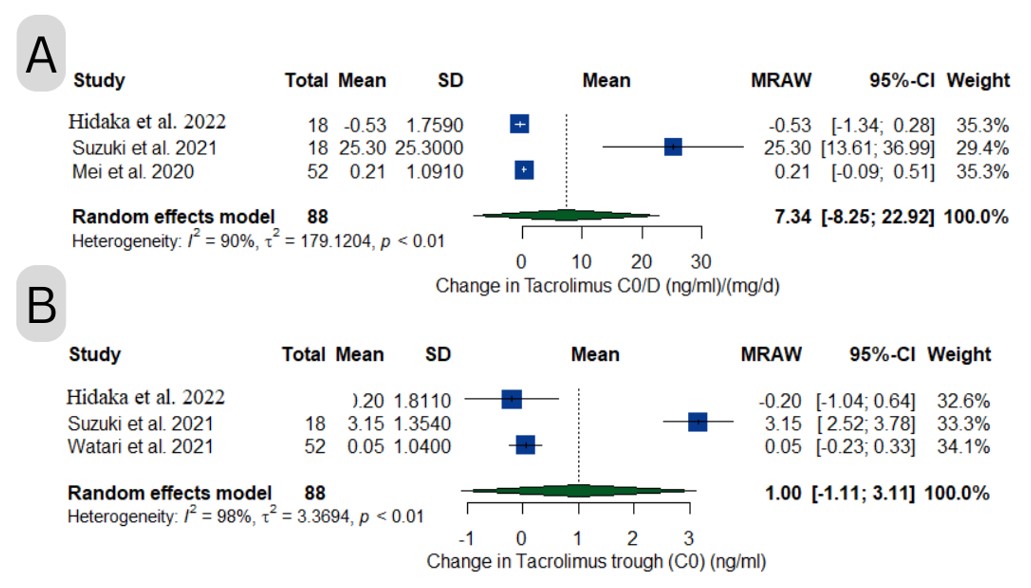
The pooled result at the bottom (random effects model) also represents the combined raw mean difference across studies, providing an overall summary estimate for the meta-analysis in its natural units. The choice to use "MRAW" is especially relevant when interpretations in natural (untransformed) units are required.
Data Extraction
Four reviewers (M.R.E., M.W., O.K.E., and M.A.E.) independently extracted data using a pre-designed sheet, which was first tested and refined through a pilot extraction process in Excel (Microsoft, USA). The extracted data were then structured into three main sections: (1) summary (Study ID, study design, country, total sample size, interventions, type of transplantation surgery, follow-up duration, and inclusion criteria). (2) Baseline characteristics of patients (e.g., demographic data, transplantation & treatment characteristics, liver function markers, and kidney function markers). (3) Outcomes data: (mean change in tacrolimus C0 and C0/D, AST, ALT, total bilirubin, eGFR, and creatinine).
Quality assessment
We evaluated the quality of the included studies using the NIH Study Quality Assessment Tool for observational and cross-sectional studies [12]. This tool assesses key factors such as study design, sample size, outcome measures, and potential biases, rating each study as poor, fair, or good. Two independent reviewers (MAE and MSE) conducted the assessments, resolving any disagreements with a third reviewer (MRE).
Statistical analysis.
The study employed R version 4.3, utilizing the “Meta” package for statistical analysis. For the analysis of a single-arm design, we used Mean difference (MD) for all continuous outcomes, summarizing the effect estimates with 95% confidence intervals (CIs). A random-effects model was applied when significant heterogeneity was detected (I² > 50%) using the Chi-square test and I² statistic. In the absence of substantial heterogeneity, a fixed-effect (common-effect) model was used. Heterogeneity was interpreted according to Cochrane recommendations: 0–40% indicating low heterogeneity, 30–60% moderate heterogeneity, 50–90% substantial heterogeneity, and 75–100% considerable heterogeneity. A Chi-square test p-value < 0.1 was considered statistically significant for heterogeneity. To address heterogeneity, sensitivity analyses were conducted using leave-one-out, in which each study was sequentially excluded.
Recommendations for monitoring and dose adjustment of tacrolimus when switching from proton pump inhibitors to vonoprazan
We recommend frequent therapeutic drug monitoring of tacrolimus, starting within 3 to 5 days of initiating vonoprazan, as this period is critical for detecting early changes in drug levels.
Results
Study selection
The search yielded 96 records; after deduplication and screening, four studies met the inclusion criteria for qualitative and quantitative synthesis, all conducted in Japan and enrolling a total of 140 recipients with follow-up of 3–6 months.
Study characteristics and baseline/switch details
All studies evaluated conversion from a PPI (predominantly rabeprazole) to vonoprazan in tacrolimus-treated transplant recipients; Table 1 summarizes design, population, and follow-up; Table 2 expands per-study baseline and switching details: tacrolimus daily dose pre/post and titrations; switching protocol and timing relative to trough sampling; duration on prior PPI and specific agent; co-medications influencing CYP3A/P-gp (e.g., azoles, macrolides, diltiazem, corticosteroid dose); stability indicators (time since transplant, recent rejection/infection/diarrhea); and CYP3A5/CYP2C19 genotype where available; differences were noted and considered in interpretation with priority given to C0/D over C0 for before–after comparisons.
Risk of bias
Using the NIH Before–After tool, two studies were judged fair and two poor-to-fair due to uncontrolled pre–post design, small samples, potential confounding from co-medication changes and dose titrations, and unclear timing protocols; overall, risk of bias was serious across key domains.
Certainty of evidence (GRADE)
Across outcomes (C0, C0/D, ALT/AST, creatinine, eGFR, bilirubin), certainty was very low due to serious risk of bias (uncontrolled pre–post designs), very serious inconsistency (I² often high; wide prediction intervals), and serious imprecision (small k, wide CIs); indirectness was present for clinical outcomes given lack of pooled clinical endpoints; a Summary of Findings table details downgrades and effect estimates.
Primary outcomes
Tacrolimus C0/D (k=3): The pooled mean difference was 0.18 (95% CI to 0.54), not statistically significant, with moderate heterogeneity (I=56%); and 95% prediction interval are reported in Figure 1(A); leave-one-out reduced inconsistency when excluding a single study, but pooled effects generally did not exceed the prespecified 20% C0/D threshold; select individual studies reported threshold-crossing increases and are detailed in Table 2 and text. Tacrolimus C0 (k=3): The pooled mean difference was 1.00 ng/mL (95% CI to 3.11), not statistically significant, with considerable heterogeneity (I=98%); and 95% prediction interval indicated wide between-study dispersion; pooling was treated as exploratory, and narrative synthesis is emphasized given small k and inconsistency; sensitivity analysis identified one influential study affecting I.
Secondary outcomes
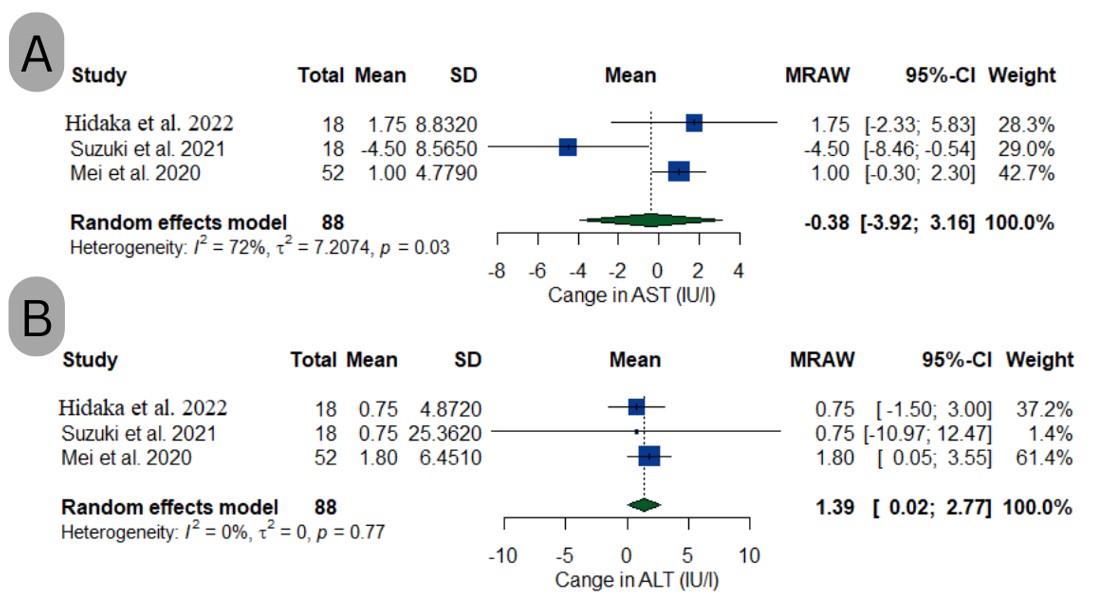
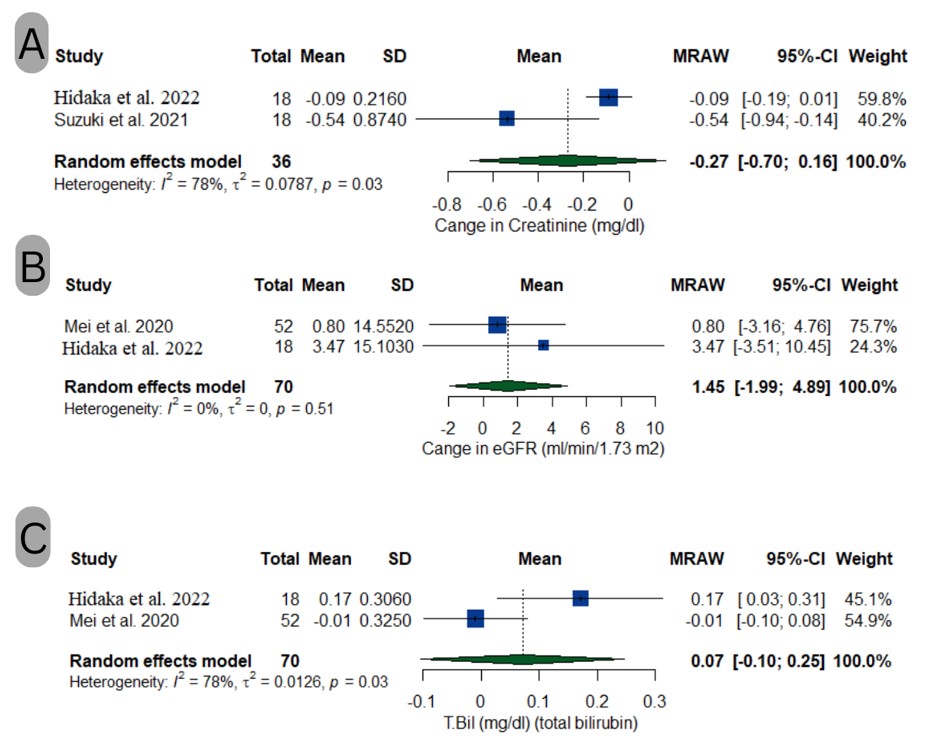
AST (k=3): Mean difference IU/L (95% CI to 3.16), not statistically significant, with substantial heterogeneity; sensitivity excluded one study to resolve inconsistency, but estimates remained imprecise; ALT (k=3): Mean difference 1.39 IU/L (95% CI 0.02 to 2.77), statistically significant with I=0%, but magnitude small and clinical relevance uncertain; creatinine (k=2): Mean difference mg/dL (95% CI to 0.16), not statistically significant, with substantial heterogeneity; eGFR (k=2): Mean difference 1.45 mL/min/1.73 m (95% CI to 4.89), not statistically significant, I=0%; total bilirubin (k=2): Mean difference 0.07 mg/dL (95% CI to 4.89), not statistically significant, with substantial heterogeneity; and prediction intervals are reported for random-effects outcomes in Figure 1, Figure 2, Figure 3; r-sensitivity analyses (0.5–0.8) were directionally robust but imprecise.
Publication bias
Funnel plots and small-study tests were not performed/interpreted due to k<10 and poor reliability of such diagnostics in small meta-analyses; this limitation is acknowledged in Methods and Discussion in 3.3. Risk of Bias and Certainty of Evidence The risk of bias assessment was conducted using the National Institutes of Health (NIH) quality assessment tool for the included studies. Two studies showed good quality, and two assessed fair quality Table 3.
Discussion
Tacrolimus is a widely used immunosuppressant in organ transplant recipients, and its therapeutic efficacy depends heavily on maintaining appropriate blood concentrations. Given its narrow therapeutic index, any alterations in its metabolism due to drug-drug interactions (DDIs) may lead to adverse effects such as nephrotoxicity or increased risk of rejection [13].
Several studies have demonstrated that vonoprazan can significantly increase tacrolimus blood concentrations compared with rabeprazole. The rise in tacrolimus levels can be attributed to the shared cytochrome P450 (CYP) 3A4/5 metabolic pathway. Tacrolimus is predominantly metabolized by CYP3A4, and vonoprazan, unlike rabeprazole, is also extensively metabolized by CYP3A4, leading to a competitive inhibition effect [14] This leads to reduced tacrolimus clearance, thereby increasing its systemic exposure. Vonoprazan influences tacrolimus metabolism, which is crucial for optimizing post-transplant patient management [15].
| Study ID | Study design | Country | N | Intervention | Transplantation | Follow-up | Inclusion Criteria | Conclusion | ||
|---|---|---|---|---|---|---|---|---|---|---|
| Age | PPI before conversion | Immunosuppressants | ||||||||
| Hidaka et al., 2022 [15] | Retrospective Observational Study | Japan | 18 | Vonoprazan + Tacrolimus | Liver transplantation | 6 months | 57.5 6.8 | Rabeprazole, Omeprazole, Lansoprazole | Steroids and Tacrolimus | Tacrolimus trough levels and C0/D remained stable after switching from PPIs to vonoprazan, with no impact on liver function; safe in stable LDLT patients. |
| Suzuki et al., 2021 [14] | Retrospective Observational Study | Japan | 18 | Vonoprazan + Tacrolimus | Kidney transplantation | * | 44.5 11.5 | Rabeprazole | Mycophenolate mofetil, Corticosteroids, Tacrolimus | Vonoprazan alters tacrolimus metabolism via CYP3A4 unlike conventional PPIs; concentration change range (0–192.5%) requires dose adjustment with close monitoring post-transplant. |
| Watari et al., 2021 [16] | Retrospective Observational Study | Japan | 52 | Vonoprazan + Tacrolimus | Kidney transplantation | * | 48.5 11.6 | Rabeprazole | Tacrolimus | Switching from rabeprazole to vonoprazan did not affect tacrolimus levels across CYP polymorphism groups, confirming safety for renal transplant recipients. |
| Mei et al., 2020 [17] | Retrospective Observational Study | Japan | 52 | Vonoprazan + Tacrolimus | Kidney transplantation | 3 months | 55.7 13 | Rabeprazole | Mycophenolate mofetil, Methylprednisolone, Tacrolimus | Tacrolimus C0/D increased by 0.2 (ng/mL)/(mg/d) after switching to vonoprazan, but the change was clinically insignificant; safe in kidney transplant recipients. |
C0/D, concentration-to-dose ratio; LDLT, living donor liver transplantation; CYP, cytochrome P450.
| Study ID | Age | Sex (male), N (%) | Body weight (kg) | Tacrolimus dose (mg) | The duration between transplantation and conversion (months) | Tacrolimus trough (C0) (ng/ml) | Tacrolimus Ratio C0/D | AST (IU/l) | ALT (IU/l) | Creatinine (mg/dl) | eGFR | Total bilirubin |
|---|---|---|---|---|---|---|---|---|---|---|---|---|
| Hidaka et al., 2022 [15] | 57.5 (6.8) | 9 (50%) | 64.5 (13.5) | 3.2 (2) | 30 (15) | 4.12 (1.5) | 3.15 (1.8) | 20.7 (7.3) | 13.7 (3.8) | 0.94 (0.24) | 58.9 (15.5) | 0.75 (0.22) |
| Suzuki et al., 2021 [14] | 44.5 (11.5) | 12 (66.67%) | 64.5 (12) | 0.143 (0.052) | * | 5.35 (1.043) | 82.9 (24.8) | 21.25 (9.6) | 37.5 (23.05) | 2 (1) | * | * |
| Watari et al., 2021 [16] | 48.5 (11.6) | 34 (65.5%) | 60.7 (14.7) | 4.35 (1.7) | 43 (24.5) | 5.72 (1.04) | * | * | * | * | * | * |
| Mei et al., 2020 [17] | 55.7 (13) | 35 (67.3%) | 63.2 (12.8) | 3 (1.6) | 58.8 (27.9) | * | 1.98 (1.02) | 18.6 (4.2) | 15.8 (5.5) | * | 50.6 (14.4) | 0.73 (0.33) |
Data are presented in Mean±SD or proportions as (%); No., Number; *, not reported
| Study ID | Q1 | Q2 | Q3 | Q4 | Q5 | Q6 | Q7 | Q8 | Q9 | Q10 | Q11 | Q12 | Q13 | Q14 | Overall Quality Rating |
|---|---|---|---|---|---|---|---|---|---|---|---|---|---|---|---|
| Hidaka et al., 2022 [15] | YES | YES | YES | YES | NO | YES | YES | NO | NO | YES | YES | YES | YES | YES | Fair Quality Study |
| Suzuki et al., 2021 [14] | YES | YES | YES | YES | NO | YES | NO | NO | YES | YES | YES | YES | YES | YES | Fair Quality Study |
| Watari et al., 2021 [16] | YES | YES | YES | YES | YES | YES | NO | NO | YES | NO | YES | YES | YES | YES | Good Quality Study |
| Mei et al., 2020 [17] | YES | YES | YES | YES | YES | YES | YES | NO | YES | NO | YES | YES | YES | YES | Good Quality Study |
Q1, Was the research question or objective in this paper clearly stated?;
Q2, Was the study population clearly specified and defined?
Q3, Was the participation rate of eligible persons at least 50%?
Q4, Were all the subjects selected or recruited from the same or similar populations (including the same time period)?
Q5, Were inclusion and exclusion criteria for being in the study pre-specified and applied uniformly?
Q6, Was a sample size justification, power description, or variance and effect estimates provided?
Q7, For the analyses in this paper, were the exposure(s) of interest measured prior to the outcome(s) being measured?
Q8, Was the timeframe sufficient so that one could reasonably expect to observe an association between exposure and outcome?
Q9, For exposures that can vary over time, did the study examine different levels of the exposure as they occurred over time?
Q10, Were the exposure measures (independent variables) clearly defined, valid, reliable, and implemented consistently across all participants?
Q11, Was the exposure(s) assessed more than once over time?
Q12, Were the outcome measures (dependent variables) clearly defined, valid, reliable, and implemented consistently across all participants?
Q13, Were the outcome assessors blinded to the exposure status of participants?
Q14, Was loss to follow-up after baseline 20% or less?
Q15, Were key potential confounding variables measured and adjusted statistically for their impact on the relationship between exposure(s) and outcome(s)?
A study by Suzuki et al. (2021) observed a 65.8% increase in tacrolimus blood concentration and a 41.8% rise in its concentration-to-dose (C/D) ratio after switching from rabeprazole to vonoprazan in kidney transplant recipients[14]. Risk of toxicity if tacrolimus dose adjustments are not made appropriately. Additionally, a study by Mei et al. (2020) demonstrated that tacrolimus C0/D increased significantly after conversion from rabeprazole to vonoprazan, albeit with minor clinical implications. This suggests that while the interaction is evident, its clinical impact may be manageable with appropriate therapeutic drug monitoring (TDM)[17].
In Comparison with Conventional PPIs, such as omeprazole and lansoprazole, which are also metabolized by CYP enzymes, primarily CYP2C19 and CYP3A4. They elevate tacrolimus blood concentrations by inhibiting CYP3A4. However, rabeprazole differs from other PPIs as it is primarily metabolized through a non-enzymatic pathway, resulting in minimal interactions with tacrolimus [18,13].
On the other hand, vonoprazan exhibits stronger and more sustained gastric acid suppression due to its mechanism as a potassium-competitive acid blocker. However, this advantage is accompanied by an increased risk of DDIs with tacrolimus. The shift from rabeprazole to vonoprazan, therefore, requires closer monitoring of tacrolimus levels to prevent toxicity while maintaining immunosuppressive efficacy.
One of the major concerns is its impact on liver and kidney function. Tacrolimus-induced nephrotoxicity there is deterioration in liver function parameters, such as aspartate transaminase (AST) and alanine transaminase (ALT)[19,20,16]. Although Tacrolimus trough levels and C0/D values remained stable in LT recipients after switching from PPIs to vonoprazan, Hidaka et al. (2022)[15] Indicated no significant hepatotoxicity. Additionally, the estimated glomerular filtration rate (eGFR) was stable, supporting the safety of vonoprazan Coadministration in kidney transplant recipients.
Our results suggest that while individual studies may report notable changes, the overall effect remains inconclusive due to outcome variability. Our study indicates that ALT may be affected to a measurable extent, and the clinical significance of these changes depends on their magnitude and impact on patient outcomes. A slight reduction in creatinine (-0.27 mg/dL) and an increase in eGFR (1.45 mL/min/1.73 m²) are relatively small. They may not translate into meaningful clinical improvements in kidney function, especially given their wide confidence intervals and non-significance. However, even minor increases in ALT (1.39 IU/L) and the variability in AST levels could indicate potential liver function alterations, which may be clinically relevant in specific populations, such as those with preexisting liver conditions or receiving hepatotoxic treatments. The heterogeneity in creatinine and AST changes suggests that individual patient factors and study differences must be considered before drawing definitive conclusions.
Overall, while these biochemical changes provide insights into potential variations in organ function, their direct impact on clinical decision-making remains limited without further evidence correlating them with patient outcomes or adverse effects.
Although tacrolimus concentrations increased post-conversion, the magnitude of this increase was not significantly different between CYP3A5 expression and non-expression. This suggests that vonoprazan’s effect on tacrolimus metabolism is primarily mediated through CYP3A4 rather than CYP3A5.
Limitation
First, the sample sizes in all four studies were relatively small, limiting the generalizability of the findings. Larger, multicenter studies are needed to validate these results across diverse patient populations. The inclusion of only four studies, all originating from Japan, raises concerns regarding the generalizability of the results to broader, more diverse populations. The homogeneity in geographic origin may reflect specific healthcare practices, patient demographics, or clinical protocols unique to Japan, which may not be applicable elsewhere. Additionally, this concentration of studies from a single country introduces the potential for regional publication bias, thereby limiting the external validity of the conclusions. The total sample size (n=140) across four small studies may be insufficient for detecting clinically meaningful differences. High heterogeneity between studies limits the reliability of pooled estimates.
Another important limitation of this meta-analysis is that all included studies utilized single-arm before-and-after designs without concurrent control groups, which restricts the ability to establish causality between the observed outcomes and the drug-drug interactions under investigation. In the absence of comparator arms, it is challenging to rule out the influence of temporal trends, such as natural disease progression or regression to the mean. Additionally, clinical decision-making factors, including dose titrations, changes in concomitant medications, or evolving treatment guidelines, may have contributed to the observed changes. Unmeasured confounders, such as fluctuations in disease severity, the emergence of comorbid conditions, or variations in patient adherence, may also have impacted results. These factors collectively limit the strength of causal inference and underscore the need for future well-controlled studies to validate these findings.
Conclusions
Vonoprazan fumarate, a potential alternative to proton-pump inhibitors. Offering a rapid, economical, and efficient approach for drug-drug interaction assessment. Vonoprazan significantly increases tacrolimus blood concentrations by inhibiting CYP3A4, requiring careful therapeutic drug monitoring and potential dose adjustments. While vonoprazan offers superior acid suppression compared to traditional PPIs, its interaction with tacrolimus raises concerns regarding nephrotoxicity and drug accumulation. Although CYP3A5 and CYP2C19 polymorphisms influence tacrolimus metabolism, Vonoprazan has been proven to outperform traditional PPIs and be more effective in various gastric acid-related conditions. Given these findings, clinicians should exercise caution when prescribing vonoprazan to transplant recipients receiving tacrolimus. Close monitoring of tacrolimus levels, renal function, and liver enzymes is essential to ensure patient safety.
Future studies with larger cohorts and longer follow-up periods are necessary to further elucidate the long-term clinical implications of vonoprazan-tacrolimus interactions.
We recommended close monitoring of tacrolimus trough levels when switching from rabeprazole to vonoprazan, along with blood level measurements. TDM results and patient-specific factors, such as renal function should guide the magnitude of dose adjustment. Also, Future research should include randomized controlled trials with adequate sample sizes, diverse ethnic populations, and concurrent control groups to establish definitive evidence of vonoprazan-tacrolimus interactions.
Based on available data, rabeprazole may have fewer drug-drug interactions with tacrolimus compared to vonoprazan, but head-to-head trials with other PPIs are lacking.
Conflicts of Interest
All authors declared no conflict of interest.
Funding Source
No funding was received for conducting this study.
Acknowledgments
None
Institutional Review Board (IRB)
Not applicable to this study.
Large Language Model
None
Authors Contribution
IR formulated the idea. MRE and MSE designed the research workflow. MRE and MSE searched the databases. MRE, MW, OKE, MAE, and AH screened the retrieved records and extracted relevant data, then IR resolved the conflicts. MRE, MSE, and OKE conducted the quality assessment. MSE analyzed the data. MSE, PT, and AH wrote the final manuscript. WB revised the entire manuscript. IR supervised the project. All authors read and approved the manuscript.
Data Availability
All required data are included in the manuscript or the supplementary material, and any additional data can be obtained from the corresponding author upon a reasonable request.
References
- Halloran P. F.. Immunosuppressive drugs for kidney transplantation. N Engl J Med. 2004;351(26):2715-29. doi:10.1056/NEJMra033540 PMID: 15616206
- Kershner R. P., Fitzsimmons W. E.. Relationship of FK506 whole blood concentrations and efficacy and toxicity after liver and kidney transplantation. Transplantation. 1996;62(7):920-6. doi:10.1097/00007890-199610150-00009 PMID: 8878385
- Iwasaki K.. Metabolism of tacrolimus (FK506) and recent topics in clinical pharmacokinetics. Drug Metab Pharmacokinet. 2007;22(5):328-35. doi:10.2133/dmpk.22.328 PMID: 17965516
- Ali Khan M., Howden C. W.. The Role of Proton Pump Inhibitors in the Management of Upper Gastrointestinal Disorders. Gastroenterol Hepatol (N Y). 2018;14(3):169-175. PMID: 29928161 PMCID: PMC6004044
- Homma M., Itagaki F., Yuzawa K., Fukao K., Kohda Y.. Effects of lansoprazole and rabeprazole on tacrolimus blood concentration: case of a renal transplant recipient with CYP2C19 gene mutation. Transplantation. 2002;73(2):303-4. doi:10.1097/00007890-200201270-00028 PMID: 11821750
- Rancic Nemanja, Vavic Neven, Kovacevic Aleksandra, Mikov Momir, Dragojevic-Simic Viktorija. Drug-drug interactions of tacrolimus. Hospital Pharmacology - International Multidisciplinary Journal. 2015;2(3):291-296. doi:10.5937/hpimj1503291R
- Isoda K., Takeuchi T., Kotani T., Hirano-Kuwata S., Shoda T., Hata K., Yoshida S., Makino S., Hanafusa T.. The proton pump inhibitor lansoprazole, but not rabeprazole, the increased blood concentrations of calcineurin inhibitors in Japanese patients with connective tissue diseases. Intern Med. 2014;53(13):1413-8. doi:10.2169/internalmedicine.53.2394 PMID: 24990333
- Scott D. R., Munson K. B., Marcus E. A., Lambrecht N. W., Sachs G.. The binding selectivity of vonoprazan (TAK-438) to the gastric H+, K+ -ATPase. Aliment Pharmacol Ther. 2015;42(11-12):1315-26. doi:10.1111/apt.13414 PMID: 26423447 PMCID: PMC4626316
- Yamasaki H., Kawaguchi N., Nonaka M., Takahashi J., Morohashi A., Hirabayashi H., Moriwaki T., Asahi S.. In vitro metabolism of TAK-438, vonoprazan fumarate, a novel potassium-competitive acid blocker. Xenobiotica. 2017;47(12):1027-1034. doi:10.1080/00498254.2016.1203505 PMID: 27414183
- Page Matthew J, McKenzie Joanne E, Bossuyt Patrick M, Boutron Isabelle, Hoffmann Tammy C, Mulrow Cynthia D, Shamseer Larissa, Tetzlaff Jennifer M, Akl Elie A, Brennan Sue E. The PRISMA 2020 statement: an updated guideline for reporting systematic reviews. bmj. 2021;372.
- Higgins JP. Cochrane handbook for systematic reviews of interventions. Version 5.1. 0 [updated March 2011]. The Cochrane Collaboration. www. cochrane-handbook. org. 2011.
- National Heart Lung, and Blood Institute. Quality assessment tool for observational cohort and cross-sectional studies. 2014.
- Lecointre K, Furlan V, Taburet A‐M. In vitro effects of tacrolimus on human cytochrome P450. Fundamental & Clinical Pharmacology. 2002;16(6):455-460.
- Suzuki Yoshiharu, Yoshihashi Takuya, Takahashi Kazuhiro, Furuya Kinji, Ohkohchi Nobuhiro, Oda Tatsuya, Homma Masato. Drug–drug interaction between tacrolimus and vonoprazan in kidney transplant recipients. Journal of Clinical Medicine. 2021;10(17):3964. doi:10.3390/jcm10173964
- Hidaka Masaaki, Soyama Akihiko, Hashizume Junya, Hara Takanobu, Matsunaga Noriko, Matsushima Hajime, Tanaka Takayuki, Hamada Takashi, Imamura Hajime, Adachi Tomohiko. The Effects of Vonoprazan Fumarate on the Tacrolimus Blood Concentration in Liver Transplant Recipients. Cancer Diagnosis & Prognosis. 2022;2(5):553. doi:10.21873/cdp.10141
- Watari Shogo, Araki Motoo, Matsumoto Jun, Yoshinaga Kasumi, Sekito Takanori, Maruyama Yuki, Mitsui Yosuke, Sadahira Takuya, Kubota Risa, Nishimura Shingo. Blood concentrations of tacrolimus upon conversion from rabeprazole to vonoprazan in renal transplant recipients: Correlation with cytochrome P450 gene polymorphisms. Drug Metabolism and Pharmacokinetics. 2021;40:100407. doi:10.1016/j.dmpk.2021.100407
- Mei Takanori, Noguchi Hiroshi, Suetsugu Kimitaka, Hisadome Yu, Kaku Keizo, Okabe Yasuhiro, Masuda Satohiro, Nakamura Masafumi. Effects of concomitant administration of vonoprazan fumarate on the tacrolimus blood concentration in kidney transplant recipients. Biological and Pharmaceutical Bulletin. 2020;43(10):1600-1603. doi:10.1248/bpb.b20-00361
- Kogame Akifumi, Takeuchi Toshiyuki, Nonaka Masami, Yamasaki Hitomi, Kawaguchi Naohiro, Bernards Ai, Tagawa Yoshihiko, Morohashi Akio, Kondo Takahiro, Moriwaki Toshiya. Disposition and metabolism of TAK-438 (vonoprazan fumarate), a novel potassium-competitive acid blocker, in rats and dogs. Xenobiotica. 2017;47(3):255-266.
- Niwa Toshiro, Yamamoto Sachiko, Saito Miho, Shiraga Toshifumi, Takagi Akira. Effect of cyclosporine and tacrolimus on cytochrome p450 activities in human liver microsomes. Yakugaku Zasshi. 2007;127(1):209-216.
- Thölking Gerold, Reuter Stefan. Commentary: the clinical impact of the C0/D ratio and the CYP3A5 genotype on outcome in tacrolimus treated kidney transplant recipients. Frontiers in Pharmacology. 2021;12:603345.
References
Halloran PF. Immunosuppressive drugs for kidney transplantation. N Engl J Med. 2004;351(26):2715-29. [PMID: 15616206, https://doi.org/10.1056/NEJMra033540].
Kershner RP, Fitzsimmons WE. Relationship of FK506 whole blood concentrations and efficacy and toxicity after liver and kidney transplantation. Transplantation. 1996;62(7):920-6. [PMID: 8878385, https://doi.org/10.1097/00007890-199610150-00009].
Iwasaki K. Metabolism of tacrolimus (FK506) and recent topics in clinical pharmacokinetics. Drug Metab Pharmacokinet. 2007;22(5):328-35. [PMID: 17965516, https://doi.org/10.2133/dmpk.22.328].
Ali Khan M, Howden CW. The Role of Proton Pump Inhibitors in the Management of Upper Gastrointestinal Disorders. Gastroenterol Hepatol (N Y). 2018;14(3):169-75. [PMID: 29928161, PMCID: PMC6004044].
Homma M, Itagaki F, Yuzawa K, Fukao K, Kohda Y. Effects of lansoprazole and rabeprazole on tacrolimus blood concentration: case of a renal transplant recipient with CYP2C19 gene mutation. Transplantation. 2002;73(2):303-4. [PMID: 11821750, https://doi.org/10.1097/00007890-200201270-00028].
Rancic N, Vavic N, Kovacevic A, Mikov M, Dragojevic-Simic V. Drug-drug interactions of tacrolimus. Hospital Pharmacology - International Multidisciplinary Journal. 2015;2(3):291-6. [https://doi.org/10.5937/hpimj1503291R].
Isoda K, Takeuchi T, Kotani T, Hirano-Kuwata S, Shoda T, Hata K, Yoshida S, Makino S, Hanafusa T. The proton pump inhibitor lansoprazole, but not rabeprazole, the increased blood concentrations of calcineurin inhibitors in Japanese patients with connective tissue diseases. Intern Med. 2014;53(13):1413-8. [PMID: 24990333, https://doi.org/10.2169/internalmedicine.53.2394].
Scott DR, Munson KB, Marcus EA, Lambrecht NW, Sachs G. The binding selectivity of vonoprazan (TAK-438) to the gastric H+, K+ -ATPase. Aliment Pharmacol Ther. 2015;42(11-12):1315-26. [PMID: 26423447, PMCID: PMC4626316, https://doi.org/10.1111/apt.13414].
Yamasaki H, Kawaguchi N, Nonaka M, Takahashi J, Morohashi A, Hirabayashi H, Moriwaki T, Asahi S. In vitro metabolism of TAK-438, vonoprazan fumarate, a novel potassium-competitive acid blocker. Xenobiotica. 2017;47(12):1027-34. [PMID: 27414183, https://doi.org/10.1080/00498254.2016.1203505].
Page MJ, McKenzie JE, Bossuyt PM, Boutron I, Hoffmann TC, Mulrow CD, Shamseer L, Tetzlaff JM, Akl EA, Brennan SE. The PRISMA 2020 statement: an updated guideline for reporting systematic reviews. bmj. 2021;372.
Higgins J. Cochrane handbook for systematic reviews of interventions. Version 5.1. 0 [updated March 2011]. The Cochrane Collaboration. www cochrane-handbook org. 2011.
National Heart, Lung, and Blood Institute. Quality assessment tool for observational cohort and cross-sectional studies; 2014.
Lecointre K, Furlan V, Taburet A. In vitro effects of tacrolimus on human cytochrome P450. Fundamental & Clinical Pharmacology. 2002;16(6):455-60.
Suzuki Y, Yoshihashi T, Takahashi K, Furuya K, Ohkohchi N, Oda T, Homma M. Drug–drug interaction between tacrolimus and vonoprazan in kidney transplant recipients. Journal of Clinical Medicine. 2021;10(17):3964. [https://doi.org/10.3390/jcm10173964].
Hidaka M, Soyama A, Hashizume J, Hara T, Matsunaga N, Matsushima H, Tanaka T, Hamada T, Imamura H, Adachi T. The Effects of Vonoprazan Fumarate on the Tacrolimus Blood Concentration in Liver Transplant Recipients. Cancer Diagnosis & Prognosis. 2022;2(5):553. [https://doi.org/10.21873/cdp.10141].
Watari S, Araki M, Matsumoto J, Yoshinaga K, Sekito T, Maruyama Y, Mitsui Y, Sadahira T, Kubota R, Nishimura S. Blood concentrations of tacrolimus upon conversion from rabeprazole to vonoprazan in renal transplant recipients: Correlation with cytochrome P450 gene polymorphisms. Drug Metabolism and Pharmacokinetics. 2021;40:100407. [https://doi.org/10.1016/j.dmpk.2021.100407].
Mei T, Noguchi H, Suetsugu K, Hisadome Y, Kaku K, Okabe Y, Masuda S, Nakamura M. Effects of concomitant administration of vonoprazan fumarate on the tacrolimus blood concentration in kidney transplant recipients. Biological and Pharmaceutical Bulletin. 2020;43(10):1600-3. [https://doi.org/10.1248/bpb.b20-00361].
Kogame A, Takeuchi T, Nonaka M, Yamasaki H, Kawaguchi N, Bernards A, Tagawa Y, Morohashi A, Kondo T, Moriwaki T. Disposition and metabolism of TAK-438 (vonoprazan fumarate), a novel potassium-competitive acid blocker, in rats and dogs. Xenobiotica. 2017;47(3):255-66.
Niwa T, Yamamoto S, Saito M, Shiraga T, Takagi A. Effect of cyclosporine and tacrolimus on cytochrome p450 activities in human liver microsomes. Yakugaku Zasshi. 2007;127(1):209-16.
Thölking G, Reuter S. Commentary: the clinical impact of the C0/D ratio and the CYP3A5 genotype on outcome in tacrolimus treated kidney transplant recipients. Frontiers in Pharmacology. 2021;12:603345.
Data Availability Statement
All required data are included in the manuscript or the supplementary material, and any additional data can be obtained from the corresponding author upon a reasonable request.
License
Copyright (c) 2025 Islam Rajab, Mohamed R. Ezz, Mohamed S. Elgendy, Omar K. Elsawy, Mohamed Wagdy, Mohamed A. Elshewikh, Abdallah Hussein, Patrick Tempera, Walid Baddoura

This work is licensed under a Creative Commons Attribution 4.0 International License.
Copyright and Licensing
All articles published in ASIDE Gastroenterology are open access and freely available online immediately upon publication, without embargo.
This journal applies the terms of the Creative Commons Attribution 4.0 International License (CC BY 4.0). Under this license, anyone may copy, redistribute, remix, transform, and build upon the material for any purpose, even commercially, provided that proper credit is given to the original author(s), a link to the license is provided, and any changes made are indicated.
-
License link: https://creativecommons.org/licenses/by/4.0/
-
Machine-readable license metadata is embedded in each article and its DOI record.
Copyright Holder
Copyright in all articles remains with the author(s). ASIDE Gastroenterology is published and owned by PubPorta Publishing LLC. By submitting a manuscript, authors agree to grant the publisher a non-exclusive license to publish, distribute, archive, and identify itself as the original publisher of the work under the terms of the CC BY 4.0 license.
Academic oversight and scholarly guidance are provided by the American Society for Inclusion, Diversity, and Equity in Healthcare (ASIDE). Copyright and licensing arrangements are administered by the publisher.
Third-party Material
Any material (e.g., images, figures, or tables) not covered by CC BY 4.0 will be clearly indicated in the article. Users must obtain permission directly from the copyright holder for reuse of such third-party material.
Author Rights and Self-Archiving
Authors are permitted to deposit all versions of their work (preprint, author’s accepted manuscript, and version of record) in institutional or subject repositories of their choice immediately upon publication, without embargo, provided that the DOI and license information are included.
Additional Files
Published
Issue
Section
How to Cite
Article history
- Received
- 28 May 2025
- Received in revised form
- 1 Oct 2025
- Accepted
- 11 Oct 2025
- Published
- 17 Dec 2025