
War Injuries of External Male Genitalia: A Prospective Single-Center Study from the General Military Hospital, Sana’a, Yemen (2022–2024)
DOI:
https://doi.org/10.71079/ASIDE.HS.012126461Abstract
Background: War-related external male genital injuries are uncommon but clinically significant, often coexisting with severe pelvic, vascular, and musculoskeletal trauma and causing potential long-term functional, cosmetic, and psychological effects.
Methods: This prospective, single-center study at the General Military Hospital, Sana’a, Yemen, included all consecutive male patients presenting with war-related external genital injuries from April 2022 to March 2024. Minor isolated injuries were managed in the emergency department, while severe or associated injuries required admission. Data collected included injury mechanism, management, complications, and short-term outcomes. Primary outcomes were injury patterns, management strategies, and one-month clinical outcomes. Secondary outcomes included complications, erectile function, cosmetic acceptability, and semen analysis at one month.
Results: Fifty-two patients (mean age 23.3 ± 4.9 years) were included. Penetrating trauma occurred in 44 (84.6%) and blunt trauma in 8 (15.4%). Penile injuries were seen in 16 (30.8%) and testicular injuries in 46 (88.4%). Isolated genital injuries occurred in 20 (38.4%), with 32 (61.5%) having associated injuries. All patients underwent surgery for penetrating wounds, large hematomas, or hematoceles. At one-month follow-up, early complications occurred in 12/52 patients, including wound infections (15.4%) and urinary tract infections (7.7%). Of 42 patients completing investigations, semen analysis was normal in 71.4%, and 28.6% had abnormal semen parameters. Late complications included testicular atrophy (33.3%), erectile dysfunction (4.8%), and post-operative penile curvature (4.8%).
Conclusion: Prompt assessment and timely surgical management are essential. While most patients had satisfactory short-term outcomes, a notable proportion experienced complications, highlighting the need for structured protocols and longer follow-up.
Keywords:
War injuries, External genital trauma, Penile injury, Testicular injury, Surgical managementFull Text
Introduction
Genital injuries are clinically significant due to their frequent association with major pelvic and vascular trauma from both blunt and penetrating mechanisms, as well as the potential for chronic impairment following penile and scrotal injuries [1]. While injuries to the external genitalia are rarely life-threatening on their own, they are often accompanied by other potentially fatal injuries to the abdomen, pelvis, or groin [2]. Traumatic injuries to the genitourinary (GU) tract occur in 2.2–10.3% of hospitalized trauma patients, with external genital injuries accounting for one-third to two-thirds of these cases [3]. Approximately 70% of GU injuries in combat settings involve the external genitalia, representing up to 5% of all military-related trauma [4,5,6]. GU trauma occurs across all age groups but is most common in males aged 15–40 years, with 5% of cases occurring in children under ten years of age [7].
The testes, scrotum, and penis are vulnerable to both blunt and penetrating trauma. Testicular injuries may range from contusions to ruptures, while scrotal trauma often involves deep lacerations, burns, or avulsions. Penile injuries include fractures (rupture of the corpus cavernosum), amputations, strangulation, or bite-related injuries, as well as missile injuries [8].
Because trauma predominantly affects young individuals, injuries to the external genitalia can profoundly impact health-related quality of life, compromising urinary function, sexual performance, fertility potential, cosmetic appearance, and psychological well-being [9].
In Yemen, the ongoing conflict over the past decade has led to a notable increase in war-related male genital injuries, primarily from gunshots, explosions, and blast injuries. However, there is a scarcity of data on the epidemiology, management, and short-term outcomes of these injuries in low-resource, conflict settings. Aim: This study aimed to evaluate the mechanisms, types, and anatomical distribution of war-related external genital injuries, associated injuries, management strategies, and short-term clinical outcomes, including complications, sexual and reproductive function, and cosmetic results.
Patients and Methods
This prospective, single-center study was conducted at the General Military Hospital, Sana’a, Yemen, from April 2022 to March 2024. The study included all consecutive male patients presenting to the emergency department with war-related external genital injuries.
Inclusion criteria were males of any age with war-related external genital trauma. Exclusion criteria included non-war-related injuries, previous genital surgery, or incomplete clinical data.
Data collected included patient demographics, injury mechanism (penetrating vs blunt), anatomical site, associated injuries, time from trauma to hospital presentation and surgery, management approach, intraoperative findings, hospital stay, and follow-up outcomes. Patients were examined systematically, including the penis, scrotum, and perineum, documenting penetrating injuries, scrotal swelling, or hematomas.
Management
Mild isolated injuries were treated conservatively in the emergency department with local wound care. Surgical intervention was performed for penetrating injuries, large hematomas, or urethral involvement. Urethral injuries were managed with urethral catheterization or suprapubic cystostomy following preoperative retrograde urethrogram. Scrotal ultrasound and Doppler were selectively performed to evaluate testicular integrity and perfusion. Standard laboratory investigations included CBC, kidney and liver function tests, urinalysis, and urine culture.
Follow-up
One month after injury, patients underwent semen analysis to assess post-traumatic reproductive function. Evaluation followed standard laboratory protocols and included assessment of semen volume, sperm concentration, motility, and morphology. This timing allowed stabilization of acute post-injury changes and provided an initial assessment of fertility-related outcomes following management of external genital trauma. Outcomes were classified as “excellent” (good wound healing, satisfactory cosmetic appearance, preserved sexual function) or “unfavorable” (significant complications such as testicular atrophy, abnormal semen parameters, erectile dysfunction, or penile deviation). All patient information, including injury details, course of treatment, and follow-up findings, was recorded on a specifically designed data collection sheet.
Statistical analysis
Only descriptive statistics were used, with percentages and means calculated for all variables. This study represents a consecutive series of eligible patients; no formal sample size calculation was performed.
Results
Epidemiology
During the study period, 52 patients with external genital injuries were admitted to the urology department Table 1. All patients were male, with a mean age of 23.3 ± 4.9 years (range: 10–32 years). Most patients were aged 20–29 years (38/52, 73.1%). Thirty patients (57.7%) were single, and 22 (42.3%) were married.
Penetrating trauma was the predominant mechanism, occurring in 44 patients (84.6%). Injuries caused by explosive devices accounted for 24 cases (46.2%), while gunshot or stabbing injuries occurred in 20 cases (38.4%). Blunt trauma was observed in 8 patients (15.4%) Table 1.
| Category | Subcategory | Frequency | Percentage% |
|---|---|---|---|
| 1. Age category | <20 years | 10 | 19.2 |
| 20-29 years | 38 | 73.1 | |
| 30-39 years | 4 | 7.7 | |
| 2. Marital status | Single | 30 | 57.7 |
| Married | 22 | 42.3 | |
| Mechanism of Injury | Blunt: RTA, Fall astride | 8 | 15.4 |
| Penetrating: | 44 | 84.6 | |
| Gunshot, Stabbed, | 20 | 38.4 | |
| Shells (explosive devices) | 24 | 46.2 |
RTA, Road Traffic Accident; n, Number of participants.
Types and Distribution of Genital Injuries
Scrotal injuries were identified in 44 patients (84.6%), penile injuries in 16 patients (30.8%), and testicular injuries in 46 patients (88.5%). Testicular injuries involved the right testis in 12 patients (23.1%), the left testis in 20 (38.5%), and were bilateral in 14 patients (26.9%) Table 2.
AAST Injury Grading
According to the AAST classification, most scrotal injuries were Grade II (32/44, 72.7%). Testicular injuries were most commonly Grade I (16/46, 34.8%) and Grade V (14/46, 30.4%). Penile injuries were predominantly Grade II (12/16, 75.0%) Table 2.
| External Genitalia Examination | Type of Injury | Frequency | Percentage% |
|---|---|---|---|
| Penis | Laceration | 16 | 30.8 |
| Scrotum | Laceration | 18 | 34.6 |
| Swelling | 2 | 3.8 | |
| Skin loss | 16 | 30.8 | |
| Testes | Testicular dislocation | 6 | 11.5 |
| Testicular rupture | 12 | 23.1 | |
| Hematocoele | 10 | 19.2 | |
| Side of Testes injury | Right testis | 12 | 23.1 |
| Left testis | 20 | 38.5 | |
| Bilateral | 14 | 26.9 | |
| AAST Grade | |||
| Penis (n = 16) | Scrotum (n = 44) | Testes (n = 46) | |
| Grade I | 2 | 6 | 16 |
| Grade II | 12 | 32 | 8 |
| Grade III | 2 | 0 | 4 |
| Grade IV | 0 | 4 | 4 |
| Grade V | 0 | 2 | 14 |
AAST, American Association for the Surgery of Trauma; n, Number of participants.
Associated Injuries
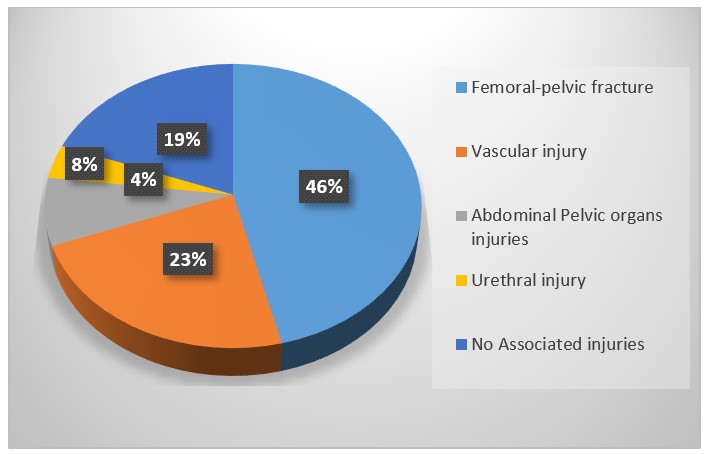
Concomitant injuries were present in 32 patients (61.5%). Femoral–pelvic fractures were the most frequent associated injury (24/52, 46.2%), followed by vascular injuries (12/52, 23.1%), abdominal–pelvic organ injuries (4/52, 7.7%), and urethral injuries (2/52, 3.8%) Figure 1.
Surgical Repair Indications
Six patients (11.5%) had extensive hematomas, six patients (11.5%) had hematocoele, and the majority of patients (n=40, 76.9%) had indications for intervention because of penetrating injuries.
Surgical Management and Discharge Outcomes
All patients underwent surgical management. Fourteen patients (26.9%) required scrotal exploration and/or orchiectomy due to testicular destruction or avulsion. Blood transfusion was required in 14 patients (26.9%) because of associated vascular or orthopedic injuries. Thirty patients (57.7%) were discharged home, while 22 (42.3%) were transferred to other departments for continued care Table 3.
Complications and Follow-up
During the study, early complications were observed in 12 of the 52 patients, including wound infections in 8 patients (15.4%) and urinary tract infections in 4 patients (7.7%). At the one-month follow-up, 42 patients completed post-injury investigations. Urine analysis was normal in all 42 patients (100%). Semen analysis was normal in 30 patients (71.4%), while 12 patients (28.6%) demonstrated abnormal semen parameters at one month, including oligospermia and/or motility disorders in 8 patients (19.0%) and azoospermia in 4 patients (9.5%). Semen culture was negative in 40 patients (95.2%) and positive in 2 patients (4.8%). Late complications included testicular atrophy in 14 patients (33.3%), erectile dysfunction in 2 patients (4.8%), and post-operative penile curvature in 2 patients (4.8%). Abnormal semen parameters at one month were observed in 12 patients (28.6%). At one-month follow-up, 28 patients (66.7%) achieved a satisfactory outcome, characterized by good wound healing, preserved sexual function, and acceptable cosmetic appearance, while 14 patients (33.3%) experienced an unfavorable outcome, including complications such as testicular atrophy, abnormal semen parameters, erectile dysfunction, or post-operative penile deformity Table 3.
| Surgical category | Intervention details | Frequency | Percentage (%) |
|---|---|---|---|
| Penile injuries | Glans laceration, Buck’s fascia laceration treated by Penile exploration and suturing | 14 | 26.9 |
| Cutaneous avulsion/laceration involving the glans treated by Penile stump refashioning with primary suturing | 2 | 3.8 | |
| Scrotal injuries | Superficial or deep laceration/contusion treated by debridement and primary/secondary suturing | 40 | 76.9 |
| Scrotal hematoma evacuation | 4 | 7.7 | |
| Testicular injuries | Scrotal exploration and/or orchiectomy for testicular destruction or avulsion | 14 | 26.9 |
| Hematocele evacuation for contusion/hematoma/subclinical laceration | 24 | 46.2 | |
| Scrotal exploration with testicular repair | 8 | 15.4 | |
| Supportive management | Blood transfusion for associated vascular or orthopedic bleeding | 14 | 26.9 |
| Discharge and Associated Injuries | Discharge to another department | 22 | 42.3 |
| Discharge home | 30 | 57.7 | |
| Early Complications (n = 52) | |||
| Wound infection | 8 | 15.4 | |
| Urinary tract infection | 4 | 7.7 | |
| Follow-up investigations at 1 Month (n = 42) | |||
| Urine analysis | Normal | 42 | 100 |
| Semen analysis | Normal | 30 | 71.4 |
| Abnormal semen parameters at one month | 12 | 28.6 | |
| Oligospermia/motility disorder | 8 | 19.0 | |
| Azoospermia | 4 | 9.5 | |
| Semen culture | Negative | 40 | 95.2 |
| Positive | 2 | 4.8 | |
| Late complications | |||
| Erectile dysfunction | 2 | 4.8 | |
| Testicular atrophy | 14 | 33.3 | |
| Penile abnormality: post-operative curvature formation | 2 | 4.8 | |
| Abnormal semen parameters at one month | 12 | 28.6 | |
| Outcome | |||
| Satisfactory outcome | 28 | 66.7 | |
| Unfavorable outcome | 14 | 33.3 | |
n, Number of patients.
Discussion
Young men are frequently affected by injuries to the male external genitalia. Several studies have documented similar findings: Lee et al., in a 10-year review, reported a mean age of 27.8 years [10], while Ahmed et al. observed a mean age of 28±3.2 years [11]. In our study, the mean age was 23.3±4.9 years, which aligns with these reports. Diagnosis was primarily based on clinical assessment, followed by emergency surgery. Scrotal ultrasound was performed in 14 patients (53.8%) and was not systematically applied. This approach aligns with Djè and Coulibaly [12,13], who suggest emergency surgical exploration except in cases of severe trauma. This therapy would decrease the likelihood of problems and aftereffects. The treatment attitude to scrotal injuries is diverse and depends above all on the existence or absence of a hematocele on clinical evaluation [14].
Mechanisms of injury were predominantly penetrating (84.6%), with blunt trauma representing 15.4%. RTA and gunshot injuries accounted for 68% and 16% of injuries, respectively, in the Ahmed et al. study [11], but penetrating injuries accounted for 79% of injuries in other reports [15]. This is comparable to the situation in other nations where penetrating wounds are more common [16]. Gunshot wounds accounted for 38.4%, while explosive devices caused 46.2% of injuries. Penile injuries were noted in 30.8% of patients, lower than the 60% reported in large cohort studies by Bertini and Corriere [17], likely due to differences in sample size and study period.
All patients underwent prompt assessment and management, including hemodynamic stabilization and urethral evaluation when indicated. Penetrating penile injuries were treated with debridement and exploration, preserving tissue for potential reconstruction, with corpora repaired using absorbable sutures [18]. Scrotal and testicular injuries were addressed immediately: hematomas were evacuated, necrotic tissue excised, and tunica albuginea closed, using tunica vaginalis flaps in selected cases (15.4% of testicular repairs; 46.2% of hematocele evacuations). Orchiectomy was required in 26.9% of patients with non-viable testes, mostly due to high-velocity gunshot injuries, consistent with previous reports [19,20].
Penetrating scrotal wounds were generally managed with exploration; partial scrotal skin loss was repaired primarily. Large hematoceles were drained promptly to prevent infection and ischemia, whereas stable hematomas were managed conservatively with rest, ice, and elevation [21,22].
Associated injuries occurred in 32 patients (61.5%), primarily vascular and musculoskeletal, requiring multidisciplinary management. In Ahmed et al.’s study, related injuries were observed in 41% of cases [11]. Mean hospital stay was 5.2±5.1 days, comparable to Coulibaly [12] but shorter than reports from Burkina Faso [22].
At one-month follow-up, 28 patients (66.7%) achieved satisfactory cosmetic and functional outcomes, including good wound healing, acceptable genital appearance, and preserved sexual function. Exceptions included two patients requiring bilateral orchiectomy with subsequent testosterone therapy. Semen analysis, completed in 42 patients, showed normal results in 71.4%, oligoasthenozoospermia in 19.0%, and azoospermia in 9.5%. Early infection was uncommon and managed with local care. Cosmetic and functional outcomes of therapy of penetrating genital damage are usually favorable if adequate, on-time treatment and repair are undertaken [23]. In testicular injuries, sperm production and sustained hormonal function have been observed in men with adequately bilateral repaired testes after penetrating injuries [24].
Limitations
This study is limited by its single-center military setting, small sample size, and potential selection bias (only patients reaching this hospital were included). Follow-up was incomplete, and validated instruments for sexual function or quality of life (e.g., IIEF) were not used.
Conclusion
External male genital injuries during war are caused by a variety of mechanisms, ranging from minor penile lacerations to complete avulsion of the testes and scrotum. Timely evaluation, meticulous wound irrigation with saline and mild antiseptics, and prompt surgical intervention remain critical for minimizing infection and preserving function. In our cohort, while a majority of patients achieved satisfactory cosmetic and functional outcomes at one month, a substantial proportion experienced complications, including testicular atrophy, abnormal semen parameters, penile deformity, and erectile dysfunction. These findings highlight the need for standardized management protocols for war-related genital trauma and for future multi-center studies with longer follow-up to better assess fertility, sexual function, and quality of life outcomes.
Key finding
Prompt assessment and timely surgical management are essential. While most patients had satisfactory short-term outcomes, a notable proportion experienced complications, highlighting the need for structured protocols and longer follow-up.
From the authors' abstract.
中文摘要
战争相关外部男性生殖器损伤:也门萨那总军医院2022–2024年前瞻性单中心研究
背景:战争相关外部男性生殖器损伤虽不常见,但临床意义重大,常伴严重盆腔、血管及肌肉骨骼创伤,可能导致长期功能、外观及心理影响。
方法:本前瞻性单中心研究在也门萨那总军医院进行,纳入2022年4月至2024年3月期间所有因战争相关外部生殖器损伤就诊的男性连续患者。轻度孤立损伤在急诊科处理,严重或伴随损伤需住院。收集数据包括损伤机制、处理方式、并发症及短期结果。主要结局为损伤模式、处理策略及1个月临床结局;次要结局包括并发症、勃起功能、外观可接受性及1个月时的精液分析。
结果:共纳入52例患者(平均年龄23.3 ± 4.9岁)。穿透性创伤占44例(84.6%),钝性创伤占8例(15.4%)。阴茎损伤见于16例(30.8%),睾丸损伤见于46例(88.4%)。孤立生殖器损伤占20例(38.4%),伴随损伤占32例(61.5%)。所有患者因穿透性伤口、大血肿或睾丸鞘膜积血而接受手术。一个月随访时,12/52例出现早期并发症,包括伤口感染(15.4%)和泌尿道感染(7.7%)。完成检查的42例中,精液分析正常占71.4%,异常占28.6%。晚期并发症包括睾丸萎缩(33.3%)、勃起功能障碍(4.8%)和术后阴茎弯曲(4.8%)。
结论:及时评估与及时手术管理至关重要。虽然大多数患者短期结果令人满意,但相当比例出现并发症,提示需要制定结构化方案并进行长期随访。
本中文摘要为机器辅助翻译,仅供参考;以英文摘要为准。 Machine-assisted Chinese translation of the English abstract; the English abstract is the version of record.
References
1. Shewakramani S, Reed KC. Genitourinary trauma. Emerg Med Clin North Am. 2011;29(3):501-18. [PMID: 21782071, https://doi.org/10.1016/j.emc.2011.04.009].
2. Waxman S, Beekley A, Morey A, Soderdahl D. Penetrating trauma to the external genitalia in Operation Iraqi Freedom. Int J Impot Res. 2009;21(2):145-8. [PMID: 19020522, https://doi.org/10.1038/ijir.2008.59].
3. Al-Mamari SA. Epidemiology of Scrotal and Testicular Trauma. Urogenital Trauma: A Practical Guide. 2023:371-3. [https://doi.org/10.1007/978-981-99-6171-9_43].
4. Hudak SJ, Hakim S. Operative management of wartime genitourinary injuries at Balad Air Force Theater Hospital, 2005 to 2008. J Urol. 2009;182(1):180-3. [PMID: 19450817, https://doi.org/10.1016/j.juro.2009.02.150].
5. McCormick CS, Dumais MG, Johnsen NV, Voelzke BB, Hagedorn JC. Male genital trauma at a level 1 trauma center. World J Urol. 2020;38(12):3283-9. [PMID: 32077992, https://doi.org/10.1007/s00345-020-03115-0].
6. Williams M, Jezior J. Management of combat-related urological trauma in the modern era. Nat Rev Urol. 2013;10(9):504-12. [PMID: 23877722, https://doi.org/10.1038/nrurol.2013.148].
7. Gioffre-Florio M, Murabito LM, Visalli C, Pergolizzi FP, Fama F. Trauma in elderly patients: a study of prevalence, comorbidities and gender differences. G Chir. 2018;39(1):35-40. [PMID: 29549679, PMCID: PMC5902142, https://doi.org/10.11138/gchir/2018.39.1.035].
8. Hadjipavlou M, Sharma D. Traumatic Scrotal and Testicular Injuries. A Clinical Guide to Urologic Emergencies. 2021:202-15. [https://doi.org/10.1002/9781119021506.ch15].
9. Harvey-Kelly KF, Kanakaris NK, Obakponovwe O, West RM, Giannoudis PV. Quality of life and sexual function after traumatic pelvic fracture. J Orthop Trauma. 2014;28(1):28-35. [PMID: 23481925, https://doi.org/10.1097/BOT.0b013e31828fc063].
10. Lee SH, Bak CW, Choi MH, Lee HS, Lee MS, Yoon SJ. Trauma to male genital organs: a 10-year review of 156 patients, including 118 treated by surgery. BJU Int. 2008;101(2):211-5. [PMID: 17922859, https://doi.org/10.1111/j.1464-410X.2007.07265.x].
11. Ahmed A, Mbibu NH. Aetiology and management of injuries to male external genitalia in Nigeria. Injury. 2008;39(1):128-33. [PMID: 17572420, https://doi.org/10.1016/j.injury.2007.02.039].
12. Coulibaly M, Issa A, Kossogué A, Ouattara Z. Traumatisme des bourses: aspects cliniques et thérapeutiques au service d’urologie du CHU Gabriel Touré. Mali Médical. 2017;32:13-6.
13. Dje K, Yao B, Sanou B, Kokoua A, Gnananzan KG. Les complications uro-genitales des traumatismes du bassin a propos de 41 cas. SOPEMI; 2007. [PMID: 18679344].
14. Fouedjio JH, Fouelifack FY, Nnang NA, Mbu RE. [Epidemiological, clinical and therapeutic aspects of supposed benign ovarian tumors at the Central Hospital of Yaounde]. Pan Afr Med J. 2016;25:207. [PMID: 28270904, PMCID: PMC5326262, https://doi.org/10.11604/pamj.2016.25.207.9939].
15. Mohr AM, Pham AM, Lavery RF, Sifri Z, Bargman V, Livingston DH. Management of trauma to the male external genitalia: the usefulness of American Association for the Surgery of Trauma organ injury scales. J Urol. 2003;170(6 Pt 1):2311-5. [PMID: 14634403, https://doi.org/10.1097/01.ju.0000089241.71369.fa].
16. Cline KJ, Mata JA, Venable DD, Eastham JA. Penetrating trauma to the male external genitalia. J Trauma. 1998;44(3):492-4. [PMID: 9529176, https://doi.org/10.1097/00005373-199803000-00011].
17. Bertini JE Jr, Corriere JN Jr. The etiology and management of genital injuries. J Trauma. 1988;28(8):1278-81. [PMID: 3411650, https://doi.org/10.1097/00005373-198808000-00025].
18. Kunkle DA, Lebed BD, Mydlo JH, Pontari MA. Evaluation and management of gunshot wounds of the penis: 20-year experience at an urban trauma center. J Trauma. 2008;64(4):1038-42. [PMID: 18404072, https://doi.org/10.1097/TA.0b013e3180342036].
19. Gomez RG, Castanheira AC, McAninch JW. Gunshot wounds to the male external genitalia. J Urol. 1993;150(4):1147-9. [PMID: 8371375, https://doi.org/10.1016/s0022-5347(17)35710-5].
20. Morey AF, Metro MJ, Carney KJ, Miller KS, McAninch JW. Consensus on genitourinary trauma: external genitalia. BJU Int. 2004;94(4):507-15. [PMID: 15329102, https://doi.org/10.1111/j.1464-410X.2004.04993.x].
21. Cass AS. Testicular trauma. J Urol. 1983;129(2):299-300. [PMID: 6834494, https://doi.org/10.1016/s0022-5347(17)52062-5].
22. Kambou T, Ouattara A, Zaré C. TRAUMATISMES UROGENITAUX : PROFIL EPIDEMIOLOGIQUE ET ASPECTS LESIONNELS AU CENTRE HOSPITALIER UNIVERSITAIRE SOURO SANON DE BOBO DIOULASSO (BURKINA FASO); 2014.
23. Cavalcanti AG, Krambeck R, Araujo A, Manes CH, Favorito LA. Penile lesion from gunshot wound: a 43-case experience. Int Braz J Urol. 2006;32(1):56-60; discussion 60-3. [PMID: 16519829, https://doi.org/10.1590/s1677-55382006000100009].
24. Brandes SB, Buckman RF, Chelsky MJ, Hanno PM. External genitalia gunshot wounds: a ten-year experience with fifty-six cases. J Trauma. 1995;39(2):266-71; discussion 271-2. [PMID: 7674395, https://doi.org/10.1097/00005373-199508000-00013].
Data Availability Statement
The data supporting the findings of this study are not publicly available because they include sensitive, patient-level information collected in a military hospital setting. De-identified data may be made available from the corresponding author upon reasonable request, subject to approval by the General Military Hospital Ethics Committee and any applicable local regulations.
License
Copyright (c) 2026 Wael Alsaqaf, Khaled Alkohlany, Majdi Alshami, Mahmood Shaif, Abdullah Al-Sakkaf, Ahmed Farei, Aziz Shamsan, Nasser Albaddai

This work is licensed under a Creative Commons Attribution 4.0 International License.
Copyright and Licensing
All articles published in ASIDE Health Sciences are open access and freely available online immediately upon publication, without embargo.
This journal applies the terms of the Creative Commons Attribution 4.0 International License (CC BY 4.0). Under this license, anyone may copy, redistribute, remix, transform, and build upon the material for any purpose, even commercially, provided that proper credit is given to the original author(s), a link to the license is provided, and any changes made are indicated.
-
License link: https://creativecommons.org/licenses/by/4.0/
-
Machine-readable license metadata is embedded in each article and its DOI record.
Copyright Holder
Copyright in all articles remains with the author(s). ASIDE Health Sciences is published and owned by PubPorta Publishing LLC. By submitting a manuscript, authors agree to grant the publisher a non-exclusive license to publish, distribute, archive, and identify itself as the original publisher of the work under the terms of the CC BY 4.0 license.
Academic oversight and scholarly guidance are provided by the American Society for Inclusion, Diversity, and Equity in Healthcare (ASIDE). Copyright and licensing arrangements are administered by the publisher.
Third-party Material
Any material (e.g., images, figures, or tables) not covered by CC BY 4.0 will be clearly indicated in the article. Users must obtain permission directly from the copyright holder for reuse of such third-party material.
Author Rights and Self-Archiving
Authors are permitted to deposit all versions of their work (preprint, author’s accepted manuscript, and version of record) in institutional or subject repositories of their choice immediately upon publication, without embargo, provided that the DOI and license information are included.
Published
Issue
Section
How to Cite
Article history
- Received
- 23 Dec 2025
- Received in revised form
- 5 Jan 2026
- Accepted
- 19 Jan 2026
- Published
- 21 Jan 2026