Divergent Temporal Trends in Site-Specific Sarcoma Mortality in the United States, 1999–2020: A Population-Based Analysis
DOI:
https://doi.org/10.71079/ASIDE.Onc.050726713Abstract
Background: Sarcomas are heterogeneous malignancies with prognoses that vary markedly by anatomical site. Whether population-level mortality trends differ across anatomical locations remains unclear.
Methods: Sarcoma-related deaths in the United States from 1999 to 2020 were analyzed using the CDC WONDER Underlying Cause of Death database. ICD-10 codes classified deaths into six anatomical categories: bone, retroperitoneal/peritoneal, trunk soft tissue, extremity soft tissue, head and neck, and unspecified. Negative binomial regression models with a population offset estimated site-specific trends, and an interaction model tested heterogeneity across sites. Sensitivity analyses excluded 2020 and recalculated proportions among specified-site deaths only.
Results: Nearly half of the deaths were coded to unspecified sites (49.8%), with no improvement over time. Among specified sites, bone accounted for the largest share (22.6%), followed by retroperitoneal/peritoneal sarcomas (15.1%). Overall mortality increased by 1.32% annually (IRR 1.013, 95% CI 1.012–1.014), with significant increases across all specified sites. Decomposition showed that retroperitoneal/peritoneal (43.5%) and bone (29.7%) sarcomas contributed the largest shares of the overall increase. Trend heterogeneity was significant (p < 0.001), with trunk soft-tissue and head-and-neck sarcomas increasing the fastest. Findings were robust after excluding 2020 and in specified-site–only analyses.
Conclusions: Mortality coded to sarcoma-related ICD-10 underlying-cause categories increased across all anatomically specified sites, with heterogeneous site-specific trends. Retroperitoneal/peritoneal and bone categories contributed most to the absolute increase, while trunk soft tissue and head and neck categories showed the steepest relative increases.
Keywords:
Sarcoma, Mortality Trends, Anatomical Site, Cancer Surveillance, Negative Binomial Regression, Death Certificate CodingFull Text
Introduction
Sarcomas are a heterogeneous group of malignant neoplasms arising from mesenchymal tissue that account for approximately 0.7 – 1.0% of adult cancers [1,2]. Despite their relative rarity, sarcomas contribute disproportionately to cancer morbidity and mortality because of their aggressive biology, diagnostic complexity, and frequent identification at advanced stages [1,3]. The clinical behavior and prognosis of sarcomas depend heavily on the anatomical site of origin, tumor size, histologic subtype, and surgical resectability [4,2].
Anatomical site is a particularly important prognostic determinant. Sarcomas arising in clinically occult locations such as the retroperitoneum are often diagnosed at a larger size and more advanced stage than those of the extremities, leading to substantially poorer outcomes [4,5]. Retroperitoneal sarcomas present unique therapeutic challenges, including late symptom onset, surgical inaccessibility, and high rates of local recurrence [6,5]. Conversely, extremity sarcomas are typically detected earlier and are more amenable to limb-sparing surgical approaches [4,7]. These site-dependent differences suggest that population-level mortality patterns may vary across anatomical locations.
Although prior epidemiological studies have examined trends in sarcoma incidence and overall mortality [1,8,9], relatively little attention has been given to whether temporal trends in sarcoma-related deaths differ by anatomical site. National death certificate databases offer a mechanism to assess long-term patterns reflecting changes in diagnostic practices, disease classification, referral patterns, and treatment approaches [10,9]. However, such data are subject to important limitations, including incomplete anatomical coding and reliance on underlying cause-of-death classification [11,12].
Using mortality data from the Centers for Disease Control and Prevention’s Wide-ranging Online Data for Epidemiologic Research (CDC WONDER) system, we aimed to characterize temporal trends in the anatomical distribution of sarcoma-related deaths in the United States from 1999 to 2020, and to test whether mortality trends differ across anatomical sites using negative binomial regression modeling.
Methods
Study Design and Data Source
This population-based analysis examined sarcoma-related mortality across the entire United States population. Mortality data were obtained from the CDC WONDER Underlying Cause of Death database, which compiles death certificate data from all 50 states and the District of Columbia [10]. The study period spanned 1999 through 2020, corresponding to the period of consistent ICD-10 cause-of-death coding in the United States [13]. The analysis was restricted to 1999 – 2020 to ensure complete and stable mortality estimates for rare cancer causes. All ages and both sexes were included.
Case Definition and Anatomical Classification
Sarcoma-related deaths were identified using ICD-10 underlying cause-of-death codes for malignant neoplasms of bone, connective tissue, and soft tissue. Anatomical site groupings were defined a priori to reflect clinically meaningful categories: bone and articular cartilage (C40 – C41), retroperitoneal and peritoneal (C48.0 – C48.2), soft tissue of the head and neck (C49.0), extremity (C49.1 – C49.2), trunk (C49.3 – C49.4), and unspecified (C49.9). The code C49.8 (other specified connective and soft tissue) was not returned in the CDC WONDER query and was therefore absent from the dataset; this is documented for transparency. The complete ICD-10-to-site mapping is provided in (Supplementary Table S1). This classification balanced anatomical specificity with the known limitations of death certificate – based coding [14,13].
Statistical Analysis
Annual counts of sarcoma-related deaths were extracted for each anatomical site category. Proportional mortality was calculated by dividing site-specific death counts by the total number of sarcoma-related deaths per year, then expressing the result as a percentage. This approach was selected to characterize the relative contribution of each anatomical site over time; however, proportional mortality does not fully control for changes in age structure, and this limitation is addressed in the Limitations section.
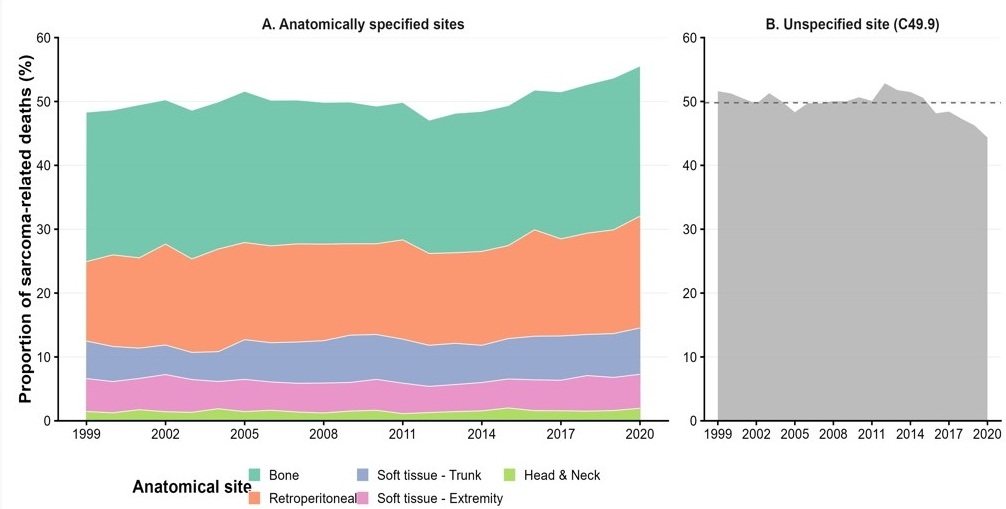
Temporal trends were visualized using stacked area plots. To improve the stability of the estimate, a supplementary analysis aggregated annual data into five-year intervals. Summary statistics, including mean, minimum, and maximum annual proportions, were calculated for each site across the study period.
A detailed reproducibility supplement is provided as (Supplementary File S3), including the exact CDC WONDER query settings, extraction date, ICD-10 code list, and site mapping, export format, handling of zero and suppressed cells, analytic workflow, software versions, and R session information. All statistical analyses were performed in R version 4.3.3 [15]. The complete analytic R code, including all sensitivity analyses, is available from the corresponding author upon reasonable request.
Ethical Considerations
This study used publicly available, de-identified mortality data and did not constitute human subjects research. Institutional review board approval and informed consent were not required.
Results
Overall Sarcoma Mortality and Anatomical Distribution
From 1999 through 2020, sarcoma-related deaths in the United States were distributed across anatomical sites with substantial variability. In 1999, a total of 5,214 sarcoma-related deaths were recorded. Approximately 51.7% were coded to unspecified anatomical sites. Among specified sites, bone sarcomas accounted for 23.4%, retroperitoneal sarcomas for 12.4%, trunk soft tissue sarcomas for 5.9%, extremity soft tissue sarcomas for 5.2%, and head and neck sarcomas for 1.5% (Table 1).
Across the entire 22-year study period, unspecified anatomical sites accounted for the highest mean annual proportion of sarcoma-related deaths (49.8%; range 44.5 – 52.9%), followed by bone sarcomas (22.6%; range 20.9 – 24.0%) and retroperitoneal sarcomas (15.1%; range 12.5 – 17.5%). Soft tissue sarcomas of the trunk (mean 6.2%), extremities (mean 4.8%), and head and neck (mean 1.5%) each contributed smaller and more stable proportions (Table 1).
Temporal Trends in Mortality by Anatomical Site
The annual proportional distribution of sarcoma-related deaths is displayed in Figure 1. Panel A shows anatomically specified sites; Panel B shows the unspecified site (C49.9) separately to avoid visual conflation of coding quality with biological anatomical categories. The relative contribution of unspecified sites remained consistently high throughout the study period (mean 49.8%; range 44.5 – 52.9%), with no evidence of improvement in anatomical coding specificity over 22 years. Bone and retroperitoneal sarcomas maintained their positions as the leading specified contributors to mortality. Aggregated five-year analyses Supplementary Figure S1, Panel A confirmed the robustness of these patterns; Panel B of Figure S1 shows proportions recalculated among specified-site deaths only (sensitivity analysis), confirming that relative rankings among specified sites are not an artifact of the large unspecified category.
| Anatomical Site | Mean Proportion (%) | Min Proportion (%) | Max Proportion (%) |
|---|---|---|---|
| Unspecified | 49.80 | 44.45 | 52.93 |
| Bone | 22.61 | 20.87 | 23.96 |
| Retroperitoneal | 15.08 | 12.45 | 17.51 |
| Soft tissue – Trunk | 6.17 | 4.25 | 7.41 |
| Soft tissue – Extremity | 4.81 | 4.10 | 5.83 |
| Head & Neck | 1.53 | 1.12 | 2.02 |
Values represent the mean, minimum, and maximum annual proportions of sarcoma-related deaths attributed to each anatomical site across the 22-year study period. Proportions are expressed as percentages of the total annual number of sarcoma-related deaths.
| Anatomical Site | IRR | 95% CI | Annual (%) | p-value | Trend |
|---|---|---|---|---|---|
| Unspecified | 1.010 | 1.008–1.012 | +0.95 | 0.001 | Increasing |
| Bone | 1.012 | 1.009–1.015 | +1.2 | 0.001 | Increasing |
| Retroperitoneal | 1.019 | 1.015–1.023 | +1.9 | 0.001 | Increasing |
| Soft tissue – Trunk | 1.029 | 1.022–1.037 | +2.9 | 0.001 | Increasing |
| Soft tissue – Extremity | 1.013 | 1.007–1.019 | +1.3 | 0.001 | Increasing |
| Head & Neck | 1.021 | 1.011–1.030 | +2.1 | 0.001 | Increasing |
IRR, incidence rate ratio; CI, confidence interval; Annual Δ, approximate percentage change in mortality rate per year. IRRs and 95% CIs were estimated from site-specific negative binomial regression models with calendar year (continuous, centered at 1999) and log of annual U.S. population as offset. All anatomically specified sites show statistically significant increasing trends (p < 0.001). Unspecified site (C49.9) was modeled separately for reference. Bone sarcoma served as the reference category in the interaction model for the likelihood ratio test.
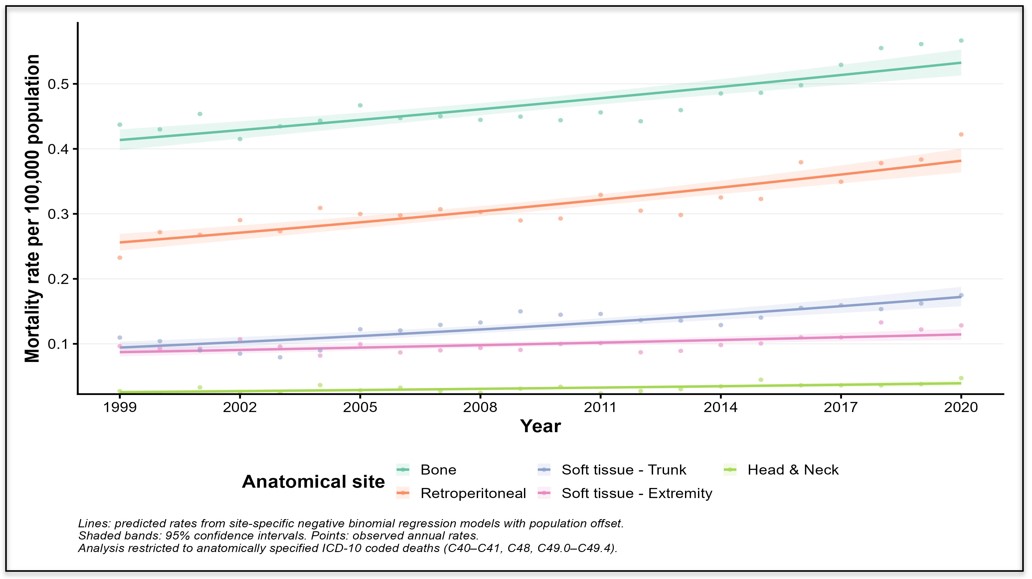
Negative binomial regression models revealed that overall sarcoma mortality increased significantly over the study period (IRR 1.013 per year, 95% CI 1.012 – 1.014; +1.32% annually). All anatomically specified sites showed statistically significant increases in mortality rate: bone sarcomas (+1.2%/year; IRR 1.012, 95% CI 1.009 – 1.015), retroperitoneal sarcomas (+1.9%/year; IRR 1.019, 95% CI 1.015 – 1.023), soft tissue sarcomas of the trunk (+2.9%/year; IRR 1.029, 95% CI 1.022 – 1.037), soft tissue sarcomas of the extremity (+1.3%/year; IRR 1.013, 95% CI 1.007 – 1.019), and head and neck sarcomas (+2.1%/year; IRR 1.021, 95% CI 1.011 – 1.030). Mortality coded to unspecified sites increased by 0.95% per year (IRR 1.010, 95% CI 1.008 – 1.012). The rate of increase differed significantly across anatomically specified sites (likelihood ratio test for site – year interaction, p < 0.001; Figure 2, Table 2), with trunk soft tissue and head and neck sarcomas showing the steepest increases and bone and extremity sarcomas the most gradual.
Decomposition of Mortality Increase by Site
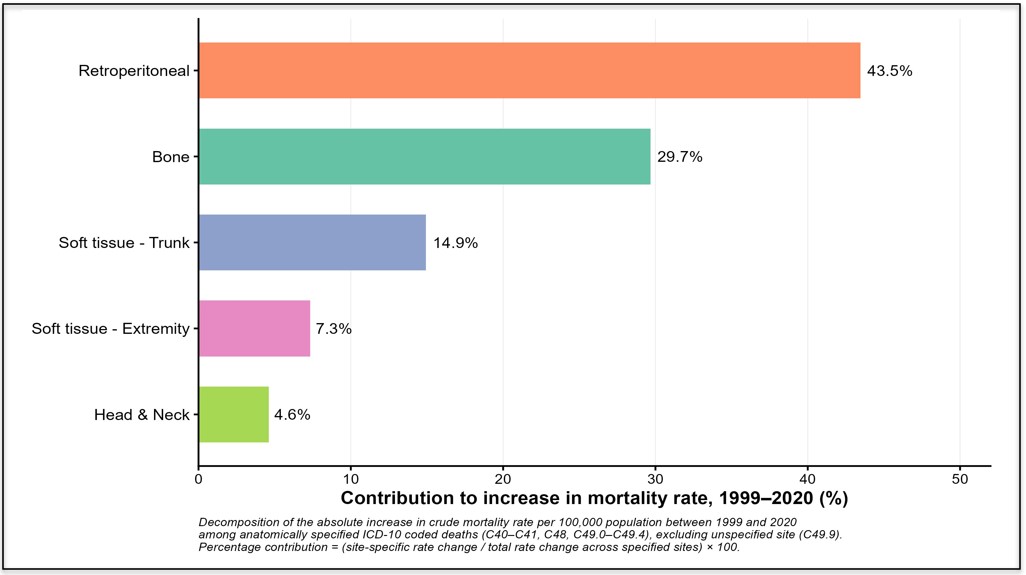
To quantify each site’s contribution to the overall increase in sarcoma mortality, we decomposed the absolute change in crude mortality rate per 100,000 population between 1999 and 2020 across anatomically specified sites Figure 3. Among specified-site deaths, retroperitoneal sarcomas accounted for the largest share of the mortality increase (43.5%; rate change +0.190 per 100,000), followed by bone sarcomas (29.7%; +0.129 per 100,000), soft tissue sarcomas of the trunk (14.9%; +0.065 per 100,000), soft tissue sarcomas of the extremity (7.3%; +0.032 per 100,000), and head and neck sarcomas (4.6%; +0.020 per 100,000). When the unspecified site (C49.9) was included in the full decomposition, it accounted for 19.6% of the absolute rate increase (+0.106 per 100,000), with the remaining 80.4% attributable to anatomically specified categories. These decomposition findings are consistent with the regression-based trend estimates and directly address the concern that site-specific upward slopes alone do not establish which sites drive aggregate national change.
Sensitivity Analyses
Exclusion of 2020 did not materially alter any site-specific trend estimates. IRRs in the 1999 – 2019 analysis were: bone 1.011 (95% CI 1.008 – 1.014), retroperitoneal 1.018 (95% CI 1.014 – 1.022), soft tissue trunk 1.029 (95% CI 1.021 – 1.037), soft tissue extremity 1.011 (95% CI 1.005 – 1.018), and head and neck 1.018 (95% CI 1.008 – 1.028). All sites remained statistically significant, confirming that the 2020 pandemic year did not drive the observed trends. Recalculation of proportional mortality among specified-site deaths only (excluding C49.9) yielded the following mean proportions: bone 45.1% (range 42.2 – 48.4%), retroperitoneal 30.0% (range 25.8 – 32.2%), soft tissue trunk 12.3% (range 8.7 – 14.8%), soft tissue extremity 9.6% (range 8.5 – 11.6%), and head and neck 3.1% (range 2.3 – 4.1%). The relative ranking and approximate proportions of specified sites were therefore not substantially distorted by the large unspecified category.
Discussion
This 22-year population-based analysis shows that deaths coded to sarcoma-related ICD-10 underlying-cause categories in the United States increased across all anatomically specified sites, with heterogeneous rates of increase. An important interpretive caveat is that each anatomical category includes heterogeneous histologic subtypes whose relative distribution may have changed over time, particularly within retroperitoneal and trunk soft tissue categories, where liposarcoma, leiomyosarcoma, and other subtypes differ substantially in biology, prognosis, and treatment responsiveness. Therefore, the observed anatomical trends may partly reflect changes in the mix of histologic subtypes rather than anatomical location alone. Histology-stratified registry analyses are needed to distinguish these possibilities.
Bone sarcomas remained the most common specified anatomical site for sarcoma-related deaths throughout the study period, with a slower but statistically significant upward trend in mortality rate (+1.2%/year). This is consistent with established clinical knowledge that bone sarcomas are aggressive malignancies requiring multimodal treatment, and suggests that therapeutic advances, including trials of preoperative radiotherapy for retroperitoneal disease, have not yet translated into measurable population-level mortality reductions [16,17,18]. Similarly, extremity soft tissue sarcomas showed the most gradual increase of all specified sites (+1.3%/year), which may reflect the counterbalancing effects of stable incidence and incrementally improving survival through limb-sparing surgery and modern radiotherapy techniques [17,19].
A central finding of this study is the persistent high proportion of sarcoma-related deaths coded to unspecified anatomical sites, averaging 49.8% across the study period, with no improvement over 22 years. This observation has implications beyond sarcoma epidemiology. Despite substantial advances in sarcoma classification, diagnostic imaging, and immunohistochemistry over the past two decades, anatomical specificity in mortality data has not improved at the national level. The most probable explanations include inadequate anatomical detail on death certificates, variability in physician documentation practices, and the inherent difficulty of identifying the primary tumor site when cancer has metastasized at the time of death [11,12]. This persistent information gap represents a structural limitation of death certificate – based cancer surveillance that may obscure site-specific mortality patterns, hinder longitudinal comparisons, and limit the capacity of public health systems to monitor progress in rare cancer outcomes [20].
The regression models assumed a constant linear time trend across the study period; possible nonlinearity and temporal autocorrelation were not formally assessed. Joinpoint regression, spline-based models, or autoregressive approaches may identify inflection points or correlated temporal patterns not captured by the present analysis.
Conclusion
Mortality coded to sarcoma-related ICD-10 underlying-cause categories in the United States increased across all anatomically specified sites from 1999 to 2020, with heterogeneous rates of increase across sites. Trunk soft tissue and head and neck categories showed the steepest relative annual increases, whereas retroperitoneal and bone categories contributed the largest absolute share of the overall rise. These findings underscore the importance of distinguishing relative trends from absolute population impact and highlight the need for improved anatomical and histologic documentation in mortality surveillance systems.
Conflicts of Interest
The authors declare that they have no financial, personal, institutional, or professional conflicts of interest that could have influenced the design, conduct, analysis, interpretation, or reporting of this study.
Funding Source
No external funding was received for this research.
Acknowledgments
The authors thank the Centers for Disease Control and Prevention for providing public access to the CDC WONDER mortality database.
Institutional Review Board (IRB)
This study used publicly available, de-identified mortality data from CDC WONDER and does not constitute human subjects research under 45 CFR 46.
Large Language Model
The authors used a large language model to support English-language editing and improve clarity and readability. The tool was used only for language refinement and did not generate new scientific content, alter the study design, perform data analysis, or influence the interpretation of the results. The authors reviewed and approved the final manuscript and remain fully responsible for its content.
Authors Contribution
MA contributed to conceptualization, methodology, investigation, data curation, formal analysis, writing – original draft preparation, and visualization. AA contributed to methodology, validation, formal analysis, writing – review and editing, and supervision. MS contributed to investigation, data curation, and writing – review and editing. RFHA contributed to investigation, resources, and writing – review and editing. ZA contributed to conceptualization, supervision, project administration, and writing – review and editing.
Data Availability
The mortality data used in this study are publicly available from the CDC WONDER Underlying Cause of Death database https://wonder.cdc.gov/ucd-icd10.html. A reproducibility supplement (Supplementary File S3) provides the exact CDC WONDER query settings, extraction date, ICD-10 code list, export settings, handling of zero and suppressed cells, analytic workflow, software versions, and R session information. The complete analytic R code, including all sensitivity analyses, is available from the corresponding author upon reasonable request.
References
- Burningham Z., Hashibe M., Spector L., Schiffman J. D.. The epidemiology of sarcoma. Clin Sarcoma Res. 2012;2(1):14. doi:10.1186/2045-3329-2-14 PMID: 23036164 PMCID: PMC3564705
- Jo V. Y., Fletcher C. D.. WHO classification of soft tissue tumours: an update based on the 2013 (4th) edition. Pathology. 2014;46(2):95-104. doi:10.1097/PAT.0000000000000050 PMID: 24378391
- Siegel R. L., Miller K. D., Wagle N. S., Jemal A.. Cancer statistics, 2023. CA Cancer J Clin. 2023;73(1):17-48. doi:10.3322/caac.21763 PMID: 36633525
- Gronchi A., Miah A. B., Dei Tos A. P., Abecassis N., Bajpai J., Bauer S., Biagini R., Bielack S., Blay J. Y., Bolle S., Bonvalot S., Boukovinas I., Bovee Jvmg, Boye K., Brennan B., Brodowicz T., Buonadonna A., De Alava E., Del Muro X. G., Dufresne A., Eriksson M., Fagioli F., Fedenko A., Ferraresi V., Ferrari A., Frezza A. M., Gasperoni S., Gelderblom H., Gouin F., Grignani G., Haas R., Hassan A. B., Hecker-Nolting S., Hindi N., Hohenberger P., Joensuu H., Jones R. L., Jungels C., Jutte P., Kager L., Kasper B., Kawai A., Kopeckova K., Krakorova D. A., Le Cesne A., Le Grange F., Legius E., Leithner A., Lopez-Pousa A., Martin-Broto J., Merimsky O., Messiou C., Mir O., Montemurro M., Morland B., Morosi C., Palmerini E., Pantaleo M. A., Piana R., Piperno-Neumann S., Reichardt P., Rutkowski P., Safwat A. A., Sangalli C., Sbaraglia M., Scheipl S., Schoffski P., Sleijfer S., Strauss D., Strauss S., Sundby Hall K., Trama A., Unk M., van de Sande M. A. J., van der Graaf W. T. A., van Houdt W. J., Frebourg T., Casali P. G., Stacchiotti S., ESMO Guidelines Committee, EURACAN, GENTURIS. Soft tissue and visceral sarcomas: ESMO-EURACAN-GENTURIS Clinical Practice Guidelines for diagnosis, treatment and follow-up. Ann Oncol. 2021;32(11):1348-1365. doi:10.1016/j.annonc.2021.07.006 PMID: 34303806
- Swallow C. J., Strauss D. C., Bonvalot S., Rutkowski P., Desai A., Gladdy R. A., Gonzalez R., Gyorki D. E., Fairweather M., van Houdt W. J., Stoeckle E., Park J. B., Albertsmeier M., Nessim C., Cardona K., Fiore M., Hayes A., Tzanis D., Skoczylas J., Ford S. J., Ng D., Mullinax J. E., Snow H., Haas R. L., Callegaro D., Smith M. J., Bouhadiba T., Stacchiotti S., Jones R. L., DeLaney T., Roland C. L., Raut C. P., Gronchi A., Transatlantic Australasian RPS Working Group. Management of Primary Retroperitoneal Sarcoma (RPS) in the Adult: An Updated Consensus Approach from the Transatlantic Australasian RPS Working Group. Ann Surg Oncol. 2021;28(12):7873-7888. doi:10.1245/s10434-021-09654-z PMID: 33852100 PMCID: PMC9257997
- Gronchi A., Pollock R. E.. Quality of local treatment or biology of the tumor: which are the trump cards for loco-regional control of retroperitoneal sarcoma?. Ann Surg Oncol. 2013;20(7):2111-3. doi:10.1245/s10434-013-2971-0 PMID: 23584516
- Lawrence W Jr, Donegan W. L., Natarajan N., Mettlin C., Beart R., Winchester D.. Adult soft tissue sarcomas. A pattern of care survey of the American College of Surgeons. Ann Surg. 1987;205(4):349-59. doi:10.1097/00000658-198704000-00003 PMID: 3566372 PMCID: PMC1492738
- Howlader N., Noone A. M., Krapcho M.. SEER Cancer Statistics Review, 1975–2018 [Internet]. 2021.
- Stiller C. A., Trama A., Serraino D., Rossi S., Navarro C., Chirlaque M. D., Casali P. G., RARECARE Working Group. Descriptive epidemiology of sarcomas in Europe: report from the RARECARE project. Eur J Cancer. 2013;49(3):684-95. doi:10.1016/j.ejca.2012.09.011 PMID: 23079473
- Centers for Disease Control and Prevention, National Center for Health Statistics. CDC WONDER Underlying Cause of Death Database [Internet]. 2026.
- Lloyd-Jones D. M., Martin D. O., Larson M. G., Levy D.. Accuracy of death certificates for coding coronary heart disease as the cause of death. Ann Intern Med. 1998;129(12):1020-6. doi:10.7326/0003-4819-129-12-199812150-00005 PMID: 9867756
- Messite J., Stellman S. D.. Accuracy of death certificate completion: the need for formalized physician training. JAMA. 1996;275(10):794-6. doi:10.1001/jama.1996.03530340058030 PMID: 8598597
- World Health Organization. International Statistical Classification of Diseases and Related Health Problems, 10th Revision (ICD-10). 2016.
- Anderson R. N., Minino A. M., Hoyert D. L., Rosenberg H. M.. Comparability of cause of death between ICD-9 and ICD-10: preliminary estimates. Natl Vital Stat Rep. 2001;49(2):1-32. PMID: 11381674
- Wickham Hadley, Averick Mara, Bryan Jennifer, Chang Winston, McGowan Lucy, François Romain, Grolemund Garrett, Hayes Alex, Henry Lionel, Hester Jim, Kuhn Max, Pedersen Thomas, Miller Evan, Bache Stephan, Müller Kirill, Ooms Jeroen, Robinson David, Seidel Dana, Spinu Vitalie, Takahashi Kohske, Vaughan Davis, Wilke Claus, Woo Kara, Yutani Hiroaki. Welcome to the Tidyverse. Journal of Open Source Software. 2019;4(43). doi:10.21105/joss.01686
- Bonvalot S., Gronchi A., Le Pechoux C., Swallow C. J., Strauss D., Meeus P., van Coevorden F., Stoldt S., Stoeckle E., Rutkowski P., Rastrelli M., Raut C. P., Hompes D., De Paoli A., Sangalli C., Honore C., Chung P., Miah A., Blay J. Y., Fiore M., Stelmes J. J., Dei Tos A. P., Baldini E. H., Litiere S., Marreaud S., Gelderblom H., Haas R. L.. Preoperative radiotherapy plus surgery versus surgery alone for patients with primary retroperitoneal sarcoma (EORTC-62092: STRASS): a multicentre, open-label, randomised, phase 3 trial. Lancet Oncol. 2020;21(10):1366-1377. doi:10.1016/S1470-2045(20)30446-0 PMID: 32941794
- Brennan Murray F., Antonescu Cristina R., Maki Robert G.. Management of Soft Tissue Sarcoma. 2013. doi:10.1007/978-1-4614-5004-7
- Pisters P. W., Leung D. H., Woodruff J., Shi W., Brennan M. F.. Analysis of prognostic factors in 1,041 patients with localized soft tissue sarcomas of the extremities. J Clin Oncol. 1996;14(5):1679-89. doi:10.1200/JCO.1996.14.5.1679 PMID: 8622088
- O'Sullivan B., Davis A. M., Turcotte R., Bell R., Catton C., Chabot P., Wunder J., Kandel R., Goddard K., Sadura A., Pater J., Zee B.. Preoperative versus postoperative radiotherapy in soft-tissue sarcoma of the limbs: a randomised trial. Lancet. 2002;359(9325):2235-41. doi:10.1016/S0140-6736(02)09292-9 PMID: 12103287
- Mariotto A. B., Noone A. M., Howlader N., Cho H., Keel G. E., Garshell J., Woloshin S., Schwartz L. M.. Cancer survival: an overview of measures, uses, and interpretation. J Natl Cancer Inst Monogr. 2014;2014(49):145-86. doi:10.1093/jncimonographs/lgu024 PMID: 25417231 PMCID: PMC4829054
References
1. Burningham Z, Hashibe M, Spector L, Schiffman JD. The epidemiology of sarcoma. Clin Sarcoma Res. 2012;2(1):14. [PMID: 23036164, PMCID: PMC3564705, https://doi.org/10.1186/2045-3329-2-14].
2. Jo VY, Fletcher CD. WHO classification of soft tissue tumours: an update based on the 2013 (4th) edition. Pathology. 2014;46(2):95-104. [PMID: 24378391, https://doi.org/10.1097/PAT.0000000000000050].
3. Siegel RL, Miller KD, Wagle NS, Jemal A. Cancer statistics, 2023. CA Cancer J Clin. 2023;73(1):17-48. [PMID: 36633525, https://doi.org/10.3322/caac.21763].
4. Gronchi A, Miah AB, Dei Tos AP, Abecassis N, Bajpai J, Bauer S, Biagini R, Bielack S, Blay JY, Bolle S, Bonvalot S, Boukovinas I, Bovee J, Boye K, Brennan B, Brodowicz T, Buonadonna A, De Alava E, Del Muro XG, Dufresne A, Eriksson M, Fagioli F, Fedenko A, Ferraresi V, Ferrari A, Frezza AM, Gasperoni S, Gelderblom H, Gouin F, Grignani G, Haas R, Hassan AB, Hecker-Nolting S, Hindi N, Hohenberger P, Joensuu H, Jones RL, Jungels C, Jutte P, Kager L, Kasper B, Kawai A, Kopeckova K, Krakorova DA, Le Cesne A, Le Grange F, Legius E, Leithner A, Lopez-Pousa A, Martin-Broto J, Merimsky O, Messiou C, Mir O, Montemurro M, Morland B, Morosi C, Palmerini E, Pantaleo MA, Piana R, Piperno-Neumann S, Reichardt P, Rutkowski P, Safwat AA, Sangalli C, Sbaraglia M, Scheipl S, Schoffski P, Sleijfer S, Strauss D, Strauss S, Sundby Hall K, Trama A, Unk M, van de Sande MAJ, van der Graaf WTA, van Houdt WJ, Frebourg T, Casali PG, Stacchiotti S, ESMO Guidelines Committee, EURACAN, GENTURIS. Soft tissue and visceral sarcomas: ESMO-EURACAN-GENTURIS Clinical Practice Guidelines for diagnosis, treatment and follow-up. Ann Oncol. 2021;32(11):1348-65. [PMID: 34303806, https://doi.org/10.1016/j.annonc.2021.07.006].
5. Swallow CJ, Strauss DC, Bonvalot S, Rutkowski P, Desai A, Gladdy RA, Gonzalez R, Gyorki DE, Fairweather M, van Houdt WJ, Stoeckle E, Park JB, Albertsmeier M, Nessim C, Cardona K, Fiore M, Hayes A, Tzanis D, Skoczylas J, Ford SJ, Ng D, Mullinax JE, Snow H, Haas RL, Callegaro D, Smith MJ, Bouhadiba T, Stacchiotti S, Jones RL, DeLaney T, Roland CL, Raut CP, Gronchi A, Transatlantic Australasian RPS Working Group. Management of Primary Retroperitoneal Sarcoma (RPS) in the Adult: An Updated Consensus Approach from the Transatlantic Australasian RPS Working Group. Ann Surg Oncol. 2021;28(12):7873-88. [PMID: 33852100, PMCID: PMC9257997, https://doi.org/10.1245/s10434-021-09654-z].
6. Gronchi A, Pollock RE. Quality of local treatment or biology of the tumor: which are the trump cards for loco-regional control of retroperitoneal sarcoma? Ann Surg Oncol. 2013;20(7):2111-3. [PMID: 23584516, https://doi.org/10.1245/s10434-013-2971-0].
7. Lawrence W Jr, Donegan WL, Natarajan N, Mettlin C, Beart R, Winchester D. Adult soft tissue sarcomas. A pattern of care survey of the American College of Surgeons. Ann Surg. 1987;205(4):349-59. [PMID: 3566372, PMCID: PMC1492738, https://doi.org/10.1097/00000658-198704000-00003].
8. Howlader N, Noone AM, Krapcho M. SEER Cancer Statistics Review, 1975–2018 [Internet]; 2021. National Cancer Institute. Available from: https://seer.cancer.gov/csr/1975_2018/.
9. Stiller CA, Trama A, Serraino D, Rossi S, Navarro C, Chirlaque MD, Casali PG, RARECARE Working Group. Descriptive epidemiology of sarcomas in Europe: report from the RARECARE project. Eur J Cancer. 2013;49(3):684-95. [PMID: 23079473, https://doi.org/10.1016/j.ejca.2012.09.011].
10. Centers for Disease Control and Prevention, National Center for Health Statistics. CDC WONDER Underlying Cause of Death Database [Internet]; 2026. Available from: https://wonder.cdc.gov/ucd-icd10.html. Accessed January 2026.
11. Lloyd-Jones DM, Martin DO, Larson MG, Levy D. Accuracy of death certificates for coding coronary heart disease as the cause of death. Ann Intern Med. 1998;129(12):1020-6. [PMID: 9867756, https://doi.org/10.7326/0003-4819-129-12-199812150-00005].
12. Messite J, Stellman SD. Accuracy of death certificate completion: the need for formalized physician training. JAMA. 1996;275(10):794–6. [PMID: 8598597, https://doi.org/10.1001/jama.1996.03530340058030].
13. World Health Organization. International Statistical Classification of Diseases and Related Health Problems, 10th Revision (ICD-10); 2016. World Health Organization. Available from: https://icd.who.int/browse10/2016/en.
14. Anderson RN, Minino AM, Hoyert DL, Rosenberg HM. Comparability of cause of death between ICD-9 and ICD-10: preliminary estimates. Natl Vital Stat Rep. 2001;49(2):1–32. [PMID: 11381674].
15. Wickham H, Averick M, Bryan J, Chang W, McGowan L, François R, Grolemund G, Hayes A, Henry L, Hester J, Kuhn M, Pedersen T, Miller E, Bache S, Müller K, Ooms J, Robinson D, Seidel D, Spinu V, Takahashi K, Vaughan D, Wilke C, Woo K, Yutani H. Welcome to the Tidyverse. Journal of Open Source Software. 2019;4(43). [https://doi.org/10.21105/joss.01686].
16. Bonvalot S, Gronchi A, Le Pechoux C, Swallow CJ, Strauss D, Meeus P, van Coevorden F, Stoldt S, Stoeckle E, Rutkowski P, Rastrelli M, Raut CP, Hompes D, De Paoli A, Sangalli C, Honore C, Chung P, Miah A, Blay JY, Fiore M, Stelmes JJ, Dei Tos AP, Baldini EH, Litiere S, Marreaud S, Gelderblom H, Haas RL. Preoperative radiotherapy plus surgery versus surgery alone for patients with primary retroperitoneal sarcoma (EORTC-62092: STRASS): a multicentre, open-label, randomised, phase 3 trial. Lancet Oncol. 2020;21(10):1366-77. [PMID: 32941794, https://doi.org/10.1016/S1470-2045(20)30446-0].
17. Brennan MF, Antonescu CR, Maki RG. Management of Soft Tissue Sarcoma; 2013. [https://doi.org/10.1007/978-1-4614-5004-7].
18. Pisters PW, Leung DH, Woodruff J, Shi W, Brennan MF. Analysis of prognostic factors in 1,041 patients with localized soft tissue sarcomas of the extremities. J Clin Oncol. 1996;14(5):1679-89. [PMID: 8622088, https://doi.org/10.1200/JCO.1996.14.5.1679].
19. O'Sullivan B, Davis AM, Turcotte R, Bell R, Catton C, Chabot P, Wunder J, Kandel R, Goddard K, Sadura A, Pater J, Zee B. Preoperative versus postoperative radiotherapy in soft-tissue sarcoma of the limbs: a randomised trial. Lancet. 2002;359(9325):2235-41. [PMID: 12103287, https://doi.org/10.1016/S0140-6736(02)09292-9].
20. Mariotto AB, Noone AM, Howlader N, Cho H, Keel GE, Garshell J, Woloshin S, Schwartz LM. Cancer survival: an overview of measures, uses, and interpretation. J Natl Cancer Inst Monogr. 2014;2014(49):145-86. [PMID: 25417231, PMCID: PMC4829054, https://doi.org/10.1093/jncimonographs/lgu024].
Data Availability Statement
The mortality data used in this study are publicly available from the CDC WONDER Underlying Cause of Death database https://wonder.cdc.gov/ucd-icd10.html. A reproducibility supplement (Supplementary File S3) provides the exact CDC WONDER query settings, extraction date, ICD-10 code list, export settings, handling of zero and suppressed cells, analytic workflow, software versions, and R session information. The complete analytic R code, including all sensitivity analyses, is available from the corresponding author upon reasonable request.
License
Copyright (c) 2026 Muhanad Alzahrani, Abdullah Alabbasi, Mohammed Sayes, Rayyan Fahad H Altemani, Ziyad Alzahrani

This work is licensed under a Creative Commons Attribution 4.0 International License.
Copyright and Licensing
All articles published in ASIDE Oncology are open access and freely available online immediately upon publication, without embargo.
This journal applies the terms of the Creative Commons Attribution 4.0 International License (CC BY 4.0). Under this license, anyone may copy, redistribute, remix, transform, and build upon the material for any purpose, even commercially, provided that proper credit is given to the original author(s), a link to the license is provided, and any changes made are indicated.
-
License link: https://creativecommons.org/licenses/by/4.0/
-
Machine-readable license metadata is embedded in each article and its DOI record.
Copyright Holder
Copyright in all articles remains with the author(s). ASIDE Oncology is published and owned by PubPorta Publishing LLC. By submitting a manuscript, authors agree to grant the publisher a non-exclusive license to publish, distribute, archive, and identify itself as the original publisher of the work under the terms of the CC BY 4.0 license.
Academic oversight and scholarly guidance are provided by the American Society for Inclusion, Diversity, and Equity in Healthcare (ASIDE). Copyright and licensing arrangements are administered by the publisher.
Third-party Material
Any material (e.g., images, figures, or tables) not covered by CC BY 4.0 will be clearly indicated in the article. Users must obtain permission directly from the copyright holder for reuse of such third-party material.
Author Rights and Self-Archiving
Authors are permitted to deposit all versions of their work (preprint, author’s accepted manuscript, and version of record) in institutional or subject repositories of their choice immediately upon publication, without embargo, provided that the DOI and license information are included.

Additional Files
Published
Issue
Section
How to Cite
Article history
- Received
- 3 Apr 2026
- Received in revised form
- 23 Apr 2026
- Accepted
- 4 May 2026
- Published
- 7 May 2026