Antibiotic Knowledge, Perception, and Practice of Intern Doctors in Turkey: A Survey Study
AHMET DOĞANⒾ1*, Azra SÖNMEZⒾ1, Beyza DİŞLİⒾ1, Hasan Şamil ÇELİKⒾ1, Chingiz RUSTAMLİⒾ1, Ecem Berra NAZLIOĞLUⒾ1, Zuhat ABDULKERİMOĞLUⒾ1, Mustafa Talha ALTUNBAŞⒾ2, Rumeysa ÖZERⒾ2
- 1Department of Infectious Diseases and Clinical Microbiology, Bolu Abant Izzet Baysal University, Faculty of Medicine, Bolu, Turkey
- 2Semester II Student, Bolu Abant Izzet Baysal University, Faculty of Medicine, Bolu, Turkey
Abstract
Background: This study aimed to measure intern doctors' knowledge, attitudes, and perceptions about antibiotic treatment and determine the situation on the subject.
Methods: A 34-question questionnaire was prepared for the study, and volunteers were administered the questionnaire face-to-face or via a Google form on a mobile WhatsApp application. Prospectively, 221 volunteer physicians participated in the survey conducted between March 15 and 22, 2024, in Turkey.
Results: Of the participants, 118 (53.4%) were male and 103 (46.6%) were female. The mean age (mean ± SD) was 24 years (24.46 ± 1.83). Many participants had good antibiotic knowledge but a poor antibiotic use percentage. The knowledge that misuse of antibiotics causes resistance was quite high, and there were deficiencies in the mechanisms of resistance. The misconceptions identified were stopping treatment when the clinical condition improved, regardless of the duration, or giving treatment every time the fever was high. There was a significant and positive correlation between age level-antibiotic knowledge and age-level-resistance awareness (rs=0.190, p=0.002 and rs=0.152, p=0.007, respectively). A significant difference was also found between gender-attitude scores (p=0.004). There was a significant (rs=0.247, p=0.003) and positive correlation between antibiotic knowledge and resistance awareness, and a significant (rs=0.610, p<0.001) and positive correlation between antibiotic knowledge and attitude and perception scores.
Conclusion: To increase the intern doctors' resistance awareness and decrease their wrong attitudes and perceptions, social programs, practical applications, and patient-oriented practices, together with some educational program curriculum changes, are needed.
Keywords: Antibiotic use, Intern doctors, Knowledge, attitude, and practice (KAP), Antimicrobial resistance, Medical Education, Turkey, Survey study
Article information
Introduction
Increased antibiotic resistance is directly associated with treatment failure, recurrent infections, cost, increased mortality, and morbidity. This resistance problem has become an increasing public health concern. Globally, there is concern that by 2050, approximately 10 million people will be lost due to resistance problems. The World Health Organization and many countries around the world are trying to develop antimicrobial resistance prevention strategies. Antimicrobial resistance can be easily detected by standard microbiological tests [1,2,3,4]. Pathogens can build resistance to antibiotics in many different ways. In antibiotic treatment management, knowing these resistance pathways and other factors that stimulate resistance to use appropriate antibiotics at appropriate times and doses [5]. The use of antibiotics in animal foods, unnecessary and excessive usage during the COVID-19 pandemic, and irrational usage of antibiotics on different spectra, such as surgical prophylaxis or inappropriate empirical treatment, especially in our country, are important factors that increase the development of resistance [6,7,8,9]. A lack of time to evaluate patients, different knowledge levels of physicians, febrile patients, fear of complications, parental expectations of antibiotics, and undetailed physical examination findings are other factors that increase inappropriate antibiotic usage [10,11,12]. Our country has a very high rate of antibiotic usage. After graduation, intern doctors prescribe antibiotics at a high rate in emergency services and family physicians. Therefore, this study aimed to analyze intern doctors’ knowledge, perception, and practices about antibiotics.
METHODS
The study was planned as a prospective, observational cross-sectional survey study between March 15-22, 2024 in Turkey, voluntarily. The interns in our center and semester 5 students who had a short transition period to internship were included in the study. Students were personally contacted during the internship or through their phone numbers registered in the hospital data processing and the questionnaire was applied with an information message. The minimum sample size was calculated as 221 with a 5% margin of error, 95% confidence interval, and 50% distribution of responses. The following formula was used to calculate the sample size [13]:
Where n is the sample size, E is the margin of error, N is the population size, r is the fraction of responses, and Z (c/100) is the critical value for confidence level c.
The questionnaire was prepared in a Word file, and a Google survey form was shared with volunteers both face-to-face and via the WhatsApp application through the registered telephone number of the intern. The questionnaire has been validated and previously implemented in other countries such as Pakistan and Uganda [14,15,16]. An English-language version of the questionnaire guide was uploaded as a supplementary file. The study questionnaire was composed of five main sections. In the introduction section, general information about the questionnaire was given, and voluntary consent was requested. Demographic data was collected in the first section. In the second section, six questions about general antibiotic knowledge were asked, and in the third section, 10 questions about antibiotic resistance were asked. Participants were asked to respond yes, no, or not sure. In the fourth section, five questions were asked to evaluate resistance awareness. The participants were asked to respond as do not know, partially know, know well, or know very well.
In the last section, 12 questions were asked to evaluate the attitudes and perceptions of intern doctors about antibiotics. The participants were asked to respond to each question as agree or disagree. Except for the demographic section, the responses received for each section were tabulated as frequencies and percentages. In addition, the second and third sections were scored together by giving 1 point for correct answers and 0 points for incorrect answers or unclear answers. Knowledge about antibiotics questions were evaluated out of 6 points. The score for knowledge about antibiotic resistance was assessed out of 10 points (yes=1 point, no=0 points, not sure=0 points). Statistical evaluation was made over a total score of 16 points. The fourth section examining awareness of antibiotic resistance received 15 points (don’t know, partially know, know well=2, know very well=3 points). The last section, which examined the attitudes and perceptions of the intern doctors, was evaluated over 12 points according to the correct answer (Agree=1 point for questions 1-4 and 10-12, disagree=1 point for questions 5-9). Students who provided incomplete information, non-volunteers, intern doctors, and those who were not Semester 5 students were not included in the study.
Ethics approval and consent to participate
The study was approved by the Abant Izzet Baysal University Noninterventional Clinical Research Ethics Committee Unit. Ethical permission was received at the meeting dated February 20, 2024, and numbered 2024/28 (Approval no: BAIBU-28). The study is a survey. An information paragraph was included for all participants in the questionnaire form. In addition, the voluntary basis was highlighted.
Statistical analysis
SPSS version 23.0 (IBM, New York, USA) was used to analyze the data. The Kolmogorov‒Smirnov test and histogram analysis were used to assess the normality of the data. Categorical variables are presented as numbers and percentages and were compared by the chi-square test or Fisher’s exact test, if appropriate. A Bonferroni correction was applied to account for multiple comparisons when analyzing associations between demographic variables and knowledge/attitude scores. The Mann-Whitney U test was used to analyze continuous variables (gender and scores) that did not show a normal distribution. Spearman’s rho test (rs) was used to analyze antibiotic knowledge scores and resistance awareness. The significance level was set as p < 0.05.
Results
Only the age and gender of the participants were questioned in terms of socio-demographic characteristics. Of the study participants, 118 (53.4%) were male, and 103 (46.6%) were female. The mean age (mean ± SD) was 24 (24.46 ± 1.83). The resistance awareness score was calculated as Mean (Min-Max) =5.98 (0-15), antibiotic knowledge score=9.79 (1-16), and attitude score=10.93 (2-12). When the responses to the six questions about general antibiotic knowledge and antibiotic usage were analyzed, it was observed that while a high percentage of correct responses were given for general antibiotic knowledge, the percentage of correct responses was low for questions related to antibiotic usage Table 1.
In the second part, where antibiotic resistance knowledge was measured, the students were asked 10 questions. The answers given to the questions about how misuse of antibiotics affects resistance were correct at a high rate. However, the rate of correct responses to questions about resistance mechanisms decreased considerably Table 1.
In the third section, where antibiotic resistance awareness was evaluated, the participants were asked five questions. The participants were generally trusted in their level of knowledge on the awareness and management of antibiotic resistance Table 2.
In the fourth part, 12 questions were asked to evaluate the participants’ attitudes and perceptions about antibiotic stewardship. Most of the students reported that they did not consider antibiotic resistance an important problem. In addition, the rate of those who stated that antibiotics should be started in fever cases was quite high. Another false perception was that antibiotic treatment should be stopped immediately when the patient’s clinic is cleared. Again, the number of those who thought that leftover antibiotics should be stored and reused was quite high. The rate of agreement with the correct responses to the other questions about antibiotic management was high Table 3.
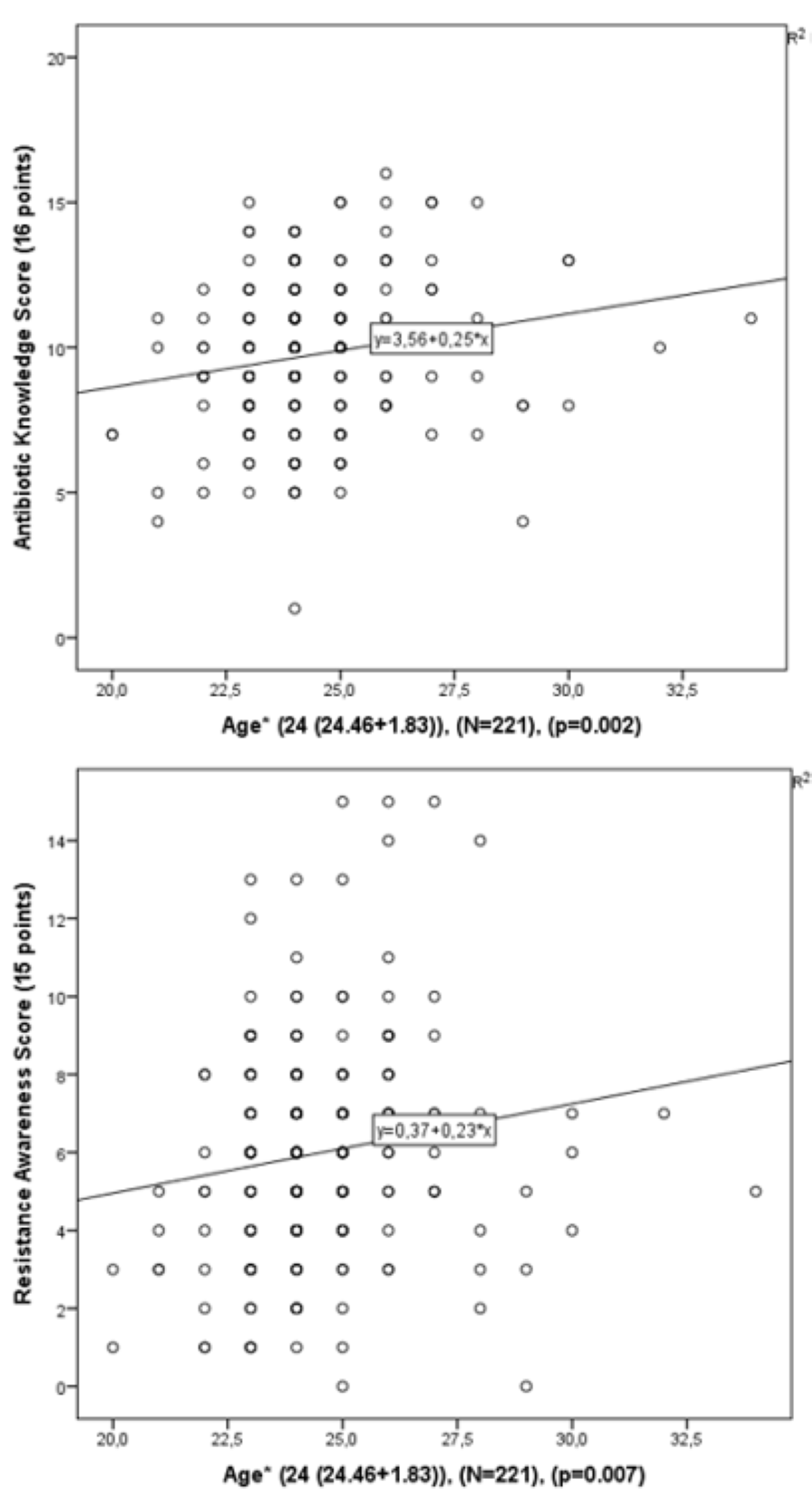
The age of the interns and their antibiotic knowledge scores and resistance awareness scores were evaluated separately. A significant but weak positive correlation was found between age and antibiotic knowledge (rs=0.190, p=0.002). It was observed that antibiotic knowledge scores increased with increasing age. Similarly, a significant but weak positive correlation was found between age and resistance awareness (rs=0.152, p=0.007) Figure 1. It was determined that awareness increased with increasing age. Resistance Awareness, Antibiotic Knowledge, and Attitude Score were evaluated separately according to gender. While a significant difference was found between the attitude scores and gender (p=0.004), no difference was observed between the other scores Table 4.
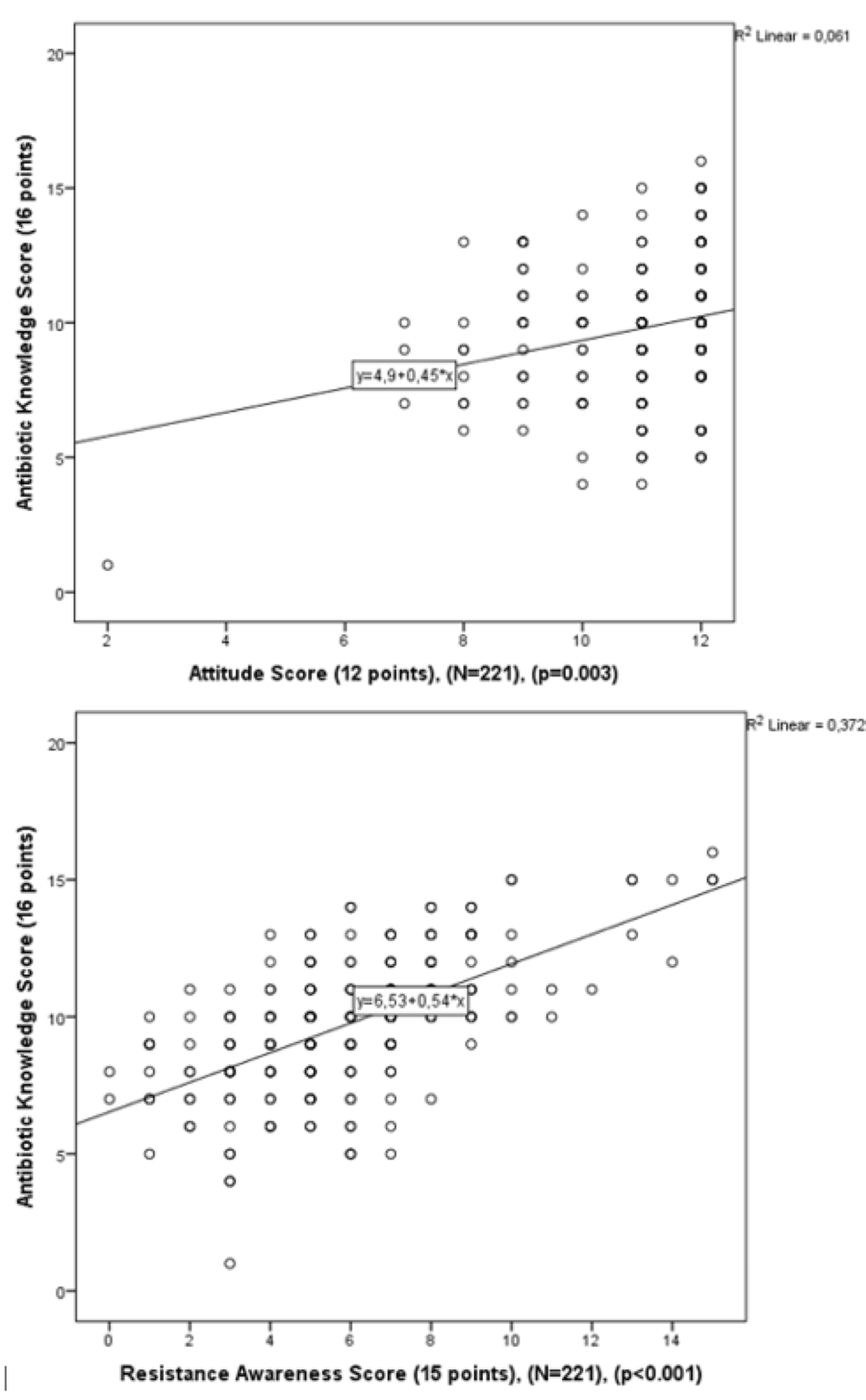
When antibiotic knowledge and resistance awareness and antibiotic knowledge and attitude scores of the intern doctors were evaluated separately, a significant but moderate positive correlation was found between antibiotic knowledge and resistance awareness (rs=0.247, p=0.003). Similarly, a significant but weakly positive correlation was found between antibiotic knowledge and attitude scores (rs=0.610, p<0.001), Figure 2.
| Question | Responses | N=221 | % |
|---|---|---|---|
| Can antibiotics destroy normal flora in the body? | Yes*NoNot sure | 21443 | 96.8%1.8%1.4% |
| Can antibiotics cause allergic reactions? | Yes*NoNot sure | 21812 | 98.6%0.5%0.9% |
| Do you know when to start antimicrobial treatment? | Yes*NoNot sure | 1541057 | 69.7%4.5%25.8% |
| Do you know how to choose the best antibiotic? | Yes*NoNot sure | 9426101 | 42.5%11.8%45.7% |
| Do you know the appropriate dosage of antibiotics to be given? | Yes*NoNot sure | 5760104 | 25.8%27.1%47.1% |
| Do you know when to switch from intravenous antibiotics to oral regimens? | Yes*NoNot sure | 607982 | 27.1%35.7%37.1% |
| Inappropriate use of antibiotics causes antibiotic resistance. | YesNoNot sure | 22001 | 99.5%0%0.5% |
| Better use of antibiotics will not affect antimicrobial resistance? | YesNoNot sure | 2117921 | 9.5%81%9.5% |
| Is it always better to prescribe broad-spectrum antibiotics even if more narrow-spectrum antibiotics are effective? | YesNoNot sure | 1717925 | 7.7%81%11.3% |
| The mechanism of resistance to beta-lactams in K. pneumoniae is mainly enzymatic. | YesNoNot sure | 6425132 | 29%11.3%59.7% |
| The resistance mechanism of methicillin-resistant S. aureus is efflux pumps. | YesNoNot sure | 6625130 | 29.9%11.3%58.8% |
| The mechanism of resistance against vancomycin-resistant E. faecalis is by changing the region of binding. | YesNoNot sure | 5413154 | 24.4%5.9%69.7% |
| Antibiotic use shorter than the standard duration provokes resistance. | YesNoNot sure | 1801724 | 81.4%7.7%10.9% |
| Failure to debride the site of infection provokes resistance. | YesNoNot sure | 1761134 | 79.6%5%15.4% |
| Does the use of antibiotics for self-limiting bacterial infections provoke resistance? | YesNoNot sure | 1272470 | 57.5%10.9%31.7% |
| Overuse of antibiotics in livestock provokes resistance. | YesNoNot sure | 1561154 | 70.6%5%24.4% |
(*): Correct response
| Question | Responses | N=221 | % |
|---|---|---|---|
| How are antibiograms analyzed? | Do not knowKnow partiallyKnow it wellKnow it very well | 541064516 | 24.4%48%20.4%7.2% |
| How to find authoritative data sources for treating infections? | Do not knowKnow partiallyKnow it wellKnow it very well | 17130659 | 7.7%58.8%29.4%4.1% |
| How to deal with a patient who wants antimicrobials? | Do not knowKnow partiallyKnow it wellKnow it very well | 27977918 | 12.2%43.9%35.7%8.1% |
| Identify the correct spectrum of different antimicrobial therapies? | Do not knowKnow partiallyKnow it wellKnow it very well | 56124338 | 25.3%56.1%14.9%3.6% |
| How to choose the best antimicrobials for a specific infection? | Do not knowKnow partiallyKnow it wellKnow it very well | 27129578 | 12.2%58.4%25.8%3.6% |
| Question | Responses | N=221 | % |
|---|---|---|---|
| Strong antimicrobial knowledge is important for my career. | AgreeDisagree | 2138 | 96.4%3.6% |
| Antimicrobials are overused in our country. | AgreeDisagree | 2183 | 98.6%1.4% |
| The antimicrobials I will prescribe/distribute will contribute to the problem of resistance. | AgreeDisagree | 17744 | 80.1%19.9% |
| I would like more training on the appropriate use of antimicrobials. | AgreeDisagree | 19724 | 89.1%10.9% |
| Efficacy is better if antimicrobials are newer and more expensive. | AgreeDisagree | 23198 | 10.4%89.6% |
| Antimicrobial resistance is not a major problem. | AgreeDisagree | 14207 | 6.3%93.7% |
| Antibiotics must be given when there is a fever. | AgreeDisagree | 9212 | 4.1%95.9% |
| Stop the antibiotics immediately when the patient feels better. | AgreeDisagree | 15206 | 6.8%93.2% |
| Leftover antibiotics should be saved for future use. | AgreeDisagree | 49172 | 22.2%77.8% |
| I should know the correct and relevant specimen to collect for an infection. | AgreeDisagree | 20912 | 94.6%5.4% |
| I can distinguish between normal flora and a true pathogen from a microbiology report. | AgreeDisagree | 20021 | 90.5%9.5% |
| I can understand the mechanisms of resistance based on a microbiology report. | AgreeDisagree | 20615 | 93.2%6.8% |
| Scores | Gender | Mean | SD | p-values | 95% CI Lower | 95% CI Upper |
|---|---|---|---|---|---|---|
| Resistance Awareness Score | MaleFemale | 5.916.06 | 2.6122.950 | 0.686 | -0.889 | 0.586 |
| Antibiotic Knowledge Score | MaleFemale | 9.5510.00 | 2.5742.292 | |||
| Attitude Score | MaleFemale | 10.6911.20 | 1.4951.123 | 0.004 | -0.872 | -0.163 |
CI, Confidence Interval of the Difference; SD, Standard deviation
Discussion
Physicians at the center of antibiotic stewardship have poor perceptions of antimicrobial therapy management and false perceptions about rational antibiotic usage [14,15,16]. The quality and adequacy of the education received by medical students directly impact their knowledge, perceptions, and attitudes toward the correct use of antibiotics. In one study, after infectious disease education, almost all the medical students who participated in the study thought that antimicrobial resistance is a public health problem today, and 98.4% of them thought that antimicrobial resistance should be prevented [17].
This study aimed to draw attention to the deficiencies, false attitudes, and perceptions of semester V students who will be interns for one month and intern doctors in antibiotic stewardship. We have once again identified the importance of general antibiotic knowledge and resistance awareness in rational antibiotic usage. These parameters directly relate to eliminating false perceptions and attitudes among intern doctors. There are many reasons for the irrational use of antibiotics. Antibiotic administration for nonbacterial infections, antibiotic administration for longer than necessary, treatment of colonization and contamination, lack of correct differentiation of other causes that increase acute phase reactants, and high fever are some of them [18,19]. Unlike in the above study, most volunteer doctors who participated were still unaware of the importance of antimicrobial resistance. However, among European countries, Turkey has a high rate of antibiotic usage [20]. One-third of the participants still did not know or were unsure about the correct choice of antibiotic, and three-quarters did not know or were unsure about the appropriate dosage and the timing of antibiotic switching. A very small proportion had misconceptions, such as taking antibiotics for every fever and repeatedly taking too many antibiotics. Furthermore, about 90 percent of participants did not know or were not sure about the positive impact of antibiotics on resistance when used with better stewardship, and the fact that they believe that antibiotics can be discontinued without waiting for adequate treatment time proves that the medical faculty education in our center should be reconsidered. Partial re-teaching of microbiology courses in semester V, making the infectious diseases compulsory, and extending their duration will seriously contribute to solving the problems we have identified in this study. The high number of students in academic institutions negatively affects the quality of education. In addition, the supply of adequate and effective equipment for the quality of education in hospitals and health institutions is another problem that needs to be addressed by politicians and government authorities. Seminars can be organized from time to time so that academicians can update their knowledge of effective teaching techniques. In addition, the potential integration of mobile learning applications, case-based discussions, or simulation-based training that will contribute to the development of students can contribute positively to the quality of education.
One of the main themes of antibiotic management is the problem of developing resistance. Knowing the resistance mechanisms of some gram-negative and gram-positive agents and choosing appropriate antibiotics accordingly will contribute to the prevention of resistance development [21]. In our study, it was shown that the general antibiotic knowledge of the intern doctors was good. They reported that they were aware of antibiotic resistance at a high rate. However, there is a serious lack of awareness of resistance methods and resistance awareness. Although there was no correlation between gender and resistance awareness, there was a poor correlation between age and resistance awareness. There was no significant correlation between age and attitudes or perceptions toward antibiotics. This may be explained by the fact that the education received by the interns about infectious diseases was forgotten at that time. We think that the fact that the intern doctors, who were older than the Term V students, did not take any internship or course related to antibiotic knowledge in the last year was effective in this. Similar studies have found results that support this thesis [22,23]. In addition, it may be thought that they are unaware that they have serious deficiencies in resistance. To overcome this deficiency, up-to-date guidelines can be prepared according to the resistance frequency of each center. Antibiotic resistance rates and the type and frequency of resistant pathogens may vary according to country, center, and region [24]. Alternatively, practical telephone applications adapted to international guidelines can be created. In addition, banning the usage of prescriptions without antibiotics as a policy in our country has been a wise decision that will contribute to the reduction of unconscious antibiotic usage and resistance development. Studies have shown that factors such as having more clinical experience and experience and seniority affect the correct attitude about antibiotics, whereas gender was shown to be an effective factor in our study [25]. In addition, it was determined that antibiotic stewardship program training led to significant improvements in knowledge and attitudes after the deficiencies of healthcare professionals on this subject were identified [26].
This study has several limitations. This study was conducted in a single center. The sample size was determined by calculating the minimum required number of participants based on the total number of semester V students and intern doctors in our center. Because of this, it cannot be generalized to the whole of our country. Factors such as the quality of training in other centers and differences in training programs may change the statistical significance and comprehensiveness. In addition, the accuracy of the results is related to the honesty of the participants in answering. Subjective responses were minimized as much as possible by not asking for any identity information that would reveal the participants. It may be possible to reach more reliable responses in large-scale surveys where participants can easily give objective responses. In addition, the inclusion of semester five students with a very short internship period may have partially affected the homogeneity. Other limitations include the fact that a generally accepted validity scale could not be used for the study, and the questions were prepared only for this study by using similar studies in the literature.
Conclusions
As a result, despite serious resistance problems due to the mismanagement of antimicrobials, intern doctors still have serious knowledge deficiencies and perception-attitude inaccuracies, especially regarding antimicrobial resistance. The age of the intern doctor is partially associated with antibiotic knowledge and resistance awareness. General antibiotic knowledge was directly associated with correct perceptions and attitudes toward antibiotic treatment. Gender was also directly associated with attitude and perception, but not with antibiotic knowledge or resistance awareness. In conclusion, our education system should be revised or facilitated to train medical doctors governed by knowledge rather than obsession, and awareness practices should be implemented
Conflicts of Interest
The authors declare no conflicts of interest.
Funding Source
This research received no specific grant from any funding agency in the public, commercial, or not-for-profit sectors.
Acknowledgments
We thank all the healthcare personnel who supported our survey during the study.
Institutional Review Board (IRB)
The study was approved by the Abant Izzet Baysal University Noninterventional Clinical Research Ethics Committee Unit. Ethical permission was received at the meeting on February 20, 2024, numbered 2024/28 (Approval no: BAIBU-28).
Large Language Model
No generative artificial intelligence or large language model tools were used in the preparation of this manuscript.
Authors Contribution
Conceptualization was equally contributed by, AD, AS, BD and HŞÇ; methodology, AD, CR, EBN, ZA; validation, AD, AS, BD, HŞÇ, CR, EBN, ZA, MTA, RÖ; formal analysis, AD; investigation, AD, AS, BD, HŞÇ, CR, EBN, ZA, MTA, RÖ; resources, AD, AS, BD; writing—original draft preparation, AD; writing—review and editing, AD; visualization, AD; supervision, AD; project administration, AD. All authors have read and agreed to the published version of the manuscript.
Data Availability
The datasets used and/or analyzed during the current study are available from the corresponding author upon reasonable request.
References
- World Economic Forum: Global Risks Report 2019. Computer Fraud & Security. 2019;2019(2):4. doi:10.1016/s1361-3723(19)30016-8
- Huemer M., Mairpady Shambat S., Brugger S. D., Zinkernagel A. S.. Antibiotic resistance and persistence-Implications for human health and treatment perspectives. EMBO Rep. 2020;21(12):e51034. doi:10.15252/embr.202051034 PMID: 33400359 PMCID: PMC7726816
- Lv L., Wan M., Wang C., Gao X., Yang Q., Partridge S. R., Wang Y., Zong Z., Doi Y., Shen J., Jia P., Song Q., Zhang Q., Yang J., Huang X., Wang M., Liu J. H.. Emergence of a Plasmid-Encoded Resistance-Nodulation-Division Efflux Pump Conferring Resistance to Multiple Drugs, Including Tigecycline, in Klebsiella pneumoniae. mBio. 2020;11(2). doi:10.1128/mBio.02930-19 PMID: 32127452 PMCID: PMC7064769
- Tang K. W. K., Millar B. C., Moore J. E.. Antimicrobial Resistance (AMR). Br J Biomed Sci. 2023;80:11387. doi:10.3389/bjbs.2023.11387 PMID: 37448857 PMCID: PMC10336207
- United Nations Department of Economic and Social Affairs. The 17 Goals. 2023.
- Ayhan M., Coskun B., Kayaaslan B., Hasanoglu I., Kalem A. K., Eser F., Bilir Y. A., Unlu S., Guner R.. Point prevalence of antibiotic usage in major referral hospital in Turkey. PLoS One. 2024;19(1):e0296900. doi:10.1371/journal.pone.0296900 PMID: 38295065 PMCID: PMC10830045
- Nandi A., Pecetta S., Bloom D. E.. Global antibiotic use during the COVID-19 pandemic: analysis of pharmaceutical sales data from 71 countries, 2020-2022. EClinicalMedicine. 2023;57:101848. doi:10.1016/j.eclinm.2023.101848 PMID: 36776504 PMCID: PMC9900305
- Sencan I., Cag Y., Karabay O., Kurtaran B., Guclu E., Ogutlu A., Demirbas Z., Bulut D., Karlidag G. E., Sefa Sayar M., Sibar E. G., Eren Kutsoylu O. O., Kul G., Erol S., Bektas B., Unver Ulusoy T., Kuzi S., Tasbakan M., Yigit O., Ceran N., Inal A. S., Ergen P., Yamazhan T., Uzar H., Agalar C.. Antibiotic use and Influencing Factors Among Hospitalized Patients with COVID-19: A Multicenter Point-Prevalence Study from Turkey. Balkan Med J. 2022;39(3):209-217. doi:10.4274/balkanmedj.galenos.2022.2021-11-62 PMID: 35611705 PMCID: PMC9136543
- Van Boeckel T. P., Pires J., Silvester R., Zhao C., Song J., Criscuolo N. G., Gilbert M., Bonhoeffer S., Laxminarayan R.. Global trends in antimicrobial resistance in animals in low- and middle-income countries. Science. 2019;365(6459). doi:10.1126/science.aaw1944 PMID: 31604207
- Cantarero-Arevalo L., Hallas M. P., Kaae S.. Parental knowledge of antibiotic use in children with respiratory infections: a systematic review. Int J Pharm Pract. 2017;25(1):31-49. doi:10.1111/ijpp.12337 PMID: 28097716
- Kotwani A., Joshi P. C., Jhamb U., Holloway K.. Prescriber and dispenser perceptions about antibiotic use in acute uncomplicated childhood diarrhea and upper respiratory tract infection in New Delhi: Qualitative study. Indian J Pharmacol. 2017;49(6):419-431. doi:10.4103/ijp.IJP_508_17 PMID: 29674796 PMCID: PMC5892023
- Morley V. J., Firgens E. P. C., Vanderbilt R. R., Zhou Y., Zook M., Read A. F., MacGeorge E. L.. Factors associated with antibiotic prescribing for acute bronchitis at a university health center. BMC Infect Dis. 2020;20(1):177. doi:10.1186/s12879-020-4825-2 PMID: 32102652 PMCID: PMC7045376
- Dogan A., Mohamed Al I. A., Abdullahi Al I. M., Orul H.. Assessment of tetanus Immunization among healthcare workers in Mogadishu, Somalia. Hum Vaccin Immunother. 2023;19(1):2202128. doi:10.1080/21645515.2023.2202128 PMID: 37133877 PMCID: PMC10294765
- Ahmed H., Bhimani S., Khanum I., Khan A., Khetpal A., Abbas M. A., Godil F., Godil A., Makhdoom I. U. M.. Knowledge, attitude and perception survey of doctors regarding antibiotic use and resistance in Karachi, Pakistan. J Pak Med Assoc. 2020;70(6):1023-1028. doi:10.5455/JPMA.6239 PMID: 32810100
- Atif M., Ihsan B., Malik I., Ahmad N., Saleem Z., Sehar A., Babar Z. U.. Antibiotic stewardship program in Pakistan: a multicenter qualitative study exploring medical doctors' knowledge, perception and practices. BMC Infect Dis. 2021;21(1):374. doi:10.1186/s12879-021-06043-5 PMID: 33882843 PMCID: PMC8059254
- Nabidda S., Ssennyonjo R., Atwaru J., Kanyike A. M., Baryayaka S., Pangholi K., Tusiimire J.. Antimicrobial resistance and rational prescription practices: knowledge, perceptions and confidence of health profession interns in Uganda. JAC Antimicrob Resist. 2023;5(5):dlad105. doi:10.1093/jacamr/dlad105 PMID: 37795426 PMCID: PMC10546811
- Yuste J. R., Matteo A. B., Gruber F.. Impact of Infectious Diseases training in the perception of antibiotic resistance and rational use of antibiotics among Spanish medical students - a cross-sectional study. BMC Med Educ. 2022;22(1):550. doi:10.1186/s12909-022-03580-8 PMID: 35840970 PMCID: PMC9287956
- Correction. BMJ Open Respir Res. 2015;2(1). doi:10.1136/bmjresp-2014-000078corr1 PMID: 26339491 PMCID: PMC4554964
- Zaidi S. F., Alotaibi R., Nagro A., Alsalmi M., Almansouri H., Khan M. A., Khan A., Memon I.. Knowledge and Attitude Towards Antibiotic Usage: A Questionnaire-Based Survey Among Pre-Professional Students at King Saud bin Abdulaziz University for Health Sciences on Jeddah Campus, Saudi Arabia. Pharmacy (Basel). 2020;8(1). doi:10.3390/pharmacy8010005 PMID: 31935856 PMCID: PMC7151657
- OECD. Embracing a One Health Framework to Fight Antimicrobial Resistance: Türkiye country note. 2025.
- Centers for Disease Control and Prevention. Antibiotic resistance threats in the United States.. 2025.
- Jairoun A., Hassan N., Ali A., Jairoun O., Shahwan M., Hassali M.. University students' knowledge, attitudes, and practice regarding antibiotic use and associated factors: a cross-sectional study in the United Arab Emirates. Int J Gen Med. 2019;12:235-246. doi:10.2147/IJGM.S200641 PMID: 31388309 PMCID: PMC6607982
- Sobierajski T., Mazinska B., Wanke-Rytt M., Hryniewicz W.. Knowledge-Based Attitudes of Medical Students in Antibiotic Therapy and Antibiotic Resistance. A Cross-Sectional Study. Int J Environ Res Public Health. 2021;18(8). doi:10.3390/ijerph18083930 PMID: 33918039 PMCID: PMC8068920
- Baddal B., Lajunen T. J., Sullman M. J. M.. Knowledge, attitudes and behaviours regarding antibiotics use among Cypriot university students: a multi-disciplinary survey. BMC Med Educ. 2022;22(1):847. doi:10.1186/s12909-022-03853-2 PMID: 36476280 PMCID: PMC9730643
- Jabbarin H., Nawajah I., Hejaz H. A.. Knowledge, Attitude, Awareness, and Perceptions among Physicians toward Antibiotic Resistance in Hospitals in South Palestine. Avicenna J Med. 2023;13(1):49-55. doi:10.1055/s-0043-1764374 PMID: 36969351 PMCID: PMC10038744
- Kjaersgaard M., Leth R. A., Udupi A., Ank N.. Antibiotic stewardship based on education: minor impact on knowledge, perception and attitude. Infect Dis (Lond). 2019;51(10):753-763. doi:10.1080/23744235.2019.1648856 PMID: 31389732