Trends in Mortality from Leukemia and Ischemic Heart Disease: A 22-Year Analysis in the U.S. (1999-2020)
Mohamed Fawzi HemidaⒾ1*, Ayesha KhanⒾ2, Alyaa Ahmed IbrahimⒾ1, Anika GoelⒾ3, Krish PatelⒾ4, Zahin ShahriarⒾ5, Ahmed W. HageenⒾ6, Mustafa AlsaadiⒾ7, Saif Ur RahmanⒾ8, Amr ArafaⒾ1, Zeyad KholeifⒾ9,10, Ahmed BahnasyⒾ9
- 1Faculty of Medicine, Alexandria University, Alexandria, Egypt
- 2Department of Internal Medicine, Nishtar Medical University and Hospital, Multan, Pakistan
- 3Department of Medicine, Kakatiya Medical College, Warangal, Telangana, India
- 4Department of Medicine, C. U. Shah Medical College, Surendranagar, Gujarat, India
- 5Department of Internal Medicine, Dhaka Medical College Hospital, Dhaka, Bangladesh
- 6Faculty of Medicine, Tanta University, Tanta, Egypt
- 7Department of Medicine, Jabir Ibn Hayyan University for Medical and Pharmaceutical Sciences, Kufa, Iraq
- 8Department of Medicine, Bacha Khan Medical College, Mardan, Pakistan
- 9Department of Cardiovascular Medicine, Mayo Clinic, Rochester, MN, USA
- 10Department of Internal Medicine, Baptist Hospital of South East Texas, Texas, USA
Abstract
Introduction: Leukemia and ischemic heart disease (IHD) are major U.S. mortality causes. This study analyzes national mortality trends from 1999 to 2020 to assess the impact of public health efforts in leukemia-associated IHD mortality rates.
Methods: This retrospective study analyzed death certificate data from the CDC-WONDER database spanning 1999 to 2020, focusing on leukemia (ICD-10: C91–C95) and ischemic heart disease (ICD-10: I20–I25) as multiple causes of mortality in the U.S. population. Crude mortality rates (CMR) and age-adjusted mortality rates (AAMR) per 100,000 population were calculated. JoinPoint analysis was performed to estimate annual percent change (APC) and average annual percent change (AAPC).
Results: From 1999 to 2020, there were 53,603 deaths from combined leukemia and ischemic heart disease among U.S. adults aged 25+, with the AAMR declining from 1.39 to 1.09 per 100,000 (AAPC= -1.30%; 95% CI: -1.90 to -0.68; P= 0.000034). A significant decrease occurred from 1999 to 2018 (AAMR: 1.39 to 0.95; APC= -2.1894%; 95% CI: -2.3995 to -1.9788, P < 0.000001), followed by a period where the trend shifted upward which is statistically significant for the certain subgroups, except men and older adults. Men had higher AAMR than women (1.87 vs. 0.62). Regional AAMRs were highest in the Midwest (1.3). Non-Hispanic Whites had the highest AAMR (1.25). Adults 65+ had a CMR of 5.27 vs. 0.26 for ages 45–64.
Conclusion: Significant health disparities exist, as mortality from combined leukemia and IHD is highest among men, older adults, rural populations, and non-Hispanic White individuals.
Keywords: Ischemic heart disease, Leukemia, Mortality, Trends, Disparities
Article information
Introduction
Over the past few years, there have been significant improvements in diagnostic approaches, medical care, and community health actions for many diseases [1,2]. Although these advancements, leukemia and ischemic heart diseases (IHD) are considered the leading causes of death among the adult population in the United States (U.S.). Leukemia is a group of bone marrow and blood cancers that comprises several variants [3], including acute and chronic types [4]. It is considered as the primary contributor of cancer-associated fatalities worldwide [5,6], with an estimated 60,000 recently detected cases per year in the U.S. [7]. Furthermore, IHD is also referred to as coronary heart disease (CHD) which remains to be the primary cause of fatality, involving diseases like sudden cardiac arrest, heart failure, and heart attacks [8]. CHD accounted for 375,476 deaths in the U.S., representing about 42.1% of all mortality associated with cardiovascular disease [9]. There are nearly 805,000 individuals in the U.S. who suffer from a heart attack every year [10]. IHD has historically improved due to continuous enhancements in cardiovascular treatment, including pharmaceutical therapies [11], procedural interventions [12], and initiatives aimed at addressing contributing factors. These initiatives addressed various conditions, including elevated cholesterol levels, diabetes, hypertension, tobacco consumption, and physical inactivity, that are strongly associated with IHD [13,14,15]. Likewise, improvements in targeted therapies, chemotherapy, immunologic treatment, and bone marrow transplantation have markedly enhanced longevity throughout past decades, yet the burden of leukemia continues to be considerably elevated [16]. Leukemia and cardiovascular diseases are closely linked. For example, several leukemia treatments, such as anthracyclines [17], tyrosine kinase inhibitors [18,19], and some targeted therapies [20], can cause cardiotoxicity, leading to heart dysfunction, arrhythmias, and ischemic events. Furthermore, the current heart conditions can limit leukemia treatment and worsen outcomes [21]. These connections underscore the importance of integrated cardio-oncology care in monitoring and managing heart risks in leukemia patients.
These healthcare progresses resulted in consistent declines in age-standardized fatality rates for both diseases during the period between the late 1990s and the early 2010s. Nevertheless, recent findings suggest that this favorable trend may be declining or plateauing in certain populations, raising major concerns regarding the sustainability of medical enhancement [22]. Furthermore, emerging evidence highlights an increase in cardiovascular mortality among adolescents and adults [9] and higher rates of leukemia-associated deaths in specific demographic groups [7]. These transitions may be linked to multiple interrelated variables, including expanding socioeconomic variations, changing disease risk patterns, the lasting consequences of the COVID-19 pandemic, and inequitable access to healthcare services [23], which interrupted preventive and standard medical care.
Despite the importance of this evidence, most prior research has emphasized either leukemia or IHD separately, and there is a lack of comparative and comprehensive evaluations that explore fatality trends for both diseases concurrently among diverse demographics. Furthermore, the existing studies lack detailed stratification by sex, age, geographic region, race/ethnicity, and urban-rural residence [24]. These factors are known to influence disease burden and its associated consequences. This results in a serious gap in interpreting whether the apparent decline in progress underscores a wider challenge in U.S. medical infrastructures. The combined analysis of IHD and leukemia is justified because they are both major causes of mortality in the U.S. Besides, they share common risk factors and healthcare influences, and have treatment-related overlaps. Studying these conditions concurrently offers a broader view of national health trends to guide policy and care.
To resolve this discrepancy, this study considered 22 years of nationwide fatality records from the Centers for Disease Control and Prevention Wide-ranging Online Data for Epidemiologic Research (CDC-WONDER) to assess mortality patterns for both IHD and leukemia among individuals aged 25 years old in the period between 1999 and 2020. Furthermore, we aim to identify whether there has been a decline in mortality rate improvement for IHD and leukemia, and to address which populations are most influenced. We hypothesize that after a period of steady decline, mortality rates for both IHD and leukemia have plateaued or increased in certain subgroups, reflecting emerging disparities in healthcare access, prevention, and treatment. Tracking mortality trends in IHD and leukemia helps clinicians target screening, prevention, and resources to populations at risk. For public health, these trends guide priority setting, integrated care planning, and policies to improve healthcare performance and equity.
Materials and Methods
Study Setting and Population
This study is a retrospective epidemiological analysis using national death data from the US over 22 years, from January 1, 1999, to December 31, 2020. The records were gathered from the CDC WONDER platform [25], particularly the Multiple Cause of Death (MCOD) database compiled by the National Center for Health Statistics (NCHS). The MCOD database collects anonymized mortality data covering all deaths recorded in the US, delivering comprehensive geographic and population-based data along with contributing factors of mortality.
We targeted adults aged 25 years and older, as mortality trends, etiological determinants, and contributing factors differ markedly across adult and pediatric groups. However, our eligibility criteria were determined by death certificates that identified leukemia or IHD as the multiple cause of mortality. Individuals with both conditions listed as either the primary cause of death or a contributing factor were included in our analysis. This was categorized by utilizing ICD-10 codes C91–C95 for leukemia and I20–I25 for IHD. Exclusion criteria involved individuals younger than 25 years and documents with missing geographic and demographic data. We chose 25 years to focus on mature adult mortality patterns, as leukemia and IHD risks differ substantially in younger populations. This age cutoff also reduces variability seen in adolescents and young adults. Besides, prior investigations have reported the same in adults 25 years in IHD [26] and leukemia [27].
We conducted this study to investigate the long-term mortality patterns across various U.S. groups and to assess differences by major sociodemographic characteristics. Consequently, we stratified the population depending on age groups (25–44, 45–64, 65+), sex (female, male), geographic region (Northeast, South, Midwest, and West) according to the U.S. Census Bureau [28], and race/ethnicity (American Indian/Alaska Native, Hispanic, Asian/Pacific Islander, Non-Hispanic White, and Non-Hispanic Black). In addition, we integrated the 2013 NCHS Rural–Urban Classification Scheme [29], classifying regions across six categories spanning from peripheral rural settings to central urban areas.
Data Extraction
We rigorously extracted the included data from the CDC WONDER platform [25] by searching the MCOD database. Moreover, death records were refined through ICD-10 codes for leukemia (C91–C95) and IHD (I20–I25). We extracted annual death rates and population denominators across each year between 1999 and 2020. Besides, both age-adjusted mortality rates (AAMRs) and crude mortality rates were determined per 100,000 individuals. However, age standardization was carried out using the direct approach, adjusted to the 2000 U.S. standard population to ensure comparability over years and demographic subgroups. These comprised sex, race/ethnicity, age based on predefined classification, spatial region, and rural–urban residence. Furthermore, the use of CDC WONDER provided standardized definitions, authenticated data collection, and nationwide representation, which strengthened the applicability and credibility of our results. Data management was executed using R (version 4.3.0) for data preparation and visualization, and Microsoft Excel for preliminary organization. Data integrity verification was conducted to prevent missing data, repetition, or data mislabeling. Additionally, no personal identifiers were applied to guarantee adherence to the ethical guidelines, along with exempting this research from institutional review board (IRB) approval according to STROBE guidelines [30] and CDC regulations on publicly accessible and de-identified datasets. Therefore, this study constituted no risk to participants and did not necessitate informed consent. According to Title 45 Code of Federal Regulations Part 46, it met the standards for exclusion from IRB assessment. All data representation and analysis were developed using GraphPad Prism (version 9) and R to ensure top-tier data visualization and analysis.
Statistical Analysis
We utilized Joinpoint Regression Analysis, a well-suited approach to assess chronological changes in disease occurrences. Likewise, the Joinpoint Regression software (version 4.9.0.1), developed by the U.S. National Cancer Institute (NCI), was used to identify statistically significant variations ("joinpoints") in mortality patterns. The application of Joinpoint modeling enabled us to locate years in which the extent or direction of death rate variation has shifted. The statistical framework adapts multiple associated linear intervals to the natural logarithm of the AAMRs. It calculates APCs in each segment and a cumulative AAPC for the study duration.
The software employs a Monte Carlo permutation technique to determine the optimal count and location of joinpoints. This is accompanied by the highest number set to three in line with NCI guidelines for long-term information. APCs and AAPCs were documented with 95% confidence intervals. Besides, a two-tailed p-value < 0.05 was reported as statistically significant. Moreover, comparative trend analyses between leukemia and IHD were conducted to investigate whether progress in lowering fatality has been equitable throughout our demographics. In addition, sensitivity analyses were conducted by omitting years affected by outlier events, such as the onset of the COVID-19 pandemic or economic crises, to ensure the reliability of mortality trend predictions over time.
Results
Overall Trends
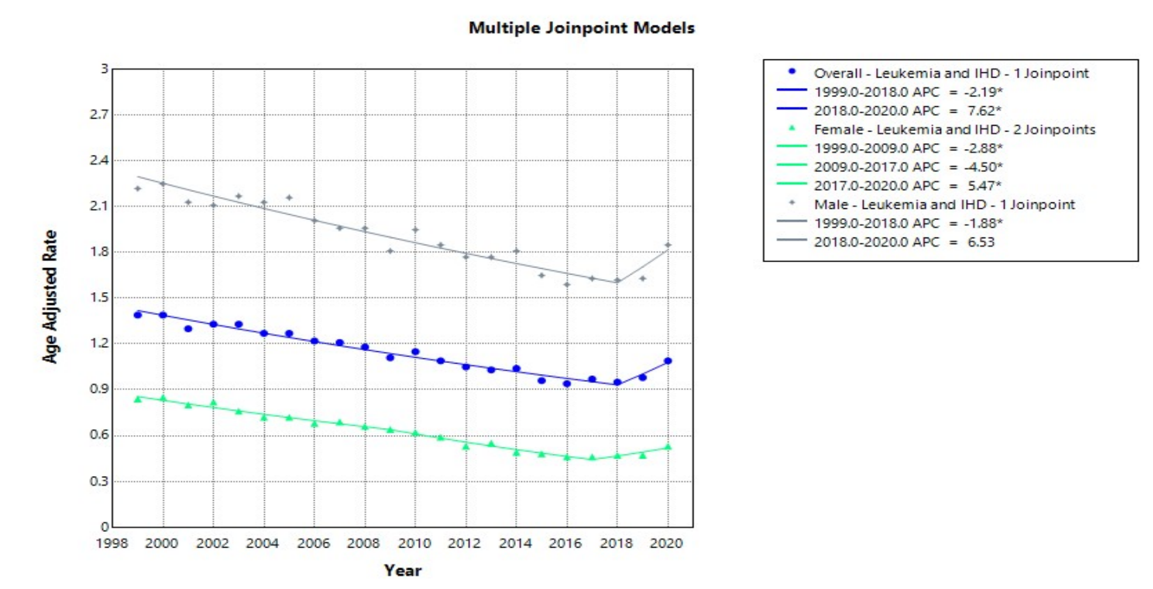
From 1999 to 2020, mortality trends for combined leukemia and ischemic heart disease in the overall adult population aged 25 and above showed notable changes over time, with 53603 deaths. The AAMR decreased from 1.39 (95% CI: 1.33 to 1.44) in 1999 to 1.09 (95% CI: 1.05 to 1.12) in 2020 (AAPC -1.2953%; 95% CI: -1.9019 to -0.6848, P = 0.000034), indicating an overall decline in mortality rates despite the recent increase. Joinpoint regression analysis identified a single joinpoint in 2018, splitting the trend into two segments. Between 1999 and 2018, AAMR declined significantly from 1.39 to 0.95, respectively (APC -2.1894%; 95% CI: -2.3995 to -1.9788, P < 0.000001). However, from 2018 to 2020, a significant upward trend was observed, with AAMR increasing from 0.95 in 2018 to 1.09 in 2020 (APC = 7.6171%; 95% CI: 0.6808 to 15.0314, P = 0.0327). (Table S1, Table S2, Table S3, Figure 1)
Gender
Mortality trends stratified by gender revealed significant disparities, with men experiencing a higher overall number of deaths compared to women (35836 vs. 17767). Men also exhibited a higher overall AAMR over the study period (1.87; 95% CI, 1.85 to 1.89) compared to women (0.62; 95% CI, 0.61 to 0.63). Additionally, AAPC showed an increase in mortality rates among men (AAPC = -1.1096%; 95% CI: -1.8943 to -0.3186, P = 0.0060) compared to women (AAPC =-2.3545%; 95% CI: -3.1496 to -1.5529, P < 0.000001).
Further analysis identified that AAMR for women declined from 0.84 in 1999 to 0.53 in 2020, with 2 joinpoints identified in 2009 and 2017.The AAMR for the first segment (1999 – 2009) declined from 0.84 to 0.64 (APC = -2.8766%; 95% CI: -3.4846 to -2.2648, P < 0.000001). This trend showed a more pronounced decline, from 0.64 in 2009 to 0.46 in 2017 (APC = -4.4981%; 95% CI: -5.6668 to -3.3149, P < 0.000001). However, from 2017 to 2020, a significant reversal occurred in AAMR, with a change from 0.46 in 2017 to 0.53 in 2020 (APC: 5.4678%; 95% CI: 0.4197 to 10.7697, P = 0.0354).
In men, the AAMR declined from 2.22 in 1999 to 1.85 in 2020 with one joinpoint detected in 2018. In the first segment (1999-2018), the AAMR declined from 2.22 in 1999 to 1.62 in 2018 (APC = -1.8809%; 95% CI: -2.1568 to -1.6041, P < 0.000001). In the second segment (2018-2020), the mortality trend showed a numerical increase (APC = +6.5%; 95% CI: -2.2% to 16.1%); however, this change was not statistically significant (P = 0.14). (Table S2, Table S3) Figure 1
Race/ethnicity Trends
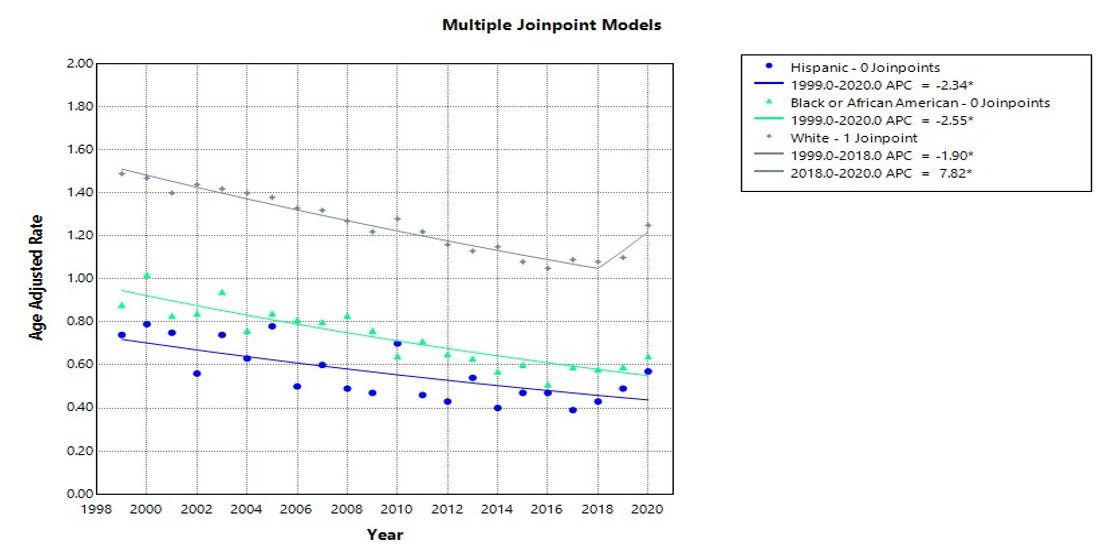
Between 1999 and 2020, Non-Hispanic (NH) White adults experienced the highest overall AAMR (1.25; 95% CI: 1.24 to 1.26) (47998 deaths), followed by NH Black or African American adults (0.71; 95% CI: 0.68 to 0.73) (2895 deaths) while the least mortality was in the Hispanics (0.54; 95% CI: 0.51 to 0.56) (1749 deaths). Among NH Black adults, the AAMR declined from 0.88 in 1999 to 0.64 in 2020 (AAPC = -2.5488%; 95% CI: -3.1178 to -1.9765, P < 0.000001), supporting the consistency of the declining trend with no join points detected.
The mortality trend for the NH White population exhibited a more complex pattern. The AAMR declined from 1.49 in 1999 to 1.25 in 2020; AAPC = -1.0167% (95% CI: -1.6526 to -0.3767, P = 0.001885), indicating an overall reduction in mortality with one joinpoint detected in 2018. In the first segment (1999-2018), AAMR declined from 1.49 to 1.08, respectively (APC = -1.9035% (95% CI: -2.0988 to -1.7068, P < 0.000001). However, a notable reversal occurred from 2018 to 2020, with a significant increase in mortality rates, as the AAMR rose from 1.08 in 2018 to 1.25 in 2020 (APC = 7.8179%, 95% CI: 0.4969 to 15.6733, P = 0.037844).
For the Hispanic adults, the mortality trend for leukemia and ischemic heart disease showed a significant decline in AAMR from 0.74 in 1999 to 0.57 in 2020 with no join points detected (AAPC -2.3413%; 95% CI: -3.4604 to -1.2105, P = 0.000356), indicating a statistically significant reduction in mortality rates. (Table S2, Table S4) Figure 2
Regional Trends
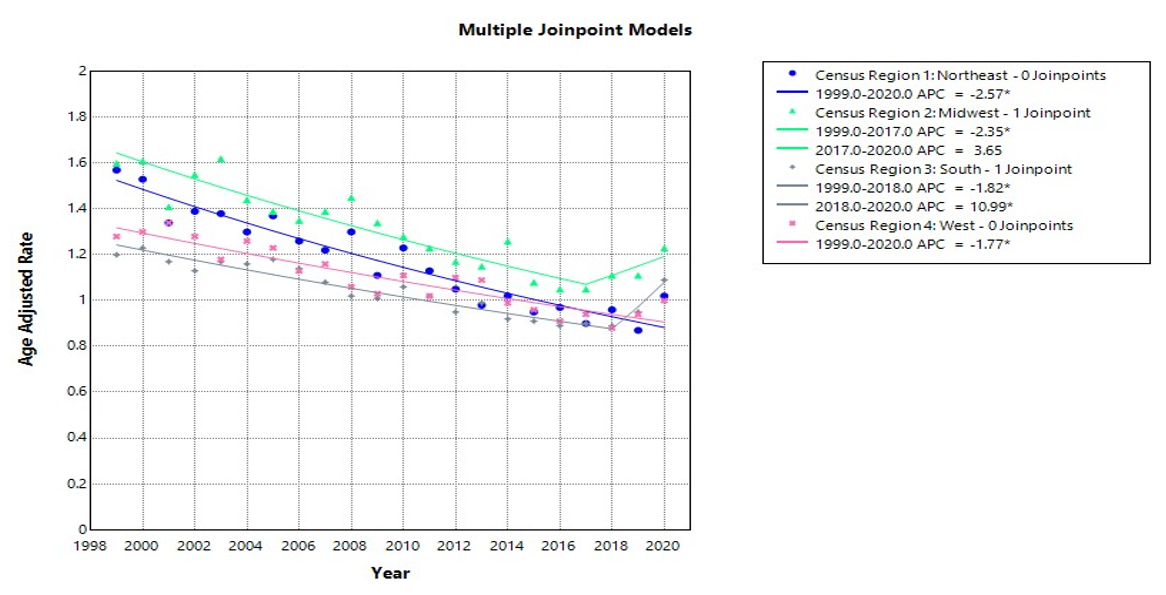
From 1999 to 2020, the majority of deaths among adults aged 25 and older with leukemias and ischemic heart disease occurred in the Midwest with the highest overall AAMR (1.3; 95% CI: 1.28 to 1.32) (14022 deaths), followed by the Northeast (1.15; 95% CI: 1.13 to 1.17) (11028 deaths), the West (1.07; 95% CI: 1.05 to 1.07) (10819 deaths), then the South (1.03; 95% CI: 1.02 to 1.05) (17734 deaths).
From 1999 to 2020, the Northeast experienced a consistent and statistically significant decline in AAMR, from 1.57 in 1999 to 1.02 in 2020, with no joinpoints detected (AAPC -2.571%; 95% CI: -2.9407 to -2.1999), indicating a sustained and significant decrease in mortality over the 22 years.
In the Midwest, the AAMR decreased from 1.6 in 1999 to 1.23 in 2020 (AAPC = -0.5182%; 95% CI: -2.5415 to -0.4842, P = 0.0041), indicating a mild but statistically significant overall decline, with one joinpoint detected in 2017. From 1999 to 2017, mortality rates significantly declined with an AAMR change from 1.6 in 1999 to 1.05 in 2017 (APC = -2.3545%; 95% CI: -2.8301 to -1.8765, P < 0.0001). However, between 2017 and 2020, there was a non-significant increase in AAMR from 1.05 in 2017 to 1.23 in 2020 (APC = 3.652%; 95% CI: -3.6495 to 11.5068, P = 0.3147)
In the south, the AAMR decreased from 1.2 in 1999 to 1.09 in 2020 (AAPC = -0.6697%; 95% CI: -1.4204 to 0.0701), which was not statistically significant (P = 0.0759) with one joinpoint detected in 2018. From 1999 to 2018, AAMR decreased significantly from 1.2 to 0.89, respectively (APC = -1.8211%; 95% CI: -2.2822 to -1.5594, P < 0.0001). From 2018 to 2020, the trend reversed, showing a significant increase in the AAMR from 0.89 to 1.09, respectively (APC = 10.9869%; 95% CI: 2.4799 to 20.2, P = 0.0134).
The West region showed a steady and significant decline in the AAMR from 1.28 in 1999 to 1 in 2020 (AAPC = -1.7657%; 95% CI: -2.0995 to -1.4309, P < 0.0001) with no joinpoints detected. Analysis of state-level data from 1999–2020 revealed significant geographic variation in age-adjusted mortality rates related to leukemia and ischemic heart disease (Table S6). The highest mortality rates were observed in Vermont (1.83 per 100,000; 95% CI, 1.58–2.09), West Virginia (1.79; 95% CI, 1.64–1.93), and North Dakota (1.78; 95% CI, 1.54–2.02). Conversely, the states with the lowest mortality rates were Nevada (0.56 per 100,000; 95% CI, 0.48–0.63), Hawaii (0.66; 95% CI, 0.55–0.77), and Georgia (0.67; 95% CI, 0.63–0.72) (Table S2, Table S5, Table S6) Figure 3.
Age-Specific Trends
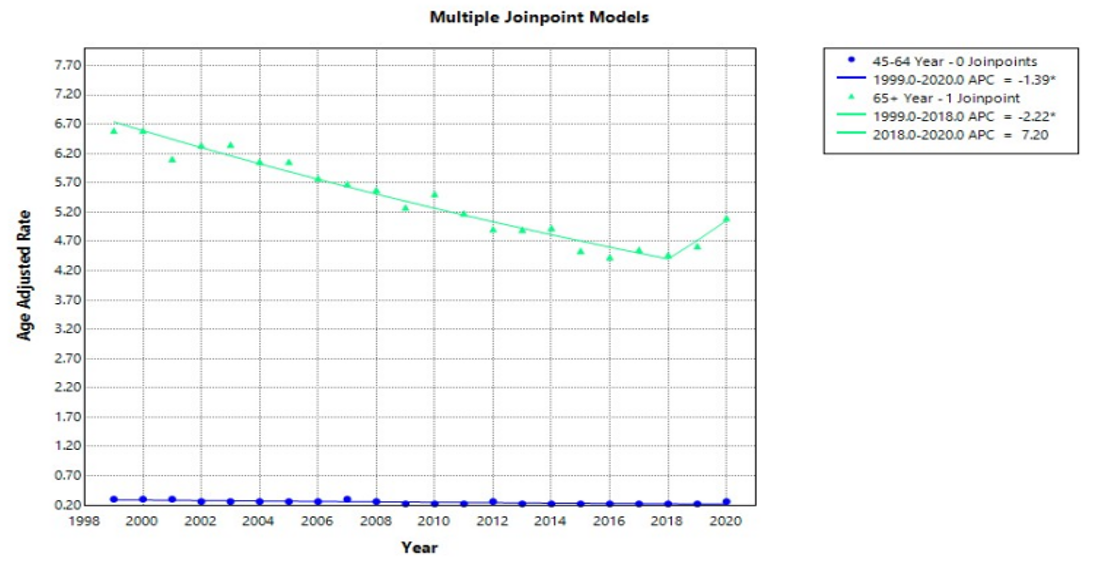
Age-stratified analysis revealed that the (+65) age group had a higher overall mortality rate with CMR (5.27; 95% CI: 5.22 to 5.32) and 48,933 deaths compared to the (45-64) age group with CMR (0.26; 95% CI: 0.25 to 0.27) and 4,415 deaths.
From 1999 to 2020, adults aged 45-64 years demonstrated a consistent and statistically significant decline in mortality rates for leukemia and ischemic heart disease with an CMR changed from 0.3 in 1999 to 0.29 in 2020 (AAPC = -1.3921%; 95% CI: -1.9549 to -0.8221, P = 0.000058), indicating a sustained reduction in mortality over the study period. For adults aged 65 and older, the mortality trend was more complex. The CMR showed a significant decline from 6.53 in 1999 to 4.81 in 2020 with one joinpoint detected in 2018 (AAPC = -1.3581%; 95% CI: -2.0427 to -0.6688, P = 0.000119), indicating a net reduction in mortality. From 1999 to 2018, there was a significant decline in AAMR from 6.53 in 1999 to 4.28 in 2018 (APC =-2.2183%; 95% CI: -2.4471 to -1.9489, P < 0.000001). However, from 2018 to 2020, the trend shifted direction, with a non-significant increase in mortality rates (APC = +7.2%; 95% CI: -0.6% to 13.6%; P = 0.07). While this recent upward trend did not reach statistical significance, it contrasts sharply with the preceding period of significant decline. Figure 4
Urban-Rural Trends
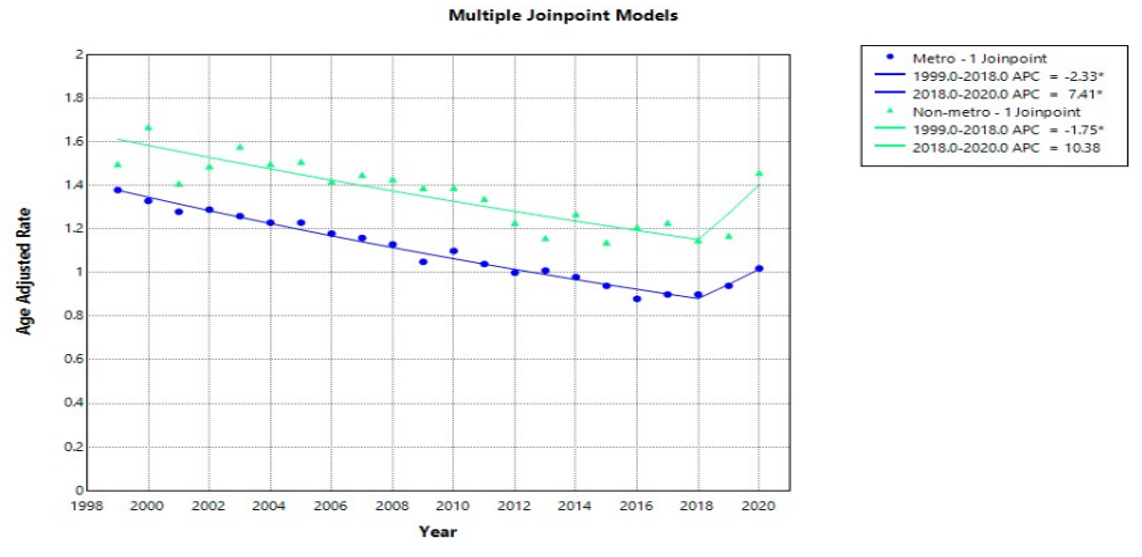
The higher trends of mortality between 1999 and 2020 occurred in nonmetropolitan (rural) areas with higher overall AAMR (1.34; 95% CI: 1.32 to 1.37) (11,460 deaths) compared to metropolitan (urban) areas with overall AAMR (1.08; 95% CI: 1.07 to 1.09) (42,143 deaths).
For urban areas, AAMR decreased from 1.38 in 1999 to 1.02 in 2020 (AAPC = -1.4414%; 95% CI: -1.9505 to -0.9499, P < 0.000001), indicating a net decline in mortality with one joinpoint in 2018. From 1999 to 2018, AAMR showed a significant decline to 0.9 in 2018 (APC = -2.3259%; 95% CI: -2.4981 to -2.1607, P < 0.000001). However, a significant reversal occurred from 2018 to 2020, with mortality rates increasing at an AAMR from 0.9 in 2018 to 1.08 in 2020 (APC = 7.4087%; 95% CI: 1.7848 to 13.3435, P = 0.012207).
In non-metropolitan (rural) areas, mortality rates also exhibited a slight decrease in AAMR from 1.5 in 1999 to 1.46 in 2020, with one joinpoint detected in 2018. (AAPC = -0.6582% ; 95% CI: -1.9919 to 0.0597, P = 0.338281), suggesting no significant overall change in mortality rates. From 1999 to 2018, the AAMR declined from 1.5 in 1999 to 1.15 in 2018 (APC: -1.7541%; 95% CI: -2.2050 to -1.3011, P < 0.000001). From 2018 to 2020, there was an upward trend, with AAMR increasing to 1.46 in 2020 (APC: 10.3821%; 95% CI: -4.6495 to 27.7833, P = 0.17265); however, this change was not statistically significant. (Table S2, Table S7) Figure 5
Place of Death Trends
The data reveal significant variation in mortality locations among the study population. The highest proportion of deaths occurred in inpatient medical facilities (22,014 deaths), representing the most common place of death. This was followed by deaths at the decedent’s home (14,919 deaths) and nursing home/long-term care facilities (9,130 deaths). In contrast, the lowest mortality counts were observed in medical facilities with unknown status (38 deaths) and among those dead-on arrival (222 deaths). Notably, hospice facilities accounted for 2,280 deaths, while outpatient or emergency room settings recorded 3,031 deaths. (Table S8)
Discussion
This 22-year analysis provides an extensive examination of mortality trends in U.S adults with leukemia and ischemic heart disease (IHD), disease states that frequently co-occur owing to overlapping risk factors, older age, and treatment adverse effects. We observed a general decline in mortality from 1999 to 2018, with a marked reversal in the recent years (2018–2020), indicating the emergence of new concerns in survivorship and management of comorbidities.
Our findings build upon and refine the existing literature on cardiovascular mortality in patients with hematological malignancies. A recent, notable study by Doolub et al. examined temporal trends using a similar dataset and timeframe, reporting that overall cardiovascular mortality among patients with leukemia decreased by 31.8% between 1999 and 2020 [31]. However, our study differs in several critical aspects, revealing a more urgent and nuanced picture. First, while Doolub et al. took a broad approach by analyzing all cardiovascular causes of death across multiple hematological cancers [31], our study provides a more granular analysis by focusing specifically on the co-occurrence of leukemia and IHD. This focused scope, combined with a more powerful statistical method —“Joinpoint regression analysis” — allowed us to uncover a critical inflection point that was missed by the broader analysis. While Doolub et al.’s findings suggest a consistent decline, our analysis reveals that the long-term decrease in mortality for leukemia and IHD (AAPC = -1.30%) masks a significant and concerning reversal. Specifically, we identified a sharp increase in mortality of +7.62% per year from 2018 to 2020. This recent uptick suggests that the progress in managing this high-risk comorbidity may be stalling or reversing, a critical insight for contemporary cardio-oncology that is not apparent from studies that average trends over two decades.
The 1.39 to 0.95 per 100,000 decrease in age-adjusted mortality rate (AAMR) between 1999 and 2018 (APC = -2.18%) is in line with the national improvements in cancer outcomes and cardiovascular care, as advances in leukemia interventions, notably those for chronic lymphocytic leukemia (CLL) and acute promyelocytic leukemia (APL) have contributed to improved survival [32]. Further, improved primary and secondary prevention of IHD, including greater use of statins, hypertension control, and added revascularization techniques, has likely decreased cardiovascular mortality [33]. Nonetheless, the rise in AAMR from 0.95 in 2018 to 1.09 in 2020 (APC = +7.6%) is concerning.
Men had a significantly larger age-adjusted linked mortality rate (AAMR) than women (1.87 vs. 0.62), reflecting previous literature involving leukemia rates and prevalence of cardiovascular disease [34,35]. The slower annual percent change (AAPC) for men (-1.11%), in contrast to women (-2.35%), also suggests that female patients may have gained more from improvements in medical services during the study period. Significantly, the mortality change after the 2017 reversal was substantial for women (APC = +5.47%), but there was no change in men, indicating that women with comorbidities may be lagging in recent preventive or compensatory strategies [36,37].
Racial differences in mortality were evident throughout the study period. White non-Hispanic men and women were the largest group of deaths (47,998) and had the highest age-adjusted mortality risk (AAMR) score (1.25). While the long-term annual age adjusted percentage change (AAPC) of -1.01% shows that the number in this group had improved over time, the reversal in the post 2018 period (APC = +7.8%) highlights the fact that a rapidly aging population may have raised the overall number of women and men that die of IHD, which may exist at a higher prevalence in Whites [38,39]. Non-Hispanic Black adults showed a more consistent decline (AAPC = -2.55%), without joinpoints, which may reflect more uniform public health outreach in this subgroup or less data volatility due to smaller sample sizes. Hispanic adults demonstrated the steepest decline in AAMR (AAPC = -2.34%) over the time period for the group, as its AAPC demonstrates a trend that reflects what is widely termed and sometimes referred to as the "Hispanic Paradox," suggesting that this group has ’better health’ than their socioeconomic status would suggest [40,41].
The area with the highest mortality burden was in the Midwest (AAMR = 1.3), while the South showed the largest increase in mortality after 2018 (APC = +10.99%). The differences between regions may be attributed to healthcare system differences including infrastructure, access to care, and disease burden, for example, states such as North Dakota and West Virginia, which had the largest state-level AAMRs, are rural Midwest states that had less specialist availability and have higher populations of smoking and obesity, which are two key contributors to both leukemia and IHD mortality [42,43]. By contrast, the West region showed a steady decrease over time, with no joinpoints (AAPC = -1.76%), indicating that this region has better access to tertiary care centers and has been willing to engage in aggressive, guideline-based treatments and standards of care.
As expected, the population aged 65 years and older represented most deaths (48,933) and had a crude mortality rate (CMR) of 5.27 versus 0.26 in the 45–64 age group. Older adults often carry multimorbidity, have a depressed physiological reserve, and have more exposure to cardiac toxicants (e.g., anthracyclines or tyrosine kinase inhibitors) [44]. The rising mortality trend after 2018 (APC = +7.2%) was not statistically significant, but biologically plausible as treatment-related cardiovascular disease is often temporal to the end of life in cancer survivorship and therefore emphasizes an urgent need for cardioncology interventions and routine surveillance for older leukemia patients [45,46]. In contrast to standard oncologic care, these cardioncology interventions should include longitudinal cardiac monitoring (e.g., echocardiography, biomarkers), early referral to cardio-oncology services for high-risk individuals, and baseline cardiovascular risk assessment before starting chemotherapy [47]. Long-term cardiac complications may be reduced by implementing structured survivorship programs that emphasize lifestyle modification, cardiotoxicity prevention, and the management of modifiable cardiovascular risk factors (such as diabetes, dyslipidemia, and hypertension). These tactics are particularly important for older adults, who are more susceptible to therapy-induced cardiotoxicity due to their decreased physiological reserve and preexisting comorbidities [48].
The difference in rates between metropolitan (AAMR = 1.08) and non-metropolitan populations (AAMR = 1.34) aligns with existing health disparities. Patients in rural settings are likely to experience longer delays in diagnosis and treatment, as well as limited access to cardiologists and oncologists, and face financial or transportation barriers [49]. Both regions experienced increases in mortality rates after 2018, but the increase in mortality was larger in rural areas (e.g., APC = +7.4%), indicating a need to expand telemedicine and decentralized care [50].
It was noticed that 40% of deaths occurred outside inpatient settings—in people’s homes (14,919) or in long-term care facilities (9,130)—suggesting a significant burden of unmonitored or poorly managed end-of-life complication [51]. This matches trends in palliative care across the country, where patients with end-stage hematologic malignancies often deteriorate quickly without going to the hospital [52,53]. The level of deaths outside of hospice facilities (2,280 deaths) might reflect limited use of palliative services, which is a known deficit in hematologic oncology [54,55].
Strengths and Limitations
Previously identified, the strengths of this study stem from factors such as its population-level representativeness, 22-year duration, and stratification by important demographic and geographic factors. In addition, Joinpoint regression analyzes and statistically tests inflection points in mortality trajectories with great precision.
A significant limitation of our study is that our analysis combined all deaths where both leukemia and ischemic heart disease were listed on the death certificate, as we used Multiple Cause of Death (MCOD), without stratifying by the Underlying Cause of Death (UCOD). Therefore, our results represent the overall mortality trend for the co-occurrence of these conditions, but do not distinguish between patients dying from leukemia with IHD as a contributing factor and those dying from IHD with leukemia as a contributing factor. These two scenarios have different clinical and etiological implications, and their mortality trends may differ. Future studies using multiple-cause-of-death data should analyze these pathways separately to provide a more granular understanding of this comorbidity. Additionally, the study has limitations due to its ecological design, as the consistency of mortality reporting may be impacted by regional or temporal differences in ICD coding practices, and the use of death certificates may be susceptible to misclassification bias, especially in complex cases. Notably, no sensitivity analyses were conducted to account for potential modifications to coding standards during the 22-year study period.
Furthermore, important clinical factors crucial for assessing results, such as chemotherapy regimens, treatment adherence, baseline cardiac function, and cardiotoxicity monitoring, are not included in the database at the individual level. Information on particular leukemia subtypes, which may vary in prognosis and treatment-related mortality, is also missing. Furthermore, the evaluation of care disparities is limited by the lack of information on socioeconomic factors, such as income, insurance coverage, and access to healthcare. We were unable to directly assess treatment effects or link observed mortality trends to particular interventions due to the ecological nature of the data. These restrictions make it challenging to draw conclusions about causality and underscore the need for more comprehensive, patient-level research.
Conclusions
After twenty years of decreasing mortality from comorbid conditions of leukemia and ischemic heart disease, reversals in mortality among key subgroups, particularly those older than 65, women, non-Hispanic Whites, and those in the South and rural areas, have created an urgent need for renewed public health attention. Prioritizing the provision of cardio-oncology services, the equitable delivery of care, and planning for survivorship will be essential to ensure that previous gains are maintained and noted disparities are addressed for this medically disadvantaged population.
Conflicts of Interest
The authors declare no competing interests that could have influenced the objectivity or outcome of this research
Funding Source
The authors declare that no specific grant or funding was received for this research from any public, commercial, or not-for-profit funding agency.
Acknowledgments
None
Institutional Review Board (IRB)
No ethical approval was required for the study.
Large Language Model
None
Authors Contribution
MFH and AK contributed to writing the original draft, review and editing, and project administration. AAI contributed to writing the original draft and review and editing. AG contributed to writing the original draft. KP contributed to writing the original draft and data extraction. ZS contributed to writing the original draft and visualization. AWH contributed to writing the original draft and methodology. MA contributed to Joinpoint analysis. SUR contributed to tables and visualization. AA contributed to writing the original draft. ZK and AB contributed to writing, review and editing, validation, and supervision.
Data Availability
Data Availability Statement: The data supporting the findings of this study are openly available in CDC-WONDER at https://wonder.cdc.gov/. The data supporting the findings of this study were obtained from the CDC WONDER online database (Centers for Disease Control and Prevention Wide‐ranging Online Data for Epidemiologic Research). The datasets used and analyzed during the current study are publicly available and can be accessed at [CDC WONDER] https://wonder.cdc.gov/. Further inquiries can be directed to the corresponding author.
References
- Dong P., Mao A., Qiu W., Li G.. Improvement of Cancer Prevention and Control: Reflection on the Role of Emerging Information Technologies. J Med Internet Res. 2024;26:e50000. doi:10.2196/50000 PMID: 38412009 PMCID: PMC10933723
- Okobi O. E., Nwogwugwu E., Ihezie C. O., Olasupo O. O., Emovon C. I., Wambai-Sani H., Ezie O. B., Afolabi A. R., Erinne O. C., O'Dare R A.. Cardiovascular Disease Patterns, Mortality, and Hospitalization Trends in Adults Over 18: Insights From the Behavioral Risk Factor Surveillance System Database. Cureus. 2024;16(8):e66604. doi:10.7759/cureus.66604 PMID: 39258090 PMCID: PMC11385429
- Asar T. O., Ragab M.. Leukemia detection and classification using computer-aided diagnosis system with falcon optimization algorithm and deep learning. Sci Rep. 2024;14(1):21755. doi:10.1038/s41598-024-72900-3 PMID: 39294306 PMCID: PMC11410793
- Ahmed N., Yigit A., Isik Z., Alpkocak A.. Identification of Leukemia Subtypes from Microscopic Images Using Convolutional Neural Network. Diagnostics (Basel). 2019;9(3). doi:10.3390/diagnostics9030104 PMID: 31450720 PMCID: PMC6787617
- Aziz N., Nabi W., Khan M., Gulzar A. H. B., Rath S., Cheema A. A. A., Arshad M. A., Hussain F., Titus A., Lal A., Anwar F.. Analyzing Two Decades of Leukemia Mortality in the U.S. (1999-2020). Clin Lymphoma Myeloma Leuk. 2025;25(8):e553-e562. doi:10.1016/j.clml.2025.03.006 PMID: 40189429
- Bi Y., Huang K., Wang M., Jin Y., Zheng Z. J.. Global, regional and national burden and quality of care index (QCI) of leukaemia and brain and central nervous system tumours in children and adolescents aged 0-19 years: a systematic analysis of the Global Burden of Disease Study 1990-2019. BMJ Open. 2025;15(3):e093397. doi:10.1136/bmjopen-2024-093397 PMID: 40122536 PMCID: PMC11931942
- Sung H., Ferlay J., Siegel R. L., Laversanne M., Soerjomataram I., Jemal A., Bray F.. Global Cancer Statistics 2020: GLOBOCAN Estimates of Incidence and Mortality Worldwide for 36 Cancers in 185 Countries. CA Cancer J Clin. 2021;71(3):209-249. doi:10.3322/caac.21660 PMID: 33538338
- Martin S. S., Aday A. W., Allen N. B., Almarzooq Z. I., Anderson C. A. M., Arora P., Avery C. L., Baker-Smith C. M., Bansal N., Beaton A. Z., Commodore-Mensah Y., Currie M. E., Elkind M. S. V., Fan W., Generoso G., Gibbs B. B., Heard D. G., Hiremath S., Johansen M. C., Kazi D. S., Ko D., Leppert M. H., Magnani J. W., Michos E. D., Mussolino M. E., Parikh N. I., Perman S. M., Rezk-Hanna M., Roth G. A., Shah N. S., Springer M. V., St-Onge M. P., Thacker E. L., Urbut S. M., Van Spall H. G. C., Voeks J. H., Whelton S. P., Wong N. D., Wong S. S., Yaffe K., Palaniappan L. P., American Heart Association Council on Epidemiology and Prevention Statistics Committee and Stroke Statistics Committee. 2025 Heart Disease and Stroke Statistics: A Report of US and Global Data From the American Heart Association. Circulation. 2025;151(8):e41-e660. doi:10.1161/CIR.0000000000001303 PMID: 39866113 PMCID: PMC12256702
- Tsao C. W., Aday A. W., Almarzooq Z. I., Alonso A., Beaton A. Z., Bittencourt M. S., Boehme A. K., Buxton A. E., Carson A. P., Commodore-Mensah Y., Elkind M. S. V., Evenson K. R., Eze-Nliam C., Ferguson J. F., Generoso G., Ho J. E., Kalani R., Khan S. S., Kissela B. M., Knutson K. L., Levine D. A., Lewis T. T., Liu J., Loop M. S., Ma J., Mussolino M. E., Navaneethan S. D., Perak A. M., Poudel R., Rezk-Hanna M., Roth G. A., Schroeder E. B., Shah S. H., Thacker E. L., VanWagner L. B., Virani S. S., Voecks J. H., Wang N. Y., Yaffe K., Martin S. S.. Heart Disease and Stroke Statistics-2022 Update: A Report From the American Heart Association. Circulation. 2022;145(8):e153-e639. doi:10.1161/CIR.0000000000001052 PMID: 35078371
- Tsao C. W., Aday A. W., Almarzooq Z. I., Anderson C. A. M., Arora P., Avery C. L., Baker-Smith C. M., Beaton A. Z., Boehme A. K., Buxton A. E., Commodore-Mensah Y., Elkind M. S. V., Evenson K. R., Eze-Nliam C., Fugar S., Generoso G., Heard D. G., Hiremath S., Ho J. E., Kalani R., Kazi D. S., Ko D., Levine D. A., Liu J., Ma J., Magnani J. W., Michos E. D., Mussolino M. E., Navaneethan S. D., Parikh N. I., Poudel R., Rezk-Hanna M., Roth G. A., Shah N. S., St-Onge M. P., Thacker E. L., Virani S. S., Voeks J. H., Wang N. Y., Wong N. D., Wong S. S., Yaffe K., Martin S. S., American Heart Association Council on Epidemiology and Prevention Statistics Committee and Stroke Statistics Subcommittee. Heart Disease and Stroke Statistics-2023 Update: A Report From the American Heart Association. Circulation. 2023;147(8):e93-e621. doi:10.1161/CIR.0000000000001123 PMID: 36695182 PMCID: PMC12135016
- Singh R., Chandi S. K., Sran S., Aulakh S. K., Nijjar G. S., Singh K., Singh S., Tanvir F., Kaur Y., Sandhu A. P. S.. Emerging Therapeutic Strategies in Cardiovascular Diseases. Cureus. 2024;16(7):e64388. doi:10.7759/cureus.64388 PMID: 39131016 PMCID: PMC11317025
- Llerena-Velastegui J., Zumbana-Podaneva K., Velastegui-Zurita S., Mejia-Mora M., Perez-Tomassetti J., Cabrera-Cruz A., Haro-Arteaga P., de Jesus Acfs, Coelho P. M., Sanahuja-Montiel C.. Comparative Efficacy of Percutaneous Coronary Intervention Versus Coronary Artery Bypass Grafting in the Treatment of Ischemic Heart Disease: A Systematic Review and Meta-Analysis of Recent Randomized Controlled Trials. Cardiol Res. 2024;15(3):153-168. doi:10.14740/cr1638 PMID: 38994227 PMCID: PMC11236347
- Abrahams T., Nicholls S. J., Nelson A. J.. Optimal Medical Therapy for Stable Ischemic Heart Disease in 2024: Focus on Blood Pressure and Lipids. Med Clin North Am. 2024;108(3):441-453. doi:10.1016/j.mcna.2023.12.005 PMID: 38548456
- Florek K., Kubler M., Gorka M., Kubler P.. New Modifiable Risk Factors Influencing Coronary Artery Disease Severity. Int J Mol Sci. 2024;25(14). doi:10.3390/ijms25147766 PMID: 39063008 PMCID: PMC11276953
- Rouleau C. R., Chirico D., Wilton S. B., MacDonald M. K., Tao T., Arena R., Campbell T., Aggarwal S.. Mortality Benefits of Cardiac Rehabilitation in Coronary Artery Disease Are Mediated by Comprehensive Risk Factor Modification: A Retrospective Cohort Study. J Am Heart Assoc. 2024;13(10):e033568. doi:10.1161/JAHA.123.033568 PMID: 38761079 PMCID: PMC11179828
- American Cancer Society. Annual cancer facts & figures [Internet]. 2025.
- Li S., Li W., Cheng M., Wang X., Chen W.. Prevention and treatment of anthracycline-induced cardiotoxicity: a systematic review and network meta-analysis of randomized controlled trials. Cardiooncology. 2025;11(1):66. doi:10.1186/s40959-025-00360-3 PMID: 40640889 PMCID: PMC12243438
- Sayegh N., Yirerong J., Agarwal N., Addison D., Fradley M., Cortes J., Weintraub N. L., Sayed N., Raval G., Guha A.. Cardiovascular Toxicities Associated with Tyrosine Kinase Inhibitors. Curr Cardiol Rep. 2023;25(4):269-280. doi:10.1007/s11886-023-01845-2 PMID: 36795308 PMCID: PMC10392782
- Wang H., Wang Y., Li J., He Z., Boswell S. A., Chung M., You F., Han S.. Three tyrosine kinase inhibitors cause cardiotoxicity by inducing endoplasmic reticulum stress and inflammation in cardiomyocytes. BMC Med. 2023;21(1):147. doi:10.1186/s12916-023-02838-2 PMID: 37069550 PMCID: PMC10108821
- Chen G., Chen G., Zhou H., Yang Q., Shang Y., Qin R., Hou Y., Zhang C., Lin J., Ye X., Wang N., Feng Y.. A bibliometric analysis of targeted therapy cardiotoxicity research in cancer patients (2004-2024). Front Med (Lausanne). 2025;12:1593178. doi:10.3389/fmed.2025.1593178 PMID: 40641976 PMCID: PMC12240959
- Upshaw J. N., Nelson J., Rodday A. M., Kumar A. J., Klein A. K., Konstam M. A., Wong J. B., Jaffe I. Z., Ky B., Friedberg J. W., Maurer M., Kent D. M., Parsons S. K.. Association of Preexisting Heart Failure With Outcomes in Older Patients With Diffuse Large B-Cell Lymphoma. JAMA Cardiol. 2023;8(5):453-461. doi:10.1001/jamacardio.2023.0303 PMID: 36988926 PMCID: PMC10061311
- Feuchtinger T., Bader P., Subklewe M., Breidenbach M., Willier S., Metzler M., Gokbuget N., Hauer J., Muller F., Schlegel P. G., Fruhwald M., Schmid C., Troeger A., Baldus C., Meisel R., Kunkele A., Topp M., Bourquin J. P., Cario G., Von Stackelberg A., Peters C.. Approaches for bridging therapy prior to chimeric antigen receptor T cells for relapsed/refractory acute lymphoblastic B-lineage leukemia in children and young adults. Haematologica. 2024;109(12):3892-3903. doi:10.3324/haematol.2023.283780 PMID: 38356450 PMCID: PMC11609793
- National Cancer Institute. Research areas - cancer disparities [Internet].
- Qu Q., Guo Q., Shi J., Chen Z., Sun J., Cheang I., Gao R., Zhou Y., Zhang H., Liao S., Yao W., Li X.. Trends in cardiovascular risk factor prevalence, treatment, and control among US adolescents aged 12 to 19 years, 2001 to March 2020. BMC Med. 2024;22(1):245. doi:10.1186/s12916-024-03453-5 PMID: 38872207 PMCID: PMC11170826
- Centers for Disease Control and Prevention. Centers for Disease Control and Prevention website [Internet].
- Essa M., Ghajar A., Delago A., Hammond-Haley M., Shalhoub J., Marshall D., Salciccioli J. D., Sugeng L., Philips B., Faridi K. F.. Demographic and State-Level Trends in Mortality Due to Ischemic Heart Disease in the United States from 1999 to 2019. Am J Cardiol. 2022;172:1-6. doi:10.1016/j.amjcard.2022.02.016 PMID: 35317929
- Chen J., Pang W., Deng M., Zheng R., Chen Y., Zhang Z., Tan Z., Bai Z.. Global, regional, and national burden of leukemia, 1990-2021: a systematic analysis of the global burden of disease in 2021. Front Med (Lausanne). 2025;12:1542317. doi:10.3389/fmed.2025.1542317 PMID: 40303374 PMCID: PMC12037485
- U.S. Census Bureau. Geographic terms and definitions [Internet].
- Ingram D. D., Franco S. J.. 2013 NCHS Urban-Rural Classification Scheme for Counties. Vital Health Stat 2. 2014:1-73. PMID: 24776070
- von Elm E., Altman D. G., Egger M., Pocock S. J., Gotzsche P. C., Vandenbroucke J. P., STROBE Initiative. The Strengthening the Reporting of Observational Studies in Epidemiology (STROBE) statement: guidelines for reporting observational studies. J Clin Epidemiol. 2008;61(4):344-9. doi:10.1016/j.jclinepi.2007.11.008 PMID: 18313558
- Doolub G., Raichman A., Abramov D., Bang V., Parwani P., Karunanithi K., Abdel-Qadir H., Kobo O., Mamas M. A.. Temporal trends in cardiovascular mortality among patients with hematological malignancies: a 20-year perspective. Expert Rev Cardiovasc Ther. 2025;23(1-2):35-43. doi:10.1080/14779072.2025.2463332 PMID: 39916300
- Avery C. L., Howard A. G., Nichols H. B.. Trends in US Cancer and Heart Disease Mortality, 1999-2018. Circulation. 2021;143(3):287-288. doi:10.1161/CIRCULATIONAHA.120.051451 PMID: 33464967 PMCID: PMC7955650
- Wong Nathan, Vulić Duško, Šobot Marko. Implementation of secondary prevention methodologies in ischemic heart disease. Scripta Medica. 2010;41(2):29-35. doi:10.5937/ScriMed1001029W
- Durugu Satya R., Ali Hassan, Sinha Shrishti, Kalantri Shreyas, Ahmed Faizan, Abboud Brian, Rojulpote Krishna V., Thirumaran Rajesh. Trends in Mortality Due to Hematologic Malignancies Among Patients Aged 25 and Older in the United States: Annual Trends and Insights on Gender Disparities from the CDC Wonder Database. Blood. 2024;144(Supplement 1):7936-7936. doi:10.1182/blood-2024-206738
- Lv Y., Cao X., Yu K., Pu J., Tang Z., Wei N., Wang J., Liu F., Li S.. Gender differences in all-cause and cardiovascular mortality among US adults: from NHANES 2005-2018. Front Cardiovasc Med. 2024;11:1283132. doi:10.3389/fcvm.2024.1283132 PMID: 38420264 PMCID: PMC10899466
- Carberry J., Aubiniere-Robb L., Kamdar A., Lomholt-Welch H., Berry C.. Reappraising Ischemic Heart Disease in Women. Rev Cardiovasc Med. 2023;24(4):118. doi:10.31083/j.rcm2404118 PMID: 39076281 PMCID: PMC11273011
- Samad F., Agarwal A., Samad Z.. Stable ischemic heart disease in women: current perspectives. Int J Womens Health. 2017;9:701-709. doi:10.2147/IJWH.S107372 PMID: 29033611 PMCID: PMC5628665
- Ahmed S., Ahmad E., Ashraf H., Ashfaq H., Akram U., Ahmad S.. Trends and Disparities in Acute Lymphoblastic Leukemia-Related Mortality in the United States from 1999 to 2020: Insights From the Centers for Disease Control and Prevention Wide-Ranging Online Data for Epidemiologic Research Database. Am J Clin Oncol. 2025;48(5):215-221. doi:10.1097/COC.0000000000001162 PMID: 39886753
- Howlader N., Sharon E., Bhattacharya M., Ehrlich L. A., Richardson N. C., Gormley N. J., de Claro R. A., Wood A. E., Mariotto A. B., Cronin K. A.. The Impact of Improved Treatments on Survival of Adult U.S. Leukemia Patients: 1990-2018. Cancer Epidemiol Biomarkers Prev. 2023;32(6):744-747. doi:10.1158/1055-9965.EPI-22-1171 PMID: 37012203
- Pinheiro P. S., Williams M., Miller E. A., Easterday S., Moonie S., Trapido E. J.. Cancer survival among Latinos and the Hispanic Paradox. Cancer Causes Control. 2011;22(4):553-61. doi:10.1007/s10552-011-9727-6 PMID: 21279543
- Rodriguez F., Hastings K. G., Boothroyd D. B., Echeverria S., Lopez L., Cullen M., Harrington R. A., Palaniappan L. P.. Disaggregation of Cause-Specific Cardiovascular Disease Mortality Among Hispanic Subgroups. JAMA Cardiol. 2017;2(3):240-247. doi:10.1001/jamacardio.2016.4653 PMID: 28114655 PMCID: PMC5663636
- Abdelmalek Mina, Lee Yu-Che, Jizzini Mazen, Chang Ko-Yun, Lee Yi, Wang Eunice S.. Association between the Leukemia Mortality-to-Incidence Ratio and State Geographic Healthcare Disparities in the United States. Blood. 2021;138(Supplement 1):3066-3066. doi:10.1182/blood-2021-151798
- Downey Laura Hall. Rural Populations and Health: Determinants, Disparities, and Solutions. Preventing Chronic Disease. 2013;10. doi:10.5888/pcd10.130097
- Markman T. M., Markman M.. Cardio-Oncology: mechanisms of cardiovascular toxicity. F1000Res. 2018;7:113. doi:10.12688/f1000research.12598.1 PMID: 29399333 PMCID: PMC5785712
- Ayaz Ahsan, Naqvi Syed Arsalan, Farooq Saad, Sickora Kathryn, Wazir Muhammad Hisham, Hajj Mahmoud El, Lateef Tashifa S., Masood Adeel, Amin Saher, Rajkumar Christopher, Patel Mehul, Husnain Muhammad, Riaz Irbaz Bin, Mir Sajid Ahmad. Cardiovascular (CV) Mortality Among Adults Diagnosed with Leukemias: A Retrospective Cohort Study. Blood. 2023;142(Supplement 1):2426-2426. doi:10.1182/blood-2023-190472
- Zhang H., He M., Zhang P., Gao Y., Ouyang L., He X., Han N., Zhang J., Guan M., Feng Y., Li Y.. Long-Term Risks of Cardiovascular Death among Older Patients with Major Hematological Malignancies: A Population-Based Cohort Study from SEER Database. Cancer Epidemiol Biomarkers Prev. 2024;33(9):1167-1176. doi:10.1158/1055-9965.EPI-23-1635 PMID: 38713156
- Kostakou P. M., Kouris N. T., Kostopoulos V. S., Damaskos D. S., Olympios C. D.. Cardio-oncology: a new and developing sector of research and therapy in the field of cardiology. Heart Fail Rev. 2019;24(1):91-100. doi:10.1007/s10741-018-9731-y PMID: 30073443
- Kanemitsu K., Hassan B. D., Mdivnishvili M., Abbas N.. The Impact of Lifestyle Intervention Programs on Long-Term Cardiac Event-Free Survival in Patients With Established Coronary Artery Disease. Cureus. 2024;16(12):e76585. doi:10.7759/cureus.76585 PMID: 39881913 PMCID: PMC11774816
- Nalley Catlin. Working in a Rural Setting as a Hematologist/Oncologist. Oncology Times. 2023;45(S22):6-6. doi:10.1097/01.Cot.0000996460.08434.12
- Fatehi Farhad, Taylor Monica, Caffery Liam J., Smith Anthony C.. Telemedicine for clinical management of adults in remote and rural areas. 2019.
- Prsic Elizabeth Horn, Teno Joan M., Gozalo Pedro. Site of death, place of care, and burdensome transitions among patients with advanced solid tumor malignancies or leukemia between 2000 and 2010. Journal of Clinical Oncology. 2015;33(29_suppl):144-144. doi:10.1200/jco.2015.33.29_suppl.144
- Mannis G. N., McNey L. M., Gupta N. K., Gross D. M.. The transfusion tether: Bridging the gap between end-stage hematologic malignancies and optimal end-of-life care. Am J Hematol. 2016;91(4):364-5. doi:10.1002/ajh.24294 PMID: 26799788
- Shaw Briony, Parker Catriona, Shortt Jake, Opat Stephen, Poon Peter. P1678: Interventions and Therapy at End of Life in Haematological Malignancy: A Retrospective Cohort Study on Healthcare Utilisation. HemaSphere. 2023;7(S3). doi:10.1097/01.HS9.0000973584.86598.b8
- Erdal S., Arslan E. N., Tandoruk M. S.. Palliative Care in Patients with Hematological Malignancies. Florence Nightingale J Nurs. 2023;31(Supp1):S59-S65. doi:10.5152/FNJN.2023.23046 PMID: 37162056 PMCID: PMC10911781
- LeBlanc T. W.. Addressing End-of-Life Quality Gaps in Hematologic Cancers: The Importance of Early Concurrent Palliative Care. JAMA Intern Med. 2016;176(2):265-6. doi:10.1001/jamainternmed.2015.6994 PMID: 26720324