Prolonged Immunosuppressive Therapy in Immune Complex-Membranoproliferative Glomerulonephritis: A Case Report of Sustained Partial Remission Over Three Years
Kubra KaynarⒾ1*, Yasin DilekⒾ2, Mert KöseⒾ2, Sevdegül Aydın MunganⒾ3
- 1Department of Nephrology, Faculty of Medicine, Karadeniz Technical University, Trabzon, Türkiye
- 2Department of Internal Medicine, Faculty of Medicine, Karadeniz Technical University, Trabzon, Türkiye
- 3Department of Pathology, Faculty of Medicine, Karadeniz Technical University, Trabzon, Türkiye
Abstract
The prevalence of membranoproliferative glomerulonephritis (MPGN) is very low among primary glomerulonephritis. Once MPGN is diagnosed, it is essential to classify the type of MPGN [immune complex (IC), complement-mediated, and without complement or IC deposition]. In cases of IC-MPGN, secondary causes should be thoroughly investigated. However, there are no randomised controlled prospective trials for the optimal treatment regime for primary IC-MPGN. Here, we present a report of primary IC-MPGN that achieved partial remission after 3 years of mycophenolate mofetil treatment, even though significant fibrosis was present in the kidney biopsy. This report may support consideration of prolonged immunosuppression in selected cases with primary IC-MPGN.
Keywords: Membranoproliferative Glomerulonephritis, Mycophenolic acid, Remission induction
Article information
Introduction
The prevalence of histopathological patterns of glomerulonephritis (GN) varies across countries and time periods. A retrospective study analyzing 356 patients reported that membranoproliferative glomerulonephritis (MPGN) accounted for 3.1% of primary GN cases [1]. In another study from Malaysia (n: 611), MPGN was found in fewer than 1.8% of primary GN cases [2]. A Brazilian study reported that 67.9% of MPGN cases (n:36 out of 53 patients) were classified as primary (idiopathic) MPGN, with a mean age of 38.1 ±16.3 years and a male predominance of 41.7% [3]. Additionally, 60.8% of primary MPGN patients showed no response to therapy, while the rest of them (39.2%) had partial or complete remission [3].
The MPGN cases were classified into three types based on the immunofluorescence microscopy (IFM) findings: immune complex-mediated MPGN (IC-MPGN), complement-mediated MPGN, and MPGN without complement or immune complex deposition [3]. Most IC-MPGN cases have an underlying secondary cause, such as hepatitis C and B virus infections, other chronic infections, monoclonal gammopathies, and autoimmune diseases like lupus nephritis [3].
Here, we present a case of primary IC-MPGN that achieved partial remission three years after the initiation of treatment.
Case Presentation
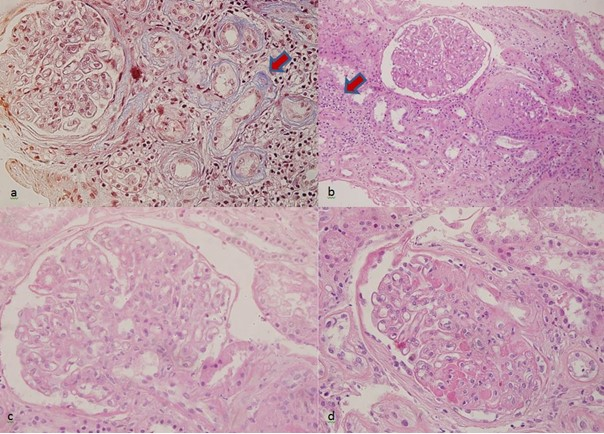
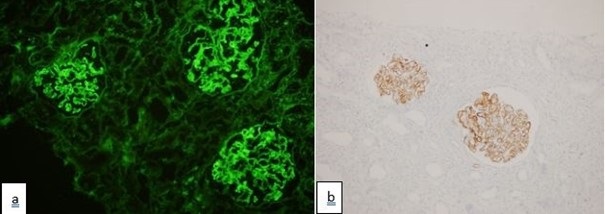
A 54-year-old male patient with a body surface area of 2.0 m2, who had previously been prescribed perindopril (10 mg) + amlodipine (5 mg) at another center, was admitted to our department with uncontrolled hypertension (150/70 mmHg). Nephrotic syndrome associated with a decreased glomerular filtration rate (GFR) was identified through laboratory findings Figure 1. Urinalysis revealed no specific features with respect to hematuria or leukocyturia. A renal biopsy, which comprised seven glomeruli, was inadequate for complete analysis by light microscopy (LM) only. Eight to ten glomeruli are usually required in order to adequately assess the severity and distribution of lesions in a kidney biopsy by LM, and at least one glomerulus (preferably two to three) is required for immunofluorescence microscopy [4,5]. Two out of the seven glomeruli were globally sclerotic. Additional findings included glomerular lobulation, mesangial hypercellularity, mesangial matrix expansion, and interstitial fibrosis (50%) Figure 2. Immunofluorescence microscopy, which was adequate and represented by four glomeruli, revealed diffuse peripheral expression of complement 4d (C4d), with no deposition of C3 or C1q, and immunoglobulin G (IgG) and M deposits at +2 severity Figure 3. These findings support the diagnosis of IC-MPGN [6].
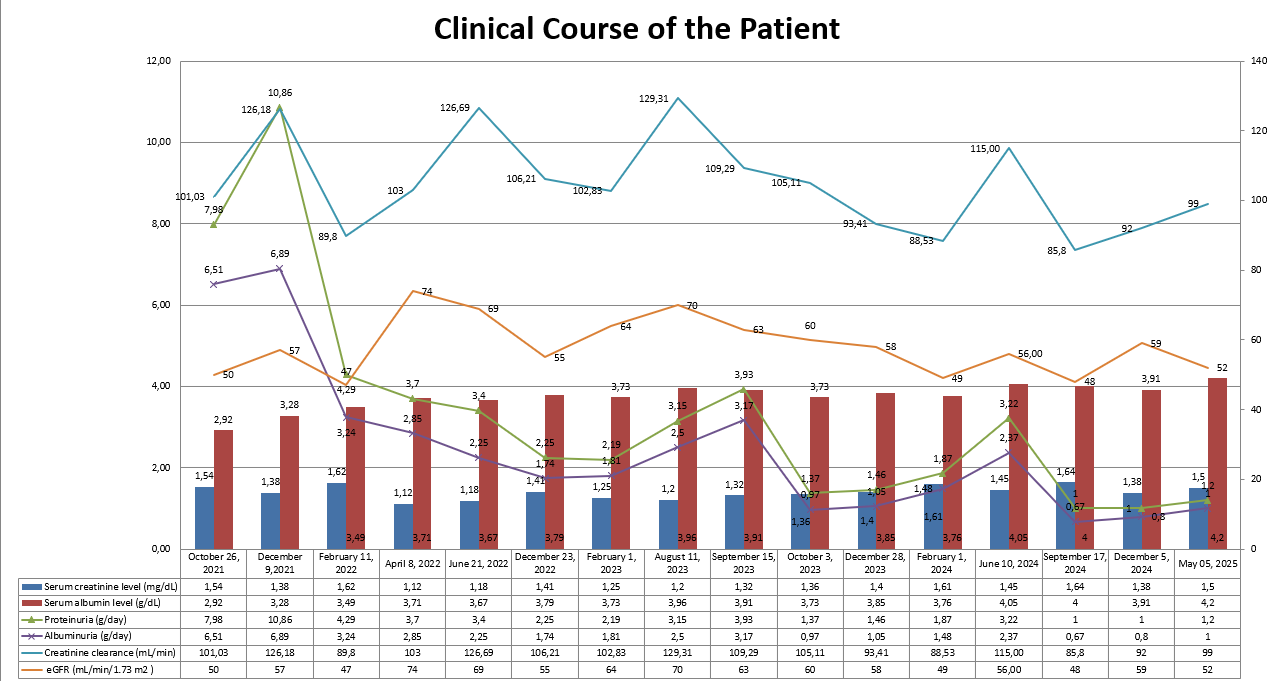
Further investigations for secondary causes were negative. Viral infections (hepatitis B, C, and Human Immunodeficiency Virus), autoantibodies (such as antinuclear, anti-dsDNA, anti-Ro-52, anti-Ro/SSA, anti-centromere, anti-La/SSB, anti-Scl 70, anti-Smith, anti-glomerular basement membrane, anti-cardiolipin, and anti-neutrophil cytoplasmic antibodies), hypocomplementemia (complement 3: 1.13g/L, complement 4: 0.31g/L, CH50 activity: 127%), and monoclonal gammopathies by serum immunofixation electrophoresis were not detected. Screening tests for malignancy also yielded no positive results. Given these findings, the patient was diagnosed with idiopathic IC-MPGN. The patient exhibited decreased eGFR (estimated GFR using Chronic Kidney Disease Epidemiology Collaboration, CKD-EPI equation) of 50 mL/min/1.73 m2 (24-h urine creatinine clearance was 101 mL/min, the muscle mass related difference between the creatinine clearance and eGFR was noticed) and nephrotic syndrome without hematuria and rapidly progressive crescentic disease Figure 1.
| Date | Serum creatinine level (mg/dL) | Proteinuria (g/d) | Albuminuria (g/d) | Received therapy | Prescribed therapy |
|---|---|---|---|---|---|
| October 23, 2021 | 1,56 | 13,02 | 9,41 | Perindopril, amlodipin | prednisone 1 mg/kg/d, calcium +vitamin D, proton pump inhibitor, amlodipine, and valsartan |
| April 8, 2022 | 1,12 | 3,7 | 2,85 | prednisone 5mg/d, calcium +vitamin D, proton pump inhibitor, amlodipine, and valsartan | MMF 2 g/day, calcium + vitamin D, proton pump inhibitor, amlodipine+valsartan, and nebivolol. |
| May 05, 2025 | 1,5 | 1,2 | 1 | MMF 2 g/day, calcium + vitamin D, proton pump inhibitor, amlodipine+valsartan, and nebivolol. | MMF 2 g/day, calcium + vitamin D, proton pump inhibitor, amlodipine+valsartan, and nebivolol+ dapagliflozin 10 mg |
| July 23, 2025 | 1,64 | 0,8 | 0,5 | MMF 2 g/day, calcium + vitamin D, proton pump inhibitor, amlodipine+valsartan, and nebivolol+ dapagliflozin 10 mg | MMF 2 g/day, calcium + vitamin D, proton pump inhibitor, amlodipine+valsartan, and nebivolol+ dapagliflozin 10 mg |
MMF, Mycophenolate mofetil; PPI, Proton pump inhibitor
The treatment regimen included pneumococcal and influenza vaccinations, prednisone 1 mg/kg/d, calcium +vitamin D, proton pump inhibitor, amlodipine, and valsartan. After three months, prednisone was gradually tapered to 20 mg/day. Proteinuria decreased from 7.98 g/d to 3.7 g/d, and serum albumin levels increased from 2.9 g/dL to 3.7 g/dL in six months of therapy. Given the unsatisfactory response, mycophenolate mofetil (MMF) 500 mg twice daily was added to the treatment regimen. The dose of MMF was prescribed at 2 g/day in the following visit. Throughout follow-up, fluctuations in proteinuria and blood pressure levels were noted. Consequently, the patient continued with a regimen of prednisolone 5 mg/day, MMF 2 g/day, calcium + vitamin D, proton pump inhibitor, amlodipine+valsartan, and nebivolol. After three years, kidney function was better, proteinuria decreased to 1 g/day and eGFR increased to 59 mL/min/1.73 m2. In addition, sodium-glucose co-transporter 2 inhibitors have recently been added to the treatment list as recommended to all patients [6]. The benefit of this addition was a greater reduction in albuminuria (500 mg/d), which was observed three months later.
Discussion
Complement-mediated MPGN is diagnosed when IFM detects dominant C3 or C4 depositions. IC-MPGN is diagnosed when IFM shows subendothelial and mesangial depositions of Ig ± C3. MPGN without Ig or complement deposition is diagnosed when IFM reveals no staining for Ig, C3, or C4 in patients with characteristic MPGN histology [3,6,7]. After a definitive diagnosis of IC-MPGN, it is essential to perform a thorough evaluation to rule out secondary causes. In this case, no secondary causes, including malignancy and hepatitis B infection, which are more common in IC-MPGN cases, were identified, leading to the diagnosis of idiopathic IC-MPGN [8]. The kidney biopsy of our patient was adequate with respect to the number of glomeruli by immunofluorescence microscopy, but had inadequate glomeruli to evaluate by LM.
The initial clinical manifestations of patients with IC-MPGN can vary widely among patients and across different geographical regions [9,10]. Our patient presented with decreased eGFR and nephrotic syndrome without hematuria, which is consistent with other studies. Nakagawa et al. reported that 20.9% of the 67 IC-MPGN patients in Japan presented without hematuria in their study [10]. On the other hand, most of those patients (56.7%) presented with nephrotic syndrome. Unfortunately, 38.8% of patients, like our case, had the first presentation of IC-MPGN as chronic glomerulonephritis (GN). The study by Nakagawa et al. outlined several treatment regimens for IC-MPGN, including intravenous methylprednisolone (43.3%), cyclosporine (25.4%), cyclophosphamide (10.4%), mizoribine (6%), azathioprine (3%), and mycophenolate mofetil (4.5%). Despite these interventions, the long-term outcomes included: complete remission in 25.4% of patients, end-stage kidney disease in 26.9%, and all-cause death in 17.9 % after a median follow-up of 4.6 years [10]. On the other hand, Elahi T et al. found that most of the IC-MPGN patients (65%) from Pakistan presented with acute kidney injury [9]. In their cohort of 163 patients, 4.9% of IC-MPGN patients did not present with hematuria. The patients were treated with steroids alone or cyclophosphamide, resulting in 34.3% achieving complete remission, 41.71% partial remission, and 19.63% progressing to end-stage kidney disease after a follow-up period of 29.45 ± 21.28 months [9].
The treatment options of idiopathic IC-MPGN are not based on randomized controlled intervention trials [11]. Nevertheless, the choice and duration of immunosuppressive drugs depend on the clinical parameters of patients with IC-MPGN. For patients with normal kidney function and nephrotic-range proteinuria, a regimen of prednisone and calcineurin inhibitors (CNI) is typically recommended. In contrast, patients with abnormal kidney function (arbitrarily defined as an estimated GFR [eGFR] <60 mL/min/1.73 m2) without rapidly progressive crescentic disease with varying degrees of proteinuria and hematuria are generally treated with prednisone and MMF [6]. Our patient was in the latter group. Prednisone for 3-6 months and MMF for 6-12 months are typical immunosuppressive treatments for these patients, as in our case [6]. However, even complete remission was achieved after cessation of MMF, and half of these patients were reported to have relapses [11]. So, we had to continue with MMF due to the persistence of proteinuria. However, the long-term benefits of these treatments are not certain [12,13]. So, this was a limitation for this extended usage of MMF treatment.
For assessment of proteinuria, 24-hour urine protein excretion is considered a gold standard diagnostic tool despite its handicaps [14]. Serum creatinine, 24-hour urine protein excretion, and a urinalysis at least every two to three months are required to assess the response to treatment for all GN [6]. Aiming for a mycophenolic acid trough level of 1 to 3 ng/mL is suggested for cases like ours. However, it is not easily accessible to explore mycophenolic acid trough levels everywhere. It is also wise to prevent and monitor infectious complications of the kidney diseases and the immunosuppressive drugs [15].
Hypertension is also closely related to kidney health, both directly by podocyte injury and indirectly by leading to cardiovascular disease [16]. Drugs such as angiotensin-converting enzyme inhibitors (ACEIs) and angiotensin receptor blockers (ARBs), which target the renin-angiotensin-aldosterone system (RAAS), slow the progression of chronic kidney disease (CKD) by reducing intraglomerular pressure, proteinuria, and inflammation [17]. Many guidelines recommend these RAAS blockers as the first-line treatments in hypertensive patients with CKD and proteinuria [6,18].
Conclusions
Interstitial fibrosis and tubular atrophy have been reported to be key predictors of long-term kidney survival. Our patient had severe glomerulosclerosis and interstitial fibrosis at the initial presentation. However, the chosen treatment regimen has been effective in preserving kidney function. At the third-year follow-up, his kidney function improved compared to the eGFR and proteinuria levels at the time of initial diagnosis, despite severe renal fibrosis. Finally, the early detection of GN is critical in determining patient and kidney survival. Therefore, routine urinalysis to assess proteinuria and hematuria should be a standard procedure for all patients to ensure early diagnosis and intervention.
Conflicts of Interest
All of the authors declare no conflict of interest.
Funding Source
This research did not receive any specific grant from funding agencies in the public, commercial, or not-for-profit sectors
Acknowledgments
Proofreading of this manuscript was performed by the Faculty of Foreign Languages, Karadeniz Technical University.
Institutional Review Board (IRB)
Written informed consent regarding this article was obtained from the patient.
Large Language Model
No support from artificial intelligence was taken.
Authors Contribution
KK contributed to conception, design, analysis, and interpretation of data, drafting the article, and revising it. YD contributed to literature research and interpretation of data. MK contributed to literature research and interpretation of data. SM contributed to interpretation of pathological findings.
Data Availability
All data supporting the findings of this single-patient case report are contained within the article.
References
- AlYousef A., AlSahow A., AlHelal B., Alqallaf A., Abdallah E., Abdellatif M., Nawar H., Elmahalawy R.. Glomerulonephritis Histopathological Pattern Change. BMC Nephrol. 2020;21(1):186. doi:10.1186/s12882-020-01836-3 PMID: 32423387 PMCID: PMC7236312
- Maifata S., Hod R., Ghani F. A., Zakaria F.. Prevalence and Pattern of Glomerulonephritis: An Experience of Two Tertiary Centers in Malaysia. Saudi J Kidney Dis Transpl. 2023;34(2):167-177. doi:10.4103/1319-2442.391896 PMID: 38146727
- Bernardes T. P., Mastroianni-Kirsztajn G.. Membranoproliferative glomerulonephritis: current histopathological classification, clinical profile, and kidney outcomes. J Bras Nefrol. 2023;45(1):45-50. doi:10.1590/2175-8239-JBN-2022-0016en PMID: 35789244 PMCID: PMC10139719
- Najafian B., Lusco M. A., Alpers C. E., Fogo A. B.. Approach to Kidney Biopsy: Core Curriculum 2022. Am J Kidney Dis. 2022;80(1):119-131. doi:10.1053/j.ajkd.2021.08.024 PMID: 35125261
- Nugent J. P., Bissonnette M. L. Z., Gibney B., Farah M., Harris A. C.. Nontargeted Native Renal Biopsy Adequacy: Preintervention Data From a Province-Wide, Multicentre, and Interdepartmental Audit. Can J Kidney Health Dis. 2023;10:20543581231205161. doi:10.1177/20543581231205161 PMID: 37841342 PMCID: PMC10576420
- Fervenza F. C., Sethi S.. Membranoproliferative glomerulonephritis: Treatment and prognosis. 2025.
- Kidney Disease: Improving Global Outcomes Glomerular Diseases Work Group. KDIGO 2021 Clinical Practice Guideline for the Management of Glomerular Diseases. Kidney Int. 2021;100(4S):S1-S276. doi:10.1016/j.kint.2021.05.021 PMID: 34556256
- Kim S., Choi Y. E., Kim S. G., Ryu D. R., Park S. H., Koo T. Y., Kim M. G., Jo S. K., Oh S. W.. Clinical features and outcomes of immune complex-membranoproliferative glomerulonephritis and C3 glomerulopathy: a multicenter observational cohort study analyzing kidney biopsy cases. Kidney Res Clin Pract. 2024. doi:10.23876/j.krcp.24.129 PMID: 39980095
- Elahi T., Ahmed S., Ahmed E., Mubarak M.. Clinicopathological characteristics and outcomes of adult patients with idiopathic membranoproliferative glomerulonephritis according to an immunofluorescence-based classification. J Nephrol. 2024;37(8):2255-2265. doi:10.1007/s40620-024-02083-7 PMID: 39400860
- Nakagawa N., Mizuno M., Kato S., Maruyama S., Sato H., Nakaya I., Sugiyama H., Fujimoto S., Miura K., Matsumura C., Gotoh Y., Suzuki H., Kuroki A., Yoshino A., Nakatani S., Hiromura K., Yamamoto R., Yokoyama H., Narita I., Isaka Y.. Demographic, clinical characteristics and treatment outcomes of immune-complex membranoproliferative glomerulonephritis and C3 glomerulonephritis in Japan: A retrospective analysis of data from the Japan Renal Biopsy Registry. PLoS One. 2021;16(9):e0257397. doi:10.1371/journal.pone.0257397 PMID: 34520493 PMCID: PMC8439563
- Noris M., Daina E., Remuzzi G.. Membranoproliferative glomerulonephritis: no longer the same disease and may need very different treatment. Nephrol Dial Transplant. 2023;38(2):283-290. doi:10.1093/ndt/gfab281 PMID: 34596686
- Bomback A. S., Charu V., Fakhouri F.. Challenges in the Diagnosis and Management of Immune Complex-Mediated Membranoproliferative Glomerulonephritis and Complement 3 Glomerulopathy. Kidney Int Rep. 2025;10(1):17-28. doi:10.1016/j.ekir.2024.09.017 PMID: 39810761 PMCID: PMC11725974
- Noris M., Remuzzi G.. C3G and Ig-MPGN-treatment standard. Nephrol Dial Transplant. 2024;39(2):202-214. doi:10.1093/ndt/gfad182 PMID: 37604793 PMCID: PMC10828209
- Hogan M. C., Reich H. N., Nelson P. J., Adler S. G., Cattran D. C., Appel G. B., Gipson D. S., Kretzler M., Troost J. P., Lieske J. C.. The relatively poor correlation between random and 24-hour urine protein excretion in patients with biopsy-proven glomerular diseases. Kidney Int. 2016;90(5):1080-1089. doi:10.1016/j.kint.2016.06.020 PMID: 27528553 PMCID: PMC5065749
- Charlesworth J. A., Gracey D. M., Pussell B. A.. Adult nephrotic syndrome: non-specific strategies for treatment. Nephrology (Carlton). 2008;13(1):45-50. doi:10.1111/j.1440-1797.2007.00890.x PMID: 18199102
- Semenikhina M., Mathew R. O., Barakat M., Van Beusecum J. P., Ilatovskaya D. V., Palygin O.. Blood Pressure Management Strategies and Podocyte Health. Am J Hypertens. 2025;38(2):85-96. doi:10.1093/ajh/hpae120 PMID: 39269328
- Mhmndar M. A., Singh T., Fatima I., Shehryar A., Zaidi M. R., Mairaj M., Khan S. M., Kolanu N. D., Ahmed S., Kamal A., Rehman A., Quinn M.. Comparative Efficacy and Safety of Angiotensin-Converting Enzyme Inhibitors, Angiotensin Receptor Blockers, and Calcium Channel Blockers in Hypertensive Patients With Chronic Kidney Disease: A Systematic Review. Cureus. 2025;17(2):e78845. doi:10.7759/cureus.78845 PMID: 40084336 PMCID: PMC11905639
- Tada K., Nakano Y., Takahashi K., Hiyamuta H., Watanabe M., Ito K., Yasuno T., Abe M., Satoh A., Kawazoe M., Maeda T., Yoshimura C., Kosuke M., Arima H.. Current use of angiotensin II receptor blockers and angiotensin-converting enzyme inhibitors for hypertension in patients with chronic kidney disease with proteinuria: a cross-sectional study based on real-world data. Hypertens Res. 2025;48(1):244-255. doi:10.1038/s41440-024-01896-0 PMID: 39300299