Bridging the Gap: Addressing Language Barriers to Advance Equity in Internal Medicine
Jayashree RavikumarⒾ1*, Divya Ravikumar2
- 1Kilpauk Medical College, Chennai, Tamil Nadu, India
- 2SRM Institution, Vadapalani, Chennai, Tamil Nadu, India
Abstract
Language barriers in healthcare are a persistent challenge that disproportionately affect patients with limited English proficiency (LEP), contributing to disparities in care, poor health outcomes, and patient dissatisfaction. In internal medicine, where effective communication is essential for diagnosis, management, and chronic disease follow-up, these barriers hinder quality and equity. This review synthesizes the current evidence on the impact of language discordance in internal medicine, explores effective mitigation strategies including interpreter services, culturally competent care, and technological tools and offers policy and practice recommendations to promote equitable healthcare delivery.
Keywords: Language barriers, Health disparities, Limited English proficiency, Interpreter services, Cultural competence
Article information
Introduction
Effective communication is foundational to quality healthcare delivery. Within internal medicine, where diagnoses and treatments can be complex, clear communication is vital for patient safety and treatment success. However, patients with limited English proficiency (LEP) often face significant language barriers. These barriers hinder accurate diagnosis, reduce treatment adherence, and lead to lower patient satisfaction [1,2].
Despite growing attention to healthcare disparities, language barriers remain a persistent and under-addressed challenge in internal medicine. While previous studies have documented communication issues in healthcare broadly, there is a lack of focused synthesis on how these barriers affect internal medicine specifically—a field heavily reliant on verbal exchanges for managing chronic, multifaceted conditions [3].
The aim of this review is to examine the impact of language barriers on clinical outcomes for LEP patients in internal medicine settings. Specifically, this review identifies where communication failures occur, explores their consequences on diagnosis, medication use, and chronic disease management, and evaluates existing strategies to mitigate these barriers. Additionally, we propose policy and educational reforms to support language equity in clinical care.
This review fills a critical gap by consolidating evidence from the past decade to inform both practice and policy. Through a structured synthesis of recent literature, it contributes to the ongoing discourse on health equity by highlighting actionable insights and outlining future research priorities.
According to the U.S. Census Bureau, over 25 million people in the United States speak English less than “very well,” and this number is growing [4]. LEP patients are more likely to experience poor health outcomes, have unmet medical needs, and miss preventive care. As LEP populations expand across all types of communities, internal medicine practitioners must address the impact of language barriers.
Methodology
A comprehensive literature review was conducted to identify relevant studies on language barriers affecting LEP patients within internal medicine. The search was carried out using PubMed, CINAHL, and the Cochrane Library databases, covering publications from January 2010 to April 2024. Search terms included: “limited English proficiency,” “language barriers,” “internal medicine,” “interpretation services,” and “healthcare disparities.”
Studies were included if they: (1) focused on LEP patients in internal medicine or general adult healthcare settings, (2) evaluated clinical outcomes, communication quality, or healthcare utilization, and (3) were published in English. Exclusion criteria included studies that focused exclusively on pediatric populations, editorial or opinion pieces, or those without outcome data. Study selection followed a two-phase screening process. First, titles and abstracts were reviewed to exclude clearly irrelevant studies. Second, full texts were assessed for eligibility based on inclusion/exclusion criteria. When available, studies were appraised for quality using the CASP (Critical Appraisal Skills Programme) checklist for cohort and qualitative studies to ensure relevance and methodological rigor.
Scope of the Problem in Internal Medicine
Language barriers in internal medicine contribute to a wide range of health disparities that are particularly pronounced in populations with limited English proficiency. These barriers affect every phase of the care continuum—from scheduling appointments and providing informed consent to understanding treatment plans and navigating follow-up services. For providers in internal medicine, whose work often involves managing chronic diseases and coordinating multidisciplinary care, effective communication is not optional; it is essential.
Internal medicine also serves as a gateway to specialist referrals and advanced diagnostics. When communication breaks down, it jeopardizes this gatekeeping role, resulting in either overuse or underuse of medical resources. Furthermore, limited language access can erode trust in the healthcare system, causing patients to delay care or avoid it entirely. Such delays often lead to more severe illness at the time of presentation, which increases the burden on healthcare systems and compromises long-term outcomes. Figure 1 illustrates a conceptual framework outlining how language barriers experienced by LEP populations lead to downstream clinical consequences and highlights key intervention points.
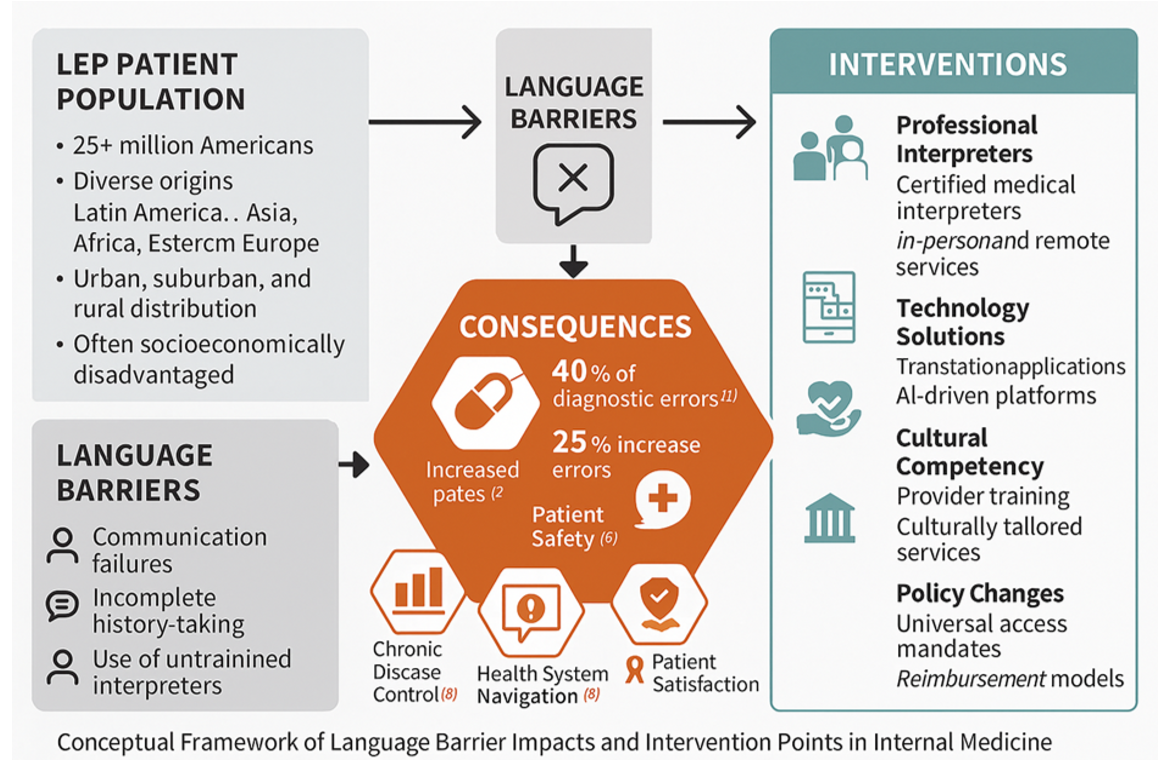
Demographics and Distribution
LEP patients include immigrants and refugees from Latin America, Asia, Africa, and Eastern Europe [5,6]. These populations bring diverse cultural backgrounds, health beliefs, and linguistic needs that significantly influence their interactions with the healthcare system. LEP individuals often speak a wide array of languages and dialects, making it essential for healthcare systems to provide adaptable and inclusive language services.
While many LEP individuals reside in urban centers with established immigrant communities, an increasing number are settling in suburban and rural areas due to shifting economic opportunities and housing patterns. This geographical spread presents unique challenges for language access in less-resourced regions, where interpreter services and culturally competent care may be less readily available. In addition to language barriers, LEP populations frequently face intersecting social determinants of health such as lower income, limited educational attainment, and restricted access to transportation and health insurance [7]. These factors compound their vulnerability to poor health outcomes and reduce their ability to navigate complex healthcare systems without targeted support. Addressing these multifaceted barriers requires a coordinated approach that integrates language services with broader equity and inclusion initiatives.
Clinical Burden
Research shows that LEP patients have worse outcomes for many conditions, including chronic illnesses such as hypertension, diabetes, asthma, and heart disease. They receive fewer preventive services like cancer screenings and immunizations and often face delayed diagnoses due to inadequate symptom communication [2,8]. When they are hospitalized, LEP patients are more likely to experience longer stays, higher readmission rates, and increased risk of adverse events [9]. A lack of effective communication leads to misunderstandings about diagnoses, medications, and follow-up instructions. In turn, this undermines treatment adherence and long-term disease control. For instance, LEP patients are more likely to misunderstand discharge instructions, contributing to post-hospital complications. Miscommunication can also lead to unnecessary diagnostic testing, further straining healthcare resources [1].
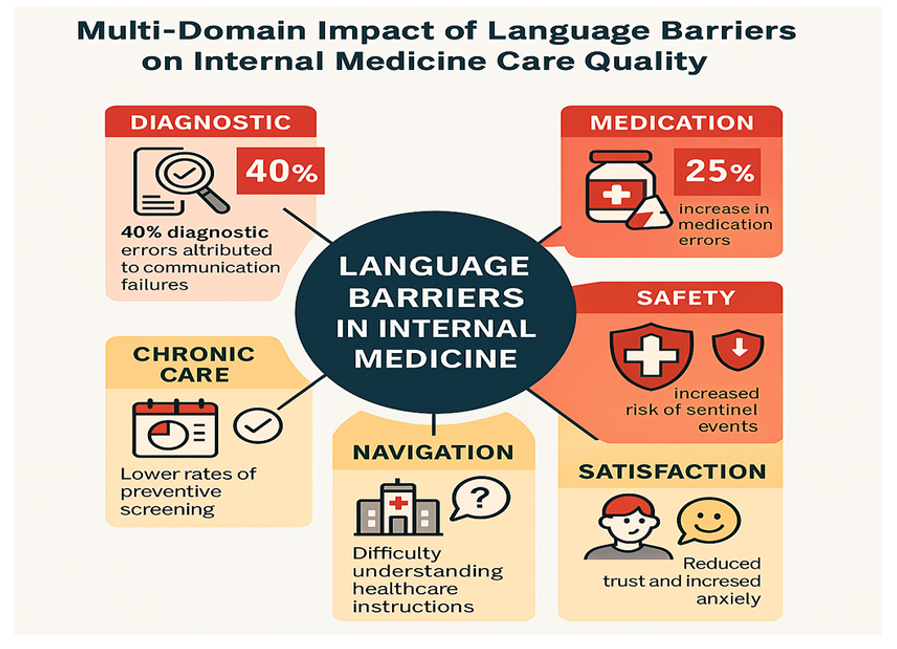
In internal medicine—where providers must rely heavily on nuanced patient histories and shared decision-making—these communication failures are particularly detrimental. Without language support, providers may inadvertently make assumptions or simplify care to avoid miscommunication, which compromises both patient safety and ethical standards [3]. Ultimately, addressing this clinical burden requires targeted, sustained interventions across both individual and system levels. Figure 2 illustrates six critical domains where language barriers compromise care quality in internal medicine, along with associated statistics and severity indicators.
| Domain | Impact on LEP Patients | Supporting Evidence |
|---|---|---|
| Diagnostic Accuracy | Delayed or incorrect diagnosis due to miscommunication | Al Shamsi et al. (2020) [1] |
| Medication Management | Incorrect usage, dosing errors, and non-adherence | Ali & Watson (2018) [10] |
| Patient Safety | Increased risk of adverse events | Divi et al. (2007) [9] |
| Chronic Disease Control | Lower screening rates and poor disease management | Sentell & Braun (2012) [8] |
| Health System Navigation | Difficulty accessing services or understanding instructions | Pandey et al. (2021) [11] |
| Patient Satisfaction | Reduced trust, increased anxiety, dissatisfaction | Flores (2006) [2]; Karliner et al. (2007) [12] |
Domain Impact on LEP Patients Supporting Evidence Diagnostic Accuracy Delayed or incorrect diagnosis due to miscommunication Al Shamsi et al. (2020) [1]
Medication Management Incorrect usage, dosing errors, and non-adherence Ali & Watson (2018) [10]
Patient Safety Increased risk of adverse events Divi et al. (2007) [9]
Chronic Disease Control Lower screening rates and poor disease management Sentell & Braun (2012) [8]
Health System Navigation Difficulty accessing services or understanding instructions Pandey et al. (2021) [11]
Patient Satisfaction Reduced trust, increased anxiety, dissatisfaction Flores (2006) [2]; Karliner et al. (2007) [12]
Communication Failures and Their Consequences
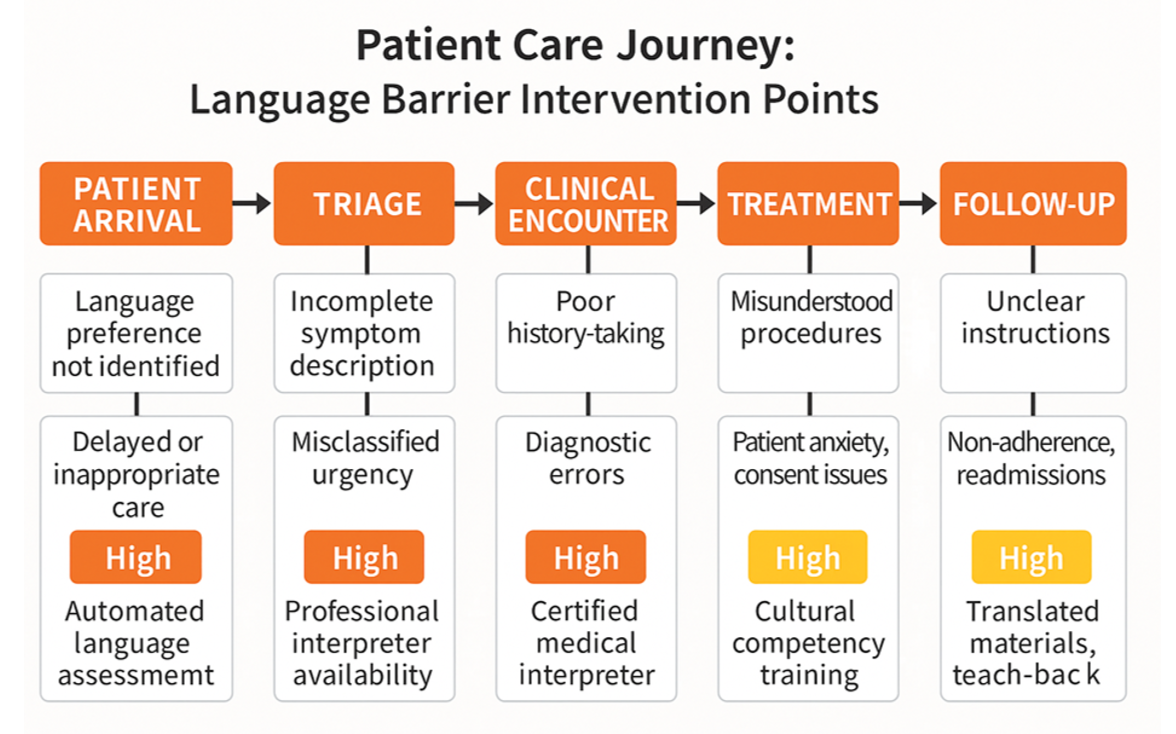
Communication is a core component of effective and equitable healthcare. For LEP patients, language discordance significantly increases the risk of clinical errors, misunderstandings, and poor outcomes. In internal medicine, where diagnostic reasoning, medication management, and continuity of care are essential, these communication failures can lead to dangerous consequences. Figure 3 outlines key stages of the patient care journey and highlights where language barriers commonly disrupt clinical communication, along with targeted intervention strategies.
Diagnostic Errors
Internal medicine depends on patients accurately describing symptoms, timelines, and treatment histories—details that shape diagnostic reasoning. When there is a language barrier, critical elements may be omitted or misinterpreted. LEP patients may struggle to articulate their symptoms clearly, especially if they are unfamiliar with medical terminology or cultural norms around expressing pain or distress. This miscommunication can result in missed or delayed diagnoses, inappropriate testing, and ineffective treatment plans [1].
A study by Al Shamsi et al. reported that nearly 40% of diagnostic errors among LEP patients were directly attributed to communication failures [1]. These errors are not only clinically significant but also ethically concerning, as they disproportionately affect already vulnerable populations. Moreover, providers may experience cognitive overload or frustration during encounters with LEP patients, which can lead to premature diagnostic closure or stereotyping.
Medication Mismanagement
Medication errors are a frequent and preventable source of harm for LEP patients. Understanding medication names, dosages, timing, side effects, and potential interactions requires clear and consistent communication. LEP patients often receive instructions in English only or through ad hoc interpreters, increasing the risk of misunderstanding [10].
Ali and Watson found a 25% increase in medication-related errors among patients facing language barriers [10]. Errors range from incorrect dosing and missed medications to serious adverse drug events. Furthermore, patients may avoid asking clarifying questions out of fear or embarrassment, particularly when family members interpret.
Pharmacy labeling, discharge instructions, and medication reconciliation are particularly vulnerable points in care transitions. Ensuring multilingual written instructions, pictogram-based aids, and pharmacist consultations with interpreters are essential steps in minimizing risk.
Use of Ad Hoc Interpreters
“Ad hoc” interpreters refer to individuals who are not professionally trained to provide medical interpretation but are asked to assist during clinical encounters. These may include family members, friends, bilingual staff without formal training, or even children. While often used out of necessity, relying on ad hoc interpreters introduces significant risks to communication accuracy, confidentiality, and patient safety.
Flores et al. found that 63% of errors committed by ad hoc interpreters had potential clinical consequences [13]. Common errors included omissions, additions, and misinterpretations that distorted the patient’s message or the clinician’s instructions. Using children in these roles can cause emotional distress and lead to withholding sensitive information. Additionally, ad hoc interpreting can interfere with patient autonomy and privacy. Patients may avoid disclosing symptoms or questions when a family member is present, especially in culturally sensitive contexts. Ethical guidelines from the National Council on Interpreting in Health Care discourage using untrained interpreters [14], advocating instead for the systematic provision of certified language professionals.
Chronic Disease Management Challenges
Understanding how patients themselves experience language barriers is critical to delivering person-centered care. Qualitative research consistently reveals that LEP patients often feel marginalized during clinical encounters. In interviews, patients have described feeling “invisible” or “ignored” when communication is handled through rushed or impersonal means. For instance, a participant in a study shared, “I just nodded because I didn’t want to bother them again. I didn’t understand but didn’t know how to ask” [11].
Other studies highlight how the mode of interpretation influences patient comfort and trust. While some appreciate the convenience of video or phone interpretation, many prefer in-person interpreters who can also help convey non-verbal cues and cultural context. One respondent in a focus group noted, “The interpreter in the room helps the doctor see me, not just hear my words, but understand me as a person” [11].
Patient-reported outcome measures (PROMs) further reinforce that language barriers reduce satisfaction, trust, and follow-up adherence. In a multicenter survey, LEP patients with consistent access to professional interpreters reported significantly higher satisfaction and confidence in their care compared to those using ad hoc or no interpretation [12]. These findings stress the need to integrate patient voices in designing, implementing, and evaluating language services.
Involving LEP patients in feedback processes and advisory roles can help ensure that services truly respond to their needs and preferences, improving equity and effectiveness. Internal medicine often involves managing long-term illnesses like diabetes or hypertension. LEP patients often have poorer control over these conditions because they struggle to understand complex care plans. For example, LEP patients with diabetes are less likely to get recommended tests like HbA1c checks, even if they have insurance [8].
Ongoing disease management requires trust and collaboration, which can break down when language is a barrier. Educational programs tailored to cultural needs have improved outcomes in LEP populations [4].
Challenges
Implementing language access solutions in actual healthcare settings is frequently complicated by several persistent barriers. The primary challenges include:
Staff shortages and interpreter availability
Many healthcare facilities, especially in rural or underfunded areas, struggle to maintain an adequate pool of trained medical interpreters. Limited interpreter coverage during evenings or weekends can delay care or compromise communication. For example, a community hospital in rural New Mexico partnered with a regional language service cooperative to share interpreter resources and implemented video remote interpreting (VRI) systems to expand access during off-hours.
Technology infrastructure limitations
Although translation apps and video interpreting services offer promising support, their use depends on reliable internet access, up-to-date devices, and user training—all of which may be lacking in resource-constrained settings. For example, a federally qualified health center in Chicago piloted a low-cost tablet-based VRI platform with preloaded training modules for providers. The initiative improved interpreter utilization by 60% within six months.
Institutional resistance and organizational culture
Some institutions may deprioritize language access due to competing administrative demands or a lack of awareness about its importance. Without leadership buy-in, even well-designed policies often fail in execution. For example, a large academic medical center in California integrated language access metrics into its quality improvement dashboard, which led to the inclusion of interpreter services in performance evaluations for department heads.
Training time, costs, and sustainability
Cultural competence and communication training for providers require time and financial resources. Ensuring long-term engagement and integration into clinical routines can be difficult without dedicated funding and institutional mandates. For example, a medical school in the Northeast embedded interpreter use and cultural humility into its core curriculum using standardized patient simulations. This sustained approach led to increased student confidence and improved patient satisfaction scores in residency.
Mitigation Strategies
Several strategies have been proposed to reduce language barriers in internal medicine.
Professional Medical Interpreters
Certified interpreters help ensure accurate, confidential communication. These professionals are trained to navigate complex medical terminology and ethical principles, including impartiality and confidentiality. Their presence facilitates trust between patients and providers and allows clinicians to gather more complete and reliable histories. Studies consistently show that professional interpreter use improves clinical outcomes, increases patient satisfaction, and reduces adverse events [12]. In addition to bedside interpretation, interpreters play a vital role during informed consent discussions, end-of-life conversations, and discharge planning—moments where precision and clarity are crucial. However, access to certified interpreters remains uneven across healthcare settings, especially in rural or resource-limited facilities. Institutions should proactively offer interpreter services, ensure round-the-clock availability via in-person, video, or phone options, and integrate interpretation into workflow protocols to avoid delays in care [3].
Technological Tools
Apps like Canopy, Google Translate, and MediBabble offer quick language help in clinical settings. These tools are particularly valuable during urgent care scenarios or when professional interpreters are unavailable. They can also assist with basic communication tasks, such as collecting patient histories, explaining procedures, or providing medication instructions [1]. However, these platforms should be seen as supplements—not substitutes—for professional interpretation. Machine translation tools can misinterpret medical terms, especially when dealing with idiomatic expressions, complex grammar, or less commonly spoken languages. There are also concerns about patient privacy, as many apps are not HIPAA-compliant and may store sensitive data on unsecured servers [14]. To maximize benefits while minimizing risks, institutions should vet and approve specific tools for clinical use, train staff in appropriate use cases, and implement backup systems to escalate to human interpretation when needed. Integrating translation features into electronic health records (EHRs) may further streamline multilingual care delivery in the future.
Culturally Competent Care Models
Language access involves more than translation. Effective care requires understanding patients’ cultural beliefs, values, and communication preferences. Culturally competent care models promote equity by acknowledging and addressing the sociocultural factors influencing health behaviors and medical decision-making [5]. The National Standards for Culturally and Linguistically Appropriate Services (CLAS) offer a comprehensive framework for healthcare organizations to improve communication and respect patient diversity. Implementing these standards can help reduce mistrust, improve adherence, and foster a more welcoming environment for LEP patients. Healthcare systems that hire bilingual staff, offer cultural competence training, and partner with community-based organizations have reported improved outcomes in patient engagement, preventive care utilization, and satisfaction [7]. These models emphasize the importance of continuity of care and building relationships within linguistically diverse communities, rather than applying one-size-fits-all solutions.
Provider Education
Training providers in cultural awareness and communication strategies improves care for LEP patients by equipping clinicians with the skills needed to recognize and navigate linguistic and cultural barriers. Education in this domain fosters empathy, reduces implicit bias, and enhances clinicians’ ability to engage in meaningful dialogue with diverse patient populations [4]. Many medical schools and residency programs now incorporate curricula on health equity, cross-cultural communication, and language access laws. Simulation-based learning using standardized patients is particularly effective for helping trainees practice interpreter use, manage cross-cultural misunderstandings, and reflect on their communication approaches [14]. Continuing medical education (CME) opportunities also enable practicing providers to stay current with best practices. Institutional support, such as allocating time for training and integrating it into performance evaluations, is essential to sustain these efforts and create a culture of linguistic equity throughout healthcare systems.
Health Policy and System Reform
Addressing language barriers effectively requires more than isolated clinical interventions—it demands systemic reform supported by institutional leadership and public policy. Health systems must prioritize language equity as a fundamental component of patient safety, regulatory compliance, and care quality.
Universal Access to Interpreter Services: Every healthcare setting—regardless of size, location, or resources—should provide timely access to professional medical interpreters. This includes establishing protocols for interpreter use in all patient-facing interactions, not just in emergencies or high-risk encounters. Institutions can implement scheduling systems, interpreter staffing pools, or remote interpreting platforms to ensure 24/7 coverage [12,3].
Reimbursement Models: Lack of reimbursement is often cited as a major barrier to offering comprehensive language services. Policymakers should mandate Medicaid and Medicare reimbursement for interpreter use, especially in federally funded facilities and community health centers. Evidence shows that the financial benefits—through reduced errors, readmissions, and malpractice risks—outweigh the cost of providing interpretation [7].
Standardized Language Data Collection: Documenting patients’ preferred language and interpreter needs in electronic health records (EHRs) ensures consistency across providers and departments. Institutions should integrate language fields into clinical workflows, train front-line staff to collect this data accurately, and use it to guide service allocation and performance evaluation [14].
Accreditation and Accountability: Accreditation bodies like the Joint Commission already recognize the role of communication in patient safety. Expanding and enforcing standards that require language access policies—and tying these to quality improvement metrics or financial incentives—can drive widespread institutional adoption [15]. Public Health Integration: Language equity must also extend to public health messaging and outreach, particularly during health crises like pandemics. Governments and health departments should ensure all communication is multilingual, culturally tailored, and co-developed with input from community stakeholders.
Ultimately, policy reform is critical to embedding language access into the healthcare system’s infrastructure, transforming it from a discretionary service into a standard of care.
Research and Future Directions
Although the evidence base supporting language access interventions is growing, several gaps remain that limit our ability to scale, sustain, and tailor these strategies effectively. Implementation Science: Much of the existing research is observational. Future work should apply implementation science methods to assess how language access programs are adopted, adapted, and sustained in real-world clinical settings. These studies can identify barriers, facilitators, and best practices that inform scale-up across diverse institutions [14]. Cost-Benefit Analysis: Despite anecdotal and ethical justification for interpreter services, rigorous economic evaluations are needed. Research should compare the cost of interpreter use to the costs associated with adverse events, unnecessary testing, malpractice claims, and readmissions in LEP populations [7]. Patient-Reported Experiences and Outcomes: More qualitative and mixed-methods studies are needed to center patient voices, especially those from underrepresented language groups. Research should examine how patients perceive interpretation quality, communication dynamics, trust, and autonomy during language-discordant encounters [11]. Chronic Disease Outcomes: Longitudinal cohort studies can clarify how language-concordant care influences chronic disease management, especially for high-burden conditions such as diabetes, hypertension, and heart failure. Understanding long-term outcomes can guide resource allocation and chronic care strategies in internal medicine [3,8]. Training and Education Effectiveness: Evaluating DEI-focused education programs using validated outcome measures can help identify which teaching strategies (e.g., simulation, service learning, cultural immersion) most effectively improve clinician competence and patient satisfaction [4]. By prioritizing these research domains, the field can generate actionable insights that translate into scalable, equity-driven language access solutions.
Limitations
This review has several limitations. First, we did not conduct a systematic search with protocol registration, which may introduce selection bias. While the search strategy was comprehensive and multi-database, the absence of a registered protocol (e.g., PROSPERO) limits reproducibility and transparency. Second, the included studies varied significantly in terms of methodology, populations studied, and outcome measures, making direct comparisons difficult and potentially limiting generalizability. The heterogeneity also complicates efforts to draw definitive conclusions about intervention effectiveness. Third, most of the supporting evidence comes from observational studies rather than randomized controlled trials. While observational data provide valuable insights, they are more susceptible to confounding and may not establish causality. Fourth, although the review focuses on internal medicine, many cited studies encompass broader healthcare settings. This focus may not fully capture language barriers in specialty practices outside of internal medicine, such as oncology, geriatrics, or emergency care, where communication needs and challenges may differ. Finally, publication bias toward studies showing significant or positive results cannot be excluded. Unpublished or null findings may provide critical counterpoints and are underrepresented in the current literature landscape.
Conclusion
Language barriers represent a critical patient safety issue requiring urgent attention. Evidence strongly supports the routine use of professional interpretation services, which are consistently associated with improvements in diagnostic accuracy, medication safety, and patient satisfaction [12]. Despite real-world implementation barriers—including staffing shortages, technology gaps, and institutional resistance—the clinical and economic benefits of investing in language access are clear. System-level reforms, such as Medicaid and Medicare reimbursement policies, data standardization, and enforcement of language equity standards, are essential to move from piecemeal to systemic solutions [14,7,15]. Internal medicine practitioners are uniquely positioned to lead these efforts, given the field’s emphasis on continuity of care, chronic disease management, and patient-provider relationships. By adopting evidence-based language access strategies, incorporating culturally competent care models, and prioritizing training in communication equity, internal medicine can drive transformative change. Future research should focus on implementation science approaches and long-term outcome studies to optimize delivery of language-concordant care. Ensuring that LEP patients are not only heard—but truly understood—must become a fundamental standard of modern, equitable healthcare.
Conflicts of Interest
The authors declare no conflicts of interest related to this manuscript.
Funding Source
No external funding was received to prepare this article.
Acknowledgments
None
Institutional Review Board (IRB)
This review did not involve human subjects and was therefore exempt from Institutional Review Board approval.
Large Language Model
This manuscript was supported in part by the use of a large-language model (ChatGPT, OpenAI) for assistance with organization, formatting, and figure development. All scientific content and analysis were reviewed and validated by the authors.
Authors Contribution
JR conceptualized the idea, wrote the original draft, reviewed, and edited the manuscript; DR conducted the literature review, designed the figures, and contributed to writing, review, and editing; all authors read and approved the final manuscript.
Data Availability
This manuscript is based solely on previously published literature. No new datasets were generated or analysed.
References
- Al Shamsi H., Almutairi A. G., Al Mashrafi S., Al Kalbani T.. Implications of Language Barriers for Healthcare: A Systematic Review. Oman Med J. 2020;35(2):e122. doi:10.5001/omj.2020.40 PMID: 32411417 PMCID: PMC7201401
- Flores G.. Language barriers to health care in the United States. N Engl J Med. 2006;355(3):229-31. doi:10.1056/NEJMp058316 PMID: 16855260
- Ngo-Metzger Q., Sorkin D. H., Phillips R. S., Greenfield S., Massagli M. P., Clarridge B., Kaplan S. H.. Providing high-quality care for limited English proficient patients: the importance of language concordance and interpreter use. J Gen Intern Med. 2007;22 Suppl 2(Suppl 2):324-30. doi:10.1007/s11606-007-0340-z PMID: 17957419 PMCID: PMC2078537
- Jacobs E., Chen A. H., Karliner L. S., Agger-Gupta N., Mutha S.. The need for more research on language barriers in health care: a proposed research agenda. Milbank Q. 2006;84(1):111-33. doi:10.1111/j.1468-0009.2006.00440.x PMID: 16529570 PMCID: PMC2690153
- Adashi E. Y., Geiger H. J., Fine M. D.. Health care reform and primary care--the growing importance of the community health center. N Engl J Med. 2010;362(22):2047-50. doi:10.1056/NEJMp1003729 PMID: 20427777
- Derose K. P., Escarce J. J., Lurie N.. Immigrants and health care: sources of vulnerability. Health Aff (Millwood). 2007;26(5):1258-68. doi:10.1377/hlthaff.26.5.1258 PMID: 17848435
- Jacobs E. A., Shepard D. S., Suaya J. A., Stone E. L.. Overcoming language barriers in health care: costs and benefits of interpreter services. Am J Public Health. 2004;94(5):866-9. doi:10.2105/ajph.94.5.866 PMID: 15117713 PMCID: PMC1448350
- Sentell T., Braun K. L.. Low health literacy, limited English proficiency, and health status in Asians, Latinos, and other racial/ethnic groups in California. J Health Commun. 2012;17 Suppl 3(Suppl 3):82-99. doi:10.1080/10810730.2012.712621 PMID: 23030563 PMCID: PMC3552496
- Divi C., Koss R. G., Schmaltz S. P., Loeb J. M.. Language proficiency and adverse events in US hospitals: a pilot study. Int J Qual Health Care. 2007;19(2):60-7. doi:10.1093/intqhc/mzl069 PMID: 17277013
- Ali P. A., Watson R.. Language barriers and their impact on provision of care to patients with limited English proficiency: Nurses' perspectives. J Clin Nurs. 2018;27(5-6):e1152-e1160. doi:10.1111/jocn.14204 PMID: 29193568
- Pandey M., Maina R. G., Amoyaw J., Li Y., Kamrul R., Michaels C. R., Maroof R.. Impacts of English language proficiency on healthcare access, use, and outcomes among immigrants: a qualitative study. BMC Health Serv Res. 2021;21(1):741. doi:10.1186/s12913-021-06750-4 PMID: 34311712 PMCID: PMC8314461
- Karliner L. S., Jacobs E. A., Chen A. H., Mutha S.. Do professional interpreters improve clinical care for patients with limited English proficiency? A systematic review of the literature. Health Serv Res. 2007;42(2):727-54. doi:10.1111/j.1475-6773.2006.00629.x PMID: 17362215 PMCID: PMC1955368
- Flores G., Laws M. B., Mayo S. J., Zuckerman B., Abreu M., Medina L., Hardt E. J.. Errors in medical interpretation and their potential clinical consequences in pediatric encounters. Pediatrics. 2003;111(1):6-14. doi:10.1542/peds.111.1.6 PMID: 12509547
- Diamond L. C., Jacobs E. A.. Let's not contribute to disparities: the best methods for teaching clinicians how to overcome language barriers to health care. J Gen Intern Med. 2010;25 Suppl 2(Suppl 2):S189-93. doi:10.1007/s11606-009-1201-8 PMID: 20352518 PMCID: PMC2847098
- Sutcliffe K. M., Lewton E., Rosenthal M. M.. Communication failures: an insidious contributor to medical mishaps. Acad Med. 2004;79(2):186-94. doi:10.1097/00001888-200402000-00019 PMID: 14744724