A Single-Center Before-and-After Quality Improvement Audit of AKI Recognition and Bundle-Based Care in Adult Medical Inpatients With KDIGO-Defined AKI in a Resource-Limited Tertiary Hospital in Pakistan
Muhammad Aamir IqbalⒾ1, Muhammad SaqibⒾ1*, Shehr I Yar KhanⒾ2, Suleman KhanⒾ1, Muhammad Sohrab MushtaqⒾ3, Fahad Naim1, Adam SaeedⒾ1
- 1Department of Medicine, MTI-Khyber Teaching Hospital, Peshawar, Pakistan
- 2Kabir Medical College, Peshawar, Pakistan
- 3DHQ Hospital, Charsadda, Pakistan
Abstract
Background: Among hospitalized adults in medical settings, delayed recognition and incomplete bundle-based care may contribute to progression, longer hospitalization, and poorer renal recovery. Adherence to AKI care bundles remains inconsistent, in resource-limited hospitals with staffing, workflow, and documentation constraints.
Methods: We conducted a single-center before-and-after improvement audit over two cycles, preceded by a pilot phase that refined case identification and data collection. The source population comprised consecutive adult medical inpatients meeting KDIGO AKI criteria during admission. In cycle one, 120 patients were assessed. The intervention included a paper-based AKI checklist, staff education, nephrotoxin-prescribing prompts, and escalation triggers. A re-audit of 118 patients was performed, followed by a 3-month sustainability review. Process indicators and outcomes were analyzed using methods and compared across cycles. Patients already under active inpatient nephrology care when AKI was identified were included in the overall cohort but excluded from the nephrology-referral denominator.
Results: Baseline compliance was suboptimal across key care domains. The intervention was associated with improved AKI recognition from 65.0% to 87.3%, medication review from 51.7% to 78.0%, and fluid assessment from 48.3% to 76.3% (all p<0.001). It was also associated with a reduction in progression to severe AKI from 33.3% to 23.7%, and a decrease in mean length of stay from 7.9±3.4 to 6.6±3.0 days. Improvements were sustained at 3 months.
Conclusion: A paper-based AKI bundle was associated with improved recognition and care processes, with changes in outcomes, supporting feasibility in resource-limited settings, although causal inference is limited by design. Further multicenter studies are warranted.
Keywords: Quality improvement, Acute kidney injury, Medicine, Nephrology
Article information
Introduction
Acute kidney injury (AKI) is a common and clinically consequential syndrome encountered across medical and nephrology services. It affects approximately 8% to 22% of hospitalized patients and is defined by an abrupt reduction in renal function of varying severity [1]. AKI is strongly associated with adverse outcomes, including increased mortality, with reported risk rising by approximately 1.4 to 15.4 times [2]. It also predisposes patients to the development of chronic kidney disease or progression of pre-existing renal dysfunction [3]. In addition, AKI is associated with increased morbidity, prolonged hospital stay, higher healthcare costs, and a greater risk of recurrent AKI after discharge [4,5].
In acute medical settings, AKI is often multifactorial, commonly arising from sepsis, hypovolemia, nephrotoxic exposure, obstructive uropathy, or hemodynamic instability. Importantly, outcomes are frequently influenced not only by the initial insult but also by delays in recognition, incomplete evaluation, and inconsistent application of supportive care measures [6].
The Kidney Disease: Improving Global Outcomes (KDIGO) guideline provides a standardized framework for AKI diagnosis based on serum creatinine changes and urine output criteria, and emphasizes early recognition, volume assessment, medication review, and timely specialist input where appropriate [7]. Similarly, National Institute for Health and Care Excellence (NICE) guidance highlights the importance of identifying at-risk patients, monitoring renal function systematically, and avoiding preventable harm from nephrotoxins or delayed escalation [8]. Despite these recommendations, AKI care in routine practice remains variable. In resource-limited settings in particular, delays in reviewing creatinine trends, incomplete urine output monitoring, and continued exposure to nephrotoxic medications are commonly observed [5,9].
This quality improvement audit was undertaken in response to these gaps in routine care. The objective was to assess baseline AKI recognition and management and to evaluate changes in practice following implementation of a structured, low-cost intervention within a tertiary care hospital in a resource-limited setting. A closed-loop audit design was used, incorporating a pilot phase to refine data collection and a subsequent sustainability check to explore whether observed changes were maintained over time.
Methods
This was a prospective, single-center, before-and-after quality improvement audit conducted in the adult medical inpatients admitted to the Departments of Medicine and Nephrology at MTI-Khyber Teaching Hospital, a tertiary care teaching hospital in a resource-limited region. The source population comprised consecutive adult patients aged 18 years or older who met KDIGO criteria for AKI during hospitalization, whether the AKI was identified on the medical ward, during acute admission, or after nephrology consultation. Patients already receiving active inpatient nephrology consultation at the time AKI was first identified were retained in the overall AKI cohort for process and outcome analyses, but were excluded from the nephrology-referral analysis because referral had already occurred and was therefore not clinically applicable.
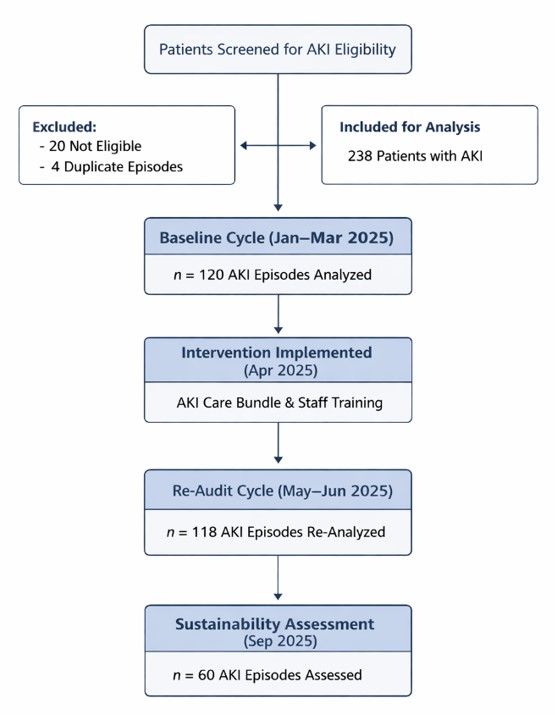
The audit was carried out in four phases: (Phase 1) a pilot phase to test the data collection tool and confirm feasibility of case identification, (Phase 2) a baseline audit cycle, (Phase 3) implementation of a structured intervention package followed by a re-audit cycle, and (Phase 4) a 3-month sustainability assessment to explore maintenance of observed changes in routine clinical practice. The audit was conducted over a defined nine-month period from 1 January 2025 to 30 September 2025. The baseline audit cycle was carried out from 1 January 2025 to 31 March 2025. This was followed by an implementation phase from 1 April 2025 to 30 April 2025 during which the intervention bundle was introduced and staff training was completed, with a defined 2-month gap between re-audit completion and sustainability assessment to assess durability rather than continuous measurement. The re-audit cycle was conducted from 1 May 2025 to 30 June 2025. A sustainability assessment was subsequently performed from 1 September 2025 to 30 September 2025 to evaluate maintenance of observed changes in routine clinical practice. Each cycle was sufficiently long to mitigate the potential influence of short-term seasonal variation in admissions and case mix Figure 1.
Case Identification and Eligibility
The inclusion criteria were deliberately broad to reflect real-world inpatients. Adults aged 18 years or older were included if they met KDIGO criteria for AKI during admission, whether the AKI was identified on the medical ward, during acute admission, or after nephrology consultation.
AKI was defined and staged according to KDIGO criteria using serum creatinine and/or urine output. Baseline creatinine was determined using the most recent value within the preceding 3 months where available. If prior creatinine was unavailable, the admission creatinine was used as a reference and AKI was defined based on subsequent changes during hospitalization, consistent with pragmatic approaches in resource-limited settings. Urine output criteria were applied where reliable charting was available.
Patients already on chronic dialysis and renal transplant recipients were excluded because their renal trajectory and management pathway differ substantially from standard AKI care. To reduce duplicate counting, each admission was assigned a unique hospital and admission identifier, and only the first AKI episode per admission was included. Where a patient was readmitted during the audit period, the episode was counted again only if it represented a clearly separate admission. A 90-day look-back was also used to identify and exclude duplicate episodes. Identifiers were collected temporarily only for linkage and deduplication purposes. A separate password-protected linkage file contained the hospital and admission identifiers needed to identify repeat episodes and verify eligibility. This linkage file was accessible only to the principal investigator and was not merged into the analytic dataset. After finalizing the dataset and checking for duplicates, all direct identifiers were removed from the working dataset. AKI was classified as community-acquired if present at admission or within 48 hours of admission, and hospital-acquired if developing thereafter. Patients already under active nephrology inpatient care at the time of AKI identification were excluded from the analysis of nephrology referral to avoid incorporation bias.
Patient Flow and Study Population
During the baseline cycle, 132 patients with suspected acute kidney injury were screened. Twelve patients were excluded due to pre-existing end-stage kidney disease, renal transplant status, or incomplete diagnostic criteria, leaving 120 eligible AKI episodes for analysis. In the re-audit cycle, 126 patients were screened; eight were excluded for similar reasons, resulting in 118 included episodes. During the sustainability phase, 64 patients were screened and four were excluded, leaving 60 patients for analysis.
Case Identification, Numerators, and Denominators
Acute kidney injury was defined according to KDIGO criteria using serum creatinine and urine output. Baseline creatinine was determined from values available within the preceding three months. When prior creatinine was unavailable, admission creatinine was used as the reference, and subsequent changes during hospitalization were used to define AKI. Urine output criteria were applied when reliable documentation was available.
For all process measures, the denominator consisted of all eligible AKI episodes unless otherwise specified. AKI recognition within 24 hours was assessed in all included patients. Repeat serum creatinine within 24 hours was assessed in all patients in whom ongoing admission blood sampling was clinically indicated. Medication review, fluid status assessment, urine output monitoring, and urinalysis were assessed in all eligible patients. Nephrology referral was assessed only in patients meeting predefined escalation criteria as per the study protocol. Nephrotoxin withholding was assessed in patients who were receiving at least one potentially nephrotoxic medication at the time of AKI recognition.
Process Measure Definitions
AKI recognition was defined as documentation of AKI diagnosis in the medical record within 24 hours of meeting KDIGO criteria. Medication review was defined as a documented clinical review of all medications within 12 hours of AKI recognition, including adjustment or discontinuation of nephrotoxic or renally cleared agents where appropriate. Fluid status assessment was defined as documented evaluation of volume status in clinical notes within 24 hours of AKI recognition. Urine output monitoring was considered adequate when at least shift-wise documentation was recorded during the first 24 hours after AKI identification. Nephrotoxin withholding was defined as temporary discontinuation or dose adjustment of drugs such as non-steroidal anti-inflammatory drugs, angiotensin-converting enzyme inhibitors, angiotensin receptor blockers, and aminoglycosides where clinically appropriate. Nephrology referral was defined according to local practice criteria, including KDIGO stage 2 or 3 AKI, persistent oliguria, refractory electrolyte imbalance, suspected intrinsic renal disease, or lack of improvement within 48 hours.
Process Measures and Outcomes
The audit standards were based on KDIGO and NICE principles, operationalized for feasibility in the local setting. Each process indicator was defined using explicit numerator, denominator, and timeframe criteria. Key documentation-based process measures included:
“Adequate documented urine output charting” was defined as at least shift-wise or hourly documentation during the first 24 hours following AKI recognition. “Medication review” referred to documented review by a physician, including adjustment or discontinuation of nephrotoxic or renally cleared medications where appropriate.
Clinical outcomes included progression to severe AKI (KDIGO stage 3), need for renal replacement therapy (reported separately), length of hospital stay, renal recovery at discharge, in-hospital mortality, and 30-day readmission. Renal recovery was defined as return of serum creatinine to within 25% of baseline at discharge. Readmission was defined as unplanned readmission to the same hospital within 30 days.
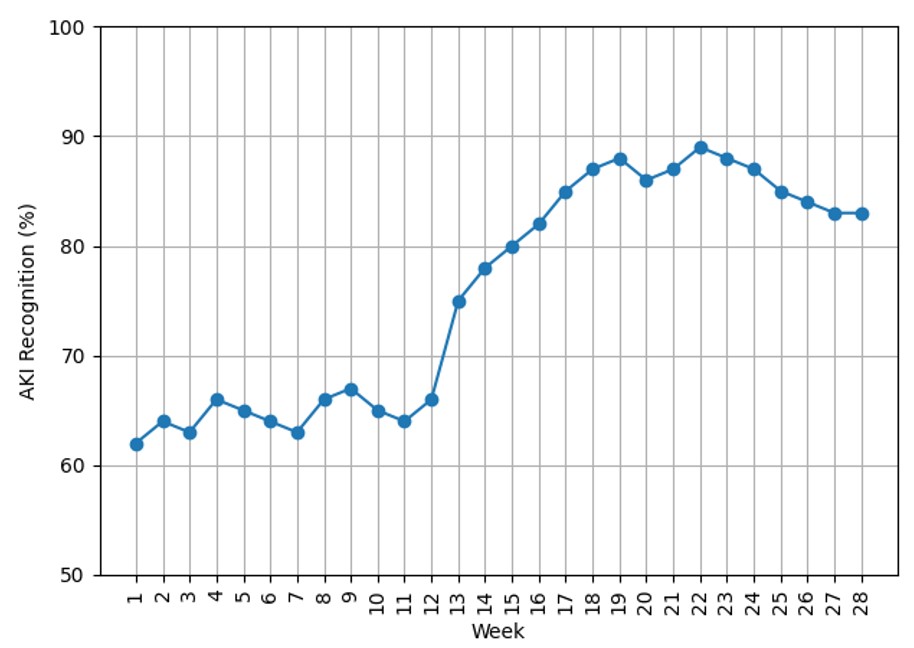
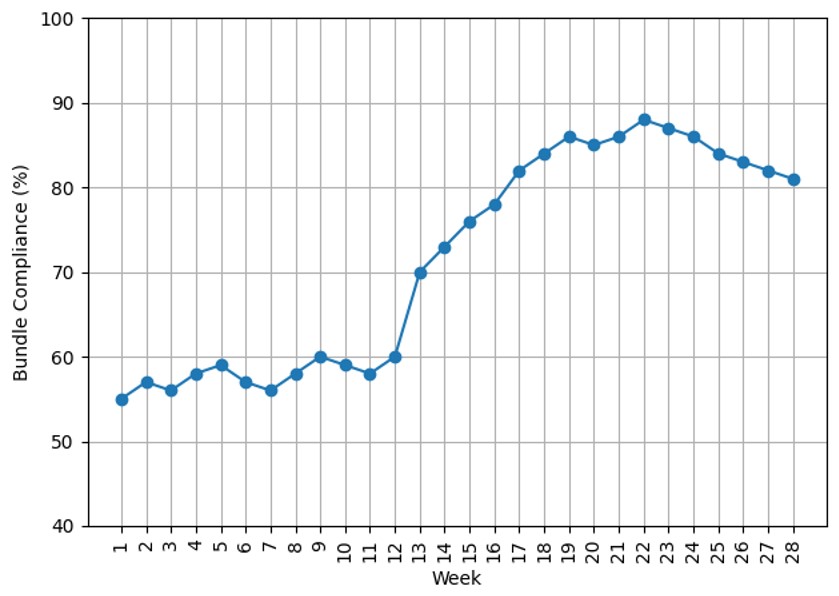
All process indicators reflect documentation of care in medical records and may not fully capture bedside execution. Process measures were additionally plotted as weekly run charts to evaluate temporal trends across cycles Figure 2 and Figure 3.
Sample Size Considerations
A pragmatic sample size approach was used. The pilot phase showed baseline compliance of approximately 55% across key process indicators. A target improvement of 20 percentage points was considered clinically meaningful, corresponding to approximately 88 patients per cycle. The baseline audit included 120 patients, allowing reasonably precise estimates of performance.
Intervention Fidelity
Intervention fidelity was assessed through structured review of randomly selected case records from each cycle. Thirty records per cycle were evaluated for presence and completeness of the AKI checklist, documentation of AKI staging, completion of medication review, and documentation of fluid assessment. The presence of a checklist in the medical record improved from 82% in the baseline period to 93% in the re-audit cycle. Completion of at least 80% of checklist items improved from 61% to 84%. Documentation of AKI stage improved from 68% to 89%, and recorded medication review improved from 64% to 86%.
Sustainability Sample
The sustainability assessment included 60 consecutive patients admitted during September 2025. These patients were selected consecutively from medical ward admissions meeting KDIGO criteria for AKI. The sample was intended as an exploratory assessment of maintenance of intervention effects rather than a formally powered comparative analysis.
Intervention
The intervention was intentionally low-cost and adapted to a resource-limited environment. It included a one-page AKI checklist Table 1, focused staff education, nephrotoxin prompts in patient charts, and a simple escalation framework. Weekly non-punitive feedback was provided at ward level.
| Domain | Checklist item |
|---|---|
| Recognition and diagnosis | Confirm AKI using KDIGO criteria based on serum creatinine and/or urine output. |
| Recognition and diagnosis | Document AKI stage clearly in the notes (stage 1, 2, or 3). |
| Recognition and diagnosis | Record baseline creatinine if available. |
| Monitoring | Repeat serum creatinine within 24 hours. |
| Monitoring | Initiate strict urine output charting |
| Monitoring | Monitor vital signs, including blood pressure and perfusion status. |
| Medication review | Review all medications within 12 hours. |
| Medication review | Stop, hold, or modify nephrotoxic drugs where clinically appropriate. |
| Medication review | Adjust doses of renally cleared medications. |
| Fluid assessment | Perform and document volume status assessment. |
| Fluid assessment | Initiate appropriate fluid resuscitation if hypovolemic. |
| Fluid assessment | Avoid fluid overload in euvolemic or hypervolemic patients. |
| Investigations | Perform urinalysis, with microscopy when indicated. |
| Investigations | Consider renal ultrasound if obstruction is suspected. |
| Escalation | Assess the need for nephrology referral. |
| Escalation | Identify red flags such as oliguria, rising creatinine, or electrolyte imbalance. |
| Documentation | Ensure AKI diagnosis and management plan are clearly documented. |
AKI, acute kidney injury; KDIGO, Kidney Disease: Improving Global Outcomes.
Implementation was supported through repeated teaching sessions, the availability of checklists, and regular feedback discussions.
Implementation and Training
The audit was conducted by a multidisciplinary team comprising residents, interns, and a supervising consultant physician. All team members underwent structured training before the baseline cycle. Inter-rater reliability during the pilot phase exceeded 90% for key variables.
Data collectors were not involved in the direct care of most patients during the baseline phase. During the re-audit phase, clinicians were aware of the intervention but were not provided with patient-level audit scoring.
Escalation and Definitions
A structured escalation framework was introduced. Nephrology referral was defined according to local practice criteria, including KDIGO stage 2 or 3 AKI, persistent oliguria, refractory electrolyte imbalance, suspected intrinsic renal disease, or lack of improvement within 48 hours. This measure was assessed only among patients who met referral criteria and were not already under active nephrology care at the time AKI was identified.
Nephrotoxin withholding refers to the temporary discontinuation or adjustment of medications such as NSAIDs, ACE inhibitors/ARBs, and aminoglycosides, where clinically feasible.
Sustainability Assessment
A sustainability assessment was conducted using a consecutive sample of 60 eligible patients admitted during the post-intervention period. This was intended as an exploratory assessment of maintenance rather than a formal longitudinal analysis. This was a one-month assessment conducted three months after the intervention period.
Data Collection and Flow
The audit proforma captured demographics, comorbidities, AKI characteristics, process measures, and outcomes Table 2.
| Section | Data captured |
|---|---|
| Patient identification | Hospital number, admission number, ward, and date of admission. |
| Demographics | Age and sex. |
| Comorbidities | Diabetes, hypertension, chronic kidney disease, cardiovascular disease, liver disease, and known obstructive uropathy. |
| AKI definition | Baseline creatinine, peak creatinine, urine output criteria, and KDIGO stage. |
| Aetiology | Prerenal, intrinsic, postrenal, sepsis-associated, and nephrotoxin-associated AKI. |
| Process measures | Time to recognition, repeat creatinine, urine output charting, fluid assessment, urinalysis, medication review, and nephrology referral. |
| Treatment actions | Fluids given, nephrotoxins withheld, dose adjustment, imaging, and dialysis. |
| Outcomes | Peak KDIGO stage, recovery at discharge, length of stay, in-hospital death, and 30-day readmission. |
AKI, acute kidney injury; KDIGO, Kidney Disease: Improving Global Outcomes.
Statistical Analysis
Descriptive statistics were used to summarize baseline characteristics and clinical variables. Categorical variables were compared using chi-square tests, and continuous variables were compared using independent sample t-tests. Effect sizes were reported as absolute risk differences with corresponding 95% confidence intervals for all major processes and clinical outcomes. Ninety-five percent confidence intervals for absolute risk differences were estimated using the Wald method for independent proportions.
The prespecified primary outcome of the study was AKI recognition within 24 hours of meeting KDIGO criteria. Secondary outcomes included all other process measures as well as clinical outcomes such as progression to severe AKI, need for renal replacement therapy, length of hospital stay, renal recovery at discharge, in-hospital mortality, and 30-day readmission.
To account for potential confounding, a multivariable logistic regression model was used to analyze the primary outcome. This model adjusted for age, sex, diabetes mellitus, chronic kidney disease, sepsis, and baseline AKI stage. Sensitivity analyses were conducted excluding patients with missing baseline creatinine values and those with hospital-acquired AKI, and results remained consistent across these analyses. Given the before-and-after design, all analyses were treated as exploratory, with associations rather than causal effects.
The study is reported in accordance with SQUIRE 2.0 guidelines [10].
Ethics and Governance
This project was conducted as a quality improvement audit and was approved by the departmental audit/governance body at MTI-Khyber Teaching Hospital. Formal institutional review board approval was waived as no patient-identifiable data were collected and no deviation from standard care occurred.
Results
A total of 120 consecutive AKI episodes were included in the baseline cycle and 118 in the re-audit cycle. Baseline characteristics were broadly comparable across cycles; however, differences in the distribution of AKI severity may reflect stage migration due to earlier recognition rather than true baseline equivalence Table 3.
| Characteristic | Baseline cycle (n=120) | Re-audit cycle (n=118) | p-value |
|---|---|---|---|
| Age, mean ± SD, years | 58.4 ± 16.5 | 57.7 ± 17.0 | 0.75 |
| Male sex, n (%) | 74 (61.7) | 71 (60.2) | 0.81 |
| Diabetes mellitus, n (%) | 52 (43.3) | 49 (41.5) | 0.78 |
| Hypertension, n (%) | 68 (56.7) | 66 (55.9) | 0.91 |
| Chronic kidney disease, n (%) | 38 (31.7) | 36 (30.5) | 0.85 |
| Sepsis or active infection, n (%) | 32 (26.7) | 31 (26.3) | 0.94 |
| Hypovolemia or dehydration, n (%) | 41 (34.2) | 39 (33.1) | 0.86 |
| NSAID exposure before admission, n (%) | 27 (22.5) | 25 (21.2) | 0.81 |
| Contrast exposure during admission, n (%) | 11 (9.2) | 10 (8.5) | 0.85 |
| ICU-level monitoring required, n (%) | 18 (15.0) | 17 (14.4) | 0.90 |
NSAID, non-steroidal anti-inflammatory drug; ICU, intensive care unit.
The distribution of AKI etiology was broadly similar across both cycles. The re-audit cycle included a lower proportion of patients with KDIGO stage 3 AKI than the baseline cycle, although this difference did not reach statistical significance Table 4.
| Variable | Baseline cycle (n=120) | Re-audit cycle (n=118) | p-value |
|---|---|---|---|
| Prerenal AKI, n (%) | 57 (47.5) | 54 (45.8) | 0.92 |
| Intrinsic AKI, n (%) | 41 (34.2) | 40 (33.9) | 0.98 |
| Postrenal AKI, n (%) | 22 (18.3) | 24 (20.3) | 0.68 |
| KDIGO stage 1, n (%) | 46 (38.3) | 49 (41.5) | 0.24 |
| KDIGO stage 2, n (%) | 34 (28.3) | 41 (34.7) | 0.24 |
| KDIGO stage 3, n (%) | 40 (33.3) | 28 (23.7) | 0.09 |
| Dialysis required during admission, n (%) | 14 (11.7) | 8 (6.8) | 0.19 |
AKI, acute kidney injury; KDIGO, Kidney Disease: Improving Global Outcomes.
Baseline performance across the process indicators showed important deficiencies. AKI was documented within 24 hours in 65.0% of cases; repeat creatinine was arranged within 24 hours in 57.5%; medication review was documented in 51.7%; fluid status was documented in 48.3%; and urine output monitoring was adequately charted in 45.0%. Nephrology referral occurred when indicated in 40.0% of eligible patients.
Following the introduction of the intervention bundle, improvement was observed across all major documentation-based process measures. Documented AKI recognition increased to 87.3%, repeat creatinine review to 81.4%, medication review to 78.0%, fluid assessment to 76.3%, urine output charting to 72.0%, and urinalysis to 75.4%. Appropriate nephrology referral, assessed only among patients eligible for referral, increased from 40.0% to 67.8%. Documented withholding or adjustment of nephrotoxins was more frequent when relevant. All of these changes were statistically significant Table 5. Nephrology referral was calculated only among patients meeting predefined escalation criteria and not already under active nephrology care at the time AKI was identified.
| Process measure | Baseline cycle (n=120) | Re-audit cycle (n=118) | Absolute change | p-value |
|---|---|---|---|---|
| AKI recognized/documented within 24h | 78 (65.0%) | 103 (87.3%) | +22.3% | <0.001 |
| Repeat creatinine within 24h | 69 (57.5%) | 96 (81.4%) | +23.9% | <0.001 |
| Medication review within 12h | 62 (51.7%) | 92 (78.0%) | +26.3% | <0.001 |
| Fluid status documented within 24h | 58 (48.3%) | 90 (76.3%) | +28.0% | <0.001 |
| Urine output charted adequately | 54 (45.0%) | 85 (72.0%) | +27.0% | <0.001 |
| Urinalysis performed | 66 (55.0%) | 89 (75.4%) | +20.4% | <0.001 |
| Nephrology referral when indicated | 48 (40.0%) | 80 (67.8%) | +27.8% | <0.001 |
| Nephrotoxins withheld when relevant | 44/70 (62.9%) | 62/68 (91.2%) | +28.3% | <0.001 |
AKI, acute kidney injury.
Clinical outcomes were also more favorable in the re-audit cycle. Progression to KDIGO stage 3 AKI was lower in the re-audit than in the baseline cycle, and the need for renal replacement therapy was also reduced. However, the latter did not reach statistical significance. Mean length of stay was shorter in the re-audit cycle, and creatinine recovery by discharge was more frequent in the re-audit cycle. This should be interpreted as an exploratory in-hospital biochemical outcome rather than a definitive measure of renal recovery. Mortality and 30-day readmission showed favorable trends but did not reach statistical significance Table 6.
| Outcome | Baseline cycle (n=120) | Re-audit cycle (n=118) | p-value |
|---|---|---|---|
| Progression to KDIGO stage 3 AKI, n (%) | 40 (33.3%) | 28 (23.7%) | 0.09 |
| Need for renal replacement therapy, n (%) | 14 (11.7%) | 8 (6.8%) | 0.19 |
| Mean length of stay, days ± SD | 7.9 ± 3.4 | 6.6 ± 3.0 | 0.002 |
| Creatinine recovery by discharge, n (%) | 73 (60.8%) | 90 (76.3%) | 0.010 |
| In-hospital mortality, n (%) | 10 (8.3%) | 6 (5.1%) | 0.34 |
| 30-day readmission with AKI, n (%) | 18 (15.0%) | 11 (9.3%) | 0.17 |
AKI, acute kidney injury; KDIGO, Kidney Disease: Improving Global Outcomes; SD, standard deviation.
The 3-month sustainability review showed some reduction from the immediate post-intervention cycle, but the process indicators remained above baseline levels.
Table 7 shows whether the gain was held after the immediate implementation period. A mild decline was observed, which is common with workflow interventions, but the process remained better than before the audit began.
| Measure | Post-intervention re-audit | 3-month spot-check (n=60) |
|---|---|---|
| AKI recognition within 24h | 87.3% | 83.3% |
| Medication review within 12h | 78.0% | 75.0% |
| Fluid assessment within 24h | 76.3% | 70.0% |
| Nephrology referral when indicated | 67.8% | 63.3% |
AKI, acute kidney injury.
Effect estimates for key documentation-based process measures showed consistent improvement following implementation of the intervention bundle. AKI recognition within 24 hours increased by 22.3% with a 95% confidence interval of 12.6% to 32.0%. Repeat creatinine monitoring improved by 23.9% (95% CI 13.8% to 33.9%). Medication review improved by 26.3% (95% CI 15.9% to 36.7%), while fluid status documentation improved by 28.0% (95% CI 17.5% to 38.5%). Urine output monitoring improved by 27.0% (95% CI 16.3% to 37.7%), urinalysis by 20.4% (95% CI 9.9% to 30.9%), nephrology referral by 27.8% (95% CI 16.6% to 39.0%), and nephrotoxin withholding by 28.3% (95% CI 16.8% to 39.8%).
In multivariable logistic regression adjusting for age, sex, diabetes mellitus, chronic kidney disease, sepsis, and baseline AKI stage, AKI recognition within 24 hours remained significantly higher in the post-intervention cycle with an adjusted odds ratio of 3.12 (95% confidence interval 1.78 to 5.49). Sensitivity analyses excluding patients with missing baseline creatinine and those with hospital-acquired AKI demonstrated consistent findings across all major process measures.
Discussion
This quality improvement audit describes changes in AKI recognition and bundle-based care processes following implementation of a structured, low-cost intervention in a resource-limited tertiary care hospital. Across two audit cycles, we observed substantial improvements in documentation of key AKI care processes, including early recognition, medication review, fluid assessment, urine output monitoring, and nephrology referral when indicated.
These changes were most pronounced in workflow-dependent documentation measures, suggesting that structured prompts, education, and feedback may improve recording and consistency of guideline-recommended AKI care processes. Given that AKI care often relies on timely identification and coordinated action across multiple steps, even modest improvements in system reliability may be clinically meaningful in resource-constrained environments.
Improvements in process measures were accompanied by more favorable trends in selected clinical outcomes, including reduced progression to severe AKI, shorter length of stay, and higher rates of creatinine recovery at discharge. An apparent improvement in creatinine recovery at discharge was observed; however, this finding should be interpreted cautiously as an exploratory biochemical outcome measured at discharge and not as a standardized long-term renal recovery endpoint. The before-and-after design does not allow attribution of outcome differences to the intervention, and observed changes may also reflect differences in case mix, AKI severity distribution, temporal practice changes, or unmeasured confounders between study periods.
Notably, mortality and 30-day readmission did not demonstrate statistically significant changes. This is not unexpected, as these outcomes are influenced by a broader range of patient and system-level factors beyond the immediate management of AKI, and the study was not powered to detect differences in these endpoints.
The sustainability assessment suggested partial maintenance of improved process performance at three months, although some decline from the immediate post-intervention period was observed. This pattern is consistent with prior quality improvement literature [11,12,13], where initial gains often attenuate without ongoing reinforcement. The findings therefore suggest that continued feedback mechanisms and periodic reinforcement may be necessary to maintain improvements over time, rather than a one-time intervention effect.
The observed lower proportion of KDIGO stage 3 AKI in the re-audit cycle may also have influenced downstream outcomes, including need for renal replacement therapy and length of stay. Importantly, this difference likely reflects a combination of true case variation and potential stage migration due to earlier recognition, rather than a stable baseline equivalence between cycles. Accordingly, stage distribution should be interpreted as a dynamic marker influenced by detection practices rather than a fixed cohort characteristic. The apparent downstream differences in clinical outcomes may therefore reflect earlier recognition, stage migration, or differences in AKI severity at presentation rather than a direct effect of the intervention. Accordingly, these outcome findings should be considered exploratory and hypothesis-generating rather than confirmatory.
From a broader systems perspective, these findings support the potential value of simple, low-cost interventions such as checklists, structured escalation pathways, and routine feedback in improving the reliability of AKI care processes. Similar interventions have shown variable effectiveness across settings, but their success often depends on local implementation fidelity, staff engagement, and integration into existing workflows rather than on the intervention’s complexity [14].
Limitations
This study has several important limitations. First, its single-center, nonrandomized before-and-after design limits internal validity and precludes causal inference. Second, improvements in documentation-based process measures may not fully reflect bedside clinical actions, and some observed changes may represent improved recording rather than actual changes in care delivery. Third, differences in AKI severity distribution between cycles may have influenced clinical outcomes. Fourth, the sustainability analysis was short-term and exploratory, limiting conclusions regarding long-term durability of effect. Finally, discharge-based renal recovery may be influenced by variations in length of stay and should be interpreted as in-hospital biochemical recovery rather than standardized longitudinal renal function recovery.
Conclusion
In this quality improvement audit, implementation of a structured AKI care bundle was associated with improved documentation and adherence to recommended AKI care processes in a resource-limited hospital setting. Improvements in selected clinical outcomes were observed but cannot be attributed causally to the intervention, given the study design. The findings highlight the potential role of simple system-level interventions in strengthening AKI care delivery, while underscoring the need for more robust prospective and multi-center evaluations to confirm effectiveness and assess long-term sustainability.
Conflicts of Interest
The authors declare that they have no known financial or non-financial conflicts of interest related to this work. No author has any competing interests, affiliations, or relationships that could have influenced the study design, data collection, analysis, interpretation, manuscript preparation, or decision to submit the article for publication.
Funding Source
The authors declare that no specific grant or funding was received for this research from any public, commercial, or not-for-profit funding agency.
Acknowledgments
None.
Institutional Review Board (IRB)
This study was conducted as a clinical audit and quality improvement project (Audit Approval Number: KTH-MTI/QI/2025/017). Patient-identifying information was collected only temporarily for linkage and deduplication, stored separately in a password-protected file accessible only to the principal investigator. It was not retained in the analytic dataset. Formal ethics committee approval was not required, and no identifiable patient data were disclosed.
Large Language Model
Artificial intelligence tools were used in a limited capacity to assist with language refinement and manuscript editing. The study design, data collection, analysis, interpretation, and final content were developed and verified by the authors.
Authors Contribution
MAI contributed to conceptualization, study design, data collection, manuscript drafting, and supervision. MS contributed to literature review, data interpretation, manuscript writing, critical revision of the manuscript, and corresponding author responsibilities. SIYK contributed to data analysis, interpretation of results, and manuscript editing. SK contributed to data collection, patient management, literature review, and manuscript writing. MSM contributed to statistical analysis, methodology support, and manuscript review. FN contributed to data acquisition, formatting, and proofreading of the manuscript. AS contributed to final manuscript review, validation of data, and approval of the submitted version. All authors contributed substantially to the work, critically reviewed the manuscript, approved the final version, and agree to be accountable for all aspects of the work.
Data Availability
The data supporting the findings of this study are available from the corresponding author on reasonable request.
References
- Sawhney S., Marks A., Fluck N., Levin A., Prescott G., Black C.. Intermediate and Long-term Outcomes of Survivors of Acute Kidney Injury Episodes: A Large Population-Based Cohort Study. Am J Kidney Dis. 2017;69(1):18-28. doi:10.1053/j.ajkd.2016.05.018 PMID: 27555107 PMCID: PMC5176133
- Gameiro J., Fonseca J. A., Outerelo C., Lopes J. A.. Acute Kidney Injury: From Diagnosis to Prevention and Treatment Strategies. J Clin Med. 2020;9(6). doi:10.3390/jcm9061704 PMID: 32498340 PMCID: PMC7357116
- Khadzhynov D., Schmidt D., Hardt J., Rauch G., Gocke P., Eckardt K. U., Schmidt-Ott K. M.. The Incidence of Acute Kidney Injury and Associated Hospital Mortality. Dtsch Arztebl Int. 2019;116(22):397-404. doi:10.3238/arztebl.2019.0397 PMID: 31366430 PMCID: PMC6676729
- Brar S., Ye F., James M. T., Harrison T. G., Pannu N., Interdisciplinary Chronic Disease Collaboration. Processes of Care After Hospital Discharge for Survivors of Acute Kidney Injury: A Population-Based Cohort Study. Am J Kidney Dis. 2024;83(2):216-228. doi:10.1053/j.ajkd.2023.07.015 PMID: 37734688
- Georges T. D., Marie-Patrice H., Ingrid T. S., Mbua R. G., Hermine F. M., Gloria A.. Causes and outcome of acute kidney injury amongst adults patients in two hospitals of different category in Cameroon; a 5 year retrospective comparative study. BMC Nephrol. 2022;23(1):364. doi:10.1186/s12882-022-02992-4 PMID: 36376867 PMCID: PMC9661768
- Wang H., Lambourg E., Guthrie B., Morales D. R., Donnan P. T., Bell S.. Patient outcomes following AKI and AKD: a population-based cohort study. BMC Med. 2022;20(1):229. doi:10.1186/s12916-022-02428-8 PMID: 35854309 PMCID: PMC9297625
- BMJ Best Practice. Acute kidney injury criteria [Internet].
- Acute kidney injury: prevention, detection and management [Internet]. 2019.
- Igiraneza G., Dusabejambo V., Finklestein F. O., Rastegar A.. Challenges in the Recognition and Management of Acute Kidney Injury by Hospitals in Resource-Limited Settings. Kidney Int Rep. 2020;5(7):991-999. doi:10.1016/j.ekir.2020.04.003 PMID: 32647756 PMCID: PMC7336002
- Ogrinc G., Davies L., Goodman D., Batalden P., Davidoff F., Stevens D.. SQUIRE 2.0 (Standards for QUality Improvement Reporting Excellence): revised publication guidelines from a detailed consensus process. BMJ Qual Saf. 2016;25(12):986-992. doi:10.1136/bmjqs-2015-004411 PMID: 26369893 PMCID: PMC5256233
- Ahmed F. R., Al-Yateem N., Nejadghaderi S. A., Gamil R., AbuRuz M. E.. Effect of acute kidney injury care bundle on kidney outcomes in cardiac patients receiving critical care: a systematic review and meta-analysis. BMC Nephrol. 2025;26(1):17. doi:10.1186/s12882-025-03955-1 PMID: 39794703 PMCID: PMC11721091
- Munoz-Sanchez A., Martin-Rodriguez L., Lopez-Sanchez P., Valdenebro M., Serrano-Salazar M. L., Marques M., Portoles J.. Intermediate and long-term AKI outcomes in a public health system. J Nephrol. 2025;38(7):1985-1994. doi:10.1007/s40620-025-02367-6 PMID: 40751025 PMCID: PMC12484351
- Sykes L., Nipah R., Kalra P., Green D.. A narrative review of the impact of interventions in acute kidney injury. J Nephrol. 2018;31(4):523-535. doi:10.1007/s40620-017-0454-2 PMID: 29188454 PMCID: PMC6061256
- Kotwal S., Herath S., Erlich J., Boardman S., Qian J., Lawton P., Campbell C., Whatnall A., Teo S., Horvath A. R., Endre Z. H.. Electronic alerts and a care bundle for acute kidney injury-an Australian cohort study. Nephrol Dial Transplant. 2023;38(3):610-617. doi:10.1093/ndt/gfac155 PMID: 35438795