Cardiac Arrest and Cardiomyopathy Related Mortality in the United States, 1999-2025: Trends and Disparities
Mahdi AhmedⒾ1, Alaa EldeebⒾ2, Maryam SaghirⒾ3, Alyaa Ahmed IbrahimⒾ2, Mohammad Rayyan FaisalⒾ4, Raveen MujeebⒾ4, Bassam HegazyⒾ2, Mohamed ZabadyⒾ2, Amr IbrahimⒾ5, Karim Othman AbdelnaimⒾ6, Walid BechibchiⒾ7, Humam Al-MachtomiⒾ8, Ehsanullah AlokozayⒾ9*, Mohaimen Mohammed Al-MachtomiⒾ10, Irfan UllahⒾ11, Mohamed Fawzi HemidaⒾ2
- 1Faculty of Medicine, Kafr Elsheikh University, Kafr el-Sheikh, Egypt
- 2Faculty of Medicine, Alexandria University, Alexandria, Egypt
- 3Department of Medicine, Jinnah Sindh Medical University, Karachi, Pakistan
- 4Department of Medicine, Dow University of Health Sciences, Karachi, Pakistan
- 5Faculty of Medicine, Monoufia University, Monoufia, Egypt
- 6Faculty of Medicine, Ain Shams University, Cairo, Egypt
- 7Faculty of Medicine, University of Constantine 3, Salah Boubnider, Constantine, Algeria
- 8Norman Bethune Health Science Center, Jilin University, Changchun, China
- 9Faculty of Medicine, Kandahar University, Kandahar, Afghanistan
- 10Belgorod National Research University, Belgorod, Russia
- 11University Hospitals Harrington Heart and Vascular Institute, Ohio, USA
Abstract
Background: Cardiac arrest and cardiomyopathy are major contributors to cardiovascular mortality and sudden death. However, long-term national mortality trends and demographic disparities remain unclear. This study aimed to evaluate U.S. mortality trends from 1999 to 2025 and assess differences by sex, race/ethnicity, and age.
Methods: We conducted a cross-sectional analysis of U.S. mortality data from 1999–2025 using the CDC WONDER Multiple Cause-of-Death database. Deaths among adults aged ≥ 25years were identified using ICD-10 codes I42 (cardiomyopathy) and I46 (cardiac arrest), including cases where these codes appeared as underlying or contributing causes of death. Age-adjusted mortality rates (AAMRs) per 100,000 population were calculated. Temporal trends were assessed using Joinpoint regression and expressed as average annual percent change (AAPC), stratified by sex, race/ethnicity, and three age groups (25–44, 45–64, and ≥ 65years).
Results: Between 1999 and 2025, 237,958 deaths from cardiac arrest and cardiomyopathy occurred among U.S. adults ≥25 years. Overall, AAMR declined from 6.33 to 2.41 (AAPC -3.83; 95% CI: -4.18 to -3.57). Males had higher mortality than females (AAMR 5.82 vs 2.71) with declines from 9.13 to 3.28 and 4.36 to 1.62, respectively. Non-Hispanic (NH) Black individuals had the highest AAMR (7.42), followed by Hispanics (4.62). Mortality was highest among those aged ≥65 years (CMR 14.74), declining from 23.88 to 7.88 between 1999 and 2025.
Conclusion: Mortality from cardiac arrest and cardiomyopathy declined significantly from 1999–2025. However, substantial disparities persisted, with higher mortality among males, NH Black individuals, and adults ≥65 years, highlighting ongoing inequities in cardiovascular outcomes.
Keywords: Cardiac arrest, Cardiomyopathy, Mortality trends, Health disparities, Joinpoint analysis
Article information
Introduction
Cardiac arrest and cardiomyopathy represent major contributors to cardiovascular morbidity and mortality worldwide and remain a significant public health concern in the United States [1]. Sudden cardiac arrest alone affects more than 350,000 individuals annually in the United States, with survival rates remaining low despite advances in resuscitation and emergency care. Approximately 90% of out-of-hospital cardiac arrest events are fatal, underscoring the persistent burden of this condition on the healthcare system and population health [1,2,3]. Cardiomyopathies, including hypertrophic, dilated, restrictive, and arrhythmogenic forms, are important underlying causes of heart failure, malignant arrhythmias, and sudden cardiac death. Hypertrophic cardiomyopathy, one of the most common inherited cardiac disorders, affects roughly 1 in 500 individuals, while dilated cardiomyopathy remains a leading cause of heart transplantation and advanced heart failure [4,5,6].
Cardiomyopathies contribute substantially to cardiac arrest and cardiovascular mortality through structural and electrical remodeling of the myocardium, which predisposes patients to ventricular arrhythmias and progressive cardiac dysfunction. Epidemiological studies have demonstrated that cardiomyopathy-related deaths continue to impose a considerable burden in the United States, with thousands of deaths reported annually. For instance, analyses of national mortality data identified over 168,000 deaths attributed to dilated cardiomyopathy between 1999 and 2020 [7]. Furthermore, cardiomyopathy-related mortality frequently exhibits demographic and geographic disparities, with higher mortality rates reported among males, older adults, and certain racial and ethnic populations [7].
Temporal analyses of cardiac arrest mortality in the United States suggest complex patterns over the past two decades. While some studies report an initial decline in age-adjusted mortality rates during the early 2000s, more recent years have shown stagnation or even reversal of these improvements, potentially related to the growing burden of cardiovascular risk factors, aging populations, and disparities in access to advanced cardiovascular care [8,9]. Additionally, cardiac arrest associated with conditions such as heart failure and metabolic disturbances has demonstrated increasing mortality trends since approximately 2011 in national datasets [8]. The recent Lancet Commission to Reduce the Global Burden of Sudden Cardiac Death emphasized that sudden cardiac death remains a major global health challenge with survival rates from sudden cardiac arrest below 10% in most regions worldwide, calling for urgent multidisciplinary strategies to improve prevention, risk stratification, and systems of care [10].
Despite the clinical significance of these conditions, limited studies have comprehensively examined the combined national mortality trends and demographic disparities associated with both cardiac arrest and cardiomyopathy over extended time periods. Understanding these patterns is essential for identifying vulnerable populations, informing prevention strategies, and guiding healthcare policy. Therefore, the present study aims to evaluate long-term trends and disparities in mortality from cardiac arrest and cardiomyopathy in the United States from 1999 to 2025 using national mortality data.
Methods
Study Design and Population
We conducted a retrospective population-based study using the Centers for Disease Control and Prevention Wide-Ranging Online Data for Epidemiologic Research (CDC WONDER) Multiple Cause-of-Death database. We analyzed national death certificate data for adults aged ≥25 years from 1999 through 2025 to evaluate mortality associated with cardiomyopathy and cardiac arrest in the United States. This age cutoff has been used to define adults in prior cardiovascular research [11,12], and restricting the analysis to ≥25 years improves the robustness and stability of mortality estimates. Deaths were identified using the International Statistical Classification of Diseases and Related Health Problems, Tenth Revision (ICD-10) codes I42 (cardiomyopathy) and I46 (cardiac arrest). The CDC WONDER query was structured to extract record-level mortality data from the Multiple Cause-of-Death files, including deaths in which I42 and/or I46 appeared anywhere on the death certificate, whether as the underlying cause of death or as contributing causes. Each decedent was counted once in the analysis, consistent with CDC WONDER’s person-level mortality reporting structure. The query parameters included: years 1999 – 2025; age ≥25 years; stratification by sex, race/ethnicity, age group, and place of death; and grouping by ICD-10 codes I42 and I46. Age-adjusted mortality rates were calculated using the standard CDC WONDER methodology. Institutional review board approval was not required because this study used publicly available, de-identified government data. The study was conducted and reported in accordance with the STROBE (Strengthening the Reporting of Observational Studies in Epidemiology) guidelines [13].
Data Abstraction
Data for population size and demographics, such as sex and race, were extracted. The place of death was categorized into medical facilities, hospice, home, and nursing home/long-term care facilities. Racial and ethnic categories were classified as non-Hispanic (NH) white, NH Black or African American, Hispanic or Latino, NH American Indian or Alaska Native, and NH Asian or Pacific Islander. Age groups were divided into 3 groups: (25 – 44, 45 – 64, and ≥ 65 years). In accordance with CDC WONDER data-use policies, cells with fewer than 10 deaths are suppressed by the database. Suppressed cells were excluded from subgroup-specific analyses, and no imputation was performed.
Statistical Analysis
Age-adjusted mortality rates (AAMRs) and crude mortality rates (CMRs) per 100,000 population from 1999–2025, by year, sex, and race, with 95% CIs, were calculated, using the 2000 U.S. population as the standard [14]. CMRs were determined by dividing the number of cardiac arrest and cardiomyopathy-related mortalities among adults by the corresponding U.S. population of that year. The Joinpoint Regression Program (Joinpoint V 5.4.0.0, National Cancer Institute) was used to determine the average annual percent change (AAPC) and the annual percent change (APC). Joinpoint regression, a segmented regression technique, was used to identify points of trend change (join points) by fitting log-linear models and using permutation tests to select the optimal number of join points, thereby ensuring model fit. This method allows identification of significant changes in AAMR over time by fitting log-linear regression models where temporal variation occurred. APCs were considered increasing or decreasing if the slope describing the change in mortality was significantly different from zero using a two-tailed t-test. A value of p< 0.05 was considered statistically significant.
Results
Overall Trends
Between 1999 and 2025, cardiac arrest and cardiomyopathy accounted for a total of 237,958 deaths among adults aged 25 years and older in the United States. Most of the deaths occurred in medical facilities as inpatients (47.10%), followed by decedent’s home (24.10%) and nursing home or long-term care settings (10.85%), outpatient or emergency room settings (12.73%), hospice facilities (1.05%), medical facilities – dead on arrival (0.85%), other locations (2.83%), medical facilities – status unknown (0.11%), and for 0.38% of cases, the place of death was not specified (Supplementary Table 1).
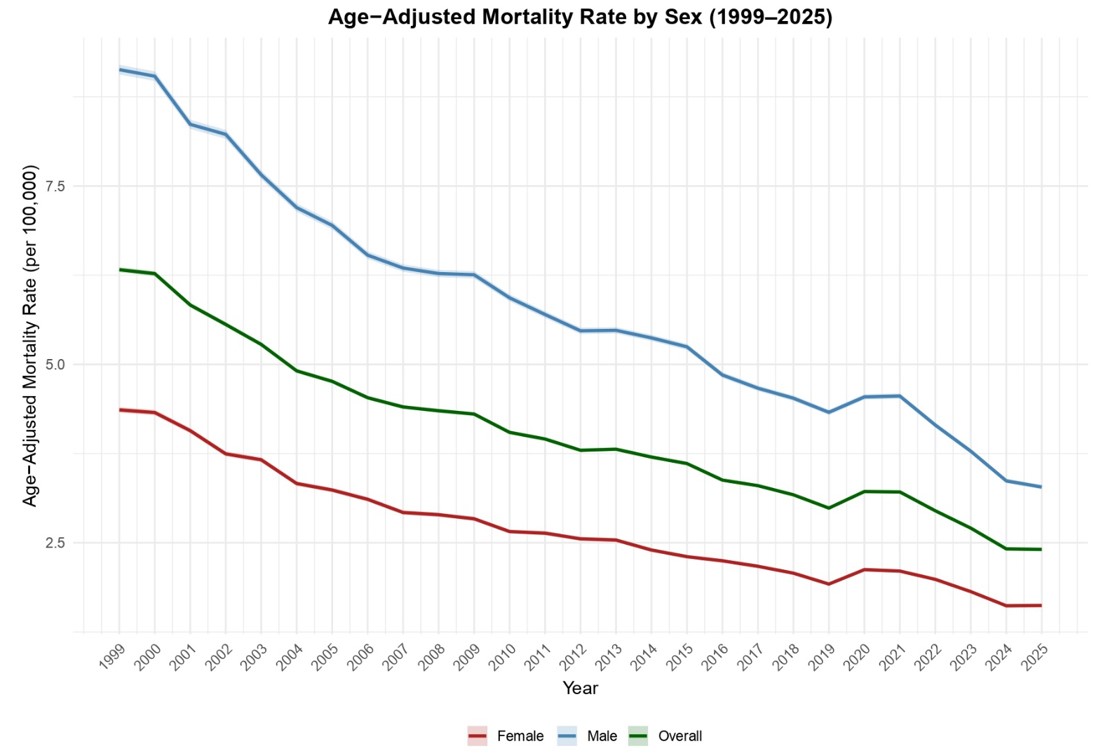
The overall AAMR declined substantially from 6.33 per 100,000 in 1999 to 2.41 in 2025, with an AAPC of -3.83 (95% CI: -4.18 to -3.57; p < 0.001). The mean AAMR was 4.04 (95% CI: 3.96 to 4.13). From 1999 to 2006, mortality decreased sharply from 6.33 to 4.53 (-4.87; 95% CI: -7.26 to -3.87, p < 0.001), followed by a continued but more gradual decline from 4.53 in 2006 to 2.95 in 2022 (-2.69; 95% CI: -2.98 to -1.19; p < 0.022). A further significant decline was observed from 2.95 in 2022 to 2.41 in 2025 (-7.37; 95% CI: -12.55 to -4.15; p < 0.001) Figure 1 and (Supplementary Table 2).
Sex-Stratified Trends
Throughout the study period, a total of 146,218 deaths were recorded among males and 91,740 among females. Males exhibited higher mortality, with an AAMR of 5.82 (95% CI: 5.67 to 5.98) compared with 2.71 (95% CI: 2.62 to 2.81) in females. On average, males experienced a greater decline in mortality than females [Males: AAPC: -4.04 (95% CI: -4.23 to -3.89; p < 0.001); Females: AAPC: -3.93 (95% CI: -4.24 to -3.74; p < 0.001)].
Among males, the AAMR declined from 9.13 in 1999 to 3.28 in 2025. Joinpoint regression revealed four segments: a marked decrease from 9.13 in 1999 to 6.53 in 2006 (-4.83; 95% CI: -6.40 to -4.09; p < 0.001), continued decline from 6.53 in 2006 to 5.25 in 2015 (-2.64; 95% CI: -3.18 to -0.47; p < 0.019), a further reduction from 5.25 in 2015 to 4.53 in 2018 (-5.07; 95% CI: -6.52 to -3.35; p < 0.001), a slight non-significant increase from 4.53 in 2018 to 4.56 in 2021 (0.62; 95% CI: -1.69 to 2.13; p < 0.547), and again a significant decline from 4.56 in 2021 to 3.28 in 2025 (-8.31; 95% CI: -10.11 to -7.27; p < 0.001).
Among females, mortality decreased from 4.36 in 1999 to 1.62 in 2025. Significant decline was observed from 4.36 in 1999 to 3.24 in 2005 (-5.37; 95% CI: -8.18 to -4.30; p < 0.001) and from 3.24 in 2005 to 2.07 in 2018 (-3.30; 95% CI: -4.34 to -2.76; p < 0.001). A slight non-significant rise was noticed from 2.07 in 2018 and 2.10 in 2021 (0.19; 95% CI: -2.70 to 1.65; p < 0.786), followed by a significant decline from 2.10 in 2021 to 1.62 in 2025 (-6.79; 95% CI: -10.33 to -5.15; p < 0.001) Figure 1 and (Supplementary Table 2).
Race/Ethnicity Trends
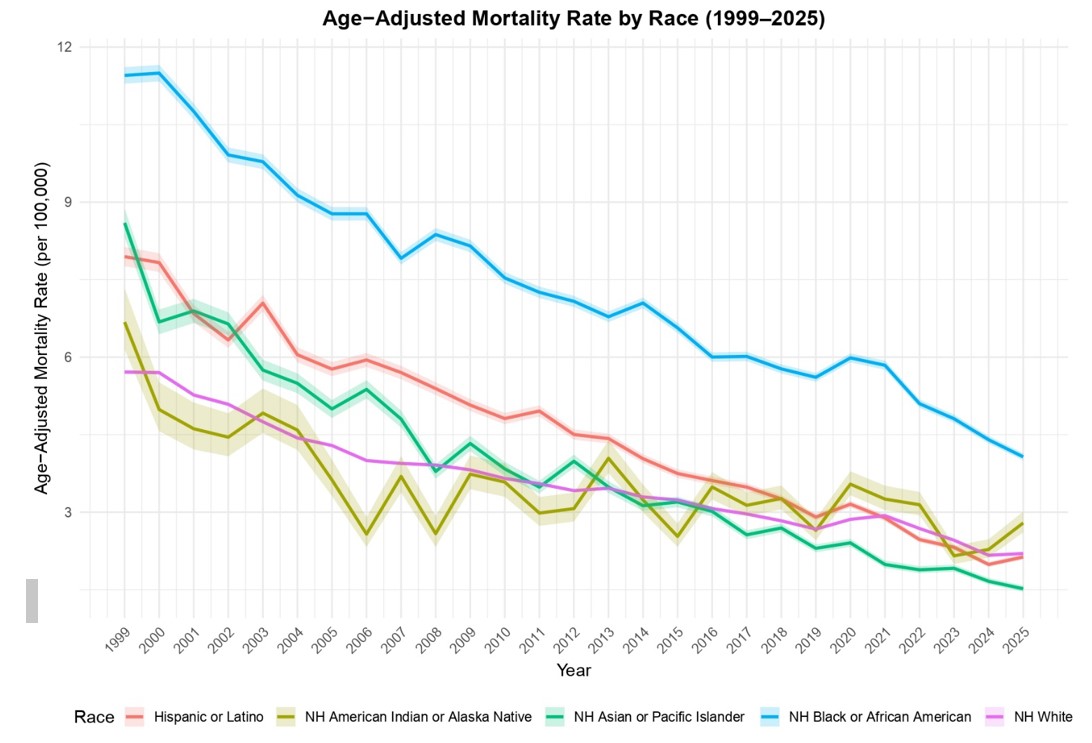
Across racial/ethnic groups, the highest overall AAMR was observed among NH Black or African Americans (7.42; 95% CI: 7.05 to 7.79), followed by Hispanics (4.62; 95% CI: 4.27 to 4.97), NH Asian or Pacific Islanders (3.94; 95% CI: 3.50 to 4.39), NH Whites (3.64; 95% CI: 3.56 to 3.73), and NH American Indian or Alaska Natives (3.54; 95% CI: 2.63 to 4.67). Distinct trends were observed among these groups [NH American Indian or Alaska Natives: AAPC: -2.92 (95% CI: -3.92 to -1.59; p < 0.001); NH Asian or Pacific Islanders: AAPC: -5.74 (95% CI: -6.14 to -5.35; p < 0.001); NH Blacks: AAPC: -3.90 (95% CI: -4.31 to -3.67; p < 0.001); NH Whites: AAPC: -3.83 (95% CI: -4.18 to -3.54; p < 0.001); Hispanics: AAPC: -5.22( 95% CI: -5.76 to -4.78; p < 0.001)].
Among NH American Indian or Alaska Natives, mortality declined steeply from 6.68 in 1999 to 2.58 in 2006 (-7.26; 95% CI: -22.68 to -2.27; p < 0.011), with a non-significant change from 2.58 in 2006 to 2.79 in 2025 (-1.27; 95% CI: -2.69 to 5.69; p < 0.352). NH Asian or Pacific Islanders experienced a consistent and significant decline from 8.60 in 1999 to 1.52 in 2025 (-5.74; 95% CI: -6.14 to -5.35; p < 0.001). For NH Blacks, mortality decreased significantly from 11.45 in 1999 to 5.77 in 2018 (-3.49; 95% CI: -4.90 to -3.18; p < 0.024), showed a non-significant plateau with an AAMR of 5.77 in 2018 and 5.84 in 2021 (0.24; 95% CI: -3.17 to 1.97; p < 0.7), and declined markedly from 5.84 in 2021 to 4.07 in 2025 (-8.72; 95% CI: -13.88 to -6.62; p < 0.001). Among NH Whites, significant decreases were observed from 5.71 in 1999 to 4.00 in 2006 (-5.10; 95% CI: -7.15 to -4.08; p < 0.001), from 4.00 in 2006 to 2.68 in 2022 (-2.63; 95% CI: -2.94 to -0.97; p < 0.025), and from 2.68 in 2022 to 2.20 in 2025 (-7.15; 95% CI: -12.48 to -3.66; p < 0.001). Hispanics experienced a significant decline from 7.95 in 1999 to 3.16 in 2020 (-4.47; 95% CI: -4.79 to -3.81; p < 0.015), followed by a continued significant reduction from 3.16 in 2020 to 2.13 in 2025 (-8.30; 95% CI: -15.31 to -5.69; p < 0.001) Figure 2 and (Supplementary Table 3).
Age-Specific Trends
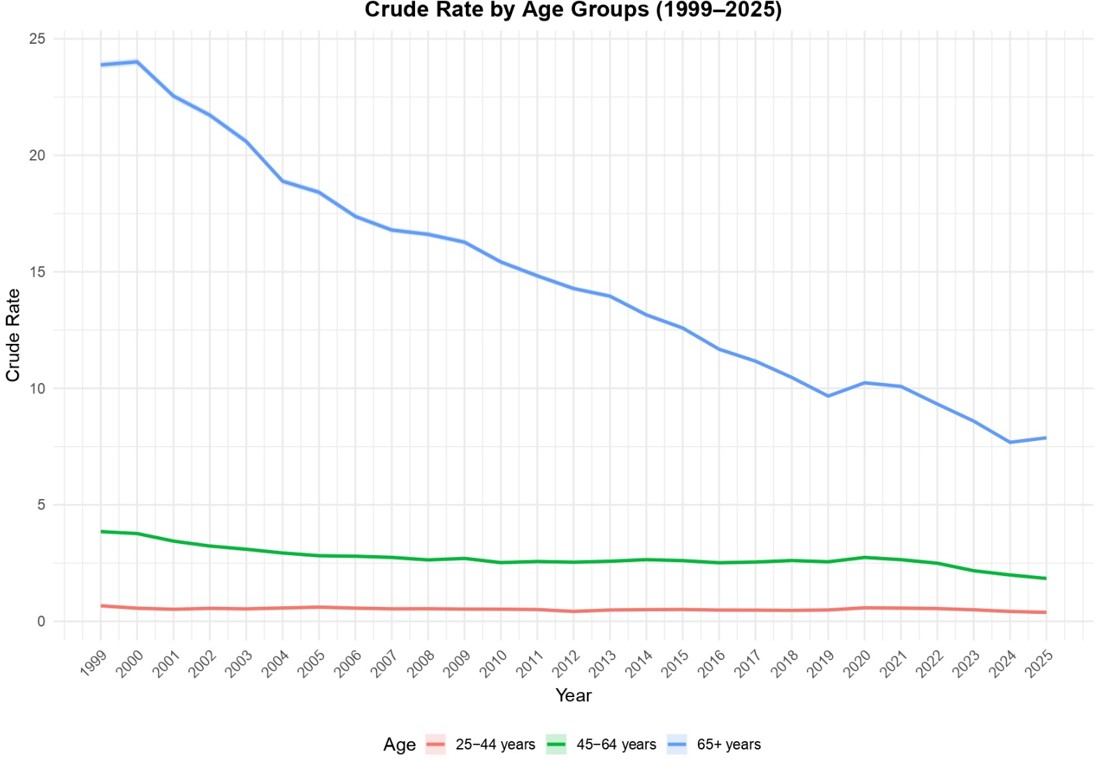
Age-specific CMRs demonstrated marked disparities across the study period. Adults aged 65+ years had the highest mortality (14.74; 95% CI: 14.38 to 15.10), followed by those aged 45-64 years (2.72; 95% CI: 2.61 to 2.84) and 25-44 years (0.52; 95% CI: 0.47 to 0.57). On average, 65+ years age group experienced greater decline in mortality over the study period, followed by 45-64 years age group and 25-44 years age group [65+ years: AAPC: -4.21 (95% CI: -4.39 to -4.03; p < 0.001); 45-64 years: AAPC: -2.86 (95% CI: -3.06 to -2.69; p < 0.001); 25-44 years: AAPC: -1.64 (95% CI: -2.20 to -1.28; p < 0.001)].
Among adults aged 25-44 years, CMR decreased from 0.67 in 1999 to 0.39 in 2025. Joinpoint analysis showed a modest decline from 0.67 in 1999 to 0.47 in 2018 (-1.30; 95% CI: -2.08 to -0.86; p < 0.001), a significant slight increase from 0.47 in 2018 to 0.57 in 2021 (8.49; 95% CI: 1.52 to 11.83; p < 0.006), and a significant decrease from 0.57 in 2021 to 0.39 in 2025 (-10.12; 95% CI: -16.29 to -6.65; p < 0.001).
Among adults aged 45-64 years, mortality decreased from 3.85 in 1999 to 1.84 in 2025. Significant reductions were observed from 3.85 in 1999 to 2.93 in 2004 (-5.63; 95% CI: -7.91 to -4.56; p < 0.001) and from 2.93 in 2004 to 2.52 in 2010 (-2.21; 95% CI: -3.65 to -0.62; p < 0.011). Mortality rates remained relatively stable from 2.52 in 2010 to 2.65 in 2021 (0.34; 95% CI: -0.04 to 1.22; p < 0.066), followed by a significant decline from 2.65 in 2021 to 1.84 in 2025 (-8.81; 95% CI: -10.25 to -7.10; p < 0.001).
Among adults aged ≥65 years, CMR declined markedly from 23.88 in 1999 to 7.88 in 2025, with a sustained, statistically significant reduction of -4.21 (95% CI: -4.39 to -4.03; p < 0.001), with no joinpoints identified Figure 3 and (Supplementary Table 4).
Discussion
In this nationwide analysis of mortality trends from cardiac arrest and cardiomyopathy among U.S. adults aged ≥25 years between 1999 and 2025, several important findings emerged. Overall mortality declined substantially during the study period, with age-adjusted mortality decreasing from 6.33 to 2.41 per 100,000. Males consistently demonstrated higher mortality rates than females, although both sexes experienced significant reductions over time. Significant racial disparities were observed, with NH Black individuals experiencing the highest mortality rates despite overall improvements across all racial and ethnic groups. Mortality increased markedly with age, with adults aged ≥65 years having the greatest burden of death. While mortality declined across most subgroups, temporary plateaus or slight increases occurred in some populations during the late 2010s and early 2020s.
The substantial decline in mortality observed in this study parallels improvements in cardiovascular care, emergency response systems, and resuscitation science over the past 27 years. Several population-based studies have reported improved survival following cardiac arrest due to enhanced emergency medical services (EMS), increased public awareness of cardiopulmonary resuscitation (CPR), and expanded availability of automated external defibrillators (AEDs). For example, analysis from the CARES registry demonstrated significant improvements in survival following out-of-hospital cardiac arrest in the United States between 2005 and 2012 [15]. Similarly, national analyses have documented improvements in survival from cardiac arrest in recent years, reflecting advances in resuscitation protocols and post-resuscitation care [16]. Improvements in in-hospital cardiac arrest outcomes have also been reported, with increasing survival rates observed over time in national registries [17].
Cardiomyopathies are important underlying causes of ventricular arrhythmias and sudden cardiac death. Inherited and acquired cardiomyopathies, including hypertrophic cardiomyopathy, dilated cardiomyopathy, and arrhythmogenic cardiomyopathy, are frequently implicated in cardiac arrest events [18]. Hypertrophic cardiomyopathy affects approximately 1 in 500 individuals and represents one of the most common genetic cardiovascular diseases associated with sudden cardiac death [19]. Dilated cardiomyopathy is another major cause of sudden cardiac death and advanced heart failure worldwide [20]. Risk stratification strategies, including the use of implantable cardioverter-defibrillators (ICDs), have significantly reduced sudden death risk in patients with cardiomyopathies [21]. Genetic screening and improved diagnostic imaging have also enhanced early identification of high-risk individuals with inherited cardiomyopathies [22].
Our findings demonstrate consistently higher mortality among males compared with females. This observation is consistent with prior studies showing that sudden cardiac death occurs more frequently in men [23]. Biological factors such as hormonal influences, electrophysiological differences, and variations in cardiac ion channel expression may contribute to sex-specific susceptibility to malignant arrhythmias [24]. Additionally, men generally have a higher prevalence of structural heart disease and ischemic heart disease, which increases the risk of ventricular arrhythmias and sudden cardiac death [25]. Nevertheless, improvements in cardiovascular care have led to declining mortality rates among both sexes over time.
Our study identified substantial racial disparities in cardiac arrest and cardiomyopathy-related mortality, with NH Black individuals experiencing the highest mortality rates. Previous research has demonstrated that Black populations in the United States experience higher rates of sudden cardiac death and cardiovascular mortality [26]. Multiple factors likely contribute to these disparities, including higher prevalence of hypertension, heart failure, and cardiomyopathy in Black populations [27,26]. Differences in socioeconomic status, healthcare access, and structural determinants of health also contribute to disparities in cardiovascular outcomes [27,28]. Importantly, several studies have demonstrated that Black individuals experiencing out-of-hospital cardiac arrest are less likely to receive bystander CPR, which significantly influences survival outcomes [29].
Age was strongly associated with mortality in our analysis, with adults aged ≥65 years demonstrating the highest death rates. Aging is associated with structural and electrophysiological changes in the myocardium that increase susceptibility to arrhythmias and sudden cardiac death [30]. Older adults also have a higher prevalence of heart failure and cardiomyopathy, which further increases the risk of cardiac arrest [31]. Comorbidities and frailty may also contribute to poorer outcomes following cardiac arrest among elderly individuals [32,31]. Despite these challenges, improvements in cardiovascular care have led to declining mortality rates, even among older adults.
Furthermore, analysis of place-of-death data revealed that a substantial proportion of deaths occurred at home or in out-of-hospital settings. This pattern may reflect gaps in early recognition of cardiac events, delays in emergency response, limited access to timely medical care, or missed opportunities for bystander intervention. Higher home-based mortality underscores the importance of targeted community education, widespread CPR training, rapid EMS dispatch, and improved access to preventive care for high-risk populations.
Future Directions
Future directions for research on cardiac arrest and cardiomyopathy-related mortality in the United States should focus on integrating granular clinical data, including comorbidities, treatment modalities, and genetic profiles, to better elucidate mechanisms underlying observed disparities. Prospective studies evaluating the impact of early detection strategies, personalized risk stratification, and targeted interventions such as widespread use of implantable cardioverter-defibrillators and community-based CPR training are warranted. Additionally, research should examine the influence of socioeconomic factors, healthcare access, and regional variations to develop equitable prevention and management strategies that further reduce mortality across high-risk populations.
Strengths
This study has several notable strengths. First, it utilized a large nationwide mortality database spanning more than two decades, enabling comprehensive evaluation of long-term epidemiological trends. Second, the use of age-adjusted mortality rates allowed accurate comparisons across demographic groups and time periods. Third, detailed stratification by sex, race/ethnicity, and age provided important insights into demographic disparities in cardiac arrest and cardiomyopathy-related mortality. Finally, the application of joinpoint regression allowed identification of temporal changes in mortality patterns and potential shifts in epidemiologic trends.
Limitations
Several limitations should be considered when interpreting these findings. First, this analysis relied on death certificate data from the CDC WONDER database, which may be subject to misclassification or inaccuracies in cause-of-death reporting. Variability in death-certificate completion and differences by certifier type (e.g., physician vs. medical examiner/coroner) could further affect accuracy. Second, the database lacks detailed clinical information, including comorbidities, disease severity, and treatment modalities, which limits the ability to explore mechanisms underlying observed mortality trends. Third, the data do not distinguish between out-of-hospital and in-hospital cardiac arrest events and may reflect differences in access to care, emergency response, and missed opportunities for intervention. Fourth, socioeconomic variables and healthcare access indicators were unavailable, preventing further investigation into factors contributing to the observed disparities. Additionally, in accordance with CDC WONDER data-use policies, cells with fewer than 10 deaths are suppressed and were excluded from subgroup analyses; this suppression may introduce bias in smaller demographic strata and could slightly underestimate mortality rates in certain subgroups, as well as affect trend estimates in less populous groups. Finally, as an observational analysis of ecological mortality data, causal or individual-level inferences cannot be drawn, and temporal or coding changes over the study period may have influenced trends.
Conclusion
Mortality related to cardiac arrest and cardiomyopathy in the United States declined substantially between 1999 and 2025. Despite these improvements, significant disparities persist across sex, race, and age groups. Males and NH Black individuals continue to experience disproportionately higher mortality rates, and older adults remain the most affected population. Continued efforts to improve early identification and management of cardiomyopathies, expand access to high-quality emergency cardiovascular care, and address structural health disparities are essential to further reduce mortality and improve outcomes.
Conflicts of Interest
The authors declare no competing interests that could have influenced the objectivity or outcome of this research.
Funding Source
No financial support was received for the study.
Acknowledgments
None.
Institutional Review Board (IRB)
Institutional Review Board approval was not required for this study because it used publicly available, de-identified data.
Large Language Model
No large language model tools were used in the preparation of this manuscript.
Authors Contribution
MA and MFH conceived the study and designed the research framework. AE, MS, AAI, MRF, and RM were responsible for data extraction, formal analysis, and drafting the initial manuscript. BH, MZ, AI, KOA, WB, HAM, EA, and MMAM contributed to data analysis, literature review, and critical revisions of the manuscript for intellectual content. IU and MFH provided overall supervision, project administration, and final approval of the published version. All authors have read and agreed to the published version of the manuscript and are accountable for the integrity of the work.
Data Availability
The data that support the findings of this study are openly available in CDC‐WONDER at https://wonder.cdc.gov/. The data supporting the findings of this study were obtained from the CDC WONDER online database (Centers for Disease Control and Prevention Wide‐ranging Online Data for Epidemiologic Research). Further inquiries can be directed to the corresponding author.
References
- Martin S. S., Aday A. W., Allen N. B., Almarzooq Z. I., Anderson C. A. M., Arora P., Avery C. L., Baker-Smith C. M., Bansal N., Beaton A. Z., Commodore-Mensah Y., Currie M. E., Elkind M. S. V., Fan W., Generoso G., Gibbs B. B., Heard D. G., Hiremath S., Johansen M. C., Kazi D. S., Ko D., Leppert M. H., Magnani J. W., Michos E. D., Mussolino M. E., Parikh N. I., Perman S. M., Rezk-Hanna M., Roth G. A., Shah N. S., Springer M. V., St-Onge M. P., Thacker E. L., Urbut S. M., Van Spall H. G. C., Voeks J. H., Whelton S. P., Wong N. D., Wong S. S., Yaffe K., Palaniappan L. P., American Heart Association Council on Epidemiology and Prevention Statistics Committee and Stroke Statistics Committee. 2025 Heart Disease and Stroke Statistics: A Report of US and Global Data From the American Heart Association. Circulation. 2025;151(8):e41-e660. doi:10.1161/CIR.0000000000001303 PMID: 39866113 PMCID: PMC12256702
- Tsao C. W., Aday A. W., Almarzooq Z. I., Anderson C. A. M., Arora P., Avery C. L., Baker-Smith C. M., Beaton A. Z., Boehme A. K., Buxton A. E., Commodore-Mensah Y., Elkind M. S. V., Evenson K. R., Eze-Nliam C., Fugar S., Generoso G., Heard D. G., Hiremath S., Ho J. E., Kalani R., Kazi D. S., Ko D., Levine D. A., Liu J., Ma J., Magnani J. W., Michos E. D., Mussolino M. E., Navaneethan S. D., Parikh N. I., Poudel R., Rezk-Hanna M., Roth G. A., Shah N. S., St-Onge M. P., Thacker E. L., Virani S. S., Voeks J. H., Wang N. Y., Wong N. D., Wong S. S., Yaffe K., Martin S. S., American Heart Association Council on Epidemiology and Prevention Statistics Committee and Stroke Statistics Subcommittee. Heart Disease and Stroke Statistics-2023 Update: A Report From the American Heart Association. Circulation. 2023;147(8):e93-e621. doi:10.1161/CIR.0000000000001123 PMID: 36695182 PMCID: PMC12135016
- Tseng Z. H., Nakasuka K.. Out-of-Hospital Cardiac Arrest in Apparently Healthy, Young Adults. JAMA. 2025;333(11):981-996. doi:10.1001/jama.2024.27916 PMID: 39976933 PMCID: PMC12107904
- Basit H, Alahmadi MH, Rout P. Hypertrophic Cardiomyopathy [Internet]. 2026.
- Massera D., Sherrid M. V., Maron M. S., Rowin E. J., Maron B. J.. How common is hypertrophic cardiomyopathy... really?: Disease prevalence revisited 27 years after CARDIA. Int J Cardiol. 2023;382:64-67. doi:10.1016/j.ijcard.2023.04.005 PMID: 37028711
- Monda E., Limongelli G., Pelliccia F.. Hypertrophic Cardiomyopathy-Current Challenges and Future Perspectives. J Clin Med. 2023;12(18). doi:10.3390/jcm12186093 PMID: 37763033 PMCID: PMC10531662
- Javaid S. S., Ashraf S. U., Khan A., Irfan M., Alamgir M. U., Ahmed Jilanee S. D., Faisal H., Peryani M. S., Ul Ain N., Khan I.. Demographic and regional mortality trends in dilated cardiomyopathy in the United States; 1999-2020. SAGE Open Med. 2025;13:20503121251329806. doi:10.1177/20503121251329806 PMID: 40143927 PMCID: PMC11938866
- Gonuguntla K., Chobufo M. D., Shaik A., Roma N., Penmetsa M., Thyagaturu H., Patel N., Taha A., Alruwaili W., Bansal R., Khan M. Z., Sattar Y., Balla S.. Temporal Trends in Race and Sex Differences in Cardiac Arrest Mortality in the USA, 1999-2020. J Cardiol. 2025;85(2):63-68. doi:10.1016/j.jjcc.2024.08.006 PMID: 39154781
- Jain V., Rao B., Knijnik L., Shah A. D., Lloyd M. S., El-Chami M. F., Bhatia N., Westerman S., Merchant F. M.. Rising burden of cardiac arrest- and heart failure-related mortality in the United States from 1999 to 2020. Heart Rhythm O2. 2024;5(4):254-255. doi:10.1016/j.hroo.2024.03.001 PMID: 38690139 PMCID: PMC11056454
- Marijon E., Narayanan K., Smith K., Barra S., Basso C., Blom M. T., Crotti L., D'Avila A., Deo R., Dumas F., Dzudie A., Farrugia A., Greeley K., Hindricks G., Hua W., Ingles J., Iwami T., Junttila J., Koster R. W., Le Polain De Waroux J. B., Olasveengen T. M., Ong M. E. H., Papadakis M., Sasson C., Shin S. D., Tse H. F., Tseng Z., Van Der Werf C., Folke F., Albert C. M., Winkel B. G.. The Lancet Commission to reduce the global burden of sudden cardiac death: a call for multidisciplinary action. Lancet. 2023;402(10405):883-936. doi:10.1016/S0140-6736(23)00875-9 PMID: 37647926
- Hemida M. F., Ibrahim A. A., Shahriar Z., Khalid M., Zeeshan N., Qaisi W., Hussein M., Sarfraz M. R., Rabie O. M., Saghir M., Saghir E., Jalal A. A., Alagamy M., Tabasum P., Ahmed R.. Mortality trends in multiple sclerosis and cardiovascular disease in adults in the United States: A 25-year mortality perspective. Mult Scler Relat Disord. 2026;105:106861. doi:10.1016/j.msard.2025.106861 PMID: 41308235
- Hemida M. F., Ibrahim A. A., Zeeshan N., Faisal M. R., Patel K., Hussein M., Dessouky A. K., Saghir M., Saghir E., Sarfraz M. R., Shahriar Z., Kadour M. A. H., Elbanna A. F., Rahma Dawelbait M. A., Ali M. F., Abdelkhalek A. M., Sayed R., Ali K.. Trends and disparities in aortic dissection mortality in the united states: a retrospective analysis. BMC Cardiovasc Disord. 2026;26(1):66. doi:10.1186/s12872-025-05446-5 PMID: 41572202 PMCID: PMC12825201
- von Elm E., Altman D. G., Egger M., Pocock S. J., Gotzsche P. C., Vandenbroucke J. P., STROBE Initiative. The Strengthening the Reporting of Observational Studies in Epidemiology (STROBE) statement: guidelines for reporting observational studies. J Clin Epidemiol. 2008;61(4):344-9. doi:10.1016/j.jclinepi.2007.11.008 PMID: 18313558
- Anderson R. N., Rosenberg H. M.. Age standardization of death rates: implementation of the year 2000 standard. Natl Vital Stat Rep. 1998;47(3):1-16, 20. PMID: 9796247
- Chan P. S., McNally B., Tang F., Kellermann A., CARES Surveillance Group. Recent trends in survival from out-of-hospital cardiac arrest in the United States. Circulation. 2014;130(21):1876-82. doi:10.1161/CIRCULATIONAHA.114.009711 PMID: 25399396 PMCID: PMC4276415
- Odom E., Nakajima Y., Vellano K., Al-Araji R., Coleman King S., Zhang Z., Merritt R., McNally B.. Trends in EMS-attended out-of-hospital cardiac arrest survival, United States 2015-2019. Resuscitation. 2022;179:88-93. doi:10.1016/j.resuscitation.2022.08.003 PMID: 35944819
- Holmberg M. J., Wiberg S., Ross C. E., Kleinman M., Hoeyer-Nielsen A. K., Donnino M. W., Andersen L. W.. Trends in Survival After Pediatric In-Hospital Cardiac Arrest in the United States. Circulation. 2019;140(17):1398-1408. doi:10.1161/CIRCULATIONAHA.119.041667 PMID: 31542952 PMCID: PMC6803102
- Polovina M., Tschope C., Rosano G., Metra M., Crea F., Mullens W., Bauersachs J., Sliwa K., de Boer R. A., Farmakis D., Thum T., Corrado D., Bayes-Genis A., Bozkurt B., Filippatos G., Keren A., Skouri H., Moura B., Volterrani M., Abdelhamid M., Asanin M., Krljanac G., Tomic M., Savarese G., Adamo M., Lopatin Y., Chioncel O., Coats A. J. S., Seferovic P. M.. Incidence, risk assessment and prevention of sudden cardiac death in cardiomyopathies. Eur J Heart Fail. 2023;25(12):2144-2163. doi:10.1002/ejhf.3076 PMID: 37905371
- Stroumpoulis K. I., Pantazopoulos I. N., Xanthos T. T.. Hypertrophic cardiomyopathy and sudden cardiac death. World J Cardiol. 2010;2(9):289-98. doi:10.4330/wjc.v2.i9.289 PMID: 21160605 PMCID: PMC2998829
- Mahmaljy H, Yelamanchili VS, Singhal M. Dilated Cardiomyopathy [Internet]. 2026.
- Ruscio E., Scacciavillani R., Gurgoglione F. L., Pinnacchio G., Bencardino G., Perna F., Narducci M. L., Pelargonio G., Niccoli G., Locorotondo G., Burzotta F.. Risk Stratification and Optimal Use of Implantable Cardioverter-Defibrillator Therapy in Primary Prevention of Sudden Cardiac Death in Genetic Cardiomyopathies, with Assessment of the Role of Genetic Variants in Guiding Therapeutic Decisions. Biomedicines. 2025;13(11). doi:10.3390/biomedicines13112626 PMID: 41301721 PMCID: PMC12650546
- Aiyer S., Kalutskaya E., Agdamag A. C., Tang W. H. W.. Genetic Evaluation and Screening in Cardiomyopathies: Opportunities and Challenges for Personalized Medicine. J Pers Med. 2023;13(6). doi:10.3390/jpm13060887 PMID: 37373876 PMCID: PMC10302702
- Butters A., Arnott C., Sweeting J., Winkel B. G., Semsarian C., Ingles J.. Sex Disparities in Sudden Cardiac Death. Circ Arrhythm Electrophysiol. 2021;14(8):e009834. doi:10.1161/CIRCEP.121.009834 PMID: 34397259
- Zaman S., Deshmukh T., Aslam A., Martin C., Kovoor P.. Sex Differences in Electrophysiology, Ventricular Tachyarrhythmia, Cardiac Arrest and Sudden Cardiac Death Following Acute Myocardial Infarction. Heart Lung Circ. 2020;29(7):1025-1031. doi:10.1016/j.hlc.2019.07.017 PMID: 31558356
- Skjelbred T., Rajan D., Svane J., Lynge T. H., Tfelt-Hansen J.. Sex differences in sudden cardiac death in a nationwide study of 54 028 deaths. Heart. 2022;108(13):1012-1018. doi:10.1136/heartjnl-2021-320300 PMID: 35277455
- Zhao D., Post W. S., Blasco-Colmenares E., Cheng A., Zhang Y., Deo R., Pastor-Barriuso R., Michos E. D., Sotoodehnia N., Guallar E.. Racial Differences in Sudden Cardiac Death. Circulation. 2019;139(14):1688-1697. doi:10.1161/CIRCULATIONAHA.118.036553 PMID: 30712378 PMCID: PMC6443438
- Abrahamowicz A. A., Ebinger J., Whelton S. P., Commodore-Mensah Y., Yang E.. Racial and Ethnic Disparities in Hypertension: Barriers and Opportunities to Improve Blood Pressure Control. Curr Cardiol Rep. 2023;25(1):17-27. doi:10.1007/s11886-022-01826-x PMID: 36622491 PMCID: PMC9838393
- Schultz W. M., Kelli H. M., Lisko J. C., Varghese T., Shen J., Sandesara P., Quyyumi A. A., Taylor H. A., Gulati M., Harold J. G., Mieres J. H., Ferdinand K. C., Mensah G. A., Sperling L. S.. Socioeconomic Status and Cardiovascular Outcomes: Challenges and Interventions. Circulation. 2018;137(20):2166-2178. doi:10.1161/CIRCULATIONAHA.117.029652 PMID: 29760227 PMCID: PMC5958918
- Garcia R. A., Spertus J. A., Girotra S., Nallamothu B. K., Kennedy K. F., McNally B. F., Breathett K., Del Rios M., Sasson C., Chan P. S.. Racial and Ethnic Differences in Bystander CPR for Witnessed Cardiac Arrest. N Engl J Med. 2022;387(17):1569-1578. doi:10.1056/NEJMoa2200798 PMID: 36300973 PMCID: PMC9760357
- North B. J., Sinclair D. A.. The intersection between aging and cardiovascular disease. Circ Res. 2012;110(8):1097-108. doi:10.1161/CIRCRESAHA.111.246876 PMID: 22499900 PMCID: PMC3366686
- Strait J. B., Lakatta E. G.. Aging-associated cardiovascular changes and their relationship to heart failure. Heart Fail Clin. 2012;8(1):143-64. doi:10.1016/j.hfc.2011.08.011 PMID: 22108734 PMCID: PMC3223374
- Hamlyn J., Lowry C., Jackson T. A., Welch C.. Outcomes in adults living with frailty receiving cardiopulmonary resuscitation: A systematic review and meta-analysis. Resusc Plus. 2022;11:100266. doi:10.1016/j.resplu.2022.100266 PMID: 35812717 PMCID: PMC9256816