Twenty-Five Years of Angina–Related Mortality in Elderly Adults Aged ≥ 65 Years: A Retrospective Cohort Study Using Real-World Data from the USA
Mohamed Fawzi HemidaⒾ1, Alyaa Ahmed IbrahimⒾ1*, Anika GoelⒾ2, Mirna HusseinⒾ1, Krish PatelⒾ3, Muhammad Raza SarfrazⒾ4, Omar Y. AlkasabrahⒾ5, Maryam SaghirⒾ6, Komal KarmaniⒾ7, Eshal SaghirⒾ8, Zahin ShahriarⒾ9, Safeya FawziⒾ10, Ahmed BahnasyⒾ11, Muhammad Faizan AliⒾ12, Amro AliⒾ13, Ahmad M. AbdelkhalekⒾ14, Raheel AhmedⒾ15
- 1Faculty of Medicine, Alexandria University, Alexandria, Egypt
- 2Department of Medicine, Kakatiya Medical College, Warangal, Telangana, India
- 3Department of Medicine, C. U. Shah Medical College, Surendranagar, Gujarat, India
- 4Department of Medicine, Bahria University Health Sciences Campus, Karachi, Pakistan
- 5Department of Internal Medicine, New York Medical College / Landmark Medical Center, Woonsocket, Rhode Island, USA
- 6Department of Medicine, Jinnah Sindh Medical University, Karachi, Pakistan
- 7Department of Medicine, Liaquat University of Medical and Health Sciences, Jamshoro, Pakistan
- 8Department of Medicine, Dow University of Health Sciences, Karachi, Pakistan
- 9Department of Internal Medicine, Dhaka Medical College Hospital, Dhaka, Bangladesh
- 10Faculty of Nursing, Matrouh University, Marsa Matrouh, Egypt
- 11Department of Cardiovascular Medicine, Mayo Clinic, Rochester, Minnesota, USA
- 12Department of Cardiology, Jinnah Postgraduate Medical Center, Karachi, Pakistan
- 13Department of Medicine, Community Regional Medical Center, Fresno, California, USA
- 14Department of Internal Medicine, Northwestern Medicine McHenry Hospital / Rosalind Franklin University, Chicago, USA
- 15National Heart and Lung Institute, Imperial College London, London, England
Abstract
Introduction: Angina is one of the ischemic heart diseases (IHD) that contributes to major cardiovascular complications up to death. We aim to assess angina-related mortality among adults aged ≥ 65 years in the U.S.
Methods: Nationwide mortality records were obtained from the CDC-WONDER database from 1999 to 2023 among U.S. adults aged ≥ 65 with angina. Age-adjusted mortality rates (AAMRs) were calculated per 100,000 population. Joinpoint regression analysis was utilized to evaluate average annual percent changes (AAPCs).
Results: From 1999 to 2023, a total of 36,544 deaths occurred among the elderly with angina in the U.S. The overall AAMR per 100,000 decreased from 7.52 in 1999 to 3.73 in 2023 (AAPC of -3.18; 95%CI: -3.79 to -2.75; p < 0.001). The AAMR for men decreased from 8.22 in 1999 to 4.75 in 2023 (AAPC of -2.53%; 95%CI: -3.02 to -2.09), and for women decreased from 6.95 in 1999 to 3.02 in 2023 (AAPC: -3.55%; 95%CI: -4.12 to -3.09). Across racial/ethnic groups, the highest overall rates were observed among NH-White individuals, 3.56. Overall, AAMRs were highest in the West, 4.00. The majority of deaths occurred in medical facilities (40.19%). Between 1999 and 2020, rural areas had a higher overall AAMR of 4.37 compared to urban areas, which had a rate of 3.02.
Conclusion: Trends in angina-related mortality declined from 1999 to 2023. Higher mortality rates were observed in men, rural areas, the West region, and among NH White individuals. Our findings indicated that these categories require targeted interventions to reduce mortality.
Keywords: Angina, Trends, Mortality, Ischemic heart disease (IHD), Cardiovascular
Article information
Introduction
Angina is a clinical manifestation of chest discomfort that occurs when myocardial oxygen supply does not meet myocardial demand, resulting in ischemia [1]. Angina occurs in about 10 million adults in the United States and has over 500,000 new cases per year diagnosed [2]. Recent estimates of the National Health Interview Survey (NHIS) describe an overall prevalence of 1.5–1.7% (2019–2023), increasing to 4.5% among adults 75 years old [3].
In the elderly population, the symptomatic and prognostic burden of angina pectoris is considerable. In a study of an outpatient cohort with coronary artery disease, approximately 21% reported angina at least monthly, and 12.5% experienced symptoms on a weekly or daily basis [4]. Despite this high prevalence, angina is often under-recognized by health care providers, a gap that is associated with greater morbidity and mortality in clinical settings [5]. Beyond obstructive CAD, many females, particularly in late life, experience ischemia with non-obstructive coronary arteries (INOCA) due to microvascular dysfunction or vasospasm, contributing to recurrent angina and adverse outcomes [6,7]. These features illustrate why it’s essential to examine angina-related mortality rather than relying solely on aggregated ischemic categories [8].
National trends in cardiovascular mortality have demonstrated variations over the years. While overall cardiovascular deaths had steadily declined for decades, recent evidence shows that these gains have plateaued in the past decade [9,10]. Additionally, the COVID-19 pandemic was linked to an alarming reversal of the trends for the country as excess cardiovascular deaths were witnessed nationwide [11]. Despite the changes observed above, little insight has been available on the evolution of mortality associated with angina over time at the population level.
In this study, we aimed to investigate the temporal, geographical, and demographic trends in angina-related mortality among adults aged 65 years and older in the United States from 1999 to 2023. Tracking anginal mortality trends identifies populations at the highest risk and guides evidence-based approaches to reduce disparities in cardiovascular outcomes.
Methods
Study Setting and Population
In this retrospective cohort study, we analyzed temporal trends in mortality using death certificate data retrieved from the Centers for Disease Control and Prevention’s Wide-ranging Online Data for Epidemiologic Research (CDC WONDER) database. We analyzed data for adults aged 65 and older between 1999 and 2023 to assess outcomes related to angina mortality. Diagnostic coding was employed using the International Statistical Classification of Diseases and Related Health Problems-10th Revision (ICD-10) to identify Angina on death certificates by using the codes [I20.0, I20.1, I20.8, I20.9]. The primary outcome of this study was Angina-related mortality. This was identified using publicly available Multiple Cause-of-Death mortality data from the CDC WONDER database. Deaths were included if Angina was listed anywhere on the death certificate, either as the underlying cause of death or as one of the contributing causes of death. This comprehensive approach ensures the capture of all deaths where Angina played a documented role, regardless of its position on the death certificate [12]. Those aged 65 or older have been identified in similar studies related to cardiovascular diseases [13]. Furthermore, data of Institutional review board approval was not required for this study as it used de-identified public use data provided by the government and adhered to the STROBE (Strengthening the Reporting of Observational Studies in Epidemiology) guidelines for reporting [14].
Data Abstraction
Data on population size, year, and demographics, including sex, age, race, region, and state, were extracted. Place of death was categorized into medical facilities, hospice, home, and nursing Home/Long-Term care facilities. Racial and ethnic categories were classified as non-Hispanic (NH) white, NH Black or African American, and Hispanic or Latino. As we ensured data availability and reliability, racial/ethnic groups (NH American Indian or Alaska Native, and NH Asian or Pacific Islander) were excluded from trend analysis due to small numbers and data suppression. Including these suppressed data points would have led to unreliable estimates and incomplete trend analyses, particularly for assessing disparities. The National Center for Health Statistics Urban-Rural Classification Scheme was used to assess the population by urban (large metropolitan area [population 1 million], medium/small metropolitan area [population 50,000–999,999]) and rural (population 50,000) counties per the 2013 U.S. census classification. It is important to note that urban-rural data were consistently available and analyzed only for the period 1999–2020 due to historical limitations in CDC WONDER stratifications [15]. Regions were stratified into Northeast, Midwest, South, and West according to the U.S. Census Bureau definitions [16].
Statistical Analysis
Crude and age-adjusted mortality rates (CMRs and AAMRs) per 100,000 population from 1999 to 2023, by year, sex, race/ethnicity, state, and urban-rural status, were calculated for the years 1999-2020, with 95% CIs, using the 2000 U.S. population as the standard [17]. Age standardization was performed using this standard to ensure comparability across years and demographic subgroups. These comprised sex, race/ethnicity, age based on predefined classification, spatial region, and rural–urban residence. Furthermore, the use of CDC WONDER provided standardized definitions, authenticated data collection, and nationwide representation, which strengthened the applicability and credibility of our results, as demonstrated in prior studies [18,19]. CMRs were determined by dividing the number of Angina deaths by the corresponding U.S. population of that year. The Joinpoint Regression Program (Version 5.4.0.0, National Cancer Institute) was employed to analyze trends in AAMR over time [20]. This method identifies points where the rate of change of the trend is statistically significant (joinpoints) and estimates the Annual Percent Change (APC) for each segment. The model selection procedure utilized permutation tests to determine the optimal number of joinpoints, with a maximum of three joinpoints allowed. Once the final model was selected, t-tests were applied to assess whether the APC for each segment was significantly different from zero. The Average Annual Percent Change (AAPC) was calculated to summarize the overall trend across the entire study period. Results are presented with 95% Confidence Intervals.
Results
Overall Trends
Over the period from 1999 to 2023, a cumulative total of 36,544 deaths attributed to Angina were documented in the United States among adults aged 65 years and older. Data on the location of death were available for 34,986 cases, indicating that 40.19% occurred in medical facilities, 32.21% at the decedent’s residence, 25.27% in nursing homes or long-term care facilities, and 2.31% in hospice settings (Supplemental Tables 1, 2).
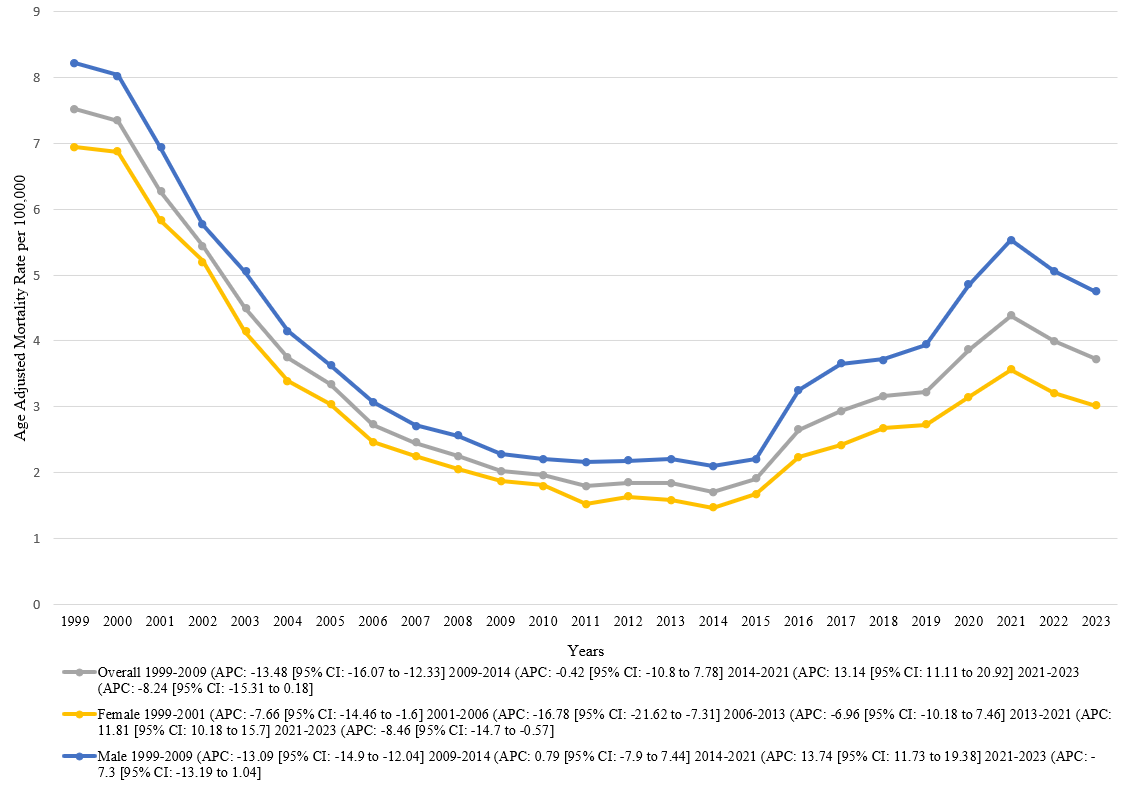
Across the 25-year study period, the AAMR for Angina showed a gradual overall decline from 7.5 per 100,000 in 1999 to 3.7 per 100,000 in 2023, corresponding to an AAPC of (95% CI: to ). Joinpoint regression identified distinct temporal phases. From 1999 to 2009, AAMR declined sharply (APC: ; 95% CI: to ), followed by a period of relative stabilization between 2009 and 2014 (APC: ; 95% CI: to ). Mortality rates then increased between 2014 and 2021 (APC: ; 95% CI: to ), before decreasing again from 2021 to 2023 (APC: ; 95% CI: to ) (Supplemental Tables 3, 4; Figure 1).
Gender Trends
Sex-related mortality patterns demonstrated distinct variations in magnitude and temporal change throughout the study period. Between 1999 and 2023, women experienced a higher cumulative mortality than men (19,991 vs. 16,553 deaths). Overall, AAMR declined in both sexes, with a steeper reduction among females—from 7.0 per 100,000 in 1999 to 3.0 per 100,000 in 2023 (AAPC: ; 95% CI: to )—compared to males, whose rates decreased from 8.2 to 4.8 per 100,000 during the same period (AAPC: ; 95% CI: to ).
Among males, AAMR decreased from 8.2 in 1999 to 2.3 in 2009 (APC: ; 95% CI: to ), followed by a period of stability until 2014 (APC: 0.8%; 95% CI: to 7.4). Rates then rose between 2014 and 2021 (APC: 13.7%; 95% CI: 11.7 to 19.4) before declining again to 4.8 in 2023 (APC: ; 95% CI: to 1.0).
Among females, AAMR initially declined from 7.0 in 1999 to 5.8 in 2001 (APC: ; 95% CI: to ), followed by a further decrease to 2.5 in 2006 (APC: ; 95% CI: to ). The rate then continued a gradual decline to 1.6 in 2013 (APC: ; 95% CI: to 7.5), increased between 2013 and 2021 (APC: 11.8%; 95% CI: 10.2 to 15.7), and finally declined again to 3.0 in 2023 (APC: ; 95% CI: to ) (Supplemental Tables 1, 3, 4; Figure 1).
Racial Trends
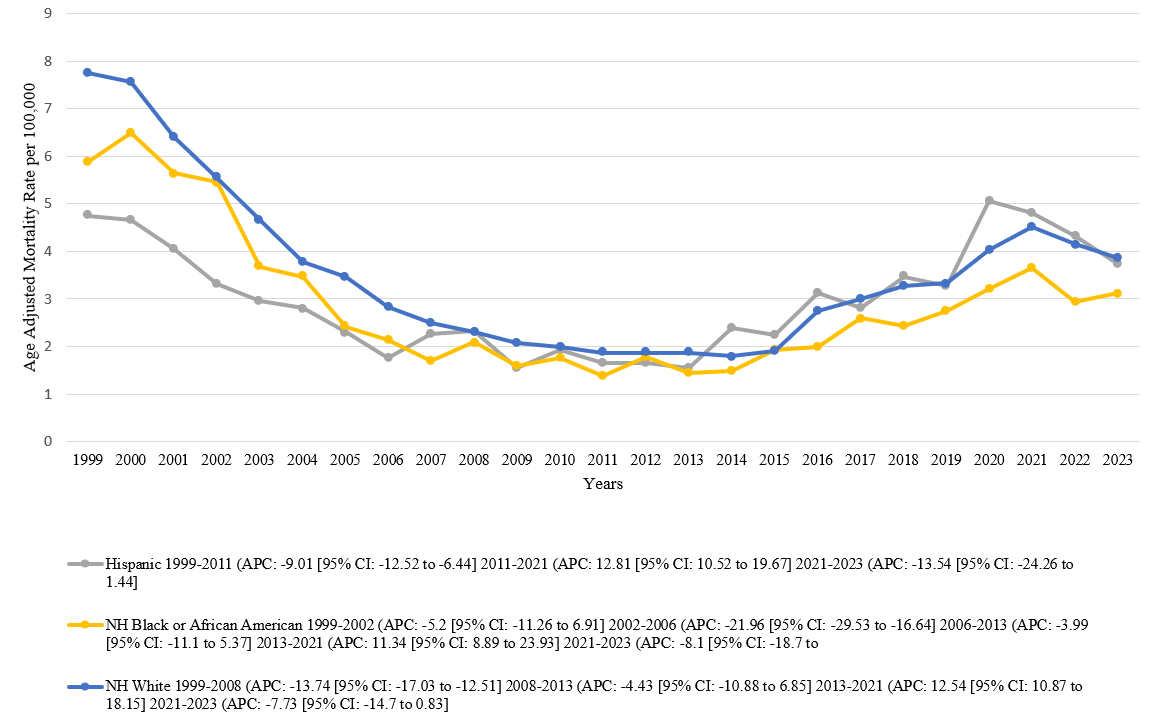
Across all racial demographic groups, the highest number of deaths occurred in NH-White individuals (32,960), followed by NH-Black or African American (2,582), while Hispanic or Latino had the lowest number of deaths (2,209). In terms of AAMR, highest overall rates were observed among NH-White individuals (3.6 per 100,000), followed by Hispanic or Latino (3.0), while NH- Black or African American individuals recorded the lowest overall AAMR (2.9). NH-White individuals showed an AAPC of -3.2% (95% CI: -3.8 to -2.8), Hispanic or Latino individuals exhibited an AAPC of -0.90% (95% CI: -1.9 to 0.2), and NH-Black or African American individuals demonstrated an AAPC of -3.1% (95% CI: -4.0 to -2.1).
Among NH-White individuals AAMR exhibited distinct phases, declining substantially from 1999-2008 with an APC of -13.7% (95% CI: -17.0 to -12.5), followed by a period of relative stability from 2008-2013 with APC of -4.4% (95% CI: -10.9 to 6.9). Subsequently, mortality rates showed an upward trend from 2013-2021 with APC of 12.5% (95% CI: 10.9 to 18.2), followed by a final decline from 2021-2023 with APC of -7.7% (95% CI: -14.7 to 0.8).
Among Hispanic or Latino individuals, AAMR revealed multiple phase transitions. Starting from an initial decline from 1999-2006, followed by frequent fluctuations through 2011, with an overall APC of -9.0% (95% CI: -12.5 to -6.4). Rates continued to decline from 2011-2013, then experienced renewed fluctuations through 2021 with APC of 12.8% (95% CI: 10.5 to 19.7). The final period from 2021-2023 showed a notable decline with APC of -13.5% (95% CI: -24.3 to 1.4).
Finally, for NH-Black or African American individuals, the AAMR demonstrated a complex pattern of changes starting from continuous fluctuation from 1999-2002 with APC of -5.2% (95% CI: -11.3 to 6.9) followed by a sudden significant decline from 2002-2006 with APC of -22.0% (95% CI: -29.5 to -16.6). Then a period of ongoing fluctuation occurred from 2006-2013 with APC of -4.0% (95% CI: -11.1 to 5.4), succeeded by an increasing trend from 2013-2021 with APC of 11.3% (95% CI: 8.9 to 23.9). A final period from 2021-2023 showed continued variability with APC of -8.1% (95% CI: -18.7 to 3.8) (Supplemental Tables 1, 3, 5; Figure 2).
Age-specific Trends
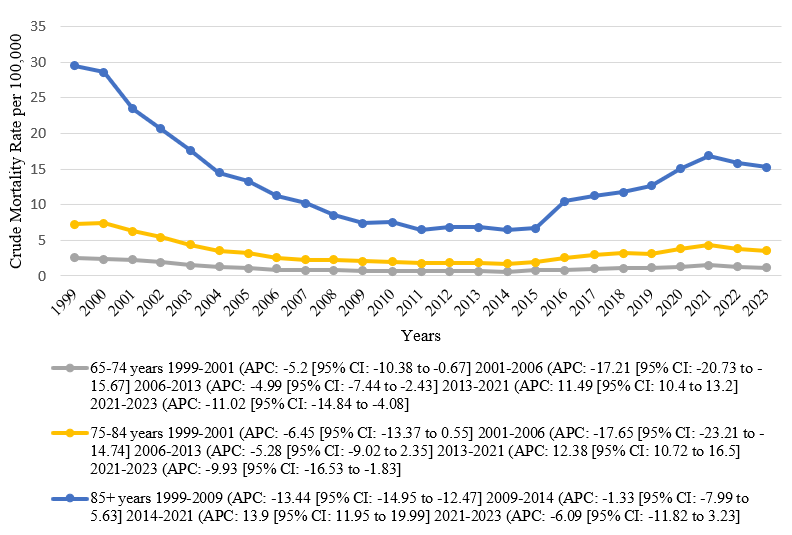
Throughout the study period, the CMR varied across age groups, with adults aged 85 years and older consistently exhibiting the highest rates compared with those aged 75- 84 and 65- 74 years. The overall CMR and average annual percent change (AAPC) were as follows: [85 years: CMR 13.4; AAPC (95% CI: to ), 75–84 years: CMR 3.4; AAPC (95% CI: to ), 65–74 years: CMR 1.2; AAPC (95% CI: to )].
Among adults aged 65–74 years, the CMR declined from 2.5 in 1999 to 2.2 in 2001 (APC: ; 95% CI: to ), followed by a steeper decrease to 0.9 in 2006 (APC: ; 95% CI: to ). Rates continued to decrease modestly until 2013 (0.7 per 100,000; APC: ; 95% CI: to ), then increased between 2013 and 2021 (1.49 per 100,000; APC: 11.5%; 95% CI: 10.4 to 13.2), before a final decline to 1.9 in 2023 (APC: ; 95% CI: to ).
For those aged 75–84 years, the CMR decreased from 7.3 in 1999 to 6.3 in 2001 (APC: ; 95% CI: to 0.6), then fell sharply to 2.5 in 2006 (APC: ; 95% CI: to ). This was followed by a gradual decline to 1.8 in 2013 (APC: ; 95% CI: to 2.4). Between 2013 and 2021, the rate rose to 4.3 per 100,000 (APC: 12.4%; 95% CI: 10.7 to 16.5), then declined slightly to 3.5 in 2023 (APC: ; 95% CI: to ).
Adults aged 85 years and older showed the greatest temporal variability, with CMR decreasing markedly from 29.5 in 1999 to 7.4 in 2009 (APC: ; 95% CI: to ), then continuing a slower decline to 6.5 in 2014 (APC: ; 95% CI: to ). This was followed by a rise to 16.9 in 2021 (APC: ; 95% CI: to ) and a modest decline to 15.2 in 2023 (APC: ; 95% CI: to ) (Supplemental Tables 3, 6; Figure 3).
Regional Trends
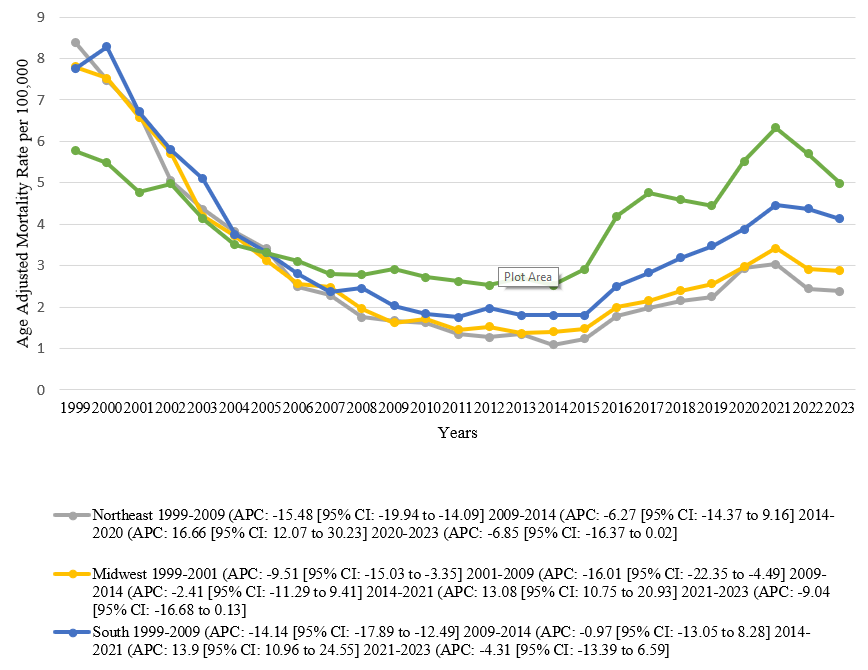
Regional analysis revealed notable geographic variation in mortality rates across the United States between 1999 and 2023. The Southern region recorded the highest number of deaths (13,600), followed by the Western (9,281), Northeastern (6,258), and Midwestern (4,705) regions. Despite regional differences in magnitude, all areas demonstrated an overall decline in AAMR over the study period. Across 1999–2023, the Western region exhibited the highest overall AAMR (4.0 per 100,000) with an average annual percent change (AAPC) of (95% CI: to 0.4), followed by the South (3.6 per 100,000; AAPC: ; 95% CI: to ), the Midwest (3.1 per 100,000; AAPC: ; 95% CI: to ), and the Northeast (3.0 per 100,000; AAPC: ; 95% CI: to ), which had the lowest overall rate.
In the West, AAMR declined from 5.8 in 1999 to 2.6 in 2011 (APC: ; 95% CI: to ), followed by fluctuating increases that peaked at 6.3 in 2021 (APC: 10.4%; 95% CI: 8.4 to 17.3), and a subsequent decline to 5.0 in 2023 (APC: ; 95% CI: to 4.5).
In the South, AAMR decreased from 7.8 in 1999 to 2.0 in 2009 (APC: ; 95% CI: to ), followed by a period of stabilization through 2014 (APC: ; 95% CI: to 8.3). Rates then rose to 4.5 in 2021 (APC: 13.9%; 95% CI: 11.0 to 24.6) and declined slightly thereafter to 4.1 in 2023 (APC: ; 95% CI: to 6.6).
The Midwest demonstrated an early decline in AAMR from 7.8 in 1999 to 6.6 in 2001 (APC: ; 95% CI: to ), followed by a steeper reduction to 1.6 in 2009 (APC: ; 95% CI: to ). Rates then fluctuated modestly, reaching 1.4 in 2014 (APC: ; 95% CI: to 9.4), increased to 3.4 in 2021 (APC: 13.1%; 95% CI: 10.8 to 20.9), and declined again to 2.9 in 2023 (APC: ; 95% CI: to 0.1).
In the Northeast, AAMR decreased markedly from 8.4 in 1999 to 1.7 in 2009 (APC: ; 95% CI: to ), continued to decline gradually to 1.1 in 2014 (APC: ; 95% CI: to 9.2), then increased to 2.9 in 2020 (APC: 16.7%; 95% CI: 12.1 to 30.2), and finally decreased to 2.4 in 2023 (APC: ; 95% CI: to 0.02) (Supplemental Tables 3, 7; Figure 4).
Urbanization Trends
Geographic disparities in AAMR persisted between 1999 and 2020, with metropolitan areas demonstrating higher mortality rates, 22,983, than their nonmetropolitan counterparts, 7,287. Although both regions experienced a decline in mortality, the reduction was more prominent in the Nonmetropolitan region, where the AAMR declined from 9.8 in 1999 to 4.6 in 2020, compared to a decline in the Metropolitan region from 7.0 in 1999 to 3.7 in 2020. The overall AAMR in the nonmetropolitan area was 4.4 with a corresponding AAPC of -3.7 (95% CI: -4.2 to -3.2), whereas in the metropolitan area, the overall AAMR was 3.0 with an AAPC of -3.1 (95% CI: -3.7 to -2.6).
Nonmetropolitan mortality patterns showed considerable variability across distinct phases. The AAMR initially declined modestly from 9.8 in 1999 to 9.5 in 2001, with an APC of -1.5 (95% CI: -7.8 to 3.4). Followed by a sharp decline through 2007, reaching 3.1 with an APC of -16.7 (95% CI: -20.8 to -15.2). The declining trend persisted but decelerated through 2014, showing 2.2 with an APC of -5.8 (95% CI: -8.5 to -2.6). From 2014 onward, mortality rates significantly increased to 4.6 by 2020 with an APC of 13.5 (95% CI: 10.8 to 17.3).
Metropolitan areas demonstrated a substantial AAMR decline from 1999 (6.98) to -2008 (2.04) in a curvilinear pattern with APC of -13.8 (95% CI: -17.5 to -12.4), followed by a period of relatively stable decline between 2008 (2.0*) and -2013 (1.8*) with APC of -3.0 (95% CI: -11.0 to 6.9). Lastly, until 2020, metropolitan areas experienced an upward trend in AAMR (3.7) with an APC of 12.4 (95% CI: 9.8 to 18.8) (Supplemental Tables 3, 8; Figure 5).
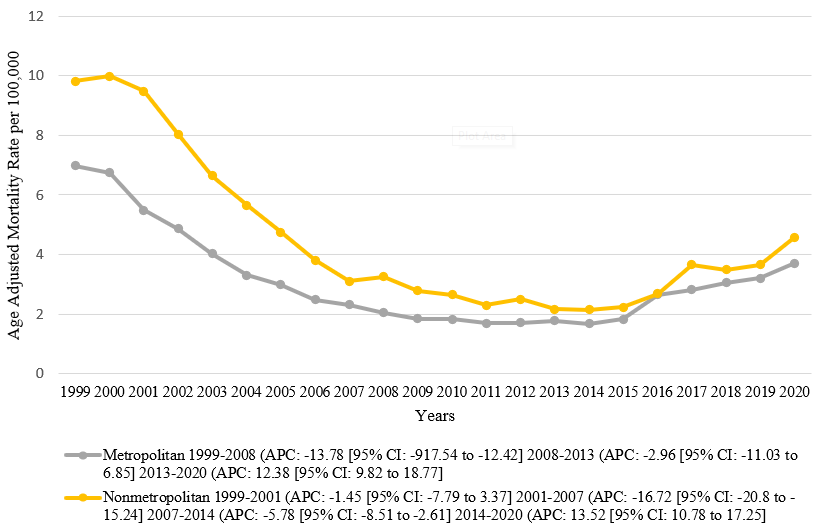
(*): Indicating potential instability for small strata.
Discussion
The current national study identified key trends in angina pectoris mortality among older adults in the United States over a 25-year period. In aggregate, mortality rates decreased over time, albeit with substantial interruptions and shifts in phase characterized by periods of decrease and increase. This decline corresponds to an absolute reduction of approximately 3.8 deaths per 100,000 older adults from 7.5 in 1999 to 3.7 in 2023, representing a meaningful reduction in population-level cardiovascular burden. When translated to the national scale, this equates to thousands of potentially avoided deaths over two decades, underscoring the clinical importance of even modest statistical trends.
Differences based on sex were apparent, with female adults having a greater proportional decrease in mortality, but cumulatively experiencing a larger number of deaths. Racial and ethnic group differences remain, with non-Hispanic White adults contributing the highest death counts to angina deaths. In contrast, the majority of deaths among Hispanic and Black populations varied more widely across time. Geographic variation was evident at the regional, state, and urbanization levels, with rural areas and certain western states bearing a greater burden compared to their metropolitan and northeastern counterparts. We found changes to the place of death, notably with medical institutions still being the most prevalent place of death. In contrast, a considerable number of deaths occurred in the home or long-term care facility, and trends in deaths in home and long-term care settings are indicative of a changing environment of care. These observations are consistent with well-documented declines in overall ischemic heart disease mortality since the end of the 20th century, which can be primarily attributed to improved primary prevention, better medications, and interventional cardiology [21,22,23]. These patterns likely mirror the broader uptake of evidence-based secondary prevention, including expanded statin use, antiplatelet therapy, cardiac rehabilitation participation, and improved access to revascularization procedures—collectively contributing to the observed mortality reduction. However, recent trends identified in this study represent a more general epidemiological shift: cardiovascular mortality in the United States plateaued, and in some sub-groups increased, after the early 2010s. These changes have been related to increased prevalence of obesity, diabetes (especially among older adults), and metabolic syndrome. As a chronic manifestation of coronary disease, angina therefore reflects this change, showing that while early benefits were substantial, two decades later, there are clear cracks in the ability to reduce risk in the long term [24,25].
The sex-related differences reported here support previous knowledge that women often experience angina differently than men, experience greater rates of ischemia with non-obstructive coronary arteries (INOCA), and microvascular dysfunction [26]. Epidemiology studies reflect that older women frequently report angina symptoms more, but are also much more likely to be underdiagnosed and undertreated. The larger declines in mortality among women as presented in this study may be suggestive of improved recognition of sex-specific symptoms and an increase or focus on secondary prevention [27,28,29].
Previous studies consistently showed that Black adults experience higher rates of cardiovascular mortality overall, driven by structural inequities in access to care, socioeconomic stressors, and a greater prevalence of uncontrolled hypertension and diabetes [30,31,32]. Yet in this study, non-Hispanic White adults accounted for the most significant proportion of angina deaths, aligning with their larger population denominator but also underscoring that angina as a diagnostic entity may be more consistently coded in this group. Hispanic and Black populations have substantially more fluctuation in the temporal patterns, which can be a function of exogenous variables, including sample size, health-seeking behavior, differences in treatment, and community-level determinants of health. As noted, this may be confounded by COVID-19 negatively affecting cardiovascular health in a profound way for a multitude of racial and ethnic minorities, inducing tremendous excess cardiovascular deaths during 2020–2021, which is highly congruent with the increases mid-decade and is apparent in multiple subgroups [33,34].
Regional disparities observed in this analysis align with prior evidence describing a persistent cardiovascular mortality gradient across the United States, particularly among rural populations in the South. Rural residents experience limited access to cardiology services, fewer preventive care resources, and greater socioeconomic disadvantage, all of which contribute to excess cardiovascular mortality [35,36]. Additional factors such as delayed presentation, longer emergency transport times, and fewer cardiac catheterization laboratories per capita further exacerbate these outcomes. Variations in state-level healthcare infrastructure, including Medicaid expansion status, hospital system performance, and provider workforce density, may also compound regional differences [37]. Interestingly, the Western region also exhibited higher mortality despite traditionally lower ischemic heart disease rates. Plausible hypotheses include the uneven distribution of healthcare resources across sparsely populated states, underdiagnosis of atypical angina or INOCA due to limited access to advanced diagnostics, and differences in death certification or documentation culture [38,39]. These explanations are presented as hypotheses rather than established causal mechanisms, and thus warrant further investigation.
The study of the place of death is clinically significant. The predominance of deaths in a hospital setting aligns with previous reports of cardiovascular mortality; however, the second-highest number of deaths occurs at home or in a long-term care facility, indicating a shift in end-of-life care processes [40,41]. However, interpretation of the rise in home and long-term care facility deaths during 2020–2021 should be made with caution. These patterns may also reflect COVID-19-related disruptions to access to acute care, hospital avoidance behavior, and potential shifts or reclassification in how the place of death was recorded during the pandemic. The increase in home deaths has been described across a variety of different causes of death, indicating patient preference to die outside of institutionalized medical care and perhaps system failure when patients do not receive timely acute care [42]. For things like angina, which can represent both chronic stable disease and acute instability, a large proportion of deaths indicated as non-hospital deaths suggest further developmental opportunities to bolster community-driven management, early recognition of decompensation, and advances in palliative cardiology [43,44,45].
The resurgence in angina mortality during the late 2010s, particularly during the 2020–2021 period, is likely multifactorial and should be interpreted with caution. In addition to broader epidemiologic trends, this increase may reflect delayed care-seeking behavior during the pandemic, direct cardiovascular complications of SARS-CoV-2 infection, e.g., microvascular dysfunction, myocarditis, and shifts in death certification practices that altered cause-of-death attribution. There have been multiple reports showing a bifurcation of downward ischemic trends emerging alongside several highly correlated factors, including obesity epidemics, rising rates of uncontrolled hypertension, and increased socio-economic stress [46,47]. However, the surge in 2020–2021 must also be interpreted in light of the COVID-19 pandemic. Potential explanations include delayed care-seeking behaviours, healthcare system strain, disruptions to routine cardiovascular management, and direct cardiovascular complications from SARS-CoV-2 infection. These multifactorial drivers make the attribution of mortality trends during this period inherently complex. Future sensitivity analyses excluding 2020–2022 could help clarify whether these years represent a sustained reversal in trend or a pandemic-driven artifact. This study also adds to the literature in differentiating angina pectoris mortality from other types of ischemic heart disease, as many national surveillance reports have included it solely as an acute myocardial infarction or ischemic endpoints.
Strengths and Limitations
The study’s core strength lies in the use of a detailed national mortality database spanning two decades, which enables in-depth temporal, demographic, and geographic analyses. Including stratification by sex, race/ethnicity, region, urbanization, and place of death allows for any nuanced interpretation. Another strength of this study is the use of joinpoint regression to identify nonlinear changes in trends, allowing for additional granularity and reliability compared to the less detailed and imprecise simple linear estimates that might have been used.
It is important to acknowledge several limitations. First, the analysis relied on the underlying cause of death coding, which may underestimate the total burden of angina pectoris when listed as a contributing cause, which limits sensitivity to accurately capturing multi-causal cardiovascular deaths. Second, there may also be suppression of small numbers in the dataset, which is particularly relevant for subgroup analyses, potentially leading to instability or imprecision in rare strata. Third, ICD-10 coding drift and misclassification over a 25-year time frame may introduce inconsistencies in how angina is reported over time and between jurisdictions, which is especially true if diagnostic practices change over time, as the analysis spans 25 years. There was a range of changes to death certificate phrasing and documentation standards over the 25-year time frame, which may have introduced apparent spikes or dips in trends over time, particularly during the 2014–2021 period, that could be indicative of changes in classification rather than actual variation from an epidemiological perspective. Fourth, while race and ethnicity were analyzed in the study, we know that misclassification on cause of death certificates has been and remains a concern.
Fifth, decreases in older adult angina deaths may more simply reflect cause-of-death substitution, whereby deaths originally coded as angina before 2000 are now coded as one of several acute cardiovascular causes (e.g., acute myocardial infarction, heart failure, or arrhythmia). If the competing risk of dying from these conditions increases, it signals that the actual burden of chronic angina supportive deaths is being underestimated. Sixth, while using the 2000 U.S. standard population offered a means for comparability with prior studies, variances in demographic aging and population composition within older adult sub-people populations since 2000 may only slightly affect absolute rates but not overall directional trends. Seventh, two racial categories—non-Hispanic American Indian or Alaskan Native, and non-Hispanic Asian or Pacific Islander were excluded from the results due to small numbers and suppression within the dataset, which enhances the statistical robustness and completeness of the dataset. Eighth, the urbanization variable was only analyzed up to 2020, as the CDC WONDER database does not provide stratifications beyond 2020. Thus, rural-urban differences that may have arisen during the pandemic and in subsequent periods, from 2021 to 2023, cannot be adequately described, potentially resulting in an underestimation of inequities in geography during the pandemic.
The ability to make causal statements and adjust for confounding factors is hampered by the unavailability of clinical data at the individual level. This study did not account for significant changes in the healthcare system during the study period (for example, the Affordable Care Act, Medicare changes, or the introduction of additional telehealth care). These healthcare system changes may have acted as temporal confounders or moderators of the mortality patterns we observed. The study also did not involve an external validation or triangulation using independent data sources, such as Medicare claims or HCUP-NIS hospitalizations for angina/unstable angina. Multiple stratified comparisons were performed without adjustment for multiplicity; therefore, findings should be interpreted as exploratory. Future studies that utilize datasets of this nature may provide some degree of external validation or proximal causation to the mortality trends observed in the present study. Finally, mortality rates over time may be influenced by shifts in the denominators of very old age bands, mainly due to demographic aging of the population and survival bias. Mortality rates in very old age bands may also be challenging to interpret in the previous years assessed.
Clinical Implications and Future Research Directions
While statistically significant declines were observed over two decades, it is essential to consider the clinical meaningfulness of these changes. Even modest annual reductions in AAMRs, when aggregated across a high-risk older population, represent substantial reductions in population-level mortality. However, these gains may not uniformly reflect improvements in angina prevalence or access to timely diagnosis and treatment, especially in disadvantaged or underserved populations. Clinically, the decline in angina-related mortality likely corresponds to expanded use of guideline-recommended therapies such as beta-blockers, antiplatelets, statins, nitrates, and the selective adoption of newer agents like ranolazine. Improved access to percutaneous coronary interventions and secondary prevention measures may also have contributed to this improvement. However, variations in treatment utilization, especially underuse in women, minorities, and rural populations, highlight persistent gaps in detection and equitable care delivery.
These results have significant implications for clinical care and policy. First, the resurgence in mortality indicates angina is an often-ignored mechanism for adding to cardiovascular death in the elderly [48]. Clinicians must maintain clinical vigilance regarding angina and cardiovascular disease, particularly in women and racial and ethnic minority groups, where atypical presentations and intractable non-obstructive coronary artery disease (INOCA) or other forms of heart disease can be a significant contributor to mortality [49,50].
Targeted policy interventions should prioritize the expansion of rural tele-cardiology services, increased access to same-day or rapid-access chest pain evaluation clinics, and culturally tailored cardiovascular education programs. Structured post-discharge follow-up programs in high-burden regions can improve treatment adherence and reduce readmissions. Additionally, standardized training for certifying physicians on the accurate documentation of ischemic heart disease subtypes, including angina, could improve death certificate validity and surveillance accuracy. It may be beneficial for public health to focus on identifying ways to prevent risk factors, enhance access to specialty cardiology services, and consider culturally relevant interventions for communities affected by cardiovascular disease. The geographic inequities observed also underscore the need to improve the dissemination of rural cardiovascular infrastructure, assess existing telehealth services, and implement policy for areas experiencing chronic high mortality rates [51,52].
These trends also unfolded alongside major shifts in the U.S. healthcare system. The implementation of Medicare Part D, the Affordable Care Act (ACA), and various state Medicaid expansions may have enhanced access to cardiovascular medications and specialty care in some populations while exacerbating disparities in others. Expanded prescription coverage through Medicare Part D likely improved long-term angina control for insured older adults, reducing mortality in more advantaged groups. The ACA’s insurance expansion may have increased detection and outpatient management of stable angina, but its benefits may have been unequally distributed across states and socioeconomic strata. The adoption of telemedicine and remote cardiac monitoring, which accelerated during the COVID-19 pandemic, could have improved continuity of care for angina in well-connected regions, but may have had limited reach in rural or digitally underserved areas. Telemedicine’s rise may have helped sustain outpatient angina care during lockdowns, though diagnostic limitations and access disparities could have widened mortality gaps. Changes in reimbursement models and evolving clinical guidelines for stable ischemic heart disease may also have influenced care patterns and outcomes.
Conclusions
To sum up, angina pectoris-related mortality in older adults in the United States has dropped significantly over the last two decades, with some interruptions, for instance, increases seen in the 2010s and during the COVID-19 pandemic. Continued disparities by sex, race/ethnicity, geography, and place of death demonstrate vulnerable populations in need of interventions. The epidemiological analysis of angina, apart from other ischemic categories, highlights ongoing considerations of chronic ischemic syndromes in shaping cardiovascular events among older adults. These trends reflect mortality where ICD-10 I20 (angina) was recorded on the death certificate among adults aged 65; patterns may differ for other ischemic heart disease subtypes or younger age groups.
Conflicts of Interest
The authors declare that they have no competing interests that could have influenced the objectivity or outcome of this research.
Funding Source
No financial support was received for the study.
Acknowledgments
None
Institutional Review Board (IRB)
No ethical approval was required for the study.
Large Language Model
None
Authors Contribution
MFH and AAI Conceptualization, Writing-original draft, Writing-review & editing. AG Writing-original draft. MH Formal Analysis, Writing-original draft. KP Data Extraction and data curation. MRS Writing-original draft. OYA Writing-original draft. MS Writing-original draft. KK Writing-original draft. ES Writing-original draft. ZS Writing-original draft. SF Writing-original draft. AB Writing-review & editing. MFA Writing-review & editing. AA Writing-review & editing. AMA and RA Writing – review & editing, Validation, Supervision
Data Availability
The data that support the findings of this study are openly available in CDC‐WONDER at https://wonder.cdc.gov/. The data supporting the findings of this study were obtained from the CDC WONDER online database (Centers for Disease Control and Prevention Wide‐ranging Online Data for Epidemiologic Research). Further inquiries can be directed to the corresponding author.
References
- Joshi P. H., de Lemos J. A.. Diagnosis and Management of Stable Angina: A Review. JAMA. 2021;325(17):1765-1778. doi:10.1001/jama.2021.1527 PMID: 33944871
- Kloner R. A., Chaitman B.. Angina and Its Management. J Cardiovasc Pharmacol Ther. 2017;22(3):199-209. doi:10.1177/1074248416679733 PMID: 28196437
- Agho A. V., Disu F., Figueroa A. S., Wiredu B., Okorigba E. M., Olanite M., Okobi O. E., Noman T.. Prevalence of Angina Pectoris: An Analysis of the National Health Interview Survey (NHIS) Database. Cureus. 2025;17(4):e83076. doi:10.7759/cureus.83076 PMID: 40438860 PMCID: PMC12116826
- Blumenthal D. M., Howard S. E., Searl Como J., O'Keefe S. M., Atlas S. J., Horn D. M., Wagle N. W., Wasfy J. H., Yeh R. W., Metlay J. P.. Prevalence of Angina Among Primary Care Patients With Coronary Artery Disease. JAMA Netw Open. 2021;4(6):e2112800. doi:10.1001/jamanetworkopen.2021.12800 PMID: 34097047 PMCID: PMC8185599
- Arnold S. V., Grodzinsky A., Gosch K. L., Kosiborod M., Jones P. G., Breeding T., Towheed A., Beltrame J., Alexander K. P., Spertus J. A.. Predictors of Physician Under-Recognition of Angina in Outpatients With Stable Coronary Artery Disease. Circ Cardiovasc Qual Outcomes. 2016;9(5):554-9. doi:10.1161/CIRCOUTCOMES.116.002781 PMID: 27531922 PMCID: PMC5031528
- Mehta P. K., Huang J., Levit R. D., Malas W., Waheed N., Bairey Merz C. N.. Ischemia and no obstructive coronary arteries (INOCA): A narrative review. Atherosclerosis. 2022;363:8-21. doi:10.1016/j.atherosclerosis.2022.11.009 PMID: 36423427 PMCID: PMC9840845
- Reynolds H. R., Bairey Merz C. N., Berry C., Samuel R., Saw J., Smilowitz N. R., de Souza Acdah, Sykes R., Taqueti V. R., Wei J.. Coronary Arterial Function and Disease in Women With No Obstructive Coronary Arteries. Circ Res. 2022;130(4):529-551. doi:10.1161/CIRCRESAHA.121.319892 PMID: 35175840 PMCID: PMC8911308
- Nanna M. G., Wang S. Y., Damluji A. A.. Management of Stable Angina in the Older Adult Population. Circ Cardiovasc Interv. 2023;16(4):e012438. doi:10.1161/CIRCINTERVENTIONS.122.012438 PMID: 36916288 PMCID: PMC10121835
- Virani S. S., Alonso A., Aparicio H. J., Benjamin E. J., Bittencourt M. S., Callaway C. W., Carson A. P., Chamberlain A. M., Cheng S., Delling F. N., Elkind M. S. V., Evenson K. R., Ferguson J. F., Gupta D. K., Khan S. S., Kissela B. M., Knutson K. L., Lee C. D., Lewis T. T., Liu J., Loop M. S., Lutsey P. L., Ma J., Mackey J., Martin S. S., Matchar D. B., Mussolino M. E., Navaneethan S. D., Perak A. M., Roth G. A., Samad Z., Satou G. M., Schroeder E. B., Shah S. H., Shay C. M., Stokes A., VanWagner L. B., Wang N. Y., Tsao C. W., American Heart Association Council on Epidemiology and Prevention Statistics Committee and Stroke Statistics Subcommittee. Heart Disease and Stroke Statistics-2021 Update: A Report From the American Heart Association. Circulation. 2021;143(8):e254-e743. doi:10.1161/CIR.0000000000000950 PMID: 33501848
- Woodruff R. C., Tong X., Khan S. S., Shah N. S., Jackson S. L., Loustalot F., Vaughan A. S.. Trends in Cardiovascular Disease Mortality Rates and Excess Deaths, 2010-2022. Am J Prev Med. 2024;66(4):582-589. doi:10.1016/j.amepre.2023.11.009 PMID: 37972797 PMCID: PMC10957309
- Wadhera R. K., Shen C., Gondi S., Chen S., Kazi D. S., Yeh R. W.. Cardiovascular Deaths During the COVID-19 Pandemic in the United States. J Am Coll Cardiol. 2021;77(2):159-169. doi:10.1016/j.jacc.2020.10.055 PMID: 33446309 PMCID: PMC7800141
- Latif F., Nasir M. M., Rehman W. U., Hamza M., Mattumpuram J., Meer K. K., Silvet H., Yarkoni A., Sabouni M. A., Braiteh N., Patel K., Nashwan A. J.. Demographics and regional trends of ischemic heart disease-related mortality in older adults in the United States, 1999-2020. PLoS One. 2025;20(1):e0318073. doi:10.1371/journal.pone.0318073 PMID: 39854527 PMCID: PMC11760020
- Maniya M. T., Siddiqi A. K., Shahzad M., Ali K. M., Chachar M. A., Amin S. B., Garcia M., Naeem M.. Rising atherosclerotic cardiovascular disease-related mortality among older adults in the United States: A 22-year retrospective cohort study using the CDC WONDER database. Hellenic J Cardiol. 2025. doi:10.1016/j.hjc.2025.06.001 PMID: 40701437
- von Elm E., Altman D. G., Egger M., Pocock S. J., Gotzsche P. C., Vandenbroucke J. P., STROBE Initiative. The Strengthening the Reporting of Observational Studies in Epidemiology (STROBE) statement: guidelines for reporting observational studies. J Clin Epidemiol. 2008;61(4):344-9. doi:10.1016/j.jclinepi.2007.11.008 PMID: 18313558
- Aggarwal R., Chiu N., Loccoh E. C., Kazi D. S., Yeh R. W., Wadhera R. K.. Rural-Urban Disparities: Diabetes, Hypertension, Heart Disease, and Stroke Mortality Among Black and White Adults, 1999-2018. J Am Coll Cardiol. 2021;77(11):1480-1481. doi:10.1016/j.jacc.2021.01.032 PMID: 33736831 PMCID: PMC8210746
- Ingram D. D., Franco S. J.. 2013 NCHS Urban-Rural Classification Scheme for Counties. Vital Health Stat 2. 2014:1-73. PMID: 24776070
- Anderson R. N., Rosenberg H. M.. Age standardization of death rates: implementation of the year 2000 standard. Natl Vital Stat Rep. 1998;47(3):1-16, 20. PMID: 9796247
- Hemida Mohamed Fawzi, Khan Ayesha, Ibrahim Alyaa Ahmed, Goel Anika, Patel Krish, Shahriar Zahin, Hageen Ahmed W., Alsaadi Mustafa, Rahman Saif Ur, Arafa Amr, Kholeif Zeyad, Bahnasy Ahmed. Trends in Mortality from Leukemia and Ischemic Heart Disease: A 22-Year Analysis in the U.S. (1999-2020). ASIDE Internal Medicine. 2025;2(2):21-30. doi:10.71079/aside.Im.091425163
- Ibrahim Alyaa Ahmed, Hemida Mohamed Fawzi, Hussein Mirna, Saghir Maryam, Faisal Mohammad Rayyan, Kritika F. N. U., Patel Krish, Ali Amro, Saghir Eshal, Tablawy Mahmoud, Mohamed Abdelrhman H., Arafa Amr. Disparities and Trends in Polycythemia Vera–Related Mortality in U.S. Adults Aged ≥45 Years from 1999 to 2023. ASIDE Internal Medicine. 2025;2(3):24-32. doi:10.71079/aside.Im.092725233
- Surveillance Research Program. Joinpoint Regression Program. Joinpoint Trend Analysis Software [Internet]. 2025.
- Braunwald E.. Cardiology: A Century of Progress. Circulation. 2024;149(2):78-79. doi:10.1161/CIRCULATIONAHA.123.064458 PMID: 38190446
- Centers for Disease Control and Prevention. Heart disease prevalence - health, United States.
- Prasad Abhiram. Ischemic Heart Disease. 2010. doi:10.1093/med/9780199755691.003.0045
- Liu M., Aggarwal R., Zheng Z., Yeh R. W., Kazi D. S., Joynt Maddox K. E., Wadhera R. K.. Cardiovascular Health of Middle-Aged U.S. Adults by Income Level, 1999 to March 2020 : A Serial Cross-Sectional Study. Ann Intern Med. 2023;176(12):1595-1605. doi:10.7326/M23-2109 PMID: 37983825 PMCID: PMC11410352
- Wall H. K., Ritchey M. D., Gillespie C., Omura J. D., Jamal A., George M. G.. Vital Signs: Prevalence of Key Cardiovascular Disease Risk Factors for Million Hearts 2022 - United States, 2011-2016. MMWR Morb Mortal Wkly Rep. 2018;67(35):983-991. doi:10.15585/mmwr.mm6735a4 PMID: 30188885 PMCID: PMC6132182
- Hausvater Anais, Anthopolos Rebecca, Seltzer Alexa, Spruill Tanya, Peteiro Jesus, Lopez-sendon Jose, Celutkiene Jelena, Sidhu Mandeep, Demchenko Elena, Beleslin Branko, Kedev Sasko, Grodzinsky Anna, Spertus John, Fleg Jerome, Maron David, Hochman Judith, Reynolds Harmony. Abstract 4147235: Sex Differences in Psychosocial Factors and Angina in Patients with Chronic Coronary Disease. Circulation. 2024;150(Suppl_1). doi:10.1161/circ.150.suppl_1.4147235
- Mehta L. S., Beckie T. M., DeVon H. A., Grines C. L., Krumholz H. M., Johnson M. N., Lindley K. J., Vaccarino V., Wang T. Y., Watson K. E., Wenger N. K., American Heart Association Cardiovascular Disease in Women and Special Populations Committee of the Council on Clinical Cardiology Council on Epidemiology and Prevention Council on Cardiovascular and Stroke Nursing and Council on Quality of Care and Outcomes Research. Acute Myocardial Infarction in Women: A Scientific Statement From the American Heart Association. Circulation. 2016;133(9):916-47. doi:10.1161/CIR.0000000000000351 PMID: 26811316
- Wenger N.. Tailoring cardiovascular risk assessment and prevention for women: One size does not fit all. Glob Cardiol Sci Pract. 2017;2017(1):e201701. doi:10.21542/gcsp.2017.1 PMID: 28971101 PMCID: PMC5621718
- Wenger Nanette. Women and Coronary Heart Disease: A Century after Herrick; Understudied, Underdiagnosed, and Undertreated. Circulation. 2011;124(suppl_21). doi:10.1161/circ.124.suppl_21.A612
- Coronado F., Melvin S. C., Bell R. A., Zhao G.. Global Responses to Prevent, Manage, and Control Cardiovascular Diseases. Prev Chronic Dis. 2022;19:E84. doi:10.5888/pcd19.220347 PMID: 36480801 PMCID: PMC9746707
- He J., Bundy J. D., Geng S., Tian L., He H., Li X., Ferdinand K. C., Anderson A. H., Dorans K. S., Vasan R. S., Mills K. T., Chen J.. Social, Behavioral, and Metabolic Risk Factors and Racial Disparities in Cardiovascular Disease Mortality in U.S. Adults : An Observational Study. Ann Intern Med. 2023;176(9):1200-1208. doi:10.7326/M23-0507 PMID: 37579311 PMCID: PMC11149775
- Kyalwazi A. N., Loccoh E. C., Brewer L. C., Ofili E. O., Xu J., Song Y., Joynt Maddox K. E., Yeh R. W., Wadhera R. K.. Disparities in Cardiovascular Mortality Between Black and White Adults in the United States, 1999 to 2019. Circulation. 2022;146(3):211-228. doi:10.1161/CIRCULATIONAHA.122.060199 PMID: 35861764 PMCID: PMC9310198
- Janus S. E., Makhlouf M., Chahine N., Motairek I., Al-Kindi S. G.. Examining Disparities and Excess Cardiovascular Mortality Before and During the COVID-19 Pandemic. Mayo Clin Proc. 2022;97(12):2206-2214. doi:10.1016/j.mayocp.2022.07.008 PMID: 36336516 PMCID: PMC9300586
- Obi K., Effron M. B.. Racial Disparities and Excess Cardiovascular Mortality Before and During the COVID-19 Pandemic: Time for a Solution. Mayo Clin Proc. 2022;97(12):2180-2183. doi:10.1016/j.mayocp.2022.10.015 PMID: 36464458 PMCID: PMC9618427
- Kulshreshtha A., Goyal A., Dabhadkar K., Veledar E., Vaccarino V.. Urban-rural differences in coronary heart disease mortality in the United States: 1999-2009. Public Health Rep. 2014;129(1):19-29. doi:10.1177/003335491412900105 PMID: 24381356 PMCID: PMC3863000
- Sekkarie A., Woodruff R. C., Casper M., Paul A. T., Vaughan A. S.. Rural-urban disparities in cardiovascular disease mortality vary by poverty level and region. J Rural Health. 2025;41(1):e12874. doi:10.1111/jrh.12874 PMID: 39152622
- Ritchey M. D., Wall H. K., Owens P. L., Wright J. S.. Vital Signs: State-Level Variation in Nonfatal and Fatal Cardiovascular Events Targeted for Prevention by Million Hearts 2022. MMWR Morb Mortal Wkly Rep. 2018;67(35):974-982. doi:10.15585/mmwr.mm6735a3 PMID: 30188881 PMCID: PMC6132183
- Bairey Merz C. N., Pepine C. J., Walsh M. N., Fleg J. L.. Ischemia and No Obstructive Coronary Artery Disease (INOCA): Developing Evidence-Based Therapies and Research Agenda for the Next Decade. Circulation. 2017;135(11):1075-1092. doi:10.1161/CIRCULATIONAHA.116.024534 PMID: 28289007 PMCID: PMC5385930
- Faheem M. S. B., Fatima Y., Munir S. U., Khabir M., Khatri N.. Trends in ischemic heart disease and thromboembolism-related mortality in the United States, 1999-2024: A population-based analysis using CDC WONDER Data. Thromb Res. 2025;255:109482. doi:10.1016/j.thromres.2025.109482 PMID: 40987074
- Chuzi S., Molsberry R., Ogunseitan A., Warraich H. J., Wilcox J. E., Grady K. L., Yancy C. W., Khan S. S.. Trends in Place of Death for Cardiovascular Mortality Related to Heart Failure in the United States From 2003 to 2017. Circ Heart Fail. 2020;13(2):e006587. doi:10.1161/CIRCHEARTFAILURE.119.006587 PMID: 32059627 PMCID: PMC7068679
- McLeod Kaitlyn, Thielen Samantha, Mosley Bridget, Sevick Carter, Khazanie Prateeti. Resource Utilization For Medicare Beneficiaries With Heart Failure At The End Of Life. Journal of Cardiac Failure. 2024;30(1). doi:10.1016/j.cardfail.2023.10.446
- Warraich Haider, Kaufman Brystana G., Cross Sarah H.. Trends and Factors Associated with Place of Death among Individuals with Cardiovascular Disease in the United States. Innovation in Aging. 2019;3(Supplement_1):S132-S133. doi:10.1093/geroni/igz038.482
- Banerjee A.. Stable coronary disease: Cinderella must go to the ball. Eur Heart J Qual Care Clin Outcomes. 2016;2(3):151-152. doi:10.1093/ehjqcco/qcw022 PMID: 29474614
- Leucker T. M., Schulman S. P., Gerstenblith G.. Stable ischemic heart disease: how to keep it that way. J Clin Invest. 2020;130(3):1055-1057. doi:10.1172/JCI135959 PMID: 31985489 PMCID: PMC7269554
- Merriel Samuel W. D.. Management of angina in primary care. Nurse Prescribing. 2017;15(10):492-497. doi:10.12968/npre.2017.15.10.492
- Ahmed M., Javaid H., Shafiq A., Nadeem Z. A., Ahsan A., Nofal A., Ahmed R., Alam M., Fudim M., Fonarow G. C., Mamas M. A.. Trends and Disparities in Coronary Artery Disease and Obesity-Related Mortality in the United States From 1999-2022. Endocrinol Diabetes Metab. 2024;7(6):e70010. doi:10.1002/edm2.70010 PMID: 39462250 PMCID: PMC11512744
- Guan C., Wu S., Xu W., Zhang J.. Global, regional, and national burden of ischaemic heart disease and its trends, 1990-2019. Public Health. 2023;223:57-66. doi:10.1016/j.puhe.2023.07.010 PMID: 37604031
- Marchionni N., Orso F.. Stable angina in the elderly: diagnostic and therapeutic approach. J Cardiovasc Med (Hagerstown). 2018;19 Suppl 1:e84-e87. doi:10.2459/JCM.0000000000000603 PMID: 29538150
- Paquin A., Bastiany A., Piche M. E.. The Complexity of Racial and Ethnic Disparities in Cardiovascular Health: A Role for Underrepresented Populations-Focused Clinics?. Can J Cardiol. 2023;39(11):1667-1669. doi:10.1016/j.cjca.2023.09.016 PMID: 37897474
- Wenger N. K.. The Feminine Face of Heart Disease 2024. Circulation. 2024;149(7):489-491. doi:10.1161/CIRCULATIONAHA.123.064460 PMID: 38346107
- Kershaw K. N., Khan S. S.. Moving Beyond the Individual: Multilevel Solutions for Equitable Hypertension Control. Circ Cardiovasc Qual Outcomes. 2022;15(9):e009374. doi:10.1161/CIRCOUTCOMES.122.009374 PMID: 36065816 PMCID: PMC10289055
- Sanchez J. M., Marcus G. M.. American Indians and atrial fibrillation. Heart Rhythm O2. 2022;3(6Part B):760-765. doi:10.1016/j.hroo.2022.08.010 PMID: 36588996 PMCID: PMC9795289