Infective Endocarditis with Severe Aortic Regurgitation Complicated by Type A Aortic Dissection in a Tricuspid Aortic Valve: A Case Report
Zubair AhmedⒾ1*, Farhan Ali2, Muqadas Fatima2, Falak NazⒾ2, Shaista Ali3, Jawad Asad2, Vinta2
- 1Richmond University Medical Center, Staten Island, New York, USA
- 2Chandka Medical College, Larkana, Sindh, Pakistan
- 3Shifa International Hospital, Islamabad, Pakistan
Abstract
Infective endocarditis (IE) is a severe infection of the endocardial surface, most commonly affecting cardiac valves. Aortic dissection (AD) is a rare but life-threatening complication of IE. We report a case of IE with severe aortic regurgitation (AR) complicated by Type A AD in a tricuspid aortic valve, presenting without chest pain.
A 40-year-old male with no comorbidities presented with intermittent low-grade fever for 4 months and progressive dyspnea for 5 days. Examination revealed blood pressure discrepancy (90/60 mmHg right arm, 110/70 mmHg left arm) and a diastolic murmur. Laboratory tests showed a WBC count of 15,000/μL, a CRP level of 15 mg/L, an ESR of 28 mm/hr, and a troponin level of 540 ng/L. Transthoracic echocardiography demonstrated a thickened tricuspid aortic valve with large vegetations, severe AR, and an intimal flap consistent with Type A AD. Blood cultures grew Streptococcus viridans. The patient received intravenous Penicillin G and Gentamicin for 2 weeks and underwent emergent surgical repair.
The coexistence of IE and AD is extremely rare, particularly in patients without bicuspid aortic valve or connective tissue disorders. Proposed mechanisms include microbial invasion of the aortic wall and hemodynamic stress from severe AR. This case underscores the importance of maintaining a high index of suspicion for AD in IE patients, even in the absence of chest pain. Early echocardiographic evaluation, rapid surgical intervention, and culture-directed antibiotics are critical for survival in IE complicated by AD.
Keywords: Infective endocarditis, Tricuspid aortic valve, Aortic regurgitation, Aortic dissection, Aortic valve vegetations
Article information
Introduction
Infective endocarditis (IE) is a life-threatening infection characterized by inflammation of the endocardial surface, most commonly involving the cardiac valves. It typically presents with fever and a new or changing heart murmur, while severe complications include embolic events, valvular destruction, and heart failure. IE is also associated with peri-annular extension, systemic embolization, and, rarely, acute aortic dissection (AD) [1,2]. The coexistence of IE and AD is exceptionally uncommon, with the literature limited primarily to isolated case reports in both adult and pediatric populations; robust incidence estimates are lacking [3,4]. There are no published case reports of infective endocarditis (IE) involving a tricuspid aortic valve concurrently with Stanford type A aortic dissection. We report a case of IE with severe aortic regurgitation (AR) complicated by Type A AD in a tricuspid aortic valve, highlighting an atypical presentation without chest pain and underscoring the importance of high clinical suspicion and early imaging [1].
Case Presentation
A 40-year-old male, with no known comorbidities, non-significant cardiac family history, and no reported connective tissue disorders, presented to the emergency department with a complaint of intermittent low-grade fevers for the past 4 months and shortness of breath for 5 days. The fevers were not associated with sore throat, chest pain, or palpitations. The rest of the systematic review was unremarkable.
On examination, visible neck pulsations were noted. Blood pressure was 90/60 mmHg in the right arm and 110/70 mmHg in the left arm. The pulse rate was 110 bpm, high volume, and the patient was afebrile. Cardiovascular examination revealed a diastolic murmur at the left lower sternal border. The chest was clear, and the rest of the systemic examination was within normal limits. Laboratory findings are summarized in Table 1.
| Parameter | Patient Value | Reference Range |
|---|---|---|
| WBC (µL) | 15,000 | 4,000–11,000 |
| CRP (mg/L) | 17 | < 5 |
| ESR (mm/hr) | 31 | < 20 |
| BUN (mg/dL) | 12 | 7–20 |
| Creatinine (mg/dL) | 1.03 | 0.6–1.3 |
| Troponin (ng/L) | 540 | < 14 |
| EKG | NSR | — |
WBC, white blood cell count; CRP, C-reactive protein; ESR, erythrocyte sedimentation rate; BUN, blood urea nitrogen; EKG, electrocardiogram; NSR, normal sinus rhythm.
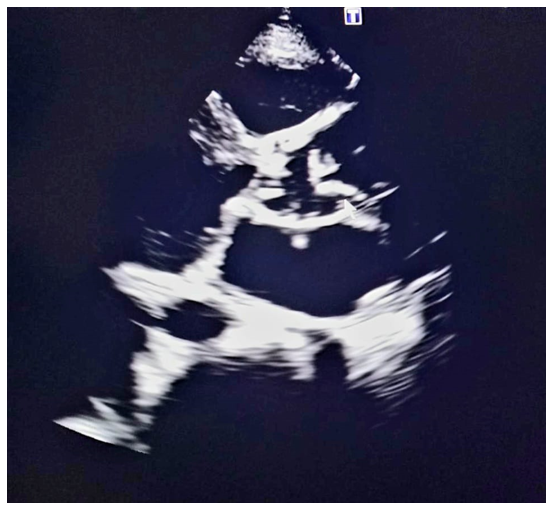
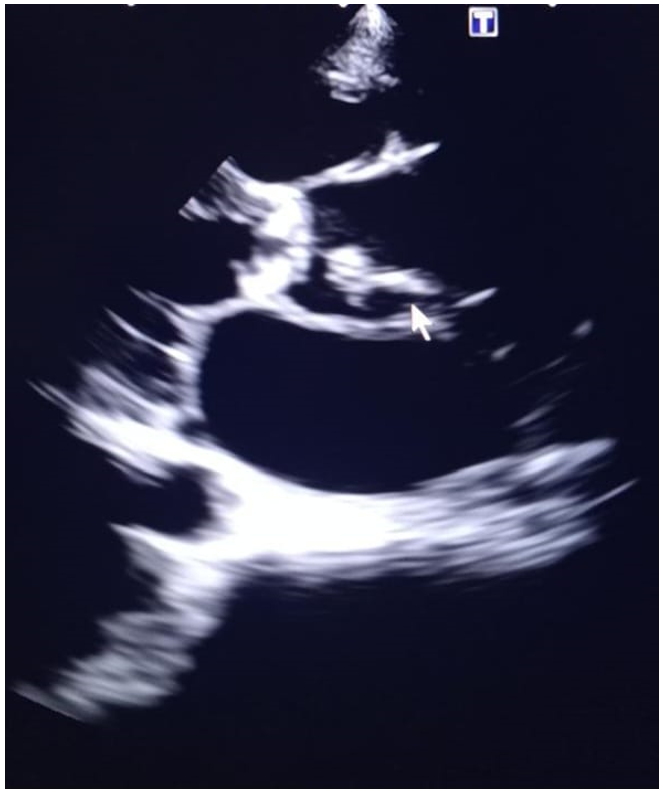
An urgent transthoracic echocardiogram revealed a thickened tricuspid aortic valve with moderately restricted mobility and multiple large echogenic/mobile masses suggestive of vegetations (Video 3). A dilated aortic root and an aortic dissection were also noted (Figure 1, Figure 2) and (Video 1). Additionally, there was moderate aortic stenosis and severe aortic regurgitation (Video 2), along with moderate tricuspid regurgitation and severe pulmonary hypertension. A TEE was not performed as the patient was transferred immediately for surgery.
Two sets of blood cultures were drawn, and both grew Streptococcus viridans. A diagnosis of infective endocarditis of the tricuspid aortic valve complicated by aortic dissection was made. The patient received intravenous Penicillin G (18 million units/day) and Gentamicin (3 mg/kg/day) for a total of 2 weeks. Repeat blood cultures were negative. The patient was stabilized and transferred emergently to a tertiary cardiac surgery unit, where he underwent successful surgical repair for the rupture.
Discussion
Infective endocarditis (IE) is a serious medical condition with high morbidity and mortality, particularly when complicated by heart failure, systemic embolization, or peri-annular abscess formation. Aortic dissection (AD) is an exceptionally rare but life-threatening sequela of IE [5].
Although a bicuspid aortic valve (BAV) is a well-recognized substrate for both IE and aortopathy/dissection, our patient had a tricuspid valve, eliminating this common risk factor. Proposed mechanisms for IE-associated AD include direct microbial invasion of the aortic wall, activation of inflammatory cytokines, proteolytic tissue destruction, and hemodynamic stress from severe aortic regurgitation, which increases wall shear and predisposes to intimal tearing. When infection extends toward the aortic root, the combination of tissue destruction and pressure load may precipitate dissection [6,2].
The coexistence of acute AD and IE is exceedingly rare, with only a limited number of cases documented in the literature [7,8,9,6]. Published reports remain sparse and heterogeneous. For example, a recent case described simultaneous acute Type A AD and undiagnosed IE in a young adult with chronic kidney disease (CKD), presenting with chest and back pain and managed with aortic root replacement and six weeks of intravenous antibiotics [1]. Our case differs by featuring no chest pain, a tricuspid valve, and no significant comorbidities, reinforcing that IE-associated AD can occur outside classic risk contexts and may lack typical pain syndromes.
Unlike the classical tearing chest pain seen in most cases of AD, our patient presented only with fever and progressive dyspnea. This highlights the need for a high index of suspicion, especially when cardiovascular findings such as diastolic murmurs, pulse deficits, and blood pressure discrepancies are present.
Initial evaluation for IE with transthoracic echocardiography (TTE) is common [10]. In our case, the definitive diagnosis of AD was confirmed by echocardiography, which demonstrated an intimal flap and aortic root dilation (Figure 1, Figure 2) and (Video 1). The TEE was deferred as the TTE provided sufficient information. Early surgical intervention is crucial in the management of AD; without intervention, mortality increases by 1–2% per hour within the first 24–48 hours, reaching nearly 50% by the end of the first week [4]. Guidelines from ACC/AHA [11], AATS [12], and EACTS/STS [13] support early surgery, individualized root and arch management, and emphasize valve replacement over repair in the presence of infection. Fortunately, our patient underwent timely surgical repair with aortic valve replacement, which was lifesaving.
Conclusion
Our case highlights a rare but serious complication of infective endocarditis—aortic dissection—presenting with atypical symptoms. In patients with suspected or confirmed IE, the absence of classic chest pain should not lower suspicion for AD when clinical findings suggest aortic regurgitation or perfusion disparity. Early use of TTE/TEE, rapid surgical engagement, and timely initiation of culture-directed antibiotics are critical steps that can be lifesaving in such scenarios.
Conflicts of Interest
The authors declare no competing interests that could have influenced the objectivity or outcome of this research.
Funding Source
The authors declare that no specific grant or funding was received for this research from any public, commercial, or not-for-profit funding agency.
Acknowledgments
None.
Informed Consent
Informed patient consent was obtained.
Large Language Model
During the preparation of this work, the authors utilized ChatGPT 5 to edit the manuscript draft for clarity and to minimize grammatical errors. After using these tools, the authors reviewed and edited the content as needed and took full responsibility for the published article.
Authors Contribution
ZA contributed to conceptualization, data collection, writing – original draft, reviewing, editing, and supervision. FA contributed to the literature review, writing, review, editing, and visualization. MF contributed to image collection and data collection. FN provided supervision, editing, and critical revision of the manuscript. SA contributed to the writing of the original draft, the literature review, and the review. JA contributed to data collection and writing. V contributed to the image collection. All authors read and approved the final manuscript.
Data Availability
No datasets were generated or analyzed for this case report. The clinical information is derived from the index patient’s medical record and is not publicly available to protect patient privacy. De-identified data may be made available from the corresponding author upon reasonable request.
References
- Hanna M., Martini N., Aboulkher Mhdg, Izzat A. W., Izzat M. B.. Simultaneous occurrence of acute aortic dissection and acute infective endocarditis in a patient with chronic kidney disease. J Surg Case Rep. 2025;2025(4):rjaf232. doi:10.1093/jscr/rjaf232 PMID: 40255329 PMCID: PMC12008118
- Shah S. Y., Higgins A., Desai M. Y.. Bicuspid aortic valve: Basics and beyond. Cleve Clin J Med. 2018;85(10):779-784. doi:10.3949/ccjm.85a.17069 PMID: 30289756
- Habib G., Badano L., Tribouilloy C., Vilacosta I., Zamorano J. L., Galderisi M., Voigt J. U., Sicari R., Cosyns B., Fox K., Aakhus S., European Association of Echocardiography. Recommendations for the practice of echocardiography in infective endocarditis. Eur J Echocardiogr. 2010;11(2):202-19. doi:10.1093/ejechocard/jeq004 PMID: 20223755
- Isselbacher E. M., Preventza O., Hamilton Black 3rd, J., Augoustides J. G., Beck A. W., Bolen M. A., Braverman A. C., Bray B. E., Brown-Zimmerman M. M., Chen E. P., Collins T. J., DeAnda Jr., A., Fanola C. L., Girardi L. N., Hicks C. W., Hui D. S., Schuyler Jones W., Kalahasti V., Kim K. M., Milewicz D. M., Oderich G. S., Ogbechie L., Promes S. B., Gyang Ross E., Schermerhorn M. L., Singleton Times S., Tseng E. E., Wang G. J., Woo Y. J., Peer Review Committee Members. 2022 ACC/AHA Guideline for the Diagnosis and Management of Aortic Disease: A Report of the American Heart Association/American College of Cardiology Joint Committee on Clinical Practice Guidelines. Circulation. 2022;146(24):e334-e482. doi:10.1161/CIR.0000000000001106 PMID: 36322642 PMCID: PMC9876736
- Murdoch D. R., Corey G. R., Hoen B., Miro J. M., Fowler Jr., V. G., Bayer A. S., Karchmer A. W., Olaison L., Pappas P. A., Moreillon P., Chambers S. T., Chu V. H., Falco V., Holland D. J., Jones P., Klein J. L., Raymond N. J., Read K. M., Tripodi M. F., Utili R., Wang A., Woods C. W., Cabell C. H., International Collaboration on Endocarditis-Prospective Cohort Study Investigators. Clinical presentation, etiology, and outcome of infective endocarditis in the 21st century: the International Collaboration on Endocarditis-Prospective Cohort Study. Arch Intern Med. 2009;169(5):463-73. doi:10.1001/archinternmed.2008.603 PMID: 19273776 PMCID: PMC3625651
- Pereira A., Dos Santos R. P., Moreno N., Castro A., Azevedo J., Pinto P.. Infective endocarditis complicated by aortic dissection and aorto-right ventricular fistula. Rev Port Cardiol. 2017;36(5):393-394. doi:10.1016/j.repc.2016.08.012 PMID: 28477979
- Elde S. F. T., Guenthart B. A., de Biasi A., Dalal A. R., Casselman K. G., Hiesinger W., Burton E. C.. Type A Aortic Dissection With Concurrent Aortic Valve Endocarditis, Subarachnoid Hemorrhage, and Disseminated Intravascular Coagulation. JACC Case Rep. 2022;4(14):839-843. doi:10.1016/j.jaccas.2021.05.008 PMID: 35912321 PMCID: PMC9334136
- Hussein K., Savin Z., Shani L., Dickstein Y., Geffen Y., Raz-Pasteur A.. Infective endocarditis caused by Finegoldia magna following aortic dissection repair: a case report and data evaluation. Am J Case Rep. 2014;15:554-8. doi:10.12659/AJCR.892057 PMID: 25515374 PMCID: PMC4270072
- Liang Y., Wan M., Wang L., Yang N., Li D.. Case Report: Management of a 10-Year-Old Patient Who Presented With Infective Endocarditis and Stanford Type A Aortic Dissection. Front Cardiovasc Med. 2021;8:816213. doi:10.3389/fcvm.2021.816213 PMID: 35155616 PMCID: PMC8831715
- Yallowitz A. W., Decker L. C.. Infectious Endocarditis [Internet]. StatPearls. 2025.
- Levy D., Sharma S., Grigorova Y., et al. Aortic Dissection. StatPearls. 2025.
- Malaisrie S. C., Szeto W. Y., Halas M., Girardi L. N., Coselli J. S., Sundt 3rd, T. M., Chen E. P., Fischbein M. P., Gleason T. G., Okita Y., Ouzounian M., Patel H. J., Roselli E. E., Shrestha M. L., Svensson L. G., Moon M. R.. 2021 The American Association for Thoracic Surgery expert consensus document: Surgical treatment of acute type A aortic dissection. J Thorac Cardiovasc Surg. 2021;162(3):735-758.e2. doi:10.1016/j.jtcvs.2021.04.053 PMID: 34112502
- Czerny M., Grabenwoger M., Berger T., Aboyans V., Della Corte A., Chen E. P., Desai N. D., Dumfarth J., Elefteriades J. A., Etz C. D., Kim K. M., Kreibich M., Lescan M., Di Marco L., Martens A., Mestres C. A., Milojevic M., Nienaber C. A., Piffaretti G., Preventza O., Quintana E., Rylski B., Schlett C. L., Schoenhoff F., Trimarchi S., Tsagakis K., EACTS/STS Scientific Document Group. EACTS/STS Guidelines for diagnosing and treating acute and chronic syndromes of the aortic organ. Eur J Cardiothorac Surg. 2024;65(2). doi:10.1093/ejcts/ezad426 PMID: 38408364