Migraine Headache in Patients with Allergic Rhinitis: A Systematic Review and Meta-Analysis of Observational Studies
Ahmed TalaiaⒾ1, Khaled KettanehⒾ2, Ayoub Ait LahcenⒾ3, Abdeljalil El Hilali4, Mohamed Magdi5, Marwa AmayemⒾ6, Mohamed WagdyⒾ7*, Shrouk Mahmoud Elghazaly8
- 1Faculty of Medicine, Tanta University, Tanta, Egypt
- 2Faculty of Medicine, Mutah University, Kerak, Jordan
- 3Faculty of Medicine and Pharmacy of Marrakech, Marrakech, Morocco
- 4Faculty of Medicine and Pharmacy of Agadir, Ibn Zohr University, Agadir, Morocco
- 5China Medical University, Shenyang, China
- 6Faculty of Medicine, Alexandria University, Alexandria, Egypt
- 7Faculty of Medicine, Modern University for Technology and Information, Cairo, Egypt
- 8Egypt Health Insurance Units, Asyut, Egypt
Abstract
Background: Migraine is a condition characterized by recurrent episodes of unilateral headache. Allergic rhinitis (AR) is an IgE-mediated inflammatory condition of the nasal mucosa that is triggered by exposure to allergens. Migraine and AR may share underlying immunological mechanisms, including histamine release and mast cell activation. Despite the growing interest in the immunological interplay between allergic conditions and neurological symptoms, the specific relationship between AR and migraine remains underexplored.
Methods: PubMed, Scopus, and Web of Science were systematically searched to identify relevant studies. Pooled odds ratio (OR) and pooled risk ratio (RR) were calculated with 95% confidence intervals (CI) using a random-effects model. The Newcastle-Ottawa Scale (NOS) was used for quality assessment. Heterogeneity assessment and subgroup analysis were also performed.
Results: Eleven studies involving 4,704,591 participants were included. The pooled OR for migraine in individuals with AR was 2.94 (95% CI: 2.02–4.29; p < 0.0001; I² = 95.62%). The pooled RR from two cohort studies was 2.27 (95% CI: 1.10–4.65; p = 0.026; I² = 99.72%). Subgroup analysis revealed significant differences in the pooled OR regarding the source of individuals with AR and the method of AR assessment, with a higher pooled OR in hospital patients (OR = 7.32) and when using skin tests (OR =6.93).
Conclusion: Migraine headaches are significantly associated with AR, particularly in hospital settings andwhenobjectivemethodsareusedforARdiagnosis.Thefindingsofthisstudyshouldbeinterpreted cautiously owing to the high heterogeneity.
Keywords: Migraine, Allergic Rhinitis, Meta-Analysis, Systematic Review, Headache
Article information
Introduction
Migraine is a prevalent and disabling neurological disorder characterized by recurrent episodes of moderate to severe unilateral headache, frequently accompanied by nausea, vomiting, photophobia, and phonophobia [1,2]. It is ranked among the leading causes of years lived with disability worldwide, particularly affecting individuals in their most productive years of life [3]. According to recent estimates, migraine affected over 1.1 billion people globally in 2021, representing a 58.15% increase in prevalence since 1990 and underscoring its substantial and growing public health burden [4,5]. Allergic rhinitis (AR) is an IgE-mediated inflammatory condition of the nasal mucosa triggered by exposure to allergens. While commonly perceived as a localized upper airway disease, AR has been increasingly associated with systemic inflammatory processes and a variety of comorbidities [6]. Its prevalence ranges from 10% to 30% in adults, with even higher rates reported in pediatric populations [7]. Given the immunological basis of both AR and migraine, a potential pathophysiological link has been proposed. Several shared mechanisms may underpin the relationship between AR and migraine, including mast cell activation, histamine release, and cytokine-mediated neuroinflammation, which can contribute to the sensitization of the trigeminovascular system —a central pathway implicated in migraine pathogenesis [8]. However, recent genetic evidence from Mendelian randomization analyses does not support a causal relationship, suggesting that previously reported associations may be confounded by environmental or diagnostic factors [9]. Moreover, an association between migraine and other allergic conditions, including atopic dermatitis, was observed [10]. Given these conflicting observations, a comprehensive synthesis of the available literature is warranted. While previous meta-analyses, such as the one by Yang et al., have explored the association between atopic dermatitis and headache disorders, no prior study has quantitatively assessed the specific relationship between allergic rhinitis (AR) and migraine headaches using pooled odds ratios compared to healthy controls. Therefore, this systematic review and meta-analysis were undertaken to estimate the pooled odds ratio of migraine in individuals with AR and to evaluate the strength and consistency of this association across observational studies.
Methods
Identification of eligible studies
This systematic review and meta-analysis study was conducted to explore the association between allergic rhinitis (AR) and migraine headaches based on observational studies providing estimates of migraine in individuals with AR compared to non-AR controls. A comprehensive search strategy was developed to identify all relevant articles with terms related to AR (allergic rhinitis OR allergic rhinopathy OR atopic rhinitis OR rhinitis allergica OR allergic rhinitides OR pollen sensitivity OR pollen allergy OR pollen allergies OR hay fever OR hayferver OR pollinosis OR seasonal rhinitis OR respiratory allergy OR and IgE-mediated rhinitis) and migraine headache (migraine OR migraine headache OR hemicrania OR cephalgia OR cephalagia OR vascular headache OR aura). A search syntax was developed and applied for three different databases: PubMed, Scopus, and Web of Science. Filters for the English language and articles were used when appropriate. Medical subject headings (MeSH) for migraine disorders and allergic rhinitis were added to the search syntax for PubMed. All identified articles from conception up to the date of database searching (February 25, 2025) were collected.
Evaluation of eligible studies
For a study to be included in the meta-analysis, it must [1] be observational in design (cohort, cross-sectional, or case-control), [2] be available in full-text format, [3] have both an allergic rhinitis group and a healthy control group, and [5] provide data regarding the occurrence of migraine in both groups for calculation of odds ratio (OR) or risk ratio (RR). Studies were excluded if they [1] were not related to migraine or AR, [2] were not available in English, [3] were of an inappropriate study design (reviews, editorials, case series, clinical trials, or book chapters), or [5] didn’t provide sufficient data for the calculation of OR or RR of migraine in individuals with AR compared to controls. The screening process was conducted by the PRISMA flowchart, adhering to the established inclusion and exclusion criteria [11]. Prior to the screening process, articles from the three databases were collected, with duplicates being removed by EndNote software. The remaining articles were exported into an Excel spreadsheet. Four authors working in pairs (KK&AE) and (AAL&MM) independently assessed each article for eligibility and extracted relevant data from eligible studies. Discrepancies in the screening and data extraction were resolved by a third author (AT).
Data extraction and quality assessment
Data extraction was conducted independently by two authors using a standardized and pre-defined data extraction form designed to collect information on study characteristics, population details, diagnostic methods, effect sizes, and outcomes. The data extraction form was piloted on three studies to ensure clarity and consistency before being applied to all included studies. Discrepancies between reviewers were resolved through discussion or consultation with a third author.
In this review, grey literature sources such as conference abstracts, theses, and preprints were explicitly excluded. This decision was based on the need to include only peer-reviewed, full-text articles to ensure methodological rigor and data completeness. While grey literature can reduce publication bias, many sources lack standardized diagnostic criteria or sufficient data for meta-analysis, which was essential for our pooled estimates.
The Newcastle-Ottawa Scale (NOS) was used for assessing the quality of the included studies [12]. The NOS evaluates each article according to eight questions within the selection, comparability, and outcomes domains, with slight variations in the questions depending on the study design. The NOS scale total score ranges from 0 to 9, with higher scores indicating higher quality. The total score is obtained from adding the scores of the three domains, and based on it, studies are classified into low-quality (<5 points), intermediate-quality (5-7 points), and high-quality (>7 points) studies [13].
Statistical analysis
The outcomes of this study were pooled OR and RR for migraine in AR patients compared to controls. Pooled OR and RR were calculated with 95% confidence intervals (CI). Heterogeneity was assessed using the I² statistic, with higher percentages reflecting greater heterogeneity [14]. A random-effects model was used for all statistical analyses, as this model accounts for variations in the study populations [15]. Sensitivity analysis was done by sequentially removing one study and observing its impact on the pooled estimate. Publication bias was assessed by funnel plots and the corresponding Egger’s test p-value, with values <0.05 indicating the presence of publication bias. Subgroup analyses were conducted for different categorical variables, including region, age group, source of study participants, study design, study quality, AR sample size, and method of AR and migraine diagnosis, to investigate the role of these variables on the pooled estimates. All statistical analyses were performed using the Comprehensive Meta-Analysis (CMA) software (Biostat, Englewood, NJ, USA version 3). A p-value of 0.05 was used as a threshold for statistical significance across all analyses.
Results
Study screening and selection
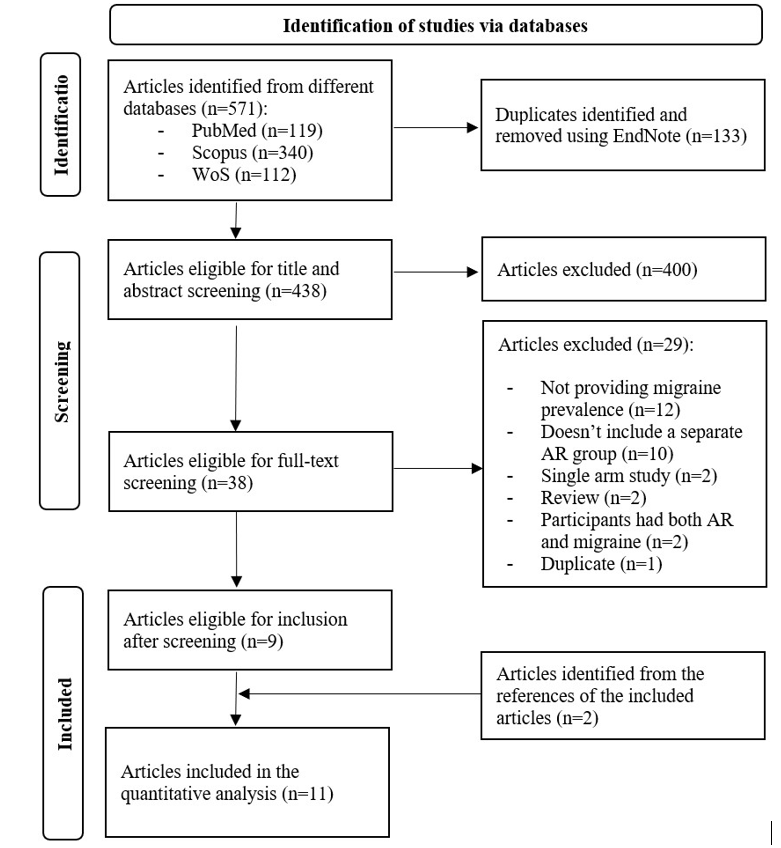
A PRISMA flowchart illustrating the process of article identification, screening, and inclusion is shown in Figure 1. A total of 571 articles were identified from the three databases. A total of 133 articles were identified as duplicates and removed prior to the screening process, leaving a final count of 438 articles. After title and abstract screening, 400 articles were excluded for being irrelevant to our study. The full texts of the remaining 38 articles were retrieved and assessed. 29 articles were excluded for different reasons, leaving nine studies as eligible [16,17,18,19,20,21,22,23,24]. Additionally, two articles were identified through manual searching of the references of the included articles [25,26]. Thus, the final number of articles included in the quantitative analysis is 11.
Characteristics of the included studies
Table 1 shows the characteristics of the included studies. The 11 included studies had 944,125 Individuals with AR and 3,760,466 non-AR controls from nine different countries, including Norway, the USA, Israel, Korea, Turkey, Iran, Sweden, Taiwan, and the UK. Nine studies were either cross-sectional or case-control studies, thus eligible for OR calculation; the remaining two articles were cohort studies, which were eligible for RR calculation [19,20,21,22,23,24]. Studies were classified according to the age group of participants into three groups: the first is studies with participants <18 years, the second is for participants >18 years, and the third group is for studies including participants from both groups. Eight studies were conducted in community settings targeting individuals from the general population, and the remaining three studies were conducted in hospital settings for patients referred to hospital-based clinics. There were variations in the diagnosis of AR and migraine in cross-sectional and case-control studies. Only three studies diagnosed AR using skin tests, with the remaining studies relying on self-reports or the presence of previous AR diagnoses. Five studies diagnosed migraine in accordance with the International Headache Society (IHS) criteria, while the remaining studies used either self-report or the presence of a previous migraine diagnosis. The two cohort studies relied on International Classification of Diseases (ICD) codes from patient records for the diagnosis of AR and migraine headaches, excluding those diagnosed with migraine at the beginning of the follow-up period. Based on the total NOS score, three studies were of high quality, while the remaining eight studies were of intermediate quality. None of the included studies was of low quality.
| Study ID | Country | Migraine Diagnosis | AR Diagnosis | Population | Age Group | Study Design | Migraine/AR | Migraine/Control | Quality |
|---|---|---|---|---|---|---|---|---|---|
| Aamodt et al. 2007 [16] | Norway | IHS criteria | self-report | general population | >18 years | Cross-sectional | 1561/8969 | 4225/38061 | 7 |
| Derebery et al. 2008 [17] | USA | self-report | self-report | general population | Both groups | Cross-sectional | 663/3831 | 243/3193 | 5 |
| Graif et al. 2018 [18] | Israel | previous diagnosis | previous diagnosis | general population | <18 years | Cross-sectional | 331/5239 | 1789/108432 | 9 |
| Han et al. 2023 [19] | Korea | ICD-10 code G43 | ICD-10 codes J301-J304 | general population | >18 years | Cohort | 95607/463510 | 412756/3144089 | 8 |
| Ku et al. 2006 [20] | USA | IHS criteria | positive skin tests with positive history and examination findings | Patients from hospital-based clinics | Both groups | Case-control | 26/76 | 2/57 | 7 |
| Ozturk et al. 2013 [21] | Turkey | IHS criteria | Skin tests and serum IgE levels | Patients with AR from ENT clinic and age-matched healthy controls | Both groups | Case-control | 40/80 | 15/80 | 5 |
| Saberi et al. 2012 [22] | Iran | IHS criteria | Clinical signs and symptoms, positive skin tests | patients referred to the ENT clinic | >18 years | Cross-sectional | 17/46 | 3/60 | 5 |
| Tsiakiris et al. 2017 [23] | Sweden | previous diagnosis | previous diagnosis | general population | >18 years | Cross-sectional | 23/298 | 111/2876 | 6 |
| Wang et al. 2016 [24] | Taiwan | ICD-9-CM code 364 | ICD-9-CM code 477 | general population | <18 years | Cohort | 2823/461850 | 860/460718 | 9 |
| Zencir et al. 2004 [26] | Turkey | IHS criteria | previous diagnosis | general population | <18 years | Cross-sectional | 20/144 | 187/1885 | 7 |
| Mortimer et al. 1993 [25] | UK | previous diagnosis | previous diagnosis | general population | <18 years | Cross-sectional | 10/82 | 43/1015 | 5 |
AR, allergic rhinitis; ENT, ear, nose, and throat; ICD-9-CM, International Classification of Diseases, 9th Revision, Clinical Modification; ICD-10, International Classification of Diseases, 10th Revision; IgE, immunoglobulin E; IHS, International Headache Society; UK, United Kingdom; USA, United States of America.
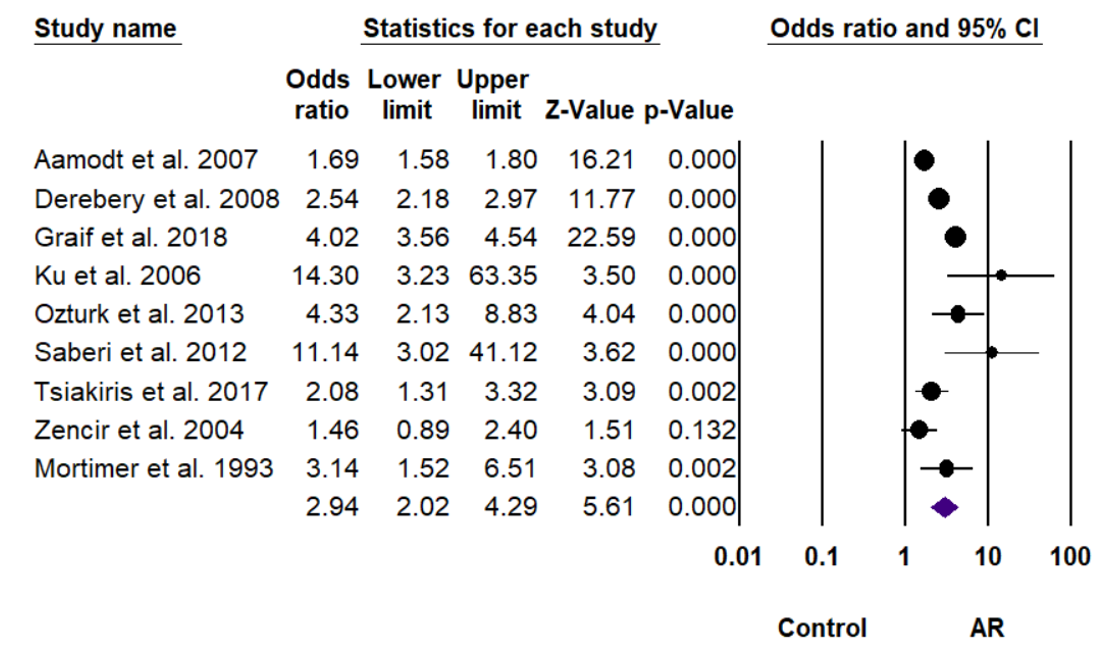
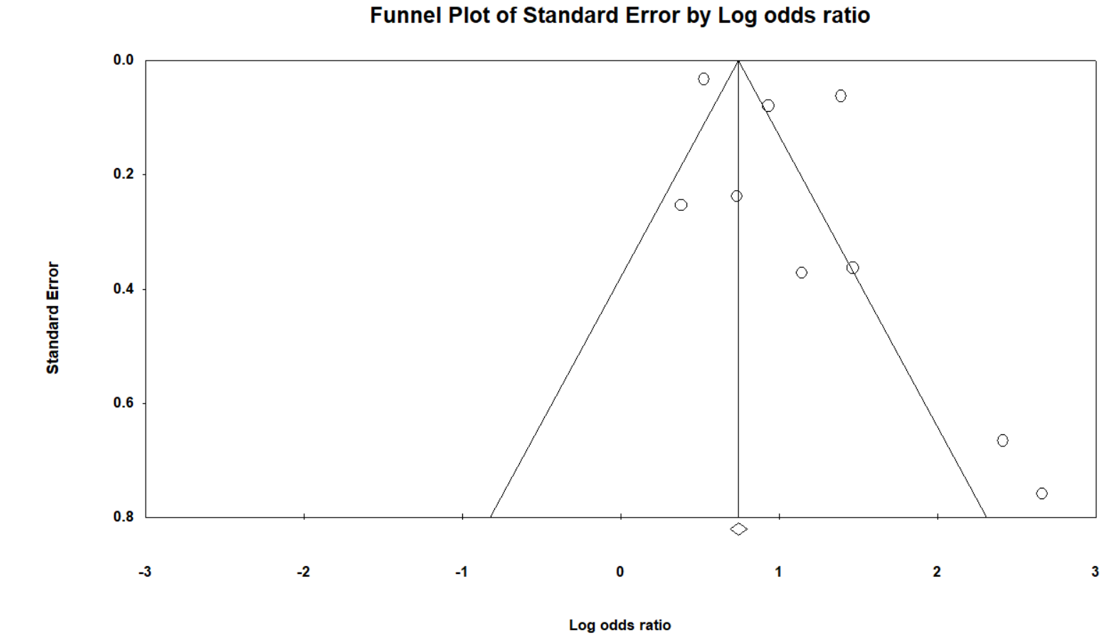
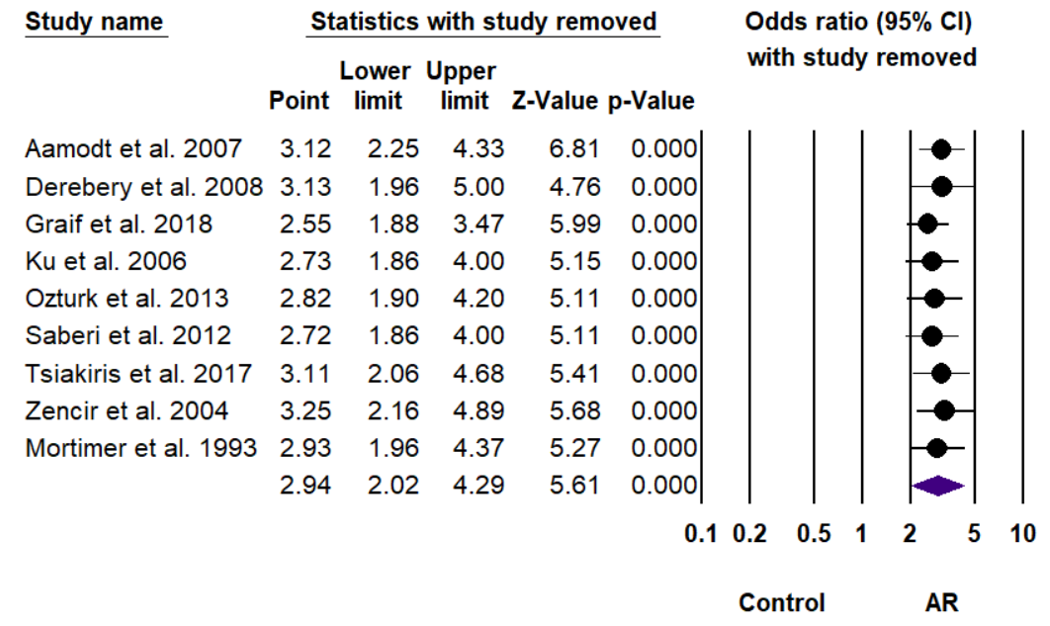
A total of nine case-control or cross-sectional studies, including 18,765 individuals with allergic rhinitis and 155,659 controls, were included in the meta-analysis to estimate the pooled odds ratio (OR) for migraine. As illustrated inFigure 2, the pooled OR for migraine among individuals with allergic rhinitis was 2.94 (95% CI: 2.02–4.29; p < 0.0001), indicating a statistically significant association. Substantial heterogeneity was observed across studies (I² = 95.62%). Assessment of publication bias using a funnel plot Figure 3 and Egger’s test yielded a p-value of 0.2655, suggesting no significant evidence of publication bias. Sensitivity analysis, presented in Figure 4, demonstrated that no single study had a disproportionate influence on the overall effect estimate.
Table 2 shows the results of the subgroup analysis for the pooled OR of migraine in AR compared to controls based on different categorical variables. Regarding the source of participants, a significantly higher pooled OR for AR patients recruited from hospitals (OR=7.32 (95% CI: 3.18–16.84)) compared to studies that recruited individuals with AR from the community (OR=2.35 (95% CI: 1.56–3.54)) was observed. All age groups showed a statistically significant pooled OR for migraine in AR compared to healthy controls. Although studies including participants from all age ranges showed higher pooled estimates compared to studies involving only those younger or older than 18 years, the differences between the groups were not statistically significant. Subgrouping in accordance with different methods for AR and migraine diagnosis showed a statistically significant pooled OR for all the methods with significant differences between the methods of AR diagnosis, whereas studies using skin tests for AR confirmation had higher pooled estimates of 6.93 (95% CI: 3.35–14.35) compared to studies relying on previous diagnosis (2.59 (95% CI: 1.73–3.88)) or self-report (2.06 (95% CI: 1.28–3.33)). Both cross-sectional and case-control studies had a statistically significant pooled OR, with no significant differences in the pooled estimates regarding study design. Grouping the studies according to the AR sample size showed a statistically significantly higher pooled OR for studies conducted on less than 100 individuals with AR (OR=5.53 (95% CI: 2.79–10.96)) compared to those conducted on more than 100 individuals with AR (OR=2.25 (95% CI: 1.45–3.5)).
| Subgroup analysis | Category | Studies (n) | I 2 (%) | OR | 95% CI | p-value (within) | p-value (across) |
|---|---|---|---|---|---|---|---|
| Source of participants | General population | 6 | 96.99 | 2.35 | 1.56–3.54 | <0.001 | 0.016 |
| Hospital patients | 3 | 32.32 | 7.32 | 3.18–16.84 | <0.001 | ||
| Age group | <18 years | 3 | 86.93 | 2.70 | 1.44–5.08 | 0.002 | 0.601 |
| >18 years | 3 | 77.11 | 2.50 | 1.28–4.87 | 0.007 | ||
| Both | 3 | 71.60 | 3.99 | 1.97–8.09 | <0.001 | ||
| Region | Asia | 4 | 83.08 | 3.46 | 2.01–5.94 | <0.001 | 0.387 |
| Europe | 3 | 42.97 | 2.11 | 1.19–3.75 | 0.011 | ||
| North America | 2 | 80.47 | 3.67 | 1.65–8.14 | 0.001 | ||
| AR diagnosis | Previous diagnosis | 4 | 85.86 | 2.59 | 1.73–3.88 | <0.001 | 0.022 |
| Self-report | 2 | 95.63 | 2.06 | 1.28–3.33 | 0.003 | ||
| Skin tests | 3 | 32.32 | 6.93 | 3.35–14.35 | <0.001 | ||
| Migraine diagnosis | IHS criteria | 5 | 82.47 | 3.03 | 1.75–5.25 | <0.001 | 0.949 |
| Previous diagnosis | 3 | 73.22 | 3.03 | 1.63–5.63 | <0.001 | ||
| Self-report | 1 | 0.00 | 2.54 | 0.95–6.77 | 0.062 | ||
| Study design | Case-control | 2 | 50.28 | 6.28 | 2.35–16.81 | <0.001 | 0.102 |
| Cross-sectional | 7 | 96.52 | 2.59 | 1.73–3.87 | <0.001 | ||
| AR sample size | <100 patients | 4 | 40.54 | 5.53 | 2.79–10.96 | <0.001 | 0.030 |
| >100 patients | 5 | 97.57 | 2.25 | 1.45–3.50 | <0.001 |
AR, allergic rhinitis; CI, confidence interval; IHS, International Headache Society; OR, odds ratio.
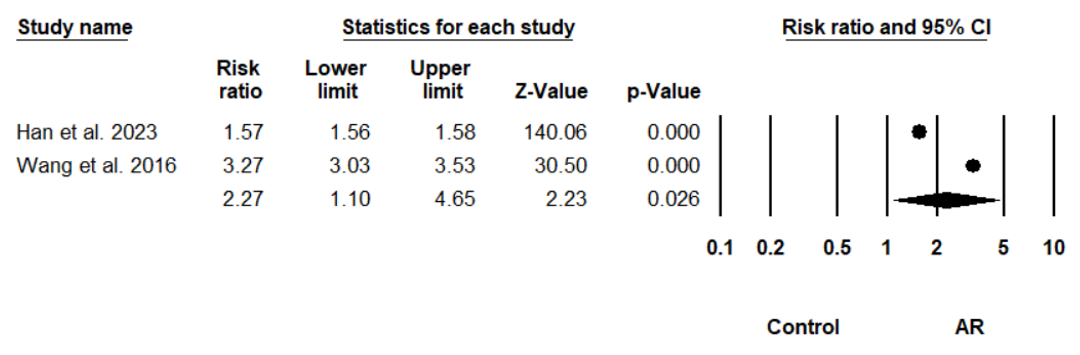
Figure 5 shows the pooled RR of migraine in AR compared to controls. As calculated from two studies with 925,360 individuals with AR and 3,604,807 non-AR controls, the pooled RR was 2.27 (95% CI: 1.10–4.65), p = 0.026, I² = 99.72%.
Discussion
The link between different atopic conditions and headache has been studied in previous literature, and meta-analyses have investigated the association between atopic conditions and headache. However, to our knowledge, this is the first meta-analysis to focus on studying the prevalence of co-occurrence of allergic rhinitis (AR) and migraine headache. This systematic review and meta-analysis investigated 11 observational studies with a total of 4,704,591 participants. Our primary finding indicated a significant association between AR and migraine headache, with an odds ratio of 2.94. Subgroup analysis demonstrated a stronger association between migraine headache and allergic rhinitis in the hospital setting compared to the general population. Remarkably, the accurate diagnosis of AR appeared to affect the association between the two conditions significantly. Our results also showed comparable associations between both conditions within different age groups and geographical regions.
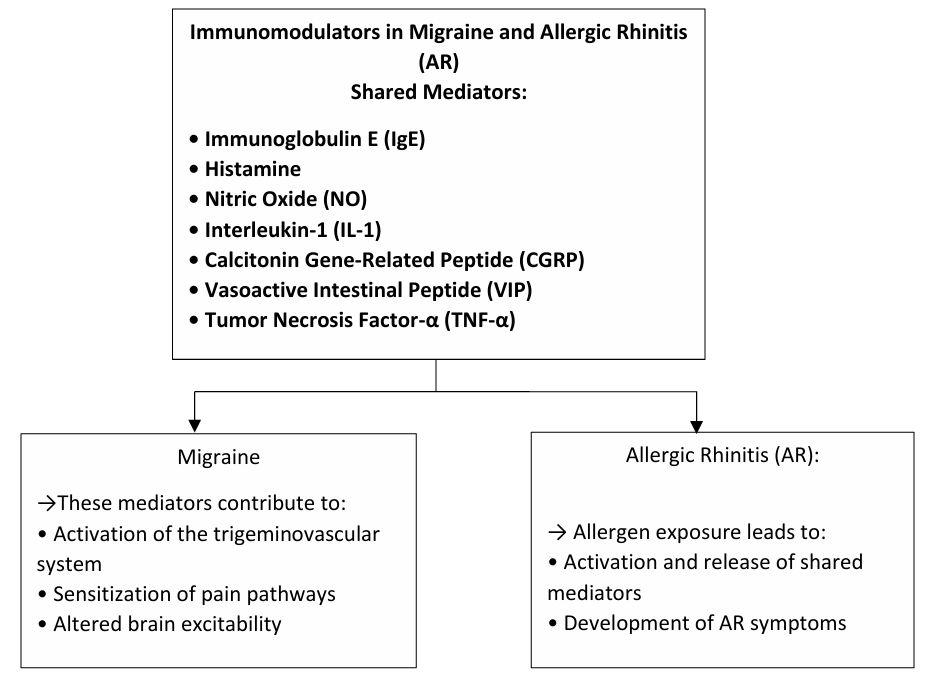
Although the exact mechanism of the coexistence of migraine headache and AR has not yet been fully determined, previous research suggests common immunological mechanisms [27,28,29,30], as well as responses to the same medications [31,32,33]. This flowchart summarizes key mediators currently believed to be involved in the development of both conditions Figure 6. This flowchart illustrates the common mediators activated in both migraine and allergic rhinitis, as well as their roles in both pathways.
The role of histamine in both conditions has been repeatedly studied in previous literature; a study by Lassen et al. showed that histamine infusion provoked migraine attacks, and those attacks could be blocked by pretreatment with pyrilamine maleate but not with placebo [34]. Histamine was hypothesized to modulate hypothalamic function and activity, which may have a major role in migraines and influence the severity of migraine attacks [35]. Moreover, whole blood from migraineurs was found to have significantly elevated levels of histamine compared to the control group [28]. A study by Forcelini et al. on pediatric populations suggests that the inflammatory response associated with AR is believed to contribute to the development and worsening of migraines by activating immune mechanisms [36]. Symptoms such as nasal congestion, discharge, and sneezing in AR involve heightened trigeminal nerve transmission, which is linked to migraine [36]. Suggesting a mutual relationship between both conditions rather than a one-way association. These results indicate a wide area of overlap between the two conditions, both in pathogenesis and management [28,32,36,37]. A study by Zencir et al. failed to demonstrate a significant association between migraine and allergic rhinitis in pediatric patients [26], highlighting the need for further research to investigate the complex interplay between these conditions.
In addition to the stated common inflammatory mediators between allergic rhinitis and migraine, different confounding factors that affect both conditions have been identified in previous literature. [6,5] Psychological factors, including anxiety and depression, as well as sleep disturbances, have been repeatedly linked to both migraine and allergic disease. [6,8,7] Additionally, dietary mediators pose a notable confounder; biogenic amines, such as histamine and tyramine, present in aged cheeses, cured meats, fermented products, and certain beverages, are well-documented migraine triggers due to their vasoactive and neuromodulatory properties. [4,9,5] These dietary factors also have the potential to provoke allergic-like responses via mast cell activation and histamine release, thereby confounding migraine–allergy associations. [10] Considering the divergent selection of the population, our analysis revealed a notable association between hospitals and patients. The odds ratio is 7.32 for hospital patients compared to 2.35 for the general population. This discrepancy may be partly explained by Berkson’s bias, which arises when both the exposure and the disease increase the likelihood of hospitalization, thereby inflating the observed association in hospital-based samples [11]. In this context, patients with more severe disease are more likely to seek or require hospital care, leading to an overrepresentation of severe cases and potentially related comorbid conditions. This is supported by Derebery et al. [17,25], who observed that patients with moderate to severe rhinitis tend to have more comorbidities than those with mild disease. The following reason could be the cause:
A selection bias that occurs when hospital-based populations are used. People with multiple conditions (e.g., both migraine and AR) are more likely to be hospitalized, making comorbidities seem more common than in the general population. Patients with more severe or complex symptoms are more likely to be referred to tertiary care centers (e.g., specialty clinics or hospitals). This means the population in hospital-based studies isn’t representative of the general population. In tertiary care, patients are often thoroughly evaluated, so multiple conditions are more likely to be diagnosed—this inflates the observed association between two diseases like AR and migraine.
Similarly, Aamodt et al. observed that the frequency of migraine attacks was positively correlated with the association with all types of asthma-related disorders [16], further contributing to the differential representation in hospital settings.
Another reason for the higher association observed in hospital-based populations is what Aamodt et al. described as “personality trait”, which means that patients who report their AR symptoms are more likely to report headache symptoms once they develop it [16]. Also, the fact that most studies on the general population relied on self-report or previous diagnosis of one or more conditions may question the accuracy of the diagnosis [38].
Furthermore, considering the effect of diagnostic accuracy, we analyzed the results according to the diagnostic system used in each study for both AR and migraine. Interestingly, when the skin prick test (SPT) was used for diagnosing AR, the results showed a significant association with migraine, with an odds ratio of 6.93, compared to 2.59 and 2.06 for previous diagnosis and self-report, respectively. SPT is believed to be the gold standard in AR diagnosis [35], likely contributing to more accurate assessment and higher diagnostic rates [36,39], thereby amplifying the observed association. This finding underscores the importance of diagnostic precision in elucidating the relationship between migraine and AR. It also underlines the necessity of utilizing standardized diagnostic procedures in future research to ensure consistency and reliability.
Notably, different diagnostic methods of migraine showed statistically significant results that are consistent across variables. However, whereas many studies relied on self-report or previous migraine diagnosis, it is of fundamental importance to note that applying the International Headache Society (IHS) classification system had a pivotal role in the results. Eross et al. concluded in their study that 86% of patients with a self-diagnosis and/or physician diagnosis of “sinus headache” have migraine (63%) or probable migraine (23%) as defined by the IHS Classification Criteria [40]. A finding replicated by Cady and Schreiber, who found in their study that 90% of physicians and/or self-diagnosed sinus headaches meet IHS criteria for migraine [40]. Another study by Schreiber assessed more than 2000 patients with reported sinus headaches and found that 80% had migraine [41]. These findings indicate that the actual number of migraine cases is significantly underestimated in existing records, and further prospective studies are needed to assess the effect of using the IHS criteria as a standard of migraine diagnosis and its impact on the results of future research. Subgroup analysis within different age groups, geographic regions, and study designs demonstrated a statistically significant relationship between AR and migraine. However, it is important to note that the consistently elevated odds ratios associated with these factors reinforce the robustness of the association between the two conditions and may reflect an underlying biological link. Overall, the subgroup analysis enhances our understanding of the complex dynamics of AR and migraine headache, considering the accuracy of diagnosis, the selection of population, and the sample size as important factors affecting their co-occurrence.
In this systematic review, we conducted a meta-analysis based on a systematic evaluation of previous research results, resulting in a relatively large sample size and confirming the link between AR and migraine. This meta-analysis also explored more precise connections between migraine and AR by considering age, regional variations, distinctions in study populations, and diverse diagnostic approaches for AR and migraine. The results of this investigation need further validation and exploration. Despite its limitations, the study results still provide preliminary clues about the potential connection between AR and migraine.
Strengths and Limitations
Several reasons contribute to the strength of this study. First, as a comprehensive analysis, we applied systematic review and meta-analysis methods, integrating data from 11 studies that encompassed more than 4 million participants, to investigate the association between AR and migraine. Second, extensive subgroup analysis has enabled a deeper understanding of the nuanced dynamics between the two conditions and a better understanding of the variable association between the AR and migraine in different populations. Third, it highlighted the potential effect of diagnostic accuracy and questioned the need for standardized diagnostic systems, thereby providing direction for future research. The study also has certain limitations. First, the study’s limited causality is a result of its observational design; therefore, it can only determine the association between the two conditions, rather than assessing the causal effect or determining the pathogenesis of both conditions. Second, substantial heterogeneity was observed among studies, likely reflecting variability in sample demographics, diagnostic methods of both conditions, and study designs. This limits the generalizability of our findings and underscores the need for more uniform study designs and diagnostic methods in future research. Additionally, tests for publication bias are underpowered when based on fewer than 10 studies and should be interpreted with caution. Despite the heterogeneity between the two cohort prospective studies, which can be attributed to differences in population characteristics, age groups, diagnostic coding, and sample size, both studies contributed to a pooled risk ratio of 2.27 (95% CI: 1.10–4.65, p = 0.026). This suggests a statistically significant association between AR and the development of migraine. As prospective studies, these findings imply that AR can be a contributing risk factor for migraine rather than being only a co-existing condition. Additionally, higher effect sizes observed in smaller studies may indicate potential small-study bias, which warrants cautious interpretation of the findings and highlights the need for larger, high-quality investigations. Also, many included studies relied on self-reported or historical diagnoses, introducing potential misclassification bias
Conclusion
Our findings demonstrate a significant association between allergic rhinitis (AR) and migraine. This relationship appears particularly relevant in cases where sinus headache symptoms persist or are resistant to typical explanations. Further research is warranted to clarify the nature of this association, ideally through prospective cohort studies with consistent diagnostic criteria and better control of confounding variables. Further high-quality prospective research is required before changes to screening or management practices can be recommended. In addition, the causal relationship between both conditions and the potential response of AR and migraine to the same management protocol is an insightful area that requires future research.
Conflicts of Interest
The authors declare no competing interests that could have influenced the objectivity or outcome of this research.
Funding Source
This research did not receive any specific grant from funding agencies in the public, commercial, or not-for-profit sectors.
Acknowledgments
None
Institutional Review Board (IRB)
This study is a systematic review and meta-analysis of previously published observational studies. No human subjects research was conducted and no institutional review board approval was required.
Large Language Model
None
Authors Contribution
AT was responsible for conceptualization, project administration, statistical analysis, preparing tables, drafting the manuscript, and review. KK contributed to screening, data extraction, and risk of bias assessment. AAL and AEH participated in screening and data extraction. MM was involved in screening, data extraction, and risk of bias assessment. MA contributed to writing the discussion section. MW and SME drafted the manuscript.
Data Availability
All studies used in the research are available in various databases.
References
- Amiri P., Kazeminasab S., Nejadghaderi S. A., Mohammadinasab R., Pourfathi H., Araj-Khodaei M., Sullman M. J. M., Kolahi A. A., Safiri S.. Migraine: A Review on Its History, Global Epidemiology, Risk Factors, and Comorbidities. Front Neurol. 2021;12:800605. doi:10.3389/fneur.2021.800605 PMID: 35281991 PMCID: PMC8904749
- Ozge A., Ozge C., Ozturk C., Kaleagasi H., Ozcan M., Yalcinkaya D. E., Ozveren N., Yalcin F.. The relationship between migraine and atopic disorders-the contribution of pulmonary function tests and immunological screening. Cephalalgia. 2006;26(2):172-9. doi:10.1111/j.1468-2982.2005.01021.x PMID: 16426272
- Leonardi M., Raggi A.. A narrative review on the burden of migraine: when the burden is the impact on people's life. J Headache Pain. 2019;20(1):41. doi:10.1186/s10194-019-0993-0 PMID: 31023226 PMCID: PMC6734273
- Dong L., Dong W., Jin Y., Jiang Y., Li Z., Yu D.. The Global Burden of Migraine: A 30-Year Trend Review and Future Projections by Age, Sex, Country, and Region. Pain Ther. 2025;14(1):297-315. doi:10.1007/s40122-024-00690-7 PMID: 39661241 PMCID: PMC11751287
- Steiner T. J., Stovner L. J.. Global epidemiology of migraine and its implications for public health and health policy. Nat Rev Neurol. 2023;19(2):109-117. doi:10.1038/s41582-022-00763-1 PMID: 36693999
- Bousquet J., Van Cauwenberge P., Khaltaev N., Aria Workshop Group, World Health Organization. Allergic rhinitis and its impact on asthma. J Allergy Clin Immunol. 2001;108(5 Suppl):S147-334. doi:10.1067/mai.2001.118891 PMID: 11707753
- Savoure M., Bousquet J., Jaakkola J. J. K., Jaakkola M. S., Jacquemin B., Nadif R.. Worldwide prevalence of rhinitis in adults: A review of definitions and temporal evolution. Clin Transl Allergy. 2022;12(3):e12130. doi:10.1002/clt2.12130 PMID: 35344304 PMCID: PMC8967272
- Martin V. T., Taylor F., Gebhardt B., Tomaszewski M., Ellison J. S., Martin G. V., Levin L., Al-Shaikh E., Nicolas J., Bernstein J. A.. Allergy and immunotherapy: are they related to migraine headache?. Headache. 2011;51(1):8-20. doi:10.1111/j.1526-4610.2010.01792.x PMID: 21054364
- Lv H., Liu K., Xie Y., Wang Y., Chen S., Liu P., Guan M., Cong J., Xu Y.. No causal association between allergic rhinitis and migraine: a Mendelian randomization study. Eur J Med Res. 2024;29(1):78. doi:10.1186/s40001-024-01682-1 PMID: 38281051 PMCID: PMC10821569
- Yang W., Dai H., Xu X. F., Jiang H. Y., Ding J. Y.. Association of atopic dermatitis and headache disorder: a systematic review and meta-analyses. Front Neurol. 2024;15:1383832. doi:10.3389/fneur.2024.1383832 PMID: 38576533 PMCID: PMC10991782
- Page M. J., McKenzie J. E., Bossuyt P. M., Boutron I., Hoffmann T. C., Mulrow C. D., Shamseer L., Tetzlaff J. M., Akl E. A., Brennan S. E., Chou R., Glanville J., Grimshaw J. M., Hrobjartsson A., Lalu M. M., Li T., Loder E. W., Mayo-Wilson E., McDonald S., McGuinness L. A., Stewart L. A., Thomas J., Tricco A. C., Welch V. A., Whiting P., Moher D.. The PRISMA 2020 statement: an updated guideline for reporting systematic reviews. BMJ. 2021;372:n71. doi:10.1136/bmj.n71 PMID: 33782057 PMCID: PMC8005924
- Stang A.. Critical evaluation of the Newcastle-Ottawa scale for the assessment of the quality of nonrandomized studies in meta-analyses. Eur J Epidemiol. 2010;25(9):603-5. doi:10.1007/s10654-010-9491-z PMID: 20652370
- Gao Y., Huang Y. B., Liu X. O., Chen C., Dai H. J., Song F. J., Wang J., Chen K. X., Wang Y. G.. Tea consumption, alcohol drinking and physical activity associations with breast cancer risk among Chinese females: a systematic review and meta-analysis. Asian Pac J Cancer Prev. 2013;14(12):7543-50. doi:10.7314/apjcp.2013.14.12.7543 PMID: 24460331
- Huedo-Medina T. B., Sanchez-Meca J., Marin-Martinez F., Botella J.. Assessing heterogeneity in meta-analysis: Q statistic or I2 index?. Psychol Methods. 2006;11(2):193-206. doi:10.1037/1082-989X.11.2.193 PMID: 16784338
- Thompson S. G., Turner R. M., Warn D. E.. Multilevel models for meta-analysis, and their application to absolute risk differences. Stat Methods Med Res. 2001;10(6):375-92. doi:10.1177/096228020101000602 PMID: 11763548
- Aamodt A. H., Stovner L. J., Langhammer A., Hagen K., Zwart J. A.. Is headache related to asthma, hay fever, and chronic bronchitis? The Head-HUNT Study. Headache. 2007;47(2):204-12. doi:10.1111/j.1526-4610.2006.00597.x PMID: 17300360
- Derebery J., Meltzer E., Nathan R. A., Stang P. E., Campbell U. B., Corrao M., Stanford R.. Rhinitis symptoms and comorbidities in the United States: burden of rhinitis in America survey. Otolaryngol Head Neck Surg. 2008;139(2):198-205. doi:10.1016/j.otohns.2008.05.019 PMID: 18656715
- Graif Y., Shohat T., Machluf Y., Farkash R., Chaiter Y.. Association between asthma and migraine: A cross-sectional study of over 110 000 adolescents. Clin Respir J. 2018;12(10):2491-2496. doi:10.1111/crj.12939 PMID: 30004178
- Han J. H., Lee H. J., Yook H. J., Han K., Lee J. H., Park Y. M.. Atopic Disorders and Their Risks of Migraine: A Nationwide Population-Based Cohort Study. Allergy Asthma Immunol Res. 2023;15(1):55-66. doi:10.4168/aair.2023.15.1.55 PMID: 36693358 PMCID: PMC9880296
- Ku M., Silverman B., Prifti N., Ying W., Persaud Y., Schneider A.. Prevalence of migraine headaches in patients with allergic rhinitis. Ann Allergy Asthma Immunol. 2006;97(2):226-30. doi:10.1016/S1081-1206(10)60018-X PMID: 16937756
- Ozturk A., Degirmenci Y., Tokmak B., Tokmak A.. Frequency of migraine in patients with allergic rhinitis. Pak J Med Sci. 2013;29(2):528-31. doi:10.12669/pjms.292.3148 PMID: 24353570 PMCID: PMC3809225
- Saberi A., Nemati S., Shakib R. J., Kazemnejad E., Maleki M.. Association between allergic rhinitis and migraine. J Res Med Sci. 2012;17(6):508-12. PMID: 23626624 PMCID: PMC3634285
- Tsiakiris G., Neely G., Lind N., Nordin S.. Comorbidity in allergic asthma and allergic rhinitis: functional somatic syndromes. Psychol Health Med. 2017;22(10):1163-1168. doi:10.1080/13548506.2016.1276606 PMID: 28034321
- Wang I. C., Tsai J. D., Lin C. L., Shen T. C., Li T. C., Wei C. C.. Allergic rhinitis and associated risk of migraine among children: a nationwide population-based cohort study. Int Forum Allergy Rhinol. 2016;6(3):322-7. doi:10.1002/alr.21654 PMID: 26446370
- Mortimer M. J., Kay J., Gawkrodger D. J., Jaron A., Barker D. C.. The prevalence of headache and migraine in atopic children: an epidemiological study in general practice. Headache. 1993;33(8):427-31. doi:10.1111/j.1526-4610.1993.hed3308427.x PMID: 8262782
- Zencir M., Ergin H., Sahiner T., Kilic I., Alkis E., Ozdel L., Gurses D., Ergin A.. Epidemiology and symptomatology of migraine among school children: Denizli urban area in Turkey. Headache. 2004;44(8):780-5. doi:10.1111/j.1526-4610.2004.04145.x PMID: 15330824
- Agnihotri N. T., McGrath K. G.. Allergic and nonallergic rhinitis. Allergy Asthma Proc. 2019;40(6):376-379. doi:10.2500/aap.2019.40.4251 PMID: 31690374
- Gazerani P., Pourpak Z., Ahmadiani A., Hemmati A., Kazemnejad A.. A correlation between migraine, histamine and immunoglobulin e. Scand J Immunol. 2003;57(3):286-90. doi:10.1046/j.1365-3083.2003.01216.x PMID: 12641658
- Levy D., Burstein R., Strassman A. M.. Mast cell involvement in the pathophysiology of migraine headache: A hypothesis. Headache. 2006;46 Suppl 1:S13-8. doi:10.1111/j.1526-4610.2006.00485.x PMID: 16927959
- Mehle M. E.. Allergy and migraine: is there a connection?. Curr Opin Otolaryngol Head Neck Surg. 2008;16(3):265-9. doi:10.1097/MOO.0b013e3282f6a629 PMID: 18475083
- Heatley R. V., Denburg J. A., Bayer N., Bienenstock J.. Increased plasma histamine levels in migraine patients. Clin Allergy. 1982;12(2):145-9. doi:10.1111/j.1365-2222.1982.tb01633.x PMID: 6176358
- Krabbe A. A., Olesen J.. Headache provocation by continuous intravenous infusion of histamine. Clinical results and receptor mechanisms. Pain. 1980;8(2):253-259. doi:10.1016/0304-3959(88)90012-7 PMID: 7402688
- Theodoropoulos D. S., Katzenberger D. R., Jones W. M., Morris D. L., Her C., Cullen N. A., Morrisa D. L.. Allergen-specific sublingual immunotherapy in the treatment of migraines: a prospective study. Eur Rev Med Pharmacol Sci. 2011;15(10):1117-21. PMID: 22165671
- Lassen L. H., Thomsen L. L., Olesen J.. Histamine induces migraine via the H1-receptor. Support for the NO hypothesis of migraine. Neuroreport. 1995;6(11):1475-9. doi:10.1097/00001756-199507310-00003 PMID: 7579128
- Nelson H. S., Rosloniec D. M., McCall L. I., Ikle D.. Comparative performance of five commercial prick skin test devices. J Allergy Clin Immunol. 1993;92(5):750-6. doi:10.1016/0091-6749(93)90019-c PMID: 8227867
- Onore C., Careaga M., Ashwood P.. The role of immune dysfunction in the pathophysiology of autism. Brain Behav Immun. 2012;26(3):383-92. doi:10.1016/j.bbi.2011.08.007 PMID: 21906670 PMCID: PMC3418145
- Perry B. F., Login I. S., Kountakis S. E.. Nonrhinologic headache in a tertiary rhinology practice. Otolaryngol Head Neck Surg. 2004;130(4):449-52. doi:10.1016/j.otohns.2004.01.005 PMID: 15100642
- Kristensen P.. [Bias from dependent errors in observational studies]. Tidsskr Nor Laegeforen. 2005;125(2):173-5. PMID: 15665891
- Wynne A. M., Henry C. J., Godbout J. P.. Immune and behavioral consequences of microglial reactivity in the aged brain. Integr Comp Biol. 2009;49(3):254-66. doi:10.1093/icb/icp009 PMID: 21665818 PMCID: PMC4447842
- Cady R. K., Schreiber C. P.. Sinus headache: a clinical conundrum. Otolaryngol Clin North Am. 2004;37(2):267-88. doi:10.1016/S0030-6665(03)00181-6 PMID: 15064062
- Schreiber C. P., Hutchinson S., Webster C. J., Ames M., Richardson M. S., Powers C.. Prevalence of migraine in patients with a history of self-reported or physician-diagnosed "sinus" headache. Arch Intern Med. 2004;164(16):1769-72. doi:10.1001/archinte.164.16.1769 PMID: 15364670