The Impact of Idiopathic Intracranial Hypertension on Cardiovascular Disease Risk Among UK Women: An Obesity-Adjusted Analysis
Ahmed Y. Azzam1,2,3*, Mahmoud M. Morsy1,4, Mohamed Hatem Ellabban5, Ahmed M. Morsy6, Adham Adel Zahran6, Mahmoud Nassar7,8, Omar S. Elsayed1, Adam Elswedy1, Osman Elamin9, Ahmed Saad Al Zomia10, Hana J. Abukhadijah11, Hammam A. Alotaibi12, Oday Atallah13, Mohammed A. Azab14, Muhammed Amir Essibayi2,15, Adam A. Dmytriw16,17, Mohamed D. Morsy18, David J. Altschul2,15
- 1October 6 University, Egypt
- 2Albert Einstein College of Medicine, USA
- 3American Society for Inclusion, Diversity, and Health Equity (ASIDE), USA
- 4American Society for Inclusion, Diversity, and Health Equity (ASIDE), USA
- 5Al-Azhar University, Egypt
- 6Cairo University, Egypt
- 7Jacobs School of Medicine and Biomedical Sciences, University at Buffalo, USA
- 8American Society for Inclusion, Diversity, and Health Equity (ASIDE), USA
- 9Jordan Hospital, Jordan
- 10King Khalid University, Saudi Arabia
- 11Hamad Medical Corporation, Qatar
- 12Prince Sultan Military Medical City, Saudi Arabia
- 13Hannover Medical School, Germany
- 14Cleveland Clinic Foundation, USA
- 15Montefiore Medical Center, Albert Einstein College of Medicine, USA
- 16Massachusetts General Hospital & Brigham and Women's Hospital, Harvard University, USA
- 17St. Michael's Hospital, University of Toronto, Canada
- 18King Khalid University, Saudi Arabia
Abstract
Introduction: Idiopathic intracranial hypertension (IIH) is associated with increased cardiovascular disease (CVD) risk, but the relative contributions of obesity versus IIH-specific factors remain unclear. This study aims to disentangle the effects of obesity and IIH on stroke and CVD risk, building upon previous research suggesting a two-fold increased risk of cardiovascular events in women with IIH compared to BMI-matched controls.
Methods: We conducted an obesity-adjusted risk analysis using Indirect Standardization analysis based on the Adderley et al. study, which utilized data from a cohort of 2,760 women with IIH and 27,125 matched healthy controls from The Health Improvement Network (THIN) database. We employed innovative statistical models to adjust for the confounding effects of obesity, estimating the risk of ischemic stroke and cardiovascular disease attributable to IIH independent of obesity. Four distinct models were used to elucidate the complex interrelationships between IIH, obesity, and CVD risk.
Results: Our analysis revealed that IIH confers additional cardiovascular risk beyond that attributed to obesity alone. Risk ratios for various cardiovascular outcomes were consistently elevated across models comparing IIH patients to controls within the same obesity strata. A striking synergistic effect between IIH and obesity was observed, with the composite CVD risk reaching a risk ratio of 6.19 (95% CI: 4.58-8.36, p<0.001) in obese IIH patients compared to non-obese controls.
Conclusions: This study provides compelling evidence for a nuanced relationship between IIH, obesity, and cardiovascular risk. IIH appears to confer substantial cardiovascular risk independent of obesity, necessitating a paradigm shift in IIH management to encompass comprehensive cardiovascular risk mitigation. Further research is needed to elucidate the underlying mechanisms and develop targeted interventions for this unique patient population.
-1.5em
Keywords: Idiopathic Intracranial Hypertension, Pseudotumor Cerebri, Stroke, Ischemic Stroke, Cardiovascular Disease
Introduction
Idiopathic intracranial hypertension (IIH) is a condition characterized by elevated intracranial pressure of unknown etiology, typically manifesting as papilledema with associated risks of visual loss and chronic disabling headache [1]. The incidence and economic burden of IIH are rising in parallel with global obesity trends [2]. While obesity is a well-established risk factor for IIH, with over 90% of patients being obese [3], the relationship between IIH and cardiovascular disease (CVD) risk remains poorly understood.
In the United States, studies indicate an incidence increase from 1.6 to 2.4 per 100,000 person-years in the general population, rising dramatically to 15-19 per 100,000 in women of childbearing age [4]. This rising disease burden encompasses both economic impacts, with annual costs exceeding millions of dollars in the US, and significant quality of life deterioration, including chronic pain, vision problems, and psychological distress [5,6].
Adderley et al. conducted a retrospective case-control population-based matched controlled cohort study using 28 years of data from The Health Improvement Network (THIN) database in the United Kingdom, THIN database is a longitudinal primary care database containing anonymized electronic health records from over 17 million patients in the United Kingdom, provides researchers with comprehensive clinical data for epidemiological studies and healthcare research. [7]. Their study suggested that women with IIH have a two-fold increased risk of cardiovascular events compared to BMI-matched controls. However, the mechanisms underlying this elevated risk and the relative contributions of obesity versus IIH-specific factors remained unclear.
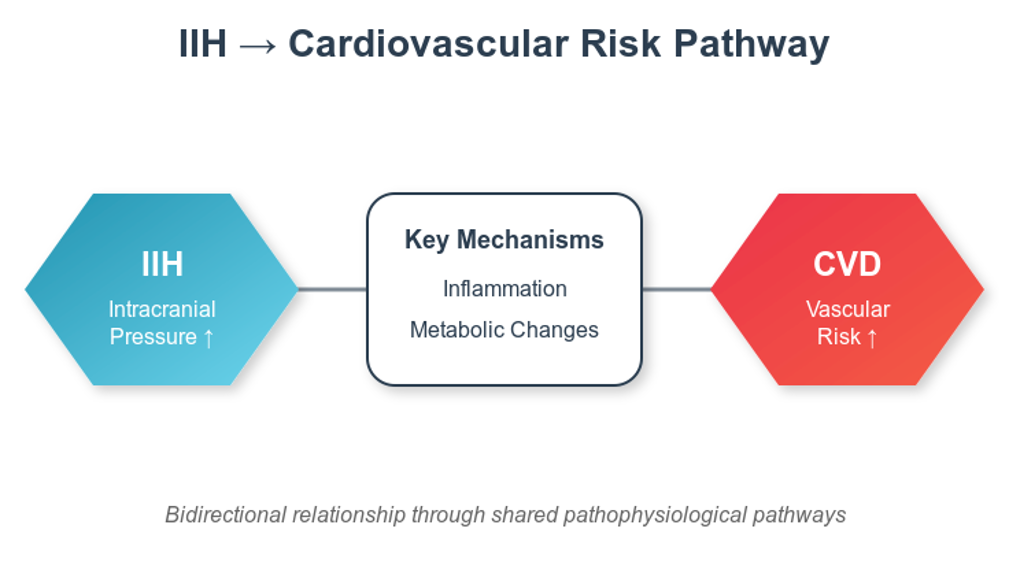
The relationship between IIH and CVD risk involves multiple pathophysiological mechanisms beyond adiposity alone. Neuroendocrine dysfunction in IIH is characterized by elevated endogenous testosterone and androstenedione levels, distinct from exogenous supplementation or polycystic ovary syndrome (PCOS) [8]. This hormonal dysregulation may affect both cerebrospinal fluid (CSF) dynamics and cardiovascular function [9]. Additionally, the current literature studies demonstrate elevated levels of pro-inflammatory cytokines in IIH patients, potentially contributing to both intracranial pressure elevation and vascular dysfunction [9]. IIH patients exhibit distinct metabolic profiles, including altered glucose homeostasis and lipid metabolism, which may independently contribute to cardiovascular risk [9,10]. Several additional risk factors may contribute to both IIH and CVD, including hormonal contraceptive use, vitamin A metabolism, sleep apnea, and chronic kidney disease [11,12,10].
Building upon Adderley et al.’s [7] findings, our study aims to disentangle the effects of obesity and IIH on stroke risk specifically. Obesity is a known independent risk factor for stroke, with an average hazard ratio (HR) of 2.29 reported in large-scale evidence [13]. By adjusting for this obesity-related risk, we seek to isolate the potential contribution of IIH itself to stroke incidence. Our study employs an established methodological approach adapted from epidemiological research on obesity [14,15] to simulate predicted ischemic stroke and CVD events in both IIH and control groups under normative weight conditions. This approach has been previously used in obesity literature [16,17].
Understanding the relationship between IIH and their associated risks, independent of obesity, has important clinical implications. If IIH itself confers additional cardiovascular risk, it may warrant more aggressive management of modifiable risk factors and earlier implementation of preventive strategies in this patient population. Furthermore, elucidating this potential association’s mechanisms could reveal new therapeutic targets for reducing cardiovascular morbidity in IIH. Our study aims to build upon the foundational work of Adderley et al. [7] to further investigate the complex interplay between IIH, obesity, and the associated risks. By employing innovative statistical methods to adjust for the confounding effects of obesity, we aim to provide crucial insights into the cardiovascular implications of IIH and inform evidence-based management strategies for this increasingly prevalent condition.
Methods
Building upon the foundational work of Adderley et al. [7], we conducted a retrospective analysis using data from their paper, which was originally obtained through THIN, a large UK primary care database. Our study focused on women with IIH and matched controls, aiming to elucidate the independent effect of IIH on stroke and cardiovascular risks, distinct from the influence of obesity. Patients were excluded from the Adderley et al. [7], study whether they had different diagnostic or clinical codes for conditions that could mimic IIH, specifically hydrocephalus, cerebral venous thrombosis, or any other cause of elevated intracranial pressure (ICP).
Additionally, female patients were excluded from the baseline cohort selection if they did not have at least one year of registration with an eligible general practice before cohort entry to ensure adequate documentation of baseline covariates. For the analysis of individual CVD outcomes, patients with a record of the specific outcome of interest at baseline were excluded from the corresponding analysis; for composite CVD analysis, patients with any CVD at baseline were excluded; for type 2 diabetes analysis, patients with either type 1 diabetes or type 2 diabetes at baseline were excluded. For sensitivity analyses, additional exclusions were applied, including excluding women diagnosed with IIH after age 60 since IIH is rare among older adults, and there may be potential misclassification errors in this age group.
Study Population and Data Source:
We utilized the cohort established by Adderley et al. [7], comprising 2,760 women with IIH and 27,125 matched controls. Participants were identified from THIN database records spanning January 1, 1990, to January 17, 2018. Controls were matched to IIH patients based on age, body mass index (BMI), and sex, with up to 10 controls per IIH case.
Outcome Measures:
Our primary outcome of interest was the incidence of composite CVD, heart failure, ischemic heart disease (IHD), ischemic stroke, transient ischemic attack (TIA), hypertension, and type 2 diabetes mellitus. We extracted the relevant data from the corresponding paper, following the coding and identification methods described by Adderley et al. [7].
Statistical Analysis:
We extended the original analysis to estimate the independent effect of IIH on stroke and cardiovascular risks, accounting for the confounding effect of obesity. Our approach involved indirect standardization and adjustment with the application of a standardized morbidity ratio (SMR) approach [18,19,20,21,22], adapted to account for obesity as a confounding variable in relationship with IIH in women around the UK. To estimate the incidence of events in both the IIH and control cohorts under a hypothetical scenario of normal weight, we employed an adjustment method based on the average HR for obesity contributing to the event risk in women compared to healthy weight women in 13-year intervals from the literature. This approach operates under the assumption that the HR remains constant throughout the 13-year study period and that the impact of obesity on the estimated events is independent of IIH status. We utilized Python 3.12 and its associated statistical libraries to perform our statistical analysis. Initially, we calculated the observed HR for each event in the IIH group compared to the control group. Subsequently, we adjusted this observed HR by obesity HR to estimate the HR for IIH independent of obesity. Based on the current evidence, the average estimated HR of obesity contributing to composite CVD is 2.89 [23,24,25,26,27,28,29]. For obesity, ischemic stroke, and TIA risk, it is estimated around HR = 1.72 [23,26,30,31,32,33,34,35,36]. For obesity and heart failure risk, it is estimated around HR = 2.61 [37,38,39,40,41,42,43]. For obesity and hypertension risk, it is estimated around HR = 2.09 [44,45,46,47,48,49,50]. For obesity and IHD risk, it is estimated around HR = 1.8 [23,24,26,28,30,51,52]. For obesity and type 2 diabetes mellitus risk, it is estimated to be around HR = 4.0 [53,54,55,56,57,58,59,60].
We calculated the HR for each event in the IIH group compared to the control group through the following equation:
HR = \dfrac{IIH\ events}{IIH\ total} \bigg/ \dfrac{Control\ events}{Control\ total}
We then adjusted this observed HR by the established HR for obesity in association with the potential risk to estimate the HR for IIH independent of obesity:
Adjusted\ HR = \dfrac{Observed\ HR}{Obesity\ HR}
Using this adjusted HR, we predicted the number of events in both groups under normative weight conditions: For the IIH group:
For the control group:
Predicted\ Control\ events = \dfrac{Control\ events}{Obesity\ HR}
Using this adjusted HR, we calculated the predicted number of events in the IIH and control groups under the assumption of normal weight. This was accomplished by applying the adjusted HR to the control group event rate and scaling for the respective group sizes. For the control group, we divided the observed events by obesity HR to estimate events under normal weight conditions.
This method allows for a comparative analysis of event risk between IIH and control populations while attempting to control the confounding effect of obesity. It provides insight into the potential independent risk associated with IIH and allows for estimating event rates under hypothetical normal weight conditions.
Ethical Considerations:
This study adhered to the ethical approval obtained by Adderley et al. [7] from the NHS South-East Multicenter Research Ethics Committee. We did not involve direct analysis of the dataset, but rather built customized statistical modeling based on the provided data and metrics from the Adderley et al. research paper [7].
Results
Baseline Characteristics:
The original retrospective cohort study by Adderley et al. [7] encompassed 29,885 participants, stratified into 2,760 (9.2%) women with IIH and 27,125 (90.8%) controls. The incident cohort comprised 48.2% and 46.7% of the IIH and control groups, respectively. Both cohorts were predominantly under 60 (98.1% IIH, 95.2% control), with identical median ages of 32.1 years (IQR: 25.62-42.00 IIH, 25.71-42.06 control). Socioeconomic status, assessed via Townsend Deprivation Quintiles, showed a comparable distribution between groups, with a slight overrepresentation of controls in the least deprived quintiles. Smoking habits differed significantly: the IIH cohort exhibited higher rates of current smoking (30.8% vs 22.6%) and lower rates of non-smoking (46.5% vs 55.5%).
Anthropometric data revealed a marginally higher median BMI in the IIH group (34.80, IQR: 29.30-40.30) compared to controls (34.30, IQR: 29.00-39.70). Notably, both groups demonstrated a high prevalence of obesity (BMI >30), affecting 62.6% and 60.9% of the IIH and control cohorts, respectively. Comorbidity profiles and pharmacological interventions showed distinct patterns. The IIH cohort demonstrated a higher prevalence of migraine (21.0% vs. 11.9%), hypertension (13.8% vs. 9.2%), and marginally increased rates of lipid-lowering medication use (6.5% vs. 5.8%). Furthermore, baseline cardiovascular morbidity was more pronounced in the IIH group, with elevated rates of ischemic heart disease (1.3% vs. 0.9%) and ischemic stroke/TIA (1.7% vs 0.7%). Interestingly, type 2 diabetes mellitus prevalence was slightly lower in the IIH cohort (4.7% vs. 5.2%) 1.
Statistical Analysis:
This analysis employed four distinct statistical models to elucidate the complex interrelationships between IIH, obesity, and CVD risk. These models were strategically designed to disentangle the individual and combined effects of IIH and obesity on CVD outcomes.
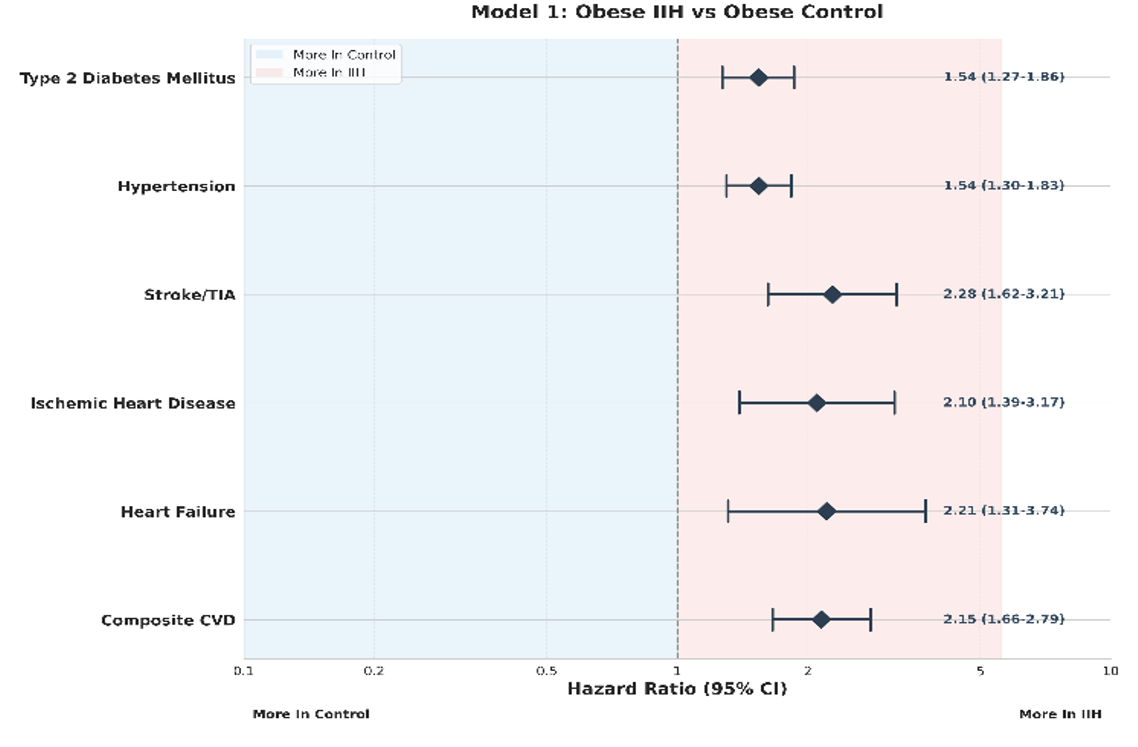
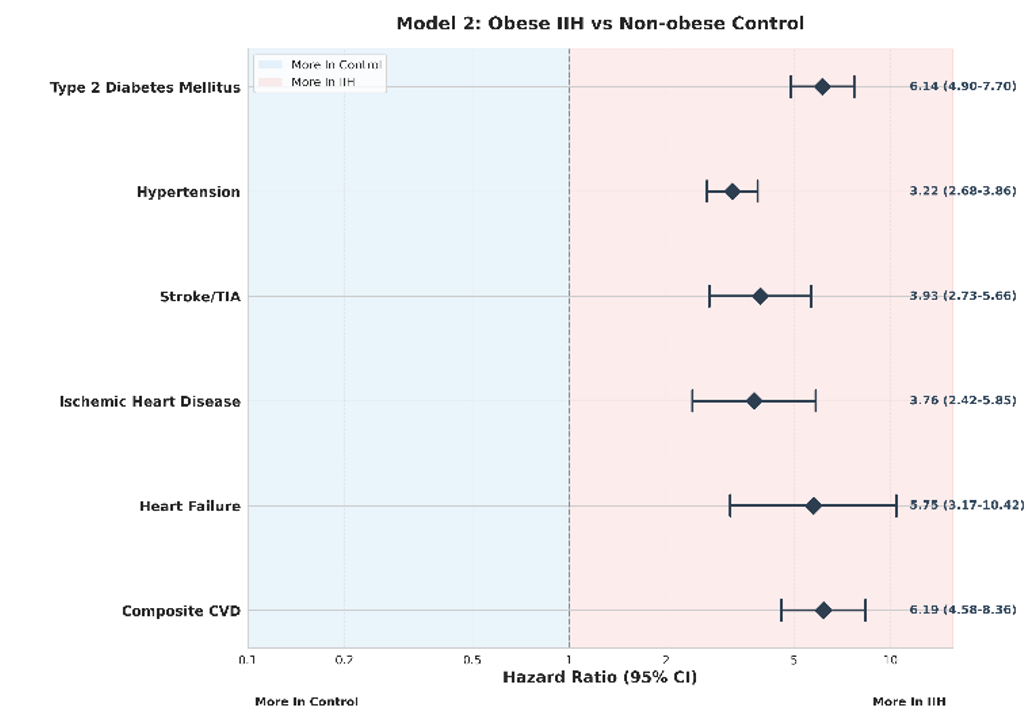
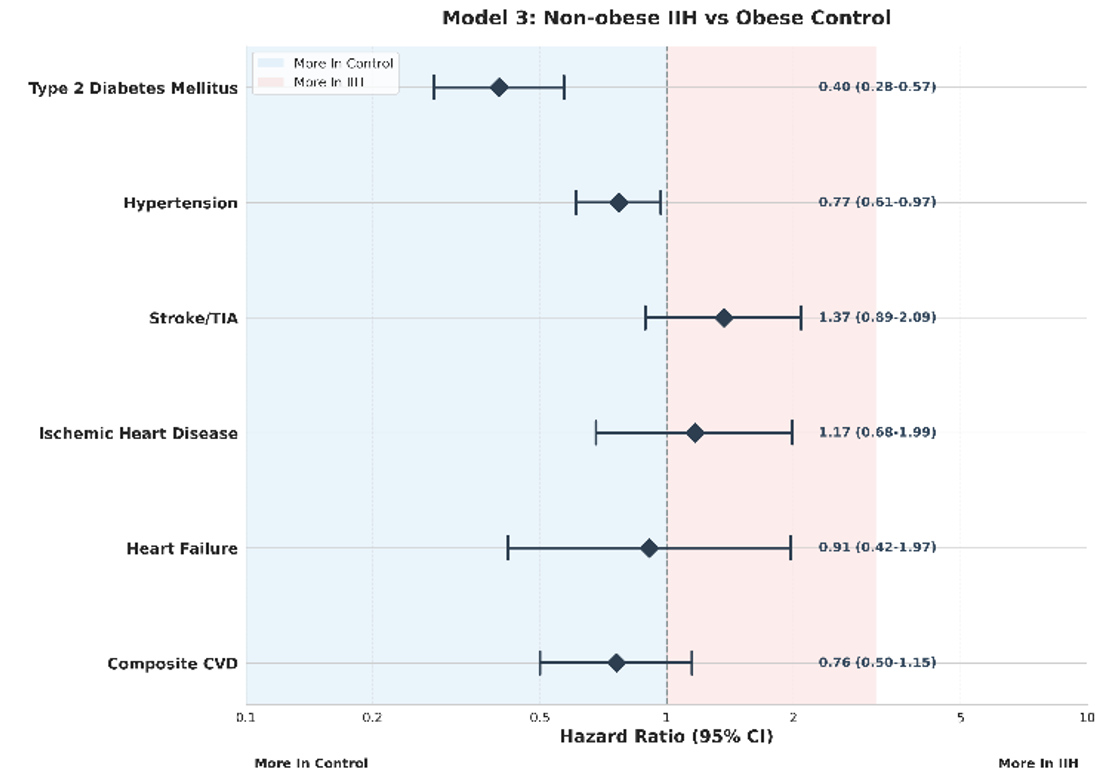
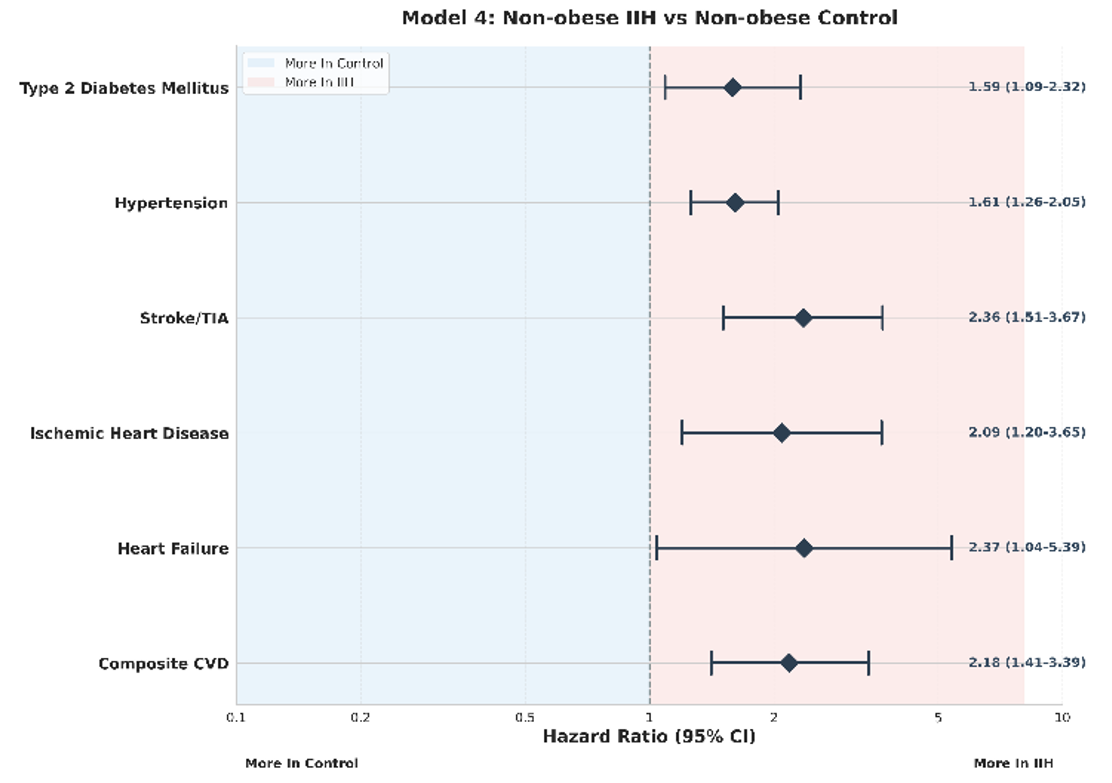
Model 1 (Obese IIH vs. Obese Control) was constructed to isolate the effect of IIH within an obese population, effectively controlling for the confounding factor of adiposity. Model 2 (Obese IIH vs. Non-obese Control) provided a comprehensive view of the combined impact of IIH and obesity compared to individuals without either condition. Model 3 (Non-obese IIH vs. Obese Control) offered a unique perspective, juxtaposing the cardiovascular risks associated with IIH in non-obese individuals against those attributed to obesity alone. Model 4 (Non-obese IIH vs. Non-obese Control) isolated the impact of IIH in a non-obese population, providing critical insights into the condition’s effects independent of obesity, [tbl:cvd_outcomes_iih].
Our findings revealed a nuanced and clinically significant relationship between IIH, obesity, and cardiovascular risk. In Model 1 1, IIH was consistently associated with elevated risks across all measured outcomes. The risk ratios (RR) ranged from 1.54 (95% CI: 1.27-1.86, p<0.001) for type 2 diabetes mellitus to 2.28 (95% CI: 1.62-3.21, p<0.001) for stroke/TIA. This uniform pattern of risk elevation suggests that IIH confers additional cardiovascular risk beyond that attributed to obesity alone, a finding of relevance in clinical risk stratification.
Model 2, 2 demonstrated even more pronounced risk elevations, with the composite CVD risk reaching a striking RR of 6.19 (95% CI: 4.58-8.36, p<0.001). This marked increase suggests a potential synergistic effect between IIH and obesity on cardiovascular health, which may have significant implications for patient management and therapeutic interventions. Notably, the risk for heart failure in this model was particularly elevated (RR 5.75, 95% CI: 3.17-10.42, p<0.001), highlighting the need for vigilant cardiac monitoring in obese IIH patients. Interestingly, Model 3, 3, presented a more complex picture. The non-significant risk ratios for most outcomes in this model suggest that non-obese individuals with IIH may not have significantly different CVD risks compared to obese individuals without IIH. This finding underscores the profound impact of obesity on cardiovascular health, potentially rivaling or even overshadowing the effects of IIH in certain contexts. Of note in this model was the significantly reduced risk of type 2 diabetes mellitus in non-obese IIH patients compared to obese controls (RR 0.40, 95% CI: 0.28-0.57, p<0.001). This intriguing paradox may offer valuable insights into the underlying pathophysiology of both conditions and warrants further mechanistic investigation.
Model 4, 4 provided robust corroboration of IIH as an independent risk factor, with significant risk elevations observed across all outcomes in non-obese IIH patients compared to non-obese controls. The composite CVD risk in this model (RR 2.18, 95% CI: 1.41-3.39, p<0.001) closely mirrored that observed in Model 1, further supporting the notion that IIH confers cardiovascular risk independent of obesity status. This finding has important implications for the management of non-obese IIH patients, who may be at underappreciated cardiovascular risk.
Ranking the CVD risks for IIH patients based on our data reveals the highest risk ratios in Model 2, with the following hierarchy: composite CVD (RR 6.19) > heart failure (RR 5.75) > stroke/TIA (RR 3.93) > ischemic heart disease (RR 3.76). This stratification underscores the critical importance of addressing both IIH and obesity in our highest-risk patients and may inform the development of targeted screening and intervention protocols. The data on type 2 diabetes mellitus warrant special consideration. The 6.14-fold increased risk (95% CI: 4.90-7.70, p<0.001) observed in obese IIH patients compared to non-obese controls (Model 2) is particularly striking. This marked elevation, coupled with the paradoxical risk reduction in non-obese IIH patients (Model 3), suggests a complex interplay between IIH, obesity, and metabolic dysfunction. These findings raise intriguing questions about potential shared pathophysiological mechanisms and may open new avenues for research into the neuroendocrine aspects of IIH. Hypertension, a known risk factor for both CVD and IIH progression, showed a consistent pattern of elevated risk across Models 1, 2, and 4. However, the reduced risk observed in Model 3 (RR 0.77, 95% CI: 0.61-0.97, p=0.03) adds another layer of complexity to our understanding of the relationship between IIH, obesity, and blood pressure regulation.
Discussion
Our obesity-adjusted analysis uncovered several significant findings that advance our understanding of how IIH influences CVD outcomes. Our primary analysis demonstrated that IIH independently raises CVD risk, as we observed consistent risk elevations (RR= 1.54 to 2.28) across CVD outcomes in our obesity-matched cohorts. Perhaps our most striking finding was the synergistic interaction between IIH and obesity; we found a 6.19-fold increased risk of composite CVD events (95% CI: 4.58-8.36, p<0.001) in obese IIH patients compared to non-obese controls. Through our modeling, we also discovered a metabolic relationship: non-obese IIH patients showed CVD risks comparable to obese controls, which are significantly higher than non-obese controls (RR 2.18, 95% CI: 1.41-3.39, p<0.001). We were particularly intrigued by the paradoxical relationship we observed with type 2 diabetes risk, which was elevated in obese IIH patients but reduced in non-obese IIH patients compared to obese controls, suggesting more complex metabolic mechanisms than previously recognized 5.
The consistent elevation of risk ratios across Models 1 and 4, which compare IIH patients to controls within the same obesity strata, strongly suggests a distinct pathophysiological process intrinsic to IIH that exacerbates cardiovascular vulnerability. This finding aligns with emerging research on the neuroendocrine and metabolic perturbations in IIH, including recent metabolomic profiling by O’Reilly MW et al. [21] revealed a unique signature of altered androgen metabolism in CSF of IIH patients, characterized by elevated levels of testosterone and androstenedione. This androgen excess may represent a crucial link between IIH and cardiovascular risk through multiple mechanisms, including vascular dysfunction, inflammatory modulation, and metabolic dysregulation. Duckles and Miller [61] demonstrated that testosterone could induce vasoconstriction through both genomic and non-genomic pathways, potentially contributing to hypertension and altered cerebrovascular autoregulation in IIH.
The chronic elevation of ICP, a characteristic of IIH, may have direct and indirect effects on cardiovascular functions. Recent work by Wardlaw et al. [62] on the glymphatic system and intracranial fluid dynamics suggests that altered CSF flow and clearance in IIH may impair the removal of metabolic waste products from the brain. This accumulation of potentially toxic metabolites could exacerbate oxidative stress and vascular inflammation, contributing to the observed CVD risk.
The striking risk elevations observed in Model 2 (Obese IIH vs. Non-obese Control) reveal a synergistic interaction between IIH and obesity that amplifies CVD risk beyond the sum of their individual effects. This synergy likely arises from the convergence of multiple pathophysiological processes, including adipokine dysregulation, neuroendocrine activation, and hemodynamic alterations. Recent work by Hornby et al. [63] demonstrates that IIH patients exhibit a distinct adipokine signature, with particularly elevated CSF leptin levels. The combination of systemic and central adipokine dysregulation may create a uniquely pro-inflammatory and pro-thrombotic state. Moreover, the evidence by Markey K et al. [64] suggests that IIH patients may have altered cortisol metabolism, potentially exacerbating the metabolic and CVD consequences of obesity-related hypothalamic-pituitary-adrenal axis dysfunction.
The paradoxical findings regarding type 2 diabetes risk in our study—elevated in obese IIH patients but reduced in non-obese IIH patients compared to obese controls—challenge our current understanding of metabolic risk in IIH. This observation may be explained by the concept of "metabolic flexibility" proposed by Goodpaster and Sparks [65]. In non-obese IIH patients, the altered androgen metabolism and potential changes in adipose tissue function may confer a degree of metabolic protection. The evidence by Mariniello et al. [66] on androgen effects on adipose tissue suggests that certain androgen profiles can enhance insulin sensitivity and improve glucose uptake in adipocytes. The specific androgen milieu in IIH may thus have differential effects depending on the overall metabolic context. Conversely, in obese IIH patients, this potential metabolic benefit may be overwhelmed by the profound insulin resistance and chronic inflammation associated with obesity. The interaction between obesity-related metabolic dysfunction and IIH-specific neuroendocrine perturbations may create a "perfect storm" for accelerated progression to type 2 diabetes [66].
Our findings necessitate a paradigm shift in the approach to cardiovascular risk management in IIH patients. We propose a multi-tiered strategy that includes enhanced risk stratification, targeted interventions, personalized metabolic management, and neuroendocrine modulation. The development of IIH-specific CVD risk calculators that incorporate novel biomarkers such as CSF androgen levels, adipokine profiles, and measures of intracranial pressure dynamics could significantly improve risk assessment in this population. Exploration of IIH-specific pharmacological interventions that address the unique pathophysiology of CVD risk in this population is warranted. For example, the potential use of selective androgen receptor modulators (SARMs) to mitigate the adverse cardiovascular effects of androgen excess while preserving potential metabolic benefits merits investigation.
Future research directions should include longitudinal studies employing advanced imaging techniques to elucidate the temporal relationship between IIH onset, progression, and cardiovascular remodeling. Multi-omics approaches integrating genomics, transcriptomics, and metabolomics could unravel the molecular mechanisms underlying the observed synergy between IIH and obesity in cardiovascular risk. Interventional trials exploring the cardiovascular impact of IIH-specific treatments, including the potential cardioprotective effects of CSF diversion procedures or novel pharmacological agents targeting ICP regulation, are crucial. Additionally, investigation of sex-specific aspects of cardiovascular risk in IIH is essential, given the strong female predominance of the condition and the potential interaction with sex hormones.
The findings from our study reveal a complex, multifaceted relationship between IIH, obesity, and CVD risk that challenges existing paradigms and opens new frontiers in personalized medicine. The independent risk conferred by IIH, the synergistic effects of obesity, and the paradoxical metabolic findings underscore the need for a nuanced, mechanism-based approach to cardiovascular risk management in this unique patient population. As we continue to unravel the intricate pathophysiology of IIH, we move closer to developing targeted interventions that may not only alleviate the neurological symptoms of the condition but also mitigate its long-term cardiovascular consequences. The implications of our findings extend beyond IIH, offering potential insights into the broader interplay between neuroendocrine function, metabolic regulation, and cardiovascular health. The methodology of our paper has several limitations; at first, the approach assumes that the HR and the values provided from the original data and HR for obesity remain constant over the 13-year period and is applicable to both the IIH group and control group.
Secondly, it assumes that the effect of obesity on the events is independent of IIH status in each patient. Thirdly, the predicted events are based on the average HR for obesity from the current literature, which may not be fully representative of the study population in larger populations or another cohort. Also, the adjusted for IIH independent from obesity should be interpreted with caution, as it is an estimation based on the available data and assumptions. To further validate the findings, it would be better to perform tailored individual-level data analysis based on BMI subgroup analysis and sensitivity tests for IIH patients and counting for other potential confounding variables in the cohort. Additionally, conducting a prospective study that directly compares IIH patients with normal weight controls would provide more comprehensive evidence for the independent effect of IIH on the proposed events.
Conclusions
Through our findings, we have established compelling evidence that IIH independently contributes to CVD risk beyond obesity alone. Our statistical modeling has revealed that IIH operates through both independent and obesity-synergistic pathways to elevate CVD risk. We consistently observed elevated risks across our obesity-stratified models, leading us to believe that IIH involves an intrinsic pathophysiological process that worsens CVD outcomes vulnerability. These findings align with emerging research on neuroendocrine dysregulation in IIH. Based on our results, we strongly advocate for a fundamental shift in IIH management to include comprehensive CVD risk assessment and mitigation. We believe developing IIH-specific CVD risk assessment tools and targeted interventions should be a priority. While we acknowledge the limitations of our study, including our assumptions about hazard ratio consistency and obesity effects, we have established a crucial foundation for future studies. We recommend prospective studies comparing IIH patients with normal-weight controls and deeper investigation of underlying mechanisms through multi-omics approaches. Our findings have significant implications for both clinical practice and future research in IIH management.
| Variable | Women With IIH (Exposed Group) | Women Without IIH (Control Group) |
|---|---|---|
| Population (n, %) | 2760 (9.2%) | 27,125 (90.8%) |
| Incident cohort | 1331 (48.2%) | 12,679 (46.7%) |
| Population aged <60 years | 2709 (98.1%) | 25,811 (95.2%) |
| Age, median (IQR), years | 32.1 (25.62–42.00) | 32.1 (25.71–42.06) |
| Townsend Deprivation Quintile | ||
| 1 (Least deprived) | 361 (13.1%) | 4268 (15.7%) |
| 2 | 381 (13.8%) | 4397 (16.2%) |
| 3 | 532 (19.3%) | 5174 (19.1%) |
| 4 | 538 (19.5%) | 5122 (18.9%) |
| 5 (Most deprived) | 454 (16.5%) | 4134 (15.2%) |
| Missing data | 494 (17.9%) | 4030 (14.9%) |
| Smoking Status | ||
| Nonsmoker | 1284 (46.5%) | 15,058 (55.5%) |
| Ex-smoker | 502 (18.2%) | 4573 (16.9%) |
| Smoker | 849 (30.8%) | 6134 (22.6%) |
| Missing data | 125 (4.5%) | 1360 (5.0%) |
| BMI, median (IQR) | 34.80 (29.30–40.30) | 34.30 (29.00–39.70) |
| Body Mass Index (BMI) Category | ||
| <25 | 246 (8.9%) | 2561 (9.4%) |
| 25–30 | 416 (15.1%) | 4203 (15.5%) |
| >30 | 1728 (62.6%) | 16,514 (60.9%) |
| Missing data | 370 (13.4%) | 3847 (14.2%) |
| Current lipid prescription | 180 (6.5%) | 1572 (5.8%) |
| Migraine | 580 (21.0%) | 3247 (11.9%) |
| Outcomes at Baseline | ||
| Heart failure | 8 (0.3%) | 58 (0.2%) |
| Ischemic heart disease (IHD) | 35 (1.3%) | 245 (0.9%) |
| Ischemic stroke / TIA | 46 (1.7%) | 189 (0.7%) |
| Hypertension | 380 (13.8%) | 2500 (9.2%) |
| Type 2 Diabetes Mellitus | 130 (4.7%) | 1425 (5.2%) |
| Outcome / Characteristic | Women With IIH (Exposed Group) | Women Without IIH (Control Group) | P-value |
|---|---|---|---|
| Composite CVD | |||
| Population, No. | 2613 | 26,356 | NA |
| Outcome events, No. (%) | 68 (2.5) | 328 (1.2) | NA |
| Person-years | 12,809 | 132,930 | NA |
| Crude incidence rate per 1000 person-years | 5.31 | 2.47 | NA |
| Follow-up, median (IQR), years | 3.50 (1.34–7.11) | 3.72 (1.51–7.39) | NA |
| Adjusted HR (95% CI) | |||
| Model 1 | 2.15 [1.66–2.79] | NA | <.001** |
| Model 2 | 6.19 [4.58–8.36] | NA | <.001** |
| Model 3 | 0.76 [0.50–1.15] | NA | 0.2 |
| Model 4 | 2.18 [1.41–3.39] | NA | <.001** |
| Heart Failure | |||
| Population, No. | 2735 | 26,989 | NA |
| Outcome events, No. (%) | 17 (0.6) | 78 (0.3) | NA |
| Person-years | 13,445 | 136,357 | NA |
| Crude incidence rate per 1000 person-years | 1.26 | 0.57 | NA |
| Follow-up, median (IQR), years | 3.58 (1.38–7.26) | 3.77 (1.52–7.50) | NA |
| Adjusted HR (95% CI) | |||
| Model 1 | 2.21 [1.31–3.74] | NA | <.001** |
| Model 2 | 5.75 [3.17–10.42] | NA | <.001** |
| Model 3 | 0.91 [0.42–1.97] | NA | 0.81 |
| Model 4 | 2.37 [1.04–5.39] | NA | 0.04* |
| Ischemic Heart Disease (IHD) | |||
| Population, No. | 2698 | 26,749 | NA |
| Outcome events, No. (%) | 27 (0.9) | 131 (0.5) | NA |
| Person-years | 13,216 | 134,521 | NA |
| Crude incidence rate per 1000 person-years | 2.04 | 0.97 | NA |
| Follow-up, median (IQR), years | 3.56 (1.37–7.20) | 3.73 (1.51–7.42) | NA |
| Adjusted HR (95% CI) | |||
| Model 1 | 2.10 [1.39–3.17] | NA | <.001** |
| Model 2 | 3.76 [2.42–5.85] | NA | <.001** |
| Model 3 | 1.17 [0.68–1.99] | NA | 0.57 |
| Model 4 | 2.09 [1.20–3.65] | NA | <.01* |
| Stroke / Transient Ischemic Attack (TIA) | |||
| Population, No. | 2674 | 26,755 | NA |
| Outcome events, No. (%) | 40 (1.5) | 181 (0.7) | NA |
| Person-years | 13,115 | 135,271 | NA |
| Crude incidence rate per 1000 person-years | 3.05 | 1.34 | NA |
| Follow-up, median (IQR), years | 3.51 (1.34–7.17) | 3.76 (1.52–7.47) | NA |
| Adjusted HR (95% CI) | |||
| Model 1 | 2.28 [1.62–3.21] | NA | <.001** |
| Model 2 | 3.93 [2.73–5.66] | NA | <.001** |
| Model 3 | 1.37 [0.89–2.09] | NA | 0.15 |
| Model 4 | 2.36 [1.51–3.67] | NA | <.001** |
| Hypertension | |||
| Population, No. | 2232 | 23,566 | NA |
| Outcome events, No. (%) | 148 (6.2) | 1059 (4.3) | NA |
| Person-years | 10,505 | 115,800 | NA |
| Crude incidence rate per 1000 person-years | 14.09 | 9.15 | NA |
| Follow-up, median (IQR), years | 3.20 (1.26–6.40) | 3.48 (1.43–6.94) | NA |
| Adjusted HR (95% CI) | |||
| Model 1 | 1.54 [1.30–1.83] | NA | <.001** |
| Model 2 | 3.22 [2.68–3.86] | NA | <.001** |
| Model 3 | 0.77 [0.61–0.97] | NA | 0.03* |
| Model 4 | 1.61 [1.26–2.05] | NA | <.001** |
| Type 2 Diabetes Mellitus | |||
| Population, No. | 2510 | 24,901 | NA |
| Outcome events, No. (%) | 120 (4.6) | 799 (3.1) | NA |
| Person-years | 12,300 | 125,947 | NA |
| Crude incidence rate per 1000 person-years | 9.76 | 6.34 | NA |
| Follow-up, median (IQR), years | 3.49 (1.34–6.94) | 3.62 (1.47–7.27) | NA |
| Adjusted HR (95% CI) | |||
| Model 1 | 1.54 [1.27–1.86] | NA | <.001** |
| Model 2 | 6.14 [4.90–7.70] | NA | <.001** |
| Model 3 | 0.40 [0.28–0.57] | NA | <.001** |
| Model 4 | 1.59 [1.09–2.32] | NA | 0.02* |
Conflicts of Interest
The authors declare no conflicts of interest.
Funding Source
The project described was supported by the National Center for Advancing Translational Sciences (NCATS), National Institutes of Health, through CTSA award number: UM1TR004400. The content is solely the responsibility of the authors and does not necessarily represent the official views of the NIH.
Acknowledgments
None
Institutional Review Board (IRB)
Additional Institutional Review Board approval was not required for this study. This work is a secondary analysis that used only aggregate, previously published summary data reported by Adderley et al. [7], whose original study was approved by the NHS South-East Multicentre Research Ethics Committee. No individual patient-level or identifiable data were accessed at any stage; the results presented here are customized statistical models built on the published metrics of that study, consistent with the ethical considerations described in Section 2.4.
Informed Consent
Informed consent was not required for this study. No individual patient-level or identifiable data were accessed. All analyses were derived from aggregate results already published by Adderley et al. [7], for which participant consent requirements were addressed in the original study.
Large Language Model
No generative artificial intelligence or large language model tools were used in the preparation of this manuscript.
Authors Contribution
AYA and MMM contributed equally to this work and were responsible for study conceptualization, data collection, analysis, and manuscript writing. MHE, AMM, AAZ, OSE, and AE assisted with data collection and analysis. OE, ASA, HJA, HAA, OA, and MAA provided methodological and technical support. MAE, AAD, and MDM contributed clinical expertise and critical review. MN assisted with project administration. DJA and AAD supervised the project. All authors reviewed and approved the final version of the manuscript. AYA serves as the corresponding author and is responsible for all communication regarding this work.
Data Availability
All data supporting the findings of this study are included in the article. Additional information is available from the corresponding author upon reasonable request.
References
- Mollan S. P., Davies B., Silver N. C., Shaw S., Mallucci C. L., Wakerley B. R., Krishnan A., Chavda S. V., Ramalingam S., Edwards J., Hemmings K., Williamson M., Burdon M. A., Hassan-Smith G., Digre K., Liu G. T., Jensen R. H., Sinclair A. J.. Idiopathic intracranial hypertension: consensus guidelines on management. J Neurol Neurosurg Psychiatry. 2018:1088. doi:10.1136/jnnp-2017-317440 PMID: 29903905 PMCID: PMC6166610
- Mollan S. P., Aguiar M., Evison F., Frew E., Sinclair A. J.. The expanding burden of idiopathic intracranial hypertension. Eye (Lond). 2019:478. doi:10.1038/s41433-018-0238-5 PMID: 30356129 PMCID: PMC6460708
- Daniels A. B., Liu G. T., Volpe N. J., Galetta S. L., Moster M. L., Newman N. J., Biousse V., Lee A. G., Wall M., Kardon R., Acierno M. D., Corbett J. J., Maguire M. G., Balcer L. J.. Profiles of obesity, weight gain, and quality of life in idiopathic intracranial hypertension (pseudotumor cerebri). Am J Ophthalmol. 2007:635. doi:10.1016/j.ajo.2006.12.040 PMID: 17386271
- Kilgore K. P., Lee M. S., Leavitt J. A., Mokri B., Hodge D. O., Frank R. D., Chen J. J.. Re-evaluating the Incidence of Idiopathic Intracranial Hypertension in an Era of Increasing Obesity. Ophthalmology. 2017:697. doi:10.1016/j.ophtha.2017.01.006 PMID: 28187976 PMCID: PMC5637544
- Wall M., McDermott M. P., Kieburtz K. D., Corbett J. J., Feldon S. E., Friedman D. I., Katz D. M., Keltner J. L., Schron E. B., Kupersmith M. J.. Effect of acetazolamide on visual function in patients with idiopathic intracranial hypertension and mild visual loss: the idiopathic intracranial hypertension treatment trial. JAMA. 2014:1641. doi:10.1001/jama.2014.3312 PMID: 24756514 PMCID: PMC4362615
- Kalyvas A. V., Hughes M., Koutsarnakis C., Moris D., Liakos F., Sakas D. E., Stranjalis G., Fouyas I.. Efficacy, complications and cost of surgical interventions for idiopathic intracranial hypertension: a systematic review of the literature. Acta Neurochir (Wien). 2017:33. doi:10.1007/s00701-016-3010-2 PMID: 27830325
- Adderley N. J., Subramanian A., Nirantharakumar K., Yiangou A., Gokhale K. M., Mollan S. P., Sinclair A. J.. Association Between Idiopathic Intracranial Hypertension and Risk of Cardiovascular Diseases in Women in the United Kingdom. JAMA Neurol. 2019:1088. doi:10.1001/jamaneurol.2019.1812 PMID: 31282950 PMCID: PMC6618853
- O'Reilly M. W., Westgate C. S., Hornby C., Botfield H., Taylor A. E., Markey K., Mitchell J. L., Scotton W. J., Mollan S. P., Yiangou A., Jenkinson C., Gilligan L. C., Sherlock M., Gibney J., Tomlinson J. W., Lavery G. G., Hodson D. J., Arlt W., Sinclair A. J.. A unique androgen excess signature in idiopathic intracranial hypertension is linked to cerebrospinal fluid dynamics. JCI Insight. 2019. doi:10.1172/jci.insight.125348 PMID: 30753168 PMCID: PMC6483000
- Colman B. D., Boonstra F., Nguyen M. N., Raviskanthan S., Sumithran P., White O., Hutton E. J., Fielding J., van der Walt A.. Understanding the pathophysiology of idiopathic intracranial hypertension (IIH): a review of recent developments. J Neurol Neurosurg Psychiatry. 2024:375. doi:10.1136/jnnp-2023-332222 PMID: 37798095
- Yiangou A., Mollan S. P., Sinclair A. J.. Idiopathic intracranial hypertension: a step change in understanding the disease mechanisms. Nat Rev Neurol. 2023:769. doi:10.1038/s41582-023-00893-0 PMID: 37957260
- Alimajstorovic Z., Mollan S. P., Grech O., Mitchell J. L., Yiangou A., Thaller M., Lyons H., Sassani M., Seneviratne S., Hancox T., Jankevics A., Najdekr L., Dunn W., Sinclair A. J.. Dysregulation of Amino Acid, Lipid, and Acylpyruvate Metabolism in Idiopathic Intracranial Hypertension: A Non-targeted Case Control and Longitudinal Metabolomic Study. J Proteome Res. 2023:1127. doi:10.1021/acs.jproteome.2c00449 PMID: 36534069 PMCID: PMC10088035
- Libien J., Kupersmith M. J., Blaner W., McDermott M. P., Gao S., Liu Y., Corbett J., Wall M.. Role of vitamin A metabolism in IIH: Results from the idiopathic intracranial hypertension treatment trial. J Neurol Sci. 2017:78. doi:10.1016/j.jns.2016.11.014 PMID: 28017254 PMCID: PMC5290478
- Strazzullo P., D'Elia L., Cairella G., Garbagnati F., Cappuccio F. P., Scalfi L.. Excess body weight and incidence of stroke: meta-analysis of prospective studies with 2 million participants. Stroke. 2010:e418. doi:10.1161/STROKEAHA.109.576967 PMID: 20299666
- Greenland S., Morgenstern H.. Confounding in health research. Annu Rev Public Health. 2001:189. doi:10.1146/annurev.publhealth.22.1.189 PMID: 11274518
- Hernan M. A., Robins J. M.. Using Big Data to Emulate a Target Trial When a Randomized Trial Is Not Available. Am J Epidemiol. 2016:758. doi:10.1093/aje/kwv254 PMID: 26994063 PMCID: PMC4832051
- Lu Yuan, Hajifathalian Kaveh, Ezzati Majid, Woodward Mark, Rimm Eric B, Danaei Goodarz, D'Este Catherine. Metabolic mediators of the eff ects of body-mass index, overweight, and obesity on coronary heart disease and stroke: a pooled analysis of 97 prospective cohorts with 1.8 million participants. 2014.
- Preston S. H., Mehta N. K., Stokes A.. Modeling obesity histories in cohort analyses of health and mortality. Epidemiology. 2013:158. doi:10.1097/EDE.0b013e3182770217 PMID: 23211348 PMCID: PMC3870658
- Fleiss Joseph L, Levin Bruce, Paik Myunghee Cho. Statistical methods for rates and proportions. 2013.
- Greenland S.. Quantifying biases in causal models: classical confounding vs collider-stratification bias. Epidemiology. 2003:300. PMID: 12859030
- Schneeweiss S.. Sensitivity analysis and external adjustment for unmeasured confounders in epidemiologic database studies of therapeutics. Pharmacoepidemiol Drug Saf. 2006:291. doi:10.1002/pds.1200 PMID: 16447304
- Hernan MA, Robins J. Causal inference: What if. boca raton: Chapman & hill/crc. 2020.
- Lin D. Y., Psaty B. M., Kronmal R. A.. Assessing the sensitivity of regression results to unmeasured confounders in observational studies. Biometrics. 1998:948. PMID: 9750244
- Schmiegelow M. D., Andersson C., Kober L., Andersen S. S., Olesen J. B., Jensen T. B., Azimi A., Nielsen M. B., Gislason G., Torp-Pedersen C.. Prepregnancy obesity and associations with stroke and myocardial infarction in women in the years after childbirth: a nationwide cohort study. Circulation. 2014:330. doi:10.1161/CIRCULATIONAHA.113.003142 PMID: 24146252
- Li T. Y., Rana J. S., Manson J. E., Willett W. C., Stampfer M. J., Colditz G. A., Rexrode K. M., Hu F. B.. Obesity as compared with physical activity in predicting risk of coronary heart disease in women. Circulation. 2006:499. doi:10.1161/CIRCULATIONAHA.105.574087 PMID: 16449729 PMCID: PMC3210835
- Song X., Tabak A. G., Zethelius B., Yudkin J. S., Soderberg S., Laatikainen T., Stehouwer C. D., Dankner R., Jousilahti P., Onat A., Nilsson P. M., Satman I., Vaccaro O., Tuomilehto J., Qiao Q.. Obesity attenuates gender differences in cardiovascular mortality. Cardiovasc Diabetol. 2014:144. doi:10.1186/s12933-014-0144-5 PMID: 25928355 PMCID: PMC4212094
- Dikaiou P., Bjorck L., Adiels M., Lundberg C. E., Mandalenakis Z., Manhem K., Rosengren A.. Obesity, overweight and risk for cardiovascular disease and mortality in young women. Eur J Prev Cardiol. 2021:1351. doi:10.1177/2047487320908983 PMID: 34647583
- Medina-Inojosa J. R., Batsis J. A., Supervia M., Somers V. K., Thomas R. J., Jenkins S., Grimes C., Lopez-Jimenez F.. Relation of Waist-Hip Ratio to Long-Term Cardiovascular Events in Patients With Coronary Artery Disease. Am J Cardiol. 2018:903. doi:10.1016/j.amjcard.2017.12.038 PMID: 29482851 PMCID: PMC6053270
- Kip K. E., Marroquin O. C., Kelley D. E., Johnson B. D., Kelsey S. F., Shaw L. J., Rogers W. J., Reis S. E.. Clinical importance of obesity versus the metabolic syndrome in cardiovascular risk in women: a report from the Women's Ischemia Syndrome Evaluation (WISE) study. Circulation. 2004:706. doi:10.1161/01.CIR.0000115514.44135.A8 PMID: 14970104
- Czernichow S., Kengne A. P., Stamatakis E., Hamer M., Batty G. D.. Body mass index, waist circumference and waist-hip ratio: which is the better discriminator of cardiovascular disease mortality risk?: evidence from an individual-participant meta-analysis of 82 864 participants from nine cohort studies. Obes Rev. 2011:680. doi:10.1111/j.1467-789X.2011.00879.x PMID: 21521449 PMCID: PMC4170776
- Kurth T., Gaziano J. M., Rexrode K. M., Kase C. S., Cook N. R., Manson J. E., Buring J. E.. Prospective study of body mass index and risk of stroke in apparently healthy women. Circulation. 2005:1992. doi:10.1161/01.CIR.0000161822.83163.B6 PMID: 15837954
- Sanchez-Inigo L., Navarro-Gonzalez D., Fernandez-Montero A., Pastrana-Delgado J., Martinez J. A.. Risk of incident ischemic stroke according to the metabolic health and obesity states in the Vascular-Metabolic CUN cohort. Int J Stroke. 2017:187. doi:10.1177/1747493016672083 PMID: 28134052
- Zahn K., Linseisen J., Heier M., Peters A., Thorand B., Nairz F., Meisinger C.. Body fat distribution and risk of incident ischemic stroke in men and women aged 50 to 74 years from the general population. The KORA Augsburg cohort study. PLoS One. 2018:e0191630. doi:10.1371/journal.pone.0191630 PMID: 29401461 PMCID: PMC5798769
- Chen M. Q., Shi W. R., Wang H. Y., Sun Y. X.. Sex Differences of Combined Effects Between Hypertension and General or Central Obesity on Ischemic Stroke in a Middle-Aged and Elderly Population. Clin Epidemiol. 2021:197. doi:10.2147/CLEP.S295989 PMID: 33732027 PMCID: PMC7956891
- Chaudhary D., Khan A., Gupta M., Hu Y., Li J., Abedi V., Zand R.. Obesity and mortality after the first ischemic stroke: Is obesity paradox real?. PLoS One. 2021:e0246877. doi:10.1371/journal.pone.0246877 PMID: 33566870 PMCID: PMC7875337
- Horn J. W., Feng T., Morkedal B., Strand L. B., Horn J., Mukamal K., Janszky I.. Obesity and Risk for First Ischemic Stroke Depends on Metabolic Syndrome: The HUNT Study. Stroke. 2021:3555. doi:10.1161/STROKEAHA.120.033016 PMID: 34281375
- Yatsuya H., Toyoshima H., Yamagishi K., Tamakoshi K., Taguri M., Harada A., Ohashi Y., Kita Y., Naito Y., Yamada M., Tanabe N., Iso H., Ueshima H.. Body mass index and risk of stroke and myocardial infarction in a relatively lean population: meta-analysis of 16 Japanese cohorts using individual data. Circ Cardiovasc Qual Outcomes. 2010:498. doi:10.1161/CIRCOUTCOMES.109.908517 PMID: 20699444
- Cordola Hsu A. R., Xie B., Peterson D. V., LaMonte M. J., Garcia L., Eaton C. B., Going S. B., Phillips L. S., Manson J. E., Anton-Culver H., Wong N. D.. Metabolically Healthy/Unhealthy Overweight/Obesity Associations With Incident Heart Failure in Postmenopausal Women: The Women's Health Initiative. Circ Heart Fail. 2021:e007297. doi:10.1161/CIRCHEARTFAILURE.120.007297 PMID: 33775111 PMCID: PMC11978397
- Padwal R., McAlister F. A., McMurray J. J., Cowie M. R., Rich M., Pocock S., Swedberg K., Maggioni A., Gamble G., Ariti C., Earle N., Whalley G., Poppe K. K., Doughty R. N., Bayes-Genis A.. The obesity paradox in heart failure patients with preserved versus reduced ejection fraction: a meta-analysis of individual patient data. Int J Obes (Lond). 2014:1110. doi:10.1038/ijo.2013.203 PMID: 24173404
- Halldin A. K., Schaufelberger M., Lernfelt B., Bjorck L., Rosengren A., Lissner L., Bjorkelund C.. Obesity in Middle Age Increases Risk of Later Heart Failure in Women-Results From the Prospective Population Study of Women and H70 Studies in Gothenburg, Sweden. J Card Fail. 2017:363. doi:10.1016/j.cardfail.2016.12.003 PMID: 27940334
- Morkedal B., Vatten L. J., Romundstad P. R., Laugsand L. E., Janszky I.. Risk of myocardial infarction and heart failure among metabolically healthy but obese individuals: HUNT (Nord-Trondelag Health Study), Norway. J Am Coll Cardiol. 2014:1071. doi:10.1016/j.jacc.2013.11.035 PMID: 24345592
- Kawada T.. Metabolically healthy obesity and cardiovascular events: A risk of obesity. Diabetes Obes Metab. 2022:763. doi:10.1111/dom.14628 PMID: 34927325
- Chandramouli C., Tay W. T., Bamadhaj N. S., Tromp J., Teng T. K., Yap J. J. L., MacDonald M. R., Hung C. L., Streng K., Naik A., Wander G. S., Sawhney J., Ling L. H., Richards A. M., Anand I., Voors A. A., Lam C. S. P.. Association of obesity with heart failure outcomes in 11 Asian regions: A cohort study. PLoS Med. 2019:e1002916. doi:10.1371/journal.pmed.1002916 PMID: 31550265 PMCID: PMC6759142
- Kenchaiah S., Ding J., Carr J. J., Allison M. A., Budoff M. J., Tracy R. P., Burke G. L., McClelland R. L., Arai A. E., Bluemke D. A.. Pericardial Fat and the Risk of Heart Failure. J Am Coll Cardiol. 2021:2638. doi:10.1016/j.jacc.2021.04.003 PMID: 34045020 PMCID: PMC8218602
- Lee S. K., Kim S. H., Cho G. Y., Baik I., Lim H. E., Park C. G., Lee J. B., Kim Y. H., Lim S. Y., Kim H., Shin C.. Obesity phenotype and incident hypertension: a prospective community-based cohort study. J Hypertens. 2013:145. doi:10.1097/HJH.0b013e32835a3637 PMID: 23079679
- Kabootari M., Akbarpour S., Azizi F., Hadaegh F.. Sex specific impact of different obesity phenotypes on the risk of incident hypertension: Tehran lipid and glucose study. Nutr Metab (Lond). 2019:16. doi:10.1186/s12986-019-0340-0 PMID: 30858870 PMCID: PMC6391753
- Lewandowska M., Wieckowska B., Sajdak S.. Pre-Pregnancy Obesity, Excessive Gestational Weight Gain, and the Risk of Pregnancy-Induced Hypertension and Gestational Diabetes Mellitus. J Clin Med. 2020. doi:10.3390/jcm9061980 PMID: 32599847 PMCID: PMC7355601
- Nurdiantami Y., Watanabe K., Tanaka E., Pradono J., Anme T.. Association of general and central obesity with hypertension. Clin Nutr. 2018:1259. doi:10.1016/j.clnu.2017.05.012 PMID: 28583324
- Curhan G. C., Chertow G. M., Willett W. C., Spiegelman D., Colditz G. A., Manson J. E., Speizer F. E., Stampfer M. J.. Birth weight and adult hypertension and obesity in women. Circulation. 1996:1310. doi:10.1161/01.cir.94.6.1310 PMID: 8822985
- Gus M., Fuchs S. C., Moreira L. B., Moraes R. S., Wiehe M., Silva A. F., Albers F., Fuchs F. D.. Association between different measurements of obesity and the incidence of hypertension. Am J Hypertens. 2004:50. doi:10.1016/j.amjhyper.2003.08.010 PMID: 14700512
- Behboudi-Gandevani S., Ramezani Tehrani F., Hosseinpanah F., Khalili D., Cheraghi L., Kazemijaliseh H., Azizi F.. Cardiometabolic risks in polycystic ovary syndrome: long-term population-based follow-up study. Fertil Steril. 2018:1377. doi:10.1016/j.fertnstert.2018.08.046 PMID: 30503137
- Freedman D. S., Williamson D. F., Croft J. B., Ballew C., Byers T.. Relation of body fat distribution to ischemic heart disease. The National Health and Nutrition Examination Survey I (NHANES I) Epidemiologic Follow-up Study. Am J Epidemiol. 1995:53. doi:10.1093/oxfordjournals.aje.a117545 PMID: 7785674
- Quesada O., Lauzon M., Buttle R., Wei J., Suppogu N., Kelsey S. F., Reis S. E., Shaw L. J., Sopko G., Handberg E., Pepine C. J., Bairey Merz C. N.. Body weight and physical fitness in women with ischaemic heart disease: does physical fitness contribute to our understanding of the obesity paradox in women?. Eur J Prev Cardiol. 2022:1608. doi:10.1093/eurjpc/zwac046 PMID: 35244151 PMCID: PMC9440958
- Okamura T., Hashimoto Y., Hamaguchi M., Obora A., Kojima T., Fukui M.. Ectopic fat obesity presents the greatest risk for incident type 2 diabetes: a population-based longitudinal study. Int J Obes (Lond). 2019:139. doi:10.1038/s41366-018-0076-3 PMID: 29717276
- Lee D. H., Keum N., Hu F. B., Orav E. J., Rimm E. B., Willett W. C., Giovannucci E. L.. Comparison of the association of predicted fat mass, body mass index, and other obesity indicators with type 2 diabetes risk: two large prospective studies in US men and women. Eur J Epidemiol. 2018:1113. doi:10.1007/s10654-018-0433-5 PMID: 30117031
- Park S. K., Ryoo J. H., Oh C. M., Choi J. M., Jung J. Y.. Longitudinally evaluated the relationship between body fat percentage and the risk for type 2 diabetes mellitus: Korean Genome and Epidemiology Study (KoGES). Eur J Endocrinol. 2018:513. doi:10.1530/EJE-17-0868 PMID: 29523634
- Carey V. J., Walters E. E., Colditz G. A., Solomon C. G., Willett W. C., Rosner B. A., Speizer F. E., Manson J. E.. Body fat distribution and risk of non-insulin-dependent diabetes mellitus in women. The Nurses' Health Study. Am J Epidemiol. 1997:614. doi:10.1093/oxfordjournals.aje.a009158 PMID: 9098178
- Anagnostis P., Paparodis R. D., Bosdou J. K., Bothou C., Macut D., Goulis D. G., Livadas S.. Risk of type 2 diabetes mellitus in polycystic ovary syndrome is associated with obesity: a meta-analysis of observational studies. Endocrine. 2021:245. doi:10.1007/s12020-021-02801-2 PMID: 34176074
- Sluik D., Boeing H., Montonen J., Pischon T., Kaaks R., Teucher B., Tjonneland A., Halkjaer J., Berentzen T. L., Overvad K., Arriola L., Ardanaz E., Bendinelli B., Grioni S., Tumino R., Sacerdote C., Mattiello A., Spijkerman A. M., van der A D. L., Beulens J. W., van der Schouw Y. T., Nilsson P. M., Hedblad B., Rolandsson O., Franks P. W., Nothlings U.. Associations between general and abdominal adiposity and mortality in individuals with diabetes mellitus. Am J Epidemiol. 2011:22. doi:10.1093/aje/kwr048 PMID: 21616928
- Yang J., Qian F., Chavarro J. E., Ley S. H., Tobias D. K., Yeung E., Hinkle S. N., Bao W., Li M., Liu A., Mills J. L., Sun Q., Willett W. C., Hu F. B., Zhang C.. Modifiable risk factors and long term risk of type 2 diabetes among individuals with a history of gestational diabetes mellitus: prospective cohort study. BMJ. 2022:e070312. doi:10.1136/bmj-2022-070312 PMID: 36130782 PMCID: PMC9490550
- Hong S., Park J. H., Han K., Lee C. B., Kim D. S., Yu S. H.. Association Between Obesity and Cardiovascular Disease in Elderly Patients With Diabetes: A Retrospective Cohort Study. J Clin Endocrinol Metab. 2022:e515. doi:10.1210/clinem/dgab714 PMID: 34597374
- Duckles S. P., Miller V. M.. Hormonal modulation of endothelial NO production. Pflugers Arch. 2010:841. doi:10.1007/s00424-010-0797-1 PMID: 20213497 PMCID: PMC2865573
- Wardlaw J. M., Benveniste H., Nedergaard M., Zlokovic B. V., Mestre H., Lee H., Doubal F. N., Brown R., Ramirez J., MacIntosh B. J., Tannenbaum A., Ballerini L., Rungta R. L., Boido D., Sweeney M., Montagne A., Charpak S., Joutel A., Smith K. J., Black S. E.. Perivascular spaces in the brain: anatomy, physiology and pathology. Nat Rev Neurol. 2020:137. doi:10.1038/s41582-020-0312-z PMID: 32094487
- Hornby C., Mollan S. P., Botfield H., O'Reilly M. W., Sinclair A. J.. Metabolic Concepts in Idiopathic Intracranial Hypertension and Their Potential for Therapeutic Intervention. J Neuroophthalmol. 2018:522. doi:10.1097/WNO.0000000000000684 PMID: 29985799 PMCID: PMC6215484
- Markey K., Mitchell J., Botfield H., Ottridge R. S., Matthews T., Krishnan A., Woolley R., Westgate C., Yiangou A., Alimajstorovic Z., Shah P., Rick C., Ives N., Taylor A. E., Gilligan L. C., Jenkinson C., Arlt W., Scotton W., Fairclough R. J., Singhal R., Stewart P. M., Tomlinson J. W., Lavery G. G., Mollan S. P., Sinclair A. J.. 11beta-Hydroxysteroid dehydrogenase type 1 inhibition in idiopathic intracranial hypertension: a double-blind randomized controlled trial. Brain Commun. 2020:fcz050. doi:10.1093/braincomms/fcz050 PMID: 32954315 PMCID: PMC7425517
- Goodpaster B. H., Sparks L. M.. Metabolic Flexibility in Health and Disease. Cell Metab. 2017:1027. doi:10.1016/j.cmet.2017.04.015 PMID: 28467922 PMCID: PMC5513193
- Mariniello B., Ronconi V., Rilli S., Bernante P., Boscaro M., Mantero F., Giacchetti G.. Adipose tissue 11beta-hydroxysteroid dehydrogenase type 1 expression in obesity and Cushing's syndrome. Eur J Endocrinol. 2006:435. doi:10.1530/eje.1.02228 PMID: 16914598