Silicone-Associated Still’s-Like Inflammatory Syndrome after Ruptured Silicone Breast Implant Treated with Adalimumab: A Case Report
Anaïs Di Via IoschpeⒾ1*, Nikita RoyⒾ2, Ioannis TassiulasⒾ3
- 1Sheba Tel-HaShomer Medical Centre, Ramat Gan, Israel
- 2Rutgers New Jersey Medical School, NJ, USA
- 3Department of Medicine, Division of Rheumatology, Icahn School of Medicine at Mount Sinai, NY, USA
Abstract
Silicone breast implants have been associated with systemic inflammatory and autoimmune-like syndromes, although the underlying mechanisms remain debated. We report the case of a 49-year-old woman who presented with several months of chronic fever, profound fatigue, anemia, polyarthralgia, dyspnea on exertion, and markedly elevated inflammatory markers. Ongoing symptoms prompted evaluation of her silicone breast implants, and imaging revealed rupture of a silicone breast implant, leading to bilateral implant removal. Despite the explantation, systemic symptoms and inflammation persisted.
Subsequent evaluation demonstrated non-necrotizing granulomatous inflammation on liver biopsy, with elemental analysis compatible with silicone-associated material beyond the implant site, and bone marrow biopsy revealed vacuolated histiocytes consistent with silicone deposition, also compatible with silicone-associated material beyond the implant site. Extensive infectious, malignant, and autoimmune evaluations were unrevealing. Based on these findings and her clinical course, her silicone breast implants were considered a potential associative trigger for a silicone-associated Still’s-like inflammatory syndrome.
Initial treatment with prednisone resulted in symptomatic improvement; however, attempts at dose reduction were followed by disease relapse. Sequential therapy with methotrexate, azathioprine, and tocilizumab failed to achieve sustained disease control. Initiation of adalimumab, a tumor necrosis factor (TNF)-α inhibitor, was associated with clinical improvement and normalization of inflammatory markers during the available follow-up period.
This case highlights a silicone-associated Still’s-like inflammatory syndrome that persisted despite explantation and multiple immunosuppressive therapies, and suggests a potential role for TNF-α inhibition in selected patients with ongoing systemic inflammation following silicone breast implantation.
Keywords: Adalimumab, Inflammatory syndrome, Granulomatous inflammation, Silicone breast implant, Tumor necrosis factor inhibitor
Article information
Introduction
Systemic inflammatory and autoimmune conditions, including adult-onset Still’s disease (AOSD) and Still-like inflammatory syndromes, have been reported in association with silicone breast implants (SBI) [1,2,3,4,5,6,7,8,9,10,11,12]. These reports describe a spectrum of systemic manifestations, including inflammatory arthritis, lupus-like syndromes, Sjögren’s syndrome, and granulomatous inflammation, raising concern for a potential immune-mediated response to silicone exposure [1,2].
In parallel, descriptive frameworks such as breast implant illness (BII) and autoimmune/inflammatory syndrome induced by adjuvants (ASIA) have been proposed to characterize the broad spectrum of systemic inflammatory manifestations reported in association with SBI [13,14,15]. Although these constructs have been widely critiqued and lack prospective validation studies [16,17], their continued presence in the literature reflects efforts to conceptualize immune dysregulation related to silicone exposure across a range of clinical presentations, which may or may not evolve into defined autoimmune or autoinflammatory diseases. Importantly, this broader framework highlights shared inflammatory pathways that may have therapeutic relevance despite diagnostic uncertainty.
While the underlying pathophysiology remains unclear, multiple silicone-associated inflammatory mechanisms have been proposed. Silicone deposition in tissues has been associated with increased macrophages, multinucleated giant cells, fibroblasts, and myofibroblasts, consistent with a persistent pro-inflammatory response observed in autoimmune and inflammatory conditions [6,1,18,11]. Notably, these findings have been described in the absence of implant rupture [10,18] or pre-existing autoimmune disease [6,10], although such factors may contribute in selected cases [1,9].
Although some patients report symptomatic improvement following explantation [9], guidance remains limited for managing cases involving implant rupture, suspected systemic dissemination, or persistent symptoms despite explantation [5,3]. Mustafá et al. and Lavranos et al. demonstrated the presence of silicone material or anti-silicone antibodies in distant tissues, including synovial and hepatic sites, in association with granulomatous or inflammatory histopathologic findings, supporting a systemic immune response beyond the implant site [8,11].
In the current case, we describe a silicone-associated Still’s-like inflammatory syndrome with systemic granulomatous involvement following rupture of a silicone breast implant. Systemic granulomatous inflammation and Still’s-like presentations have a broad differential diagnosis, including sarcoidosis, infection, drug-induced inflammation, and malignancy; however, a comprehensive diagnostic evaluation, detailed below, did not identify an alternative etiology. Despite explantation and treatment with multiple immunosuppressive therapies, including corticosteroids, methotrexate, tocilizumab, and sarilumab, the disease remained refractory. In contrast, significant clinical improvement and normalization of inflammatory markers were observed following initiation of tumor necrosis factor (TNF)- inhibition with adalimumab.
Case Presentation
A 49-year-old woman presented with several months of chronic fever, profound fatigue, malaise, polyarthralgia, and dyspnea on exertion. Her past medical history included asthma managed with inhaled therapy, chronic sinusitis, and allergic rhinitis, as well as longstanding myalgias and arthralgias and cognitive complaints (“brain fog”). Anemia, fatigue, and a pleural effusion had been noted during prior evaluations, but details regarding timing, laboratory values, or imaging were unavailable. However, anemia and fatigue did not improve following endometrial ablation in April 2017 or after a trial of oral iron supplementation. These findings predated the inflammatory presentation and were treated as background history rather than contributory diagnostic features. Notably, she had undergone bilateral silicone breast augmentation in 2008, followed by abdominoplasty and hernia repair in 2015. Her breast implants were Mentor MemoryGel silicone devices composed of polydimethylsiloxanes with a platinum catalyst, encased in a MED-450 silicone elastomer shell.
She was admitted in 2018 for evaluation of a fever of unknown origin accompanied by chills and night sweats. She denied sicca symptoms, oral or genital ulcers, Raynaud’s phenomenon, or cutaneous rashes. On examination, she was afebrile and in no acute distress. Breast examination demonstrated no erythema, induration, or nipple discharge, and skin examination was unremarkable.
Initial laboratory evaluation revealed markedly elevated inflammatory markers, including an erythrocyte sedimentation rate (ESR) of 122 mm/hour, C-reactive protein (CRP) of 120.7 mg/L, and ferritin of 652 ng/mL. Autoimmune serologic testing was negative, including antinuclear antibody (ANA), double-stranded DNA, Smith, RNP, Ro/La, rheumatoid factor, anti–cyclic citrullinated peptide, antineutrophil cytoplasmic antibodies, liver–kidney microsomal antibody, and anti–smooth muscle antibody. Blood and urine cultures were negative. Infectious evaluation excluded hepatitis B and C, HIV, tuberculosis, Brucella, Coxiella, Bartonella, and Toxoplasma. Liver biochemistry demonstrated elevated alkaline phosphatase and gamma-glutamyl transferase.
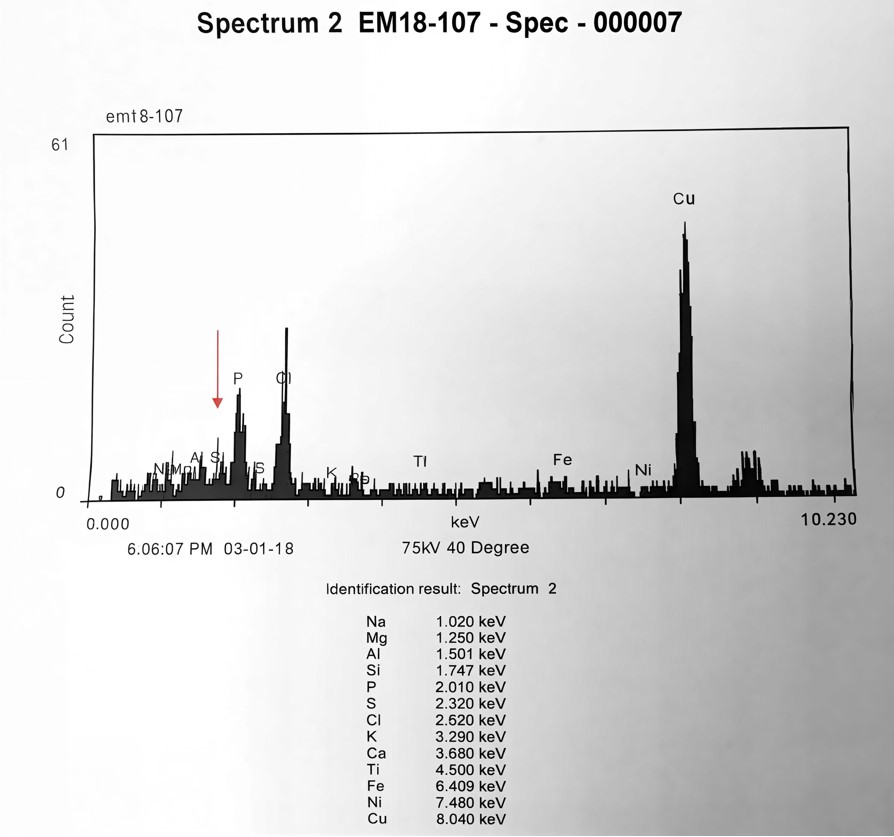
Abdominal computed tomography and magnetic resonance imaging performed earlier that year raised concern for cirrhosis and granulomatous hepatitis. Liver biopsy demonstrated focal lymphocytic infiltration and non-necrotizing granulomatous inflammation. Elemental analysis using scanning electron microscopy with energy-dispersive X-ray spectroscopy (SEM-EDS) identified a silicon signal within granulomatous areas, compatible with the presence of silicone-associated material beyond the implant site Figure 1.
In the setting of persistent fevers and systemic inflammation, further evaluation of her breast implants was pursued. Breast ultrasound and magnetic resonance imaging confirmed rupture of the left silicone implant. She underwent bilateral implant removal on April 3, 2018. Despite the explantation, she continued to experience recurrent fevers and debilitating fatigue. Treatment with prednisone 20 mg daily resulted in rapid symptomatic improvement; however, attempts to taper the dose were followed by symptom recurrence.
Given the ongoing systemic inflammation, a bone marrow biopsy was performed in July 2018. Histopathologic evaluation revealed vacuolated histiocytes consistent with silicone-associated material extending beyond the implant site.
Overall, her presentation was most consistent with a silicone-associated Still’s-like inflammatory syndrome. She did not fulfill Yamaguchi classification criteria for adult-onset Still’s disease, and a formal diagnosis of AOSD was therefore not assigned [19]. Although symptoms improved with prednisone during acute flares, disease relapse occurred with dose reduction. Methotrexate (15 mg weekly for one month followed by 20 mg weekly for one month) was initiated but failed to achieve adequate disease control and was discontinued. Sequential treatment with azathioprine (50–100 mg daily over six months), followed by IL-6 inhibition with tocilizumab injection (162 mg/0.9 mL) and subsequently sarilumab (200 mg every two weeks for four months), did not result in sustained clinical improvement. Prednisone at a dose of 8 mg daily was initiated in October 2019 and successfully discontinued in February 2020.
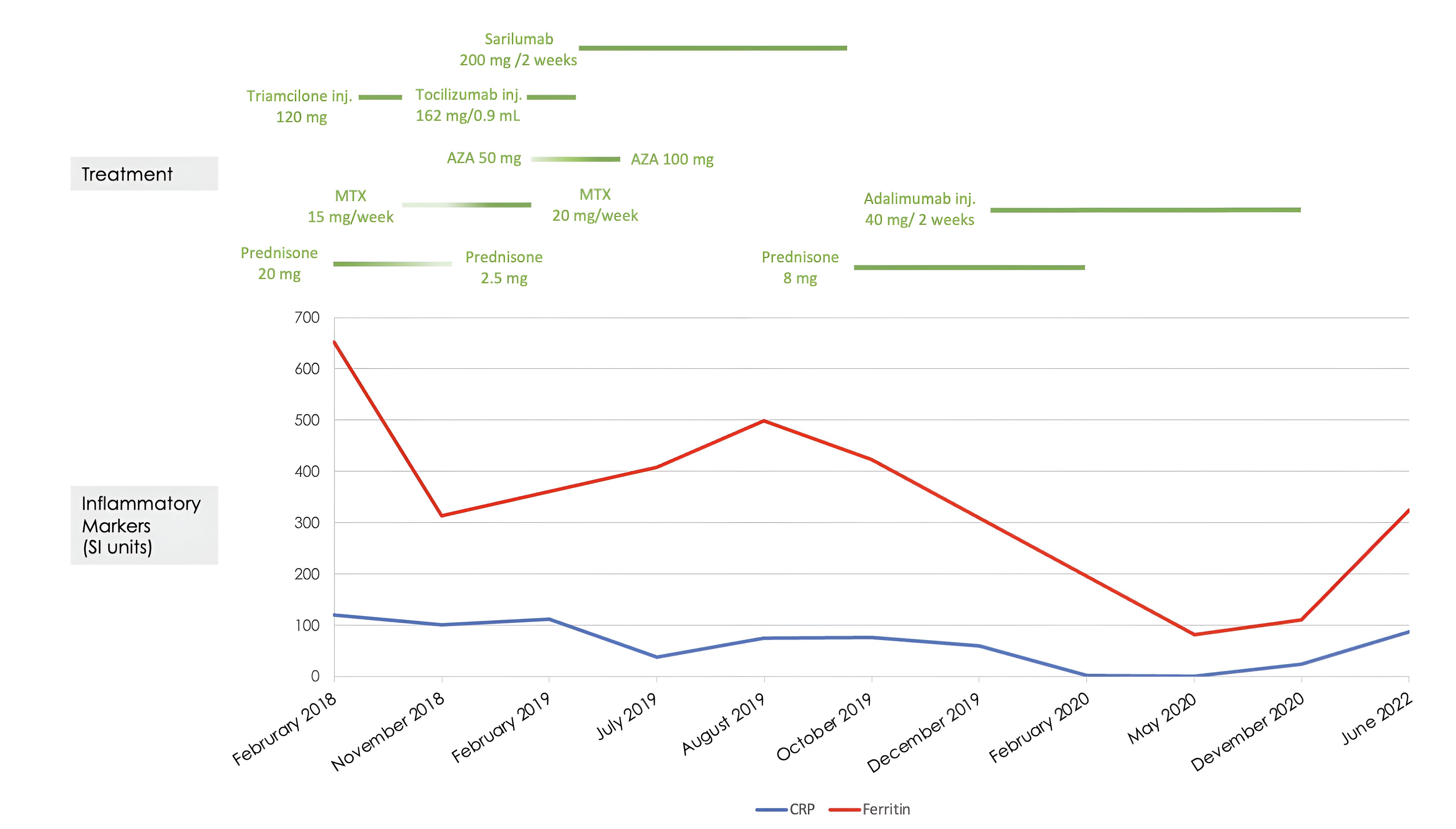
In December 2019, adalimumab was initiated at 40 mg every 2 weeks. At treatment initiation, CRP was 59 mg/L, and the most recent ferritin measurement (October 2019) was 423 ng/mL. During follow-up while receiving adalimumab, inflammatory markers progressively declined. CRP decreased to within the normal reference range by February 2020 (2 mg/L) and further normalized to mg/L by May 2020, at which time ferritin had declined to 81 ng/mL, representing the first documented normalization of both inflammatory markers since initial presentation Figure 2, with parallel clinical improvement. The patient remained on adalimumab until March 2021. The most recent laboratory data obtained during therapy, in December 2021, showed CRP 24 mg/L and ferritin 110 ng/mL. Longer-term outcomes while on treatment could not be fully assessed due to subsequent loss to follow-up. By June 2022, the patient was no longer receiving adalimumab, and inflammatory markers were again markedly elevated (CRP 86.6 mg/L, ferritin 325 ng/mL).
Methods
Chart Review and Data Collection
A comprehensive chart review was performed using the Epic electronic medical record system to obtain clinical history, physical examination findings, laboratory data, imaging studies, pathology reports, and treatment course. Additional information was obtained via a telephone interview with the patient. Written informed consent was obtained for publication of this case report.
Diagnostic Assessment
A systematic diagnostic evaluation was undertaken to identify the etiology of the patient’s systemic inflammatory syndrome. Infectious, malignant, and autoimmune causes were prioritized and comprehensively assessed through serial laboratory studies, autoimmune serologies, and extensive infectious testing. Cross-sectional imaging with abdominal computed tomography and magnetic resonance imaging was performed to evaluate hepatic pathology, while breast ultrasound and magnetic resonance imaging were obtained to assess implant integrity. Histopathologic evaluations included liver biopsy and bone marrow biopsy. Elemental analysis of liver tissue using SEM–EDS was performed to evaluate for silicone-associated material. Screening for tuberculosis and hepatitis B before initiation of biologic therapy was negative.
| Case (Author, Year) | Age / Sex | AOSD Dx | Implant Rupture | Explantation & Response | Granulomatous Pathology | Steroid Dependent | Inflammatory Markers | Treatment Course (Initial Escalation) | Final Outcome |
|---|---|---|---|---|---|---|---|---|---|
| Cretel et al., 2001 | 54 / F | Yes | No | Yes - None | Not Assessed | Yes | ↑WBC, ↑↑CRP, ↑↑Ferritin, ↑↑LFTs, ↑ESR | Prednisolone → IVIG → Azathioprine | Remission (Steroid-dependent) |
| Genovese, 1997 | 44 / F | Yes | No | No | Not Assessed | Yes | ↑WBC, ↑↑↑Ferritin, ↑LFTs, ↑↑ESR | Glucocorticoids → IVIG → Plasmapheresis | Asymptomatic (Maintained on prednisone) |
| Blasiak et al., 2008 | 41 / F | Yes | Yes | Yes- None | No | Yes | ↑WBC, ↑↑CRP, ↑LFTs, ↑↑ESR | Prednisone → Methotrexate → Chloroquine | Remission (Maintained on triple therapy) |
| Jara et al., 2012 | 25 / F | Yes | Yes | Yes- Partial | Not Assessed | Yes | ↑↑WBC, ↑↑↑CRP, ↑↑Ferritin | Prednisone → Azathioprine | Remission (Maintained on prednisone and azathioprine) |
| Dagan et al., 2015 | 24 / F | Yes | Not Reported | Not Reported | Not Assessed | Yes | ↑WBC, ↑↑CRP, ↑↑Ferritin, ↑↑LFTs | Prednisone → Methotrexate → Hydroxychloroquine → Biologics (*) | Persistent disease (Drug-dependent) |
| Wehr et al., 2017 | 25 / F | Yes | No | Yes- Partial | Yes | Yes | ↑WBC, ↑↑CRP, ↑↑↑Ferritin, ↑↑LFTs | Prednisolone → Methotrexate | Partial remission (Persistent fluctuating joint pain) |
| Maitani et al., 2024 (Case 3) | 81 / F | Yes | No | No | Not Assessed | Yes | ↑↑CRP, ↑↑Ferritin, ↑LFTs | Prednisone → Immunosuppressants (*) | Complications (Death due to sepsis) |
| Current Case, 2018 | 49 / F | No | Yes | Yes- None | Yes | Yes | ↑↑↑CRP, ↑Ferritin, ↑LFTs, ↑↑ESR | Prednisone → Triamcinolone → Methotrexate → Azathioprine → Tocilizumab → Sarilumab → Adalimumab | Partial Remission (Lost to follow up) |
This table AOSD or Still-like inflammatory syndromes associated with silicone breast implants that demonstrated refractory disease, defined by steroid dependence and/or failure of explantation, along with subsequent need for escalation to DMARDs or biologic therapy. AOSD diagnosis was based on Yamaguchi classification criteria. Explantation refers to the surgical removal of silicone breast implants. Granulomatous pathology denotes histopathologic evidence of granulomatous or foreign-body–type inflammation on tissue biopsy. Inflammatory markers are reported at initial presentation and categorized relative to institutional upper limits of normal (ULN): (Elevated, Exceeds reference range but > 3 ULN); (Moderate elevation, ≥ 3× ULN); (Severe elevation, > 10× ULN). Standardized reference ranges used for calculations: WBC, 4,500–11,000 cells/μL; ESR, Women < 50 years, < 20 mm/hr; Women > 50 years, < 30 mm/hr; Ferritin, 24–307 ng/mL; LFTs (ALT/AST) 7–55 U/L and 8–48 U/L respectively; CRP, < 0.9 mg/dL (< 9 mg/L). Final outcome reflects disease status at last follow-up, including whether disease control required ongoing maintenance therapy. Abbreviations: AOSD (adult-onset Still’s disease); ESR (erythrocyte sedimentation rate); CRP (C-reactive protein); WBC (white blood cell count); LFTs (liver function tests); ALT (alanine aminotransferase); AST (aspartate aminotransferase); IVIG (intravenous immunoglobulin); DMARDs (disease-modifying antirheumatic drugs). *Asterisk indicates treatment specified without naming the agent.
Discussion
Associations between SBIs and AOSD or Still’s-like systemic inflammatory syndromes have been described in multiple case reports [4,5,6,7,1,3,8,9,10,2,11,12]. Although the patient described in this case report did not fulfill Yamaguchi classification criteria, her clinical features closely overlapped with reported cases of AOSD in women with SBIs Table 1. This distinction is clinically relevant, as this classification criteria may not fully capture atypical or secondary Still’s-like inflammatory presentations, complicating both diagnostic certainty and treatment decisions.
Clinical outcomes among reported cases are heterogeneous. While some patients achieved total remission with explantation and conventional immunosuppressive therapy [3,8,9,10], Table 1 highlights a distinct refractory subgroup characterized by persistent systemic inflammation, initial corticosteroid responsiveness with relapse during tapering, or failure of at least one conventional synthetic disease-modifying antirheumatic drug (csDMARD). In this group, neither explantation nor corticosteroid therapy alone achieved sustained disease control, and escalation to additional immunomodulatory treatment, including IVIG, plasmapheresis, csDMARDs, or ultimately biologic therapy, was frequently required. These observations suggest that in selected patients, inadequate or unsustained immunologic control may allow ongoing systemic inflammation to persist independently of implant status.
In the present case, serial treatment attempts with methotrexate, azathioprine, and IL-6 pathway inhibition were each administered for several months, with documented tapering, but failed to achieve sustained suppression of systemic inflammation, as evidenced by persistently elevated CRP and ferritin levels Figure 2. In contrast, initiation of adalimumab was temporally associated with normalization of inflammatory markers and discontinuation of corticosteroids, with concurrent clinical improvement during the available follow-up period Figure 2. Escalation to biologic therapy was required in our case, likely due to inadequate disease control with corticosteroids and conventional immunosuppressive agents.
TNF- inhibitors were among the earliest biologic therapies evaluated in refractory AOSD, with published reports demonstrating variable efficacy, typically partial rather than complete remission [20,21,22]. Evidence supporting TNF- inhibition remains limited to small case series and observational reports, and data regarding adalimumab specifically are sparse [23,24]. To our knowledge, the present report represents the first description of sustained disease control with adalimumab in a patient with silicone-associated Still’s-like inflammatory syndrome, supporting a potential role for TNF- inhibition as a rescue strategy in selected steroid-dependent or refractory cases.
This report has several limitations. As a single case, causal inferences cannot be drawn. Although this patient exhibited clinical features overlapping with adult-onset Still’s disease, she did not meet formal classification criteria, which limits direct comparison with published AOSD cohorts and case series. Hepatic granulomatous inflammation with systemic inflammation has a broad differential diagnosis, including sarcoidosis, chronic infection, drug-induced disease, and malignancy. However, an extensive evaluation was unrevealing; these conditions cannot be definitively excluded. While TNF inhibition was associated with clinical and biochemical improvement, this does not establish a causal therapeutic effect or generalizability. Elemental analysis detected a silicon signal in granulomatous tissue; however, SEM–EDS cannot distinguish silicone polymer from silicon-containing particulates or silica, nor can it exclude contamination, thereby limiting mechanistic interpretation. Long-term outcomes could not be assessed because of loss to follow-up.
Conclusion
This case describes a silicone-associated Still’s-like inflammatory syndrome with persistent systemic inflammation and granulomatous pathology despite explantation and multiple immunosuppressive therapies. Although long-term outcomes could not be assessed, initiation of adalimumab was temporally associated with normalization of inflammatory markers and successful corticosteroid discontinuation during the available follow-up period. These findings suggest that TNF- inhibition may warrant consideration as a potential therapeutic option in selected patients with refractory disease.
Conflicts of Interest
The authors declare no competing interests that could have influenced the objectivity or outcome of this research.
Funding Source
The authors declare that no specific grant or funding was received for this research from any public, commercial, or not-for-profit funding agency.
Acknowledgments
None.
Informed Consent
Written informed consent was obtained from the patient.
Large Language Model
We used a large language model (LLM) only to improve clarity and style; no scientific content or data were generated.
Authors Contribution
Conceptualization and writing of the original draft were carried out by ADVI. Data curation and investigation were performed by ADVI and NR. Writing, review, and editing were conducted by NR and IT. Supervision was provided by IT.
Data Availability
No datasets were generated or analyzed for this study. All clinical information is contained within the manuscript.
References
- Jara L. J., Medina G., Gomez-Banuelos E., Saavedra M. A., Vera-Lastra O.. Still's disease, lupus-like syndrome, and silicone breast implants. A case of 'ASIA' (Shoenfeld's syndrome). Lupus. 2012;21(2):140-5. doi:10.1177/0961203311430970 PMID: 22235044
- Montalto M., Vastola M., Santoro L., La Regina M., Curigliano V., Manna R., Gasbarrini G.. Systemic inflammatory diseases and silicone breast prostheses: report of a case of adult still disease and review of the literature. Am J Med Sci. 2004;327(2):102-4. doi:10.1097/00000441-200402000-00010 PMID: 14770029
- Katayama I., Umeda T., Nishioka K.. Adult Still's-disease-like illness in a patient with silicone breast implants. Clin Rheumatol. 1998;17(1):81-2. doi:10.1007/BF01450969 PMID: 9586690
- Blasiak A., Blachowicz A., Gietka A., Rell-Bakalarska M., Franek E.. Still's disease in patient with silicone breast implants: case report. Pol Arch Med Wewn. 2008;118(1-2):65-7. PMID: 18405175
- Cretel E., Richard M. A., Jean R., Durand J. M.. Still's-like disease, breast prosthesis, and collagen implants. Rheumatol Int. 2001;20(3):129-31. doi:10.1007/s002960000088 PMID: 11354561
- Dagan A., Kogan M., Shoenfeld Y., Segal G.. When uncommon and common coalesce: adult onset Still's disease associated with breast augmentation as part of autoimmune syndrome induced by adjuvants (ASIA). Clin Rheumatol. 2016;35(6):1643-8. doi:10.1007/s10067-015-2869-2 PMID: 25604318
- Genovese M. C.. Fever, rash, and arthritis in a woman with silicone gel breast implants. West J Med. 1997;167(3):149-58. PMID: 9308407 PMCID: PMC1304514
- Lavranos G., Kouma D., Deveros A., Pigiotou G., Samanis G., Zintilis C.. Still's-like Disease Induced by Breast Implants in a Middle-Aged Female Health Professional. Eur J Case Rep Intern Med. 2017;4(1):000513. doi:10.12890/2016_000513 PMID: 30755905 PMCID: PMC6346920
- Liu L., Liu S., Su J.. Breast Implant, a Mimicker of Adult-Onset Still Disease. J Clin Rheumatol. 2018;24(7):412-413. doi:10.1097/RHU.0000000000000710 PMID: 29538082
- Maitani K., Kadowaki M., Yamagiwa Y., Yasuhara Y., Kozuki S., Otsuka Y., Kubo T., Tomita K.. Three Case Reports of Adult-onset Still Disease Associated with Breast Implantation. Plast Reconstr Surg Glob Open. 2024;12(5):e5844. doi:10.1097/GOX.0000000000005844 PMID: 38784828 PMCID: PMC11111390
- Mustafa J. C. R., Fleury E. F. C., Dijkman Hbpm. Case Report: Evidence of Migratory Silicone Particles Arising From Cohesive Silicone Breast Implants. Front Glob Womens Health. 2022;3:730276. doi:10.3389/fgwh.2022.730276 PMID: 35547828 PMCID: PMC9085291
- Wehr A., Grieb G., Trautwein C., Streetz K.. Unusual onset of adult still's disease due to a systemic reaction to artificial breast implants. Z Rheumatol. 2017;76(6):547-549. doi:10.1007/s00393-017-0277-5 PMID: 28204878
- Di Via Ioschpe A., Oleru O. O., Brozynski M., Seyidova N., Henderson P. W.. Contextualizing the Impact of Pop Culture on Breast Implant Illness and its Medical Relevance. Aesthetic Plast Surg. 2024;48(5):1056-1065. doi:10.1007/s00266-023-03422-y PMID: 37486364 PMCID: PMC11000431
- Rohrich R. J., Kaplan J., Dayan E.. Silicone Implant Illness: Science versus Myth?. Plast Reconstr Surg. 2019;144(1):98-109. doi:10.1097/PRS.0000000000005710 PMID: 31246810
- Shoenfeld Y., Agmon-Levin N.. 'ASIA' - autoimmune/inflammatory syndrome induced by adjuvants. J Autoimmun. 2011;36(1):4-8. doi:10.1016/j.jaut.2010.07.003 PMID: 20708902
- Ameratunga R., Gillis D., Gold M., Linneberg A., Elwood J. M.. Evidence Refuting the Existence of Autoimmune/Autoinflammatory Syndrome Induced by Adjuvants (ASIA). J Allergy Clin Immunol Pract. 2017;5(6):1551-1555 e1. doi:10.1016/j.jaip.2017.06.033 PMID: 28888842
- Watad A., Sharif K., Shoenfeld Y.. The ASIA syndrome: basic concepts. Mediterr J Rheumatol. 2017;28(2):64-69. doi:10.31138/mjr.28.2.64 PMID: 32185259 PMCID: PMC7046028
- McConnell J. P., Moyer T. P., Nixon D. E., Schnur P. L., Salomao D. R., Crotty T. B., Weinzweig J., Harris J. B., Petty P. M.. Determination of silicon in breast and capsular tissue from patients with breast implants performed by inductively coupled plasma emission spectroscopy. Comparison with tissue histology. Am J Clin Pathol. 1997;107(2):236-46. doi:10.1093/ajcp/107.2.236 PMID: 9024074
- Yamaguchi M., Ohta A., Tsunematsu T., Kasukawa R., Mizushima Y., Kashiwagi H., Kashiwazaki S., Tanimoto K., Matsumoto Y., Ota T.. Preliminary criteria for classification of adult Still's disease. J Rheumatol. 1992;19(3):424-30. PMID: 1578458
- Cavagna L., Caporali R., Epis O., Bobbio-Pallavicini F., Montecucco C.. Infliximab in the treatment of adult Still's disease refractory to conventional therapy. Clin Exp Rheumatol. 2001;19(3):329-32. PMID: 11407090
- Fautrel B., Sibilia J., Mariette X., Combe B., Club Rhumatismes et Inflammation. Tumour necrosis factor alpha blocking agents in refractory adult Still's disease: an observational study of 20 cases. Ann Rheum Dis. 2005;64(2):262-6. doi:10.1136/ard.2004.024026 PMID: 15184196 PMCID: PMC1755371
- Giulio Cavalli Stefano Franchini, Corrado Campochiaro, Elena Baldissera, Lorenzo Dagna, Maria Grazia Sabbadini. Switching Biologic Agents in Refractory Adult-Onset Still’s Disease: Efficacy and Safety in a Cohort of 20 Patients at a Single Referral Center. 2014.
- Kraetsch H. G., Antoni C., Kalden J. R., Manger B.. Successful treatment of a small cohort of patients with adult onset of Still's disease with infliximab: first experiences. Ann Rheum Dis. 2001;60 Suppl 3(Suppl 3):iii55-7. doi:10.1136/ard.60.90003.iii55 PMID: 11890655 PMCID: PMC1766667
- Lee W. S., Yoo S. H., Ko R. E., Yoo W. H.. Adalimumab in the treatment of refractory adult-onset Still's disease. Int J Rheum Dis. 2017;20(11):1798-1799. doi:10.1111/1756-185X.12421 PMID: 24954877