First Video-Documented Vine Snake (Thelotornis Capensis) Envenomation in a Healthy Adult: A Rare Case Report from South Africa
Casper GermishuysⒾ1*
- 1Department of Ophthalmology, Paarl Academic Hospital, South Africa
Abstract
Vine snake (Thelotornis capensis) envenomation is rare but can cause life-threatening coagulopathy. To our knowledge, approximately the 10th reported case of envenomation: a 42-year-old male who misidentified a vine snake as a juvenile python and sustained a bite while filming snake handling. The envenomation was captured on video and posted on social media. Initial laboratory investigations showed complete incoagulability within 28 minutes of the bite, with normal vital signs and minimal local symptoms. The patient later developed frank hematuria, highlighting the delayed onset of systemic bleeding typical of venom-induced consumptive coagulopathy. No specific antivenom exists for venom from the Thelotornis genus. Management was supportive, with close monitoring of coagulation parameters; blood products were planned if bleeding progressed, but were not ultimately required. The patient self-discharged against medical advice despite ongoing coagulopathy, but ultimately recovered fully without sequelae. This case reinforces the need for clinicians to be aware of delayed coagulopathy and the importance of supportive care in vine snake envenomation.
Keywords: Vine snake, Thelotornis capensis, Snake envenomation, Venom-induced consumptive coagulopathy, Hemotoxic venom
Article information
Introduction
The vine snake (Thelotornis capensis) is a rear-fanged arboreal colubrid characterized by its elongated body, lance-shaped head, and exceptional camouflage, often indistinguishable from a twig or vine [1]. Before the early 20th century, boomslang (Dispholidus typus) was believed to be the only colubrid capable of causing fatal envenomation in humans [2].
The first documented vine snake fatality occurred in 1953, when a snake handler who had also assumed the species was non-lethal was bitten [3]. The hemotoxic venom, similar to that of D. typus, induces haemophilic effects by activating plasminogen and accelerating fibrinolysis, leading to fibrinogen depletion and venom-induced consumptive coagulopathy (VICC) [4]. Importantly, boomslang antivenom does not cross-neutralize Vine snake venom, leaving clinicians reliant on supportive measures alone [4]. This distinction is clinically critical, as clinicians may incorrectly presume cross-protection based on shared hemotoxic syndromes, potentially leading to inappropriate antivenom administration—exposing patients to unnecessary anaphylaxis risk and offering no therapeutic benefit.
Vine snakes are generally non-aggressive, and human envenomation is exceedingly rare, with only two fatalities documented to date [1,2]. What makes this case particularly notable is the combination of video-documented fang engagement, definitive herpetological identification of the snake, and clear systemic venom effects, distinguishing it from the many suspected or potential dry bites. Management of VICC in the absence of an effective antivenom remains a significant clinical challenge, as this case report examines.
Case Presentation
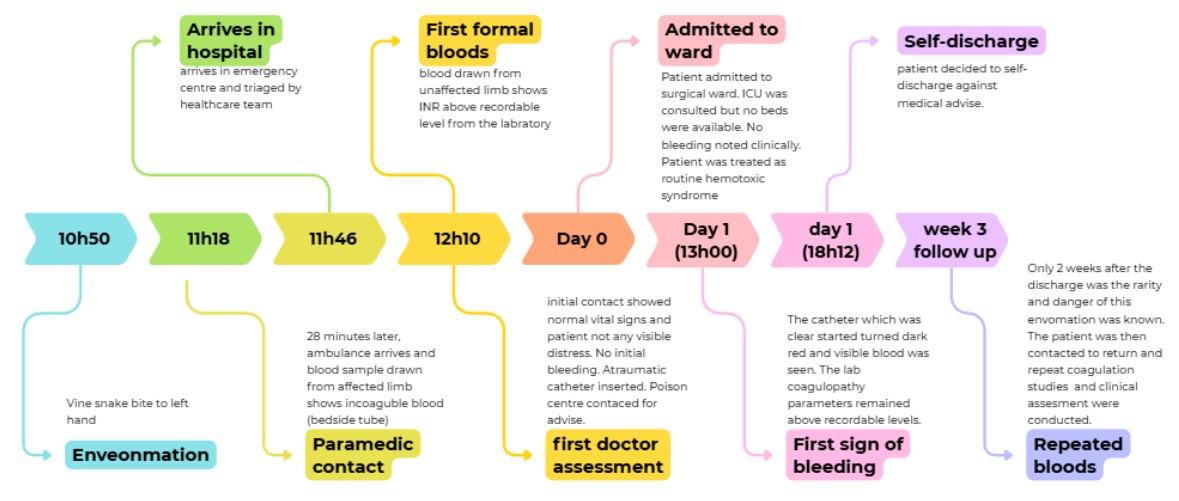
A 42-year-old healthy African male with no co-morbidities sustained a confirmed bite from a vine snake (Thelotornis capensis). He had misidentified the snake as a juvenile python and was holding it comfortably in his hand. The envenomation was captured on video (Supplementary Video 1), showing a prolonged bite with sustained rear-fang engagement on the patient’s hand. He was bitten at 10h50 and presented to a medical facility via ambulance at 11h46. The attending paramedic was a trained snake handler and identified the snake on scene, a finding subsequently confirmed by herpetologists who reviewed the envenomation video. The paramedic drew a blood specimen from the affected limb 28 minutes after envenomation, and the specimen failed to clot indefinitely in the tube (no formal tests were conducted on this specimen; subsequent draws were from the unaffected limb). The patient was first assessed by a medical doctor at 12h10, when the first formal blood specimen was obtained from the unaffected limb (Table 1). The poison center was contacted, and the clinicians were advised that no antivenom exists for this snake and that vitamin K should be started and bleeding monitored. Further, the poison center informed the clinician to start cryoprecipitate and fresh frozen plasma if the patient starts bleeding. Viscoelastic hemostatic assays would have been useful, but are not available in South African rural hospitals. Confounding alternative causes of coagulopathy were excluded clinically: anti-coagulant exposure, liver disease, sepsis, and pre-existing coagulopathy.
| Parameter | Normal values | 07/02/2024 12h10 (Hospital admission) | 08/02/2024 13h00 | 28/02/2024 12h40 (3-week follow-up) |
|---|---|---|---|---|
| INR | 0.8–1.2 | >999 | >999 | 0.9 |
| PTT ratio | 0.8–1.2 | >999 | >999 | 1.01 |
| PTT (s) | 25–35 | >999 | >999 | 27.6 |
| Hemoglobin (g/dL) | 12–17 | 13.0 | 13.0 | 12.7 |
| Platelets (/L) | 150–450 | 282 | Not done | 286 |
| Fibrinogen (g/L) | 2.0–4.0 | Not done | Not done | 2.4 |
| Anti-thrombin III (%) | 80–120 | Not done | Not done | 89 |
INR, international normalized ratio; PTT, partial thromboplastin time; PTT ratio, ratio of patient PTT to control; Hb, hemoglobin; PLT, platelets; AT III, antithrombin III; g/dL, grams per deciliter; g/L, grams per liter; s, seconds. ^*VICC-specific investigations were not performed at presentation due to limited availability and cost considerations and because results were not expected to alter management. These were performed later for educational purposes. ^ Measurement exceeded the upper limit of the analyzer’s measurement range.
Upon admission, the patient had normal vital signs: blood pressure 125/89 and heart rate 69. The patient’s index INR (drawn from the unaffected limb) in the emergency center was unable to clot. He had a catheter placed at presentation, with no peri-insertion trauma/bleeding. Two small puncture wounds were noted on the left hand with no swelling, bleeding, or oozing. No other hemorrhage, petechiae, or bruising was noted. Systemically, the only complaints were headache and diaphoresis. The following day in the ward, the INR again failed to clot, and platelet transfusion was not repeated Table 1. Notably, no hematuria was noted at insertion or in the preceding interval, making catheter-related trauma unlikely. The vitals remained normal, but frank blood was noted in the urine collection bag 22 hours after envenomation Figure 2. Spontaneous dark red urine was noted in the catheter bag. Still, there was no decline in Hemoglobin, likely due to the short duration and physiological reserves of the young healthy patient. The decision was made to defer blood products until there was clinical or laboratory deterioration (e.g., a decrease in hemoglobin or hemodynamic changes). No blood products or medications were administered, and the patient was only monitored. Later in the day, the patient refused healthcare and forcibly discharged themself against medical advice. He was advised to return immediately should any bleeding, clinical deterioration, or new symptoms occur, and was provided with a clear follow-up plan.
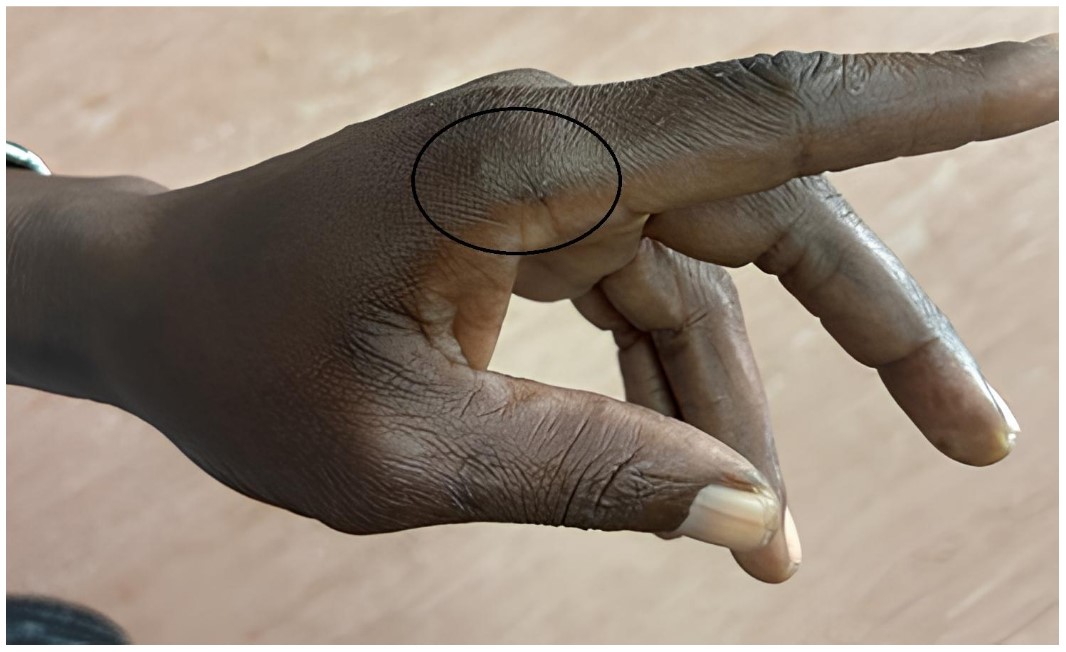
The patient’s only symptoms were headache, diaphoresis, and frank hematuria, which he self-reported all resolved four days after the envenomation. The patient returned for outpatient review 3 weeks after discharge. The wound was fully healed, with no infection or necrosis Figure 1. He reported (at the week three follow-up) that his headache, diaphoresis, and hematuria had resolved spontaneously 4 days after the envenomation. Laboratory investigations were repeated and were all within normal limits Table 1. At the time of presentation, the case was managed as a hemotoxic syndrome, and the rarity of confirmed Thelotornis envenomation was not yet appreciated. It was only after discussing the case with a snake catcher several weeks later, who noted significant interest within the herpetology community, that the uniqueness of the event became clear, prompting formal follow-up, additional laboratory testing, and a detailed review of the clinical course.
Discussion
Our patient’s clinical course reflected the recognised pattern of Thelotornis envenomation: early laboratory evidence of complete incoagulability with initially minimal clinical findings. Previous reports likewise describe minor local effects and minimal pain, with occasional puncture-site oozing despite profound systemic coagulopathy. Among the documented human cases in which the timing of bleeding was reported, the onset ranged from immediately after the bite to 15 hours post-envenomation, with manifestations including persistent oozing, gastrointestinal haemorrhage, and prolonged hematuria. In comparison, our patient developed frank hematuria at 22 hours, placing him at the upper end of the reported cases [5,6,7]. This relatively mild presentation may reflect the limited volume delivered by a juvenile snake, as suggested by the supplementary video. The case reports highlight that the onset of bleeding is often delayed for hours to days after envenomation [5,8,1,7], underscoring the need for prolonged monitoring even in initially stable patients.
Viscoelastic hemostatic assays provide valuable real-time characterisation of VICC, distinguishing fibrinogen depletion, impaired clot strength, and hyperfibrinolysis. However, these technologies are not available in South African district or rural hospitals, where most snakebite victims initially present. A D-dimer was mistakenly not done by the emergency doctor. This patient’s VICC diagnosis was made on a clinical basis. In future cases, D-dimer could serve as an early screening marker for evolving VICC, allowing clinicians to identify consumptive coagulopathy before overt bleeding develops and to intensify monitoring accordingly [9], although its diagnostic performance in African colubrid envenomation remains to be established.
No specific antivenom is available for vine snake envenomation [1]. Dispholidus typus venom is heparin-resistant, and early heparin therapy doesn’t prevent VICC, highlighting that heparin has no therapeutic role in such envenomation [8]. Supportive management remains the cornerstone of care [8,1,7]. This includes close clinical and biochemical monitoring as well as blood products when indicated. Fresh-frozen plasma is used to replace depleted clotting factors, cryoprecipitate to correct severe fibrinogen deficiency, and whole blood when significant haemorrhage occurs, providing both volume and coagulation support [8]. The administration of vitamin K has no role in VICC, as coagulopathy results from consumption rather than impaired synthesis [10]. A further learning point is the importance of balancing syndromic management with accurate snake identification. In this case, confirmation of Thelotornis capensis prevented inappropriate administration of boomslang antivenom, which carries the risk of anaphylaxis and unnecessary use of a scarce resource. Whenever feasible, species identification by an experienced handler or herpetologist should inform clinical decision-making.
Our patient initially remained hemodynamically stable throughout his admission, despite developing hematuria. He then decided to self-discharge and placed himself at risk for possible delayed catastrophic bleeding. Fortunately, he self-reported complete recovery within days, which mirrors the self-limiting nature of mild VICC as venom activity wanes and hepatic synthesis restores clotting factors.
The South African Snakebite Symposium Consensus guidelines note that delayed coagulopathic complications generally occur between 12 and 36 hours after envenomation. [11] Among the four published cases of vine-snake envenomation with documented systemic bleeding, resolution occurred at approximately 40 hours, 40 hours, 30 hours, and day 10. [12,3,13,2] In comparison, our patient’s hematuria resolved by day 4 (self-reported). Based on these data, it appears reasonable to recommend observation for at least 36 hours in patients with any laboratory evidence of coagulopathy, and prolonged monitoring—potentially beyond five days or until coagulation studies normalise—in those who develop systemic haemorrhage.
A key limitation of this report is that the clinical team was initially unaware of the rarity and significance of a confirmed Thelotornis envenomation, and the patient was managed as a general hemotoxic syndrome. As a result, not all laboratory investigations that would have been valuable in characterising the early coagulopathy were obtained at presentation. The unique nature of the case only became apparent several weeks later, prompting retrospective data collection, follow-up testing, and the reconstruction of the clinical timeline.
Conclusion
Vine snake envenomation, although rare, carries a significant risk of severe coagulopathy and delayed haemorrhage. This case underscores several key learning points: the critical importance of accurate species identification to avoid inappropriate antivenom use; the potential for early laboratory coagulopathy to precede clinical bleeding by many hours; and the necessity for prolonged observation in patients with VICC. In the absence of specific antivenom, management is supportive, centered on early recognition, laboratory monitoring, and, if indicated, timely administration of blood products. This case underscores the need for clinician awareness and contributes to the small but important body of literature guiding the management of Thelotornis capensis bites.
Conflicts of Interest
The authors declare no competing interests that could have influenced the objectivity or outcome of this research.
Funding Source
The authors declare that no specific grant or funding was received for this research from any public, commercial, or not-for-profit funding agency.
Acknowledgments
We thank Steven Meighan for granting permission to publish the supplementary video.
Institutional Review Board (IRB)
This case report was approved by the Stellenbosch University Health Research Ethics Committee via expedited review (HREC reference C25/09/038; Project ID 34797; approval date 01 October 2025; protocol expiry 30 September 2026).
Informed Consent
Written informed consent was obtained from the patient for publication of this case report and any accompanying images/video stills. Supplementary Video 1. Vine snake (Thelotornis capensis) bite showing prolonged rear-fang engagement. © Steven Meighan (Deep South Reptile Rescue). Used with permission. Audio removed prior to publication. The supplementary video is third-party material and is not covered by the article’s Creative Commons licence unless explicitly stated.
Large Language Model
The author declares that generative artificial intelligence (AI) tools (ChatGPT 5.1) were used to assist in language refinement and grammar checking during the preparation of this manuscript. The authors reviewed and verified all content, and they take full responsibility for the integrity and accuracy of the manuscript.
Authors Contribution
The author was responsible for all aspects of the work.
Data Availability
All relevant clinical information supporting the conclusions is included in the article and supplementary material. Additional details that could compromise patient privacy are not publicly available but may be considered by the corresponding author upon reasonable request, provided ethics and consent permit.
References
- Otto J., Blaylock R.. Vine snake (Thelotornis capensis) bite in a dog. J S Afr Vet Assoc. 2003;74(1):27-8. doi:10.4102/jsava.v74i1.497 PMID: 12836745
- Smith Hobart M. Another rear-fanged South African snake lethal to humans. Herpetologica. 1958;14(4):198-202.
- Broadley DG.. Fatalities from the Bites Ofdispholidusandtheolotornisand a Personal Case History. Journal of the Herpetological Association of Rhodesia. 1957;1(1):5-5. doi:10.1080/0440730x.1957.9650637
- Debono J., Dobson J., Casewell N. R., Romilio A., Li B., Kurniawan N., Mardon K., Weisbecker V., Nouwens A., Kwok H. F., Fry B. G.. Coagulating Colubrids: Evolutionary, Pathophysiological and Biodiscovery Implications of Venom Variations between Boomslang (Dispholidus typus) and Twig Snake (Thelotornis mossambicanus). Toxins (Basel). 2017;9(5). doi:10.3390/toxins9050171 PMID: 28534833 PMCID: PMC5450719
- Atkinson P. M., Bradlow B. A., White J. A., Greig H. B., Gaillard M. C.. Clinical features of twig snake (Thelotornis capensis) envenomation. S Afr Med J. 1980;58(25):1007-11. PMID: 7444704
- Blaylock RS. The identification and syndromic management of snakebite in South Africa. South African Family Practice. 2005;47(9):46-53.
- Warrell D. A.. Snake venoms in science and clinical medicine. 1. Russell's viper: biology, venom and treatment of bites. Trans R Soc Trop Med Hyg. 1989;83(6):732-40. doi:10.1016/0035-9203(89)90311-8 PMID: 2533418
- Atkinson P. M., Rebello M., Gaillard M. C., Bradlow B. A.. The role of heparin therapy in Dispholidus typus envenomation: an experimental study. Thromb Res. 1981;23(4-5):355-63. doi:10.1016/0049-3848(81)90196-1 PMID: 6798704
- Isbister G. K., Noutsos T., Jenkins S., Isoardi K. Z., Soderstrom J., Buckley N. A.. D-dimer testing for early detection of venom-induced consumption coagulopathy after snakebite in Australia (ASP-29). Med J Aust. 2022;217(4):203-207. doi:10.5694/mja2.51589 PMID: 35670073 PMCID: PMC9541317
- Corbett C., Pillay-Fuentes Lorente V., Muller G. J., Van Rensburg R.. Boomslang (Dispholidus typus) envenomation in a patient on warfarin therapy. S Afr Med J. 2020;110(10):999-1002. doi:10.7196/SAMJ.2020.v110i10.15137 PMID: 33205728
- Hardcastle T., Engelbrecht A., Lalloo V., Bell C., Toubkin M.. Approach to the diagnosis and management of snakebite envenomation in South Africa in humans. S Afr Med J. 2023;113(6):12-18. doi:10.7196/SAMJ.2023.v113i6.1037 PMID: 37278261
- Beiran D., Currie G.. Snake bite due to Thelotornis kirtlandii. (Vine snake, bird snake or twig snake). Cent Afr J Med. 1967;13(6):137-9. PMID: 6077485
- Saddler M., Paul B.. Vine snake envenomation. Cent Afr J Med. 1988;34(2):31-3. PMID: 3219721