Telehealth and In-Person Mental Health Care for Underserved Populations: A Narrative Scoping Synthesis
Shaunt PapelianⒾ1*
- 1Department of Clinical Sciences, UC Riverside School of Medicine, Riverside, CA, USA
Abstract
Background: Mental health disparities disproportionately affect rural, low-income, and racially marginalized communities. Telehealth has emerged as a potentially important modality for expanding access to mental health care, yet comparative evidence on its clinical effectiveness, engagement outcomes, and equity implications relative to in-person care remains limited and heterogeneous.
Methods: A narrative scoping synthesis was conducted following PRISMA 2020 guidelines. PubMed and Scopus were searched through December 2024 using predefined keywords. The evidence base comprised primary comparative studies, systematic reviews, a rapid review, and a qualitative scoping review. Only English-language publications were eligible, introducing potential selection bias. Single-reviewer screening and extraction were performed, no protocol was pre-registered, and no formal risk-of-bias assessment was conducted—all acknowledged methodological limitations.
Results: Eight sources meeting inclusion criteria were identified, representing approximately 14,000 participants across diverse underserved settings; several included sources are review-level syntheses and should be interpreted accordingly. Evidence suggests broadly comparable clinical outcomes between telehealth and in-person care for depression, anxiety, and PTSD in some underserved settings, though findings are context-dependent and methodologically limited. Appointment adherence findings were mixed. Technology access, language barriers, and provider cultural competency gaps were consistently identified as equity-relevant concerns.
Conclusions: Available evidence suggests telehealth may offer broadly comparable outcomes to in-person mental health care in some underserved settings, though this conclusion derives from a heterogeneous, methodologically limited evidence base and should be interpreted with caution. Equity effects remain context-specific and conditional on structural supports. High-quality prospective trials with equity-centered outcome frameworks are needed.
Keywords: Telehealth, Mental health disparities, Telepsychiatry, Health equity, Underserved populations, Digital health, Scoping synthesis
Article information
Introduction
Background and Epidemiology
Mental health disorders represent a leading contributor to the global disease burden. According to the Global Burden of Disease Study 2019, mental disorders accounted for 5.1% of all disease burden worldwide. They constituted the leading cause of years lived with disability, responsible for approximately one in six disability-adjusted life years globally [1]. Between 1990 and 2019, the estimated number of people living with a mental disorder increased from approximately 655 million to 970 million, driven substantially by population growth [1]. Despite the scale of this burden, access to mental health services remains deeply inequitable across income levels, geographies, and racial and ethnic groups.
In the United States, national survey data consistently reveal large treatment gaps. According to the 2022 National Survey on Drug Use and Health, among the 59.3 million adults with any mental illness, nearly 50% did not receive mental health treatment in the prior year [2]. Racial and ethnic disparities in treatment receipt are well-documented: Asian, Black, and Hispanic adults with any mental illness were substantially less likely than White or multiracial adults to receive mental health services [2]. These disparities reflect not only differences in help-seeking behavior but also the structural inequities embedded in the distribution and financing of care.
The Mental Health Workforce Shortage and Geographic Disparities
Geographic maldistribution of mental health professionals compounds these access challenges considerably. Data from the Rural Health Information Hub indicate that approximately 70% of rural counties in the United States have no practicing psychiatrist [3]. As of late 2024, more than 4,200 Mental Health Professional Shortage Areas had been designated in rural areas alone, with an estimated 1,797 additional practitioners required to eliminate those designations [3]. Morales and colleagues characterized this as a compounding crisis, noting that as many as 65% of nonmetropolitan counties lack psychiatrists entirely and that over 60% of rural Americans live in designated mental health provider shortage areas [4]. The consequences are clinically significant: rural communities experience higher rates of suicide relative to urban areas, a gap that has widened over time [3].
Low-income urban populations face overlapping barriers of a different character. While specialty providers may be physically closer, cost, insurance status, transportation, inflexible work schedules, and stigma collectively suppress utilization [2]. Racially and ethnically marginalized communities face additional layers of structural inequity, including historical mistrust of medical institutions, limited availability of culturally competent or linguistically concordant providers, and systemic racism embedded within healthcare systems [4].
Telehealth as a Potential Structural Solution
Telehealth – broadly defined as the delivery of healthcare services using telecommunications technologies, including synchronous video and audio platforms – has rapidly expanded as a potential response to these structural barriers. Use of telehealth for mental health services grew substantially in the years preceding the COVID-19 pandemic and accelerated dramatically from 2020 onward, when regulatory waivers relaxed geographic restrictions and expanded reimbursement [5]. The pandemic created a natural experiment in which the rapid, large-scale adoption of telemental health made comparative effectiveness data available across diverse populations and settings.
Prior systematic reviews have generally found telehealth to be broadly comparable to in-person care for common mental health conditions, including depression and anxiety, in general adult populations [6,7]. However, these reviews have not consistently focused on underserved, equity-relevant populations, where both the potential benefits and the risks of telehealth implementation differ substantially from those in broader samples. Whether telehealth expands access equitably – or reproduces and deepens existing disparities through a "digital divide" – depends substantially on how it is designed, delivered, and resourced [8].
Rationale and Aims
The intersection of mental health disparities, workforce shortages, and telehealth expansion presents a critical public health opportunity with significant equity implications. For this review, "underserved" was operationalized a priori to encompass populations characterized by at least one of the following: (1) rural or geographically isolated location with limited proximate mental health services; (2) low-income or Medicaid-enrolled status; (3) racial or ethnic minority identity in the context of documented health services disparities; or (4) limited English proficiency or linguistic minority status. Included sources were required to serve populations meeting at least one of these criteria.
This narrative scoping synthesis aims to review comparative evidence on telehealth versus in-person mental health care in underserved populations, focusing on clinical outcomes, appointment adherence, patient satisfaction, and equity-relevant access barriers. The evidence base includes primary comparative studies and review-level sources, reflecting the current state of the literature. By mapping available evidence on the conditions under which telehealth narrows or widens disparities, this synthesis aims to inform evidence-based clinical practice, policy development, and future research priorities.
Methods
Search Strategy
This review was conducted and reported following the PRISMA 2020 guidelines. The PICO framework was applied as follows: Population: adults from underserved, rural, low-income, or racially and ethnically marginalized populations (as defined in Section 1.4) seeking mental health care; Intervention: telehealth delivery of mental health services (synchronous video or telephone); Comparison: in-person delivery of equivalent mental health services; Outcomes: clinical symptom outcomes, appointment adherence and no-show rates, patient satisfaction, technology access barriers, and equity-relevant engagement metrics.
A comprehensive search of PubMed and Scopus was conducted through December 2024 (final search date: December 31, 2024). The full search strategy for PubMed was: ("telehealth" OR "telepsychiatry" OR "telemedicine" OR "videoconferencing" OR "video teleconference") AND ("mental health" OR "behavioral health" OR "depression" OR "anxiety" OR "PTSD") AND ("underserved" OR "rural" OR "low-income" OR "racial minority" OR "ethnic minority" OR "disparities" OR "health equity" OR "digital divide"). An equivalent strategy using subject headings and field tags was applied in Scopus. Boolean operators and MeSH terms were used where applicable. No supplementary search methods (gray literature, hand searching, expert consultation) were conducted, which is a limitation of this synthesis.
Eligibility Criteria
Given the mixed nature of the identified evidence base, this review adopted a scoping synthesis approach rather than a restricted primary-study systematic review. Sources were eligible for inclusion if they: (1) reported on or directly compared telehealth with in-person delivery of mental health or behavioral health services; (2) focused on or included populations characterized as underserved per the a priori definition above (rural, low-income, racially or ethnically diverse, or limited English proficiency); (3) reported at least one outcome relevant to clinical effectiveness, appointment adherence, patient satisfaction, or technology-related barriers; and (4) were published in English. Only English-language sources were included; this language restriction may have excluded relevant evidence from non-English-speaking contexts and is acknowledged as a potential source of bias.
This synthesis includes primary comparative studies (retrospective cohort analyses, prospective observational studies, cross-sectional analyses), systematic reviews and meta-analyses, a rapid review, and a qualitative systematic review. Sources were not excluded based solely on design, consistent with a scoping approach; however, review-level sources and primary studies are distinguished throughout the results and should not be interpreted as equivalent evidence. Studies evaluating only asynchronous telehealth without a synchronous comparator, editorials, case reports, or conference abstracts without sufficient original data were excluded.
Study Selection and Data Extraction
All records identified through database searches were exported for screening. Duplicate records were removed before screening. Titles and abstracts were screened by one reviewer, followed by a full-text review to confirm eligibility. Single-reviewer screening and extraction represent a significant methodological limitation of this synthesis; the absence of independent duplicate screening increases the risk of selection error and subjective inclusion bias. This limitation is acknowledged explicitly, and readers should interpret the evidence base and conclusions with appropriate caution. Data were extracted into a standardized form capturing study design, sample size, population characteristics (geographic setting, income level, racial/ethnic composition), intervention characteristics (modality, condition treated, duration, calendar period of data collection), and outcomes (clinical symptom scores, no-show rates, satisfaction ratings, reported barriers). No review protocol was registered before the conduct of this review; the lack of prospective registration is acknowledged as a limitation and raises the possibility of post hoc outcome framing.
Quality Appraisal
A formal standardized risk-of-bias assessment was not conducted for the included sources. This represents a significant limitation. Established tools are available for randomized trials (Cochrane RoB 2), observational studies (Newcastle-Ottawa Scale), and review-level evidence (AMSTAR-2); future reviews should apply the appropriate tools. In the absence of a formal appraisal, risks related to selection bias, confounding by indication, differential attrition, and pandemic-era temporal confounding were qualitatively assessed and incorporated into the narrative interpretation. Readers should interpret all comparative claims in this synthesis as low- to uncertain-certainty evidence given the absence of formal quality appraisal.
Given the substantial clinical, methodological, and temporal heterogeneity across included sources – spanning primary studies and review-level evidence, diverse settings, different telehealth modalities, and both pre-pandemic and pandemic-era periods – quantitative meta-analysis was not performed. Results are presented as a structured narrative synthesis, stratified by study design and outcome domain where possible.
Primary Outcomes
Primary outcomes assessed were: (1) clinical symptom outcomes for depression, anxiety, and PTSD; (2) appointment adherence and no-show rates; (3) patient satisfaction with care; and (4) equity-relevant access barriers, including technology access, digital literacy, and language concordance. These outcomes were selected to reflect both the clinical and structural dimensions most relevant to the question of whether telehealth effectively and equitably expands access to mental health care in underserved populations.
Results
Study Selection
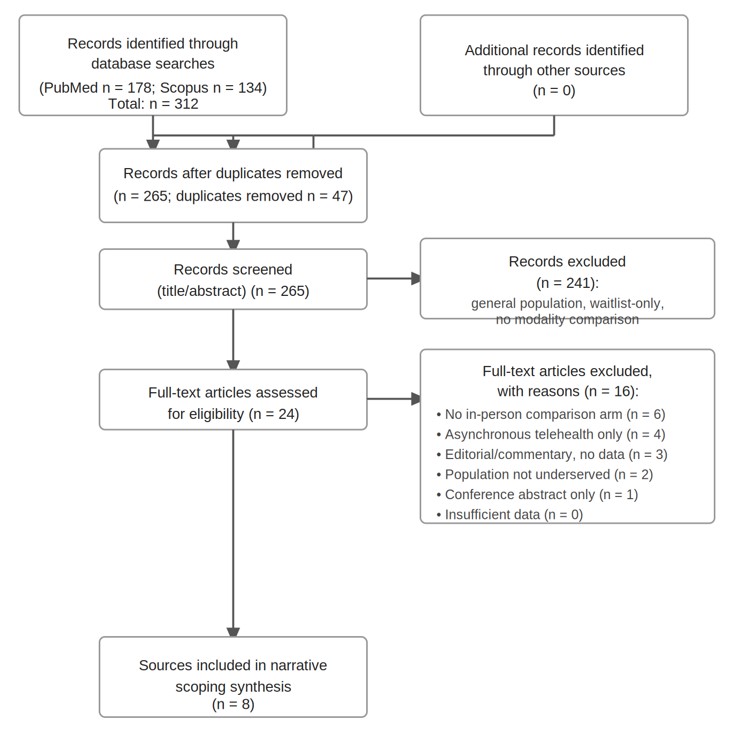
Database searches of PubMed and Scopus through December 31, 2024, identified 312 records (PubMed: 178; Scopus: 134). After removal of 47 duplicates, 265 records underwent title and abstract screening; 241 were excluded as not meeting eligibility criteria (primarily general-population comparative trials without equity-relevant sampling, studies comparing telehealth only to waitlist controls, or studies not reporting discrete comparison data between modalities). Twenty-four full texts were assessed for eligibility; sixteen were excluded (reasons: six lacked a direct in-person comparison arm, four focused exclusively on asynchronous telehealth, three were editorial or commentary without original data, two evaluated populations not meeting the underserved definition, and one was a conference abstract without sufficient data). Eight sources met all inclusion criteria and are included in this synthesis. A PRISMA flow diagram Figure 1.
The included evidence base is heterogeneous in design: two retrospective cohort analyses of electronic health records [9,10], one prospective observational multi-site study [11], one systematic review and meta-analysis [7], one rapid review [6], one retrospective cross-sectional study [12], one retrospective observational study [13], and one qualitative systematic review [8]. Because the evidence base spans primary studies and review-level sources, participant counts cannot be aggregated into a single combined total without risk of double-counting; participants in primary studies alone number in excess of 1.9 million encounters (driven primarily by the large cross-sectional study [12]); the remaining primary studies encompass several thousand additional participants. Review-level sources synthesize additional populations not enumerated separately here. Studies were published between 2019 and 2024; the majority were conducted during or after the COVID-19 pandemic, a temporal factor relevant to the interpretation of the findings (see Sections 2.4 and 4.6).
Source Characteristics and Populations
Primary comparative studies included: a retrospective cohort analysis of behavioral health clinics in rural Louisiana, where 19% of patients lacked stable housing [9]; a retrospective study of an academic outpatient psychiatry practice examining no-show rates [10]; and a prospective multi-site observational study conducted across 17 partner organizations and 95 rural clinical sites in 13 states [11]. A large retrospective cross-sectional analysis of over 1.9 million outpatient encounters in Illinois during the sustained pandemic period was also included [12], as was a retrospective observational study of telehealth use patterns among low-income racial and ethnic minority populations during the pandemic [13].
Review-level sources included: a systematic review and meta-analysis of randomized controlled trials in mood, anxiety, and PTSD populations, including underserved veterans [7]; a rapid review of behavioral health randomized trials, including combat veterans and Latino primary care patients [6]; and a qualitative systematic review of barriers and facilitators among culturally and linguistically diverse populations from multiple international settings [8].
Populations spanned rural Louisiana with predominantly low-income Medicaid-enrolled patients [9], rural communities across multiple U.S. states [11], veterans with PTSD and depression [7,6], low-income racial and ethnic minority patients in urban health centers [12,13], and culturally and linguistically diverse patients across multiple international settings [8]. The geographic scope is predominantly, but not exclusively, United States-based; the qualitative systematic review [8] included international settings, which is noted as a limitation for U.S.-specific generalizability. Mental health conditions addressed included depression, anxiety disorders, PTSD, and mixed or co-occurring conditions. Telehealth modalities included synchronous video teleconferencing and telephone-delivered care. Calendar periods ranged from pre-pandemic settings to pandemic-era settings, to sustained post-pandemic practice, and modality effects should be interpreted in this temporal context. Study-level temporal context is noted in the narrative below where relevant.
Clinical Outcomes: Direct Comparative Evidence
Note: Clinical outcome findings below derive from the primary comparative studies and review-level syntheses, which are distinguished throughout. Review-level findings represent aggregated evidence from multiple studies and are not equivalent to primary comparative data.
Depression and Anxiety
Primary comparative evidence: The multi-site telebehavioral health study by McCord and colleagues [11], conducted across 95 rural clinical sites during the pandemic period, found no clinically significant difference (defined as a 5-point or greater difference on standardized scales) in depression or anxiety symptom reductions between telehealth and in-person groups, with both achieving an average reduction of approximately 3 points on standardized symptom measures. Bulkes and colleagues [5] similarly found equivalent outcomes for depressive symptoms and quality of life between matched cohorts receiving telehealth and in-person treatment within an intensive behavioral health system.
Review-level evidence: The meta-analysis by Shaker and colleagues [7], which synthesized 20 randomized trials (7,414 identified records), found treatment efficacy for telehealth and in-person care to be statistically comparable across depressive and anxiety disorders, with working alliance scores also not significantly different between modalities. The VA rapid review [6] similarly found that most included studies across PTSD, depression, and anxiety-related disorders identified no significant differences between telehealth and in-person delivery in symptom severity at follow-up. These review-level findings reflect aggregated evidence and are not primary comparative data from underserved populations specifically.
PTSD
Review-level evidence: The VA rapid review [6] summarized that PTSD symptom severity appeared similar after in-home video teleconference and clinic-based in-person delivery of individual psychotherapy, characterized as low-strength evidence due to study heterogeneity. One meta-analysis [14] – identified as a reference cited in included reviews but not itself one of the eight included sources – reported a small but statistically significant advantage for telehealth in PTSD symptom reduction (SMD = -0.21, 95% CI [-0.37, -0.05]) in a pooled analysis of six randomized trials; this finding is noted for contextual reference but is not attributable to an included source of this synthesis. No primary comparative study focused exclusively on PTSD in underserved populations was identified among the eight included sources.
Appointment Adherence and No-Show Rates
Adherence findings were more heterogeneous than clinical outcomes and demonstrated important context-dependence. The retrospective cohort study [9] in rural Louisiana behavioral health clinics – conducted during the pandemic period, with 19% of patients lacking stable housing, and many lacking private residential space, adequate internet connectivity, and stable income – found that telehealth appointments were associated with statistically significantly higher no-show odds compared to in-person appointments (OR 1.42; 95% CI, 1.09 – 1.84). The authors attributed this to the convergence of unmet social needs that created specific barriers to telehealth engagement, including a lack of private space, unreliable internet access, and unfamiliarity with technology platforms [9].
In contrast, the multi-site rural telebehavioral health study by McCord and colleagues [11] reported comparable adherence between telehealth and in-person cohorts across a broader and more geographically diverse sample. The large cross-sectional study of over 1.9 million outpatient encounters in Illinois during the sustained pandemic phase [12] found that overall telehealth encounters were associated with significantly reduced no-show odds compared to in-person appointments (OR 0.28; 95% CI, 0.26 – 0.29); however, mental health specialty had the highest no-show odds ratio among all specialties studied (OR 2.99; 95% CI, 2.84 – 3.14), and Black and Hispanic patients on Medicaid had persistently higher no-show rates even when using telehealth. Studies of outpatient psychiatry clinics in academic settings [10] reported decreased overall no-show rates after transitioning to telehealth during the pandemic, particularly for telephone visits. However, population socioeconomic characteristics differed markedly from those in rural Louisiana. Findings on adherence, therefore, cannot be generalized across underserved populations without accounting for social needs burden and setting-specific factors.
Patient Satisfaction
Patient satisfaction was generally high in both telehealth and in-person conditions across the included sources. The meta-analysis by Shaker and colleagues [7] reported no statistically significant difference in patient satisfaction between telehealth and in-person psychiatric treatment. The rapid behavioral health review [6] similarly found that most included studies reported patient satisfaction comparable between modalities. In studies that specifically examined underserved populations, satisfaction varied more substantially by access-related factors: patients who encountered technology difficulties, experienced privacy concerns related to shared living spaces, or lacked language-concordant providers reported diminished satisfaction with telehealth specifically [8].
Equity-Relevant Access Barriers
The Digital Divide
Consistent across multiple included sources was the finding that technology access barriers disproportionately affect populations already marginalized by other social determinants of health. The qualitative systematic review by Nguyen and colleagues [8] – which included culturally and linguistically diverse populations from multiple international settings – found compounding barriers to digital health technology engagement, including limited access to devices and broadband internet, lower digital literacy, language incompatibility of platforms, and concerns about privacy and immigration authority contact for some immigrant populations. The retrospective observational study of telehealth use among low-income racial and ethnic minority patients [13] found that despite broad pandemic-era regulatory expansion of telehealth, utilization patterns remained substantially unequal, and that income and telehealth use were positively associated even within low-income samples.
Data from the 2022 National Survey on Drug Use and Health confirm that Asian, Black, and Hispanic adults with any mental illness are already less likely to receive mental health services than White and multiracial adults [2], meaning telehealth programs that fail to address structural access barriers risk deepening rather than narrowing these existing disparities. Older adults, patients with limited English proficiency, and individuals with low digital literacy were consistently identified as facing the greatest barriers to video telehealth specifically [12,8,13].
Language and Cultural Competency
Language barriers represented a distinct and clinically significant equity concern in telehealth mental health care delivery. A systematic scoping review of telepsychiatry for indigenous peoples and racial and ethnic minorities [15] found that insufficient interpreter services on telehealth platforms, the scarcity of language-concordant providers, and inadequate cultural adaptation of clinical content were among the primary identified barriers to equitable engagement. Disparities in telehealth use were most pronounced in telemental health services – where effective communication is fundamental – for patients with limited English proficiency [15]. Hispanic and Latino providers represent only approximately 6.6% of psychiatrists and 7.95% of psychologists despite constituting 19% of the U.S. population, creating a structural linguistic gap that telehealth alone cannot resolve [15].
Provider cultural competency emerged as a cross-cutting concern independent of care delivery modality. Studies in this synthesis noted that cultural mistrust, prior negative experiences with mental health services, and the absence of culturally adapted clinical materials were barriers in both in-person and telehealth settings, but were potentially amplified in telehealth due to the reduced interpersonal cues available in video-mediated communication [15,8].
Discussion
Summary of Findings
This narrative scoping synthesis reviews evidence from eight sources encompassing primary comparative studies, systematic reviews, a rapid review, and a qualitative synthesis, representing diverse underserved and equity-relevant mental health populations. Available evidence suggests that telehealth may offer broadly comparable outcomes to in-person care for depression, anxiety, and PTSD in some underserved settings. This is broadly consistent with the existing literature on general adult populations [6,7]. However, this conclusion must be interpreted with caution, given the methodological limitations of this synthesis, including single-reviewer screening, the absence of formal risk-of-bias assessment, mixed study designs, and the inclusion of both primary and review-level sources. Adherence findings were meaningfully heterogeneous and context-dependent: telehealth improved or maintained adherence in some settings but was associated with higher no-show rates in the most socioeconomically marginalized populations, where unmet social needs created specific barriers to telehealth engagement [9]. Patient satisfaction was generally comparable across modalities, but equity-relevant access barriers – particularly the digital divide, language barriers, and provider cultural competency deficits – were consistently identified as critical gaps. Direct comparative findings and contextual evidence of equity barriers are distinguished throughout this discussion.
Interpretation of Clinical Findings
The available evidence suggesting broadly comparable clinical outcomes across depression, anxiety, and PTSD is contextually and programmatically significant. Given the scale of the mental health workforce shortage – with 70% of rural counties lacking a psychiatrist and over 4,200 rural Mental Health Professional Shortage Areas designated as of 2025 [3] – a modality that may deliver comparable clinical outcomes while removing geographic barriers has substantial public health implications. However, clinicians and policymakers should interpret these findings as low- to uncertain-certainty evidence. The language of "non-inferiority" has not been used in this synthesis because no included primary study was formally designed as a non-inferiority trial, and no formal non-inferiority framework was applied in this review. The more accurate characterization is that outcomes were not clearly different between modalities in the available evidence, with the important caveat that this evidence base is methodologically limited.
Most included studies were conducted in settings where access to adequate devices and broadband was assumed or facilitated, and where providers had received some preparation for telehealth delivery. In settings where these conditions are not met – as exemplified by the rural Louisiana behavioral health clinic study [9], where nearly one in five patients lacked stable housing, and many lacked reliable internet access – telehealth not only failed to improve adherence but was associated with worse engagement. This underscores that any clinical benefits of telehealth are conditional on structural preconditions being met and cannot be assumed to generalize across all underserved populations.
The Digital Divide as a Health Equity Problem
A consistent theme across the included sources was that the digital divide – characterized by unequal access to devices, broadband internet, and digital literacy – disproportionately affects the populations most in need of expanded access to mental health services [8,13]. This creates a structural paradox: the groups that stand to benefit most from telehealth’s potential are also the groups least equipped, without targeted support, to do so. Older adults, individuals with low socioeconomic status, patients with limited English proficiency, and some racial and ethnic minority communities face compounding disadvantages in engaging with video telehealth specifically [12,8,13].
This finding has pragmatic policy implications. Universal broadband access, device provision for low-income patients, and digital literacy programs are not merely technical infrastructure investments but also health equity interventions. Several included sources noted that audio-only telephone-based telehealth, though often considered inferior to video, may serve as a critical access bridge for populations for whom video remains inaccessible, and that policies restricting reimbursement to video-only telehealth risk excluding the most marginalized patients [11,13].
Cultural Competency as an Irreducible Equity Requirement
Beyond technological access, provider cultural competency was identified as a dimension of equitable telehealth that cannot be resolved by technological investment alone. The systematic scoping review of telepsychiatry cultural adaptations [15] found that successful telehealth programs for indigenous peoples and racial and ethnic minorities required community involvement in program design, adaptation of clinical materials, culturally concordant or informed providers, and language access services that went beyond basic translation. The structural underrepresentation of racial and ethnic minority mental health providers is not a telehealth problem. Still, telehealth’s potential to connect patients with culturally concordant providers despite geographic barriers remains substantially unrealized, given the current workforce composition [15].
These findings align with the broader evidence on mental health disparities: racial and ethnic minority adults are less likely to receive mental health treatment even when controlling for access factors [2], suggesting that access alone does not resolve disparities rooted in cultural mistrust, stigma, and the absence of culturally affirming care.
Pandemic Timing and Temporal Confounding
A substantial limitation of the evidence base is that most included sources were conducted during or after the COVID-19 pandemic. Reimbursement rules, clinic workflows, patient behavior, and the availability of in-person alternatives all changed dramatically during this period, making it difficult to attribute observed modality differences – or the absence of such differences – to telehealth per se, rather than to the broader context of pandemic-era healthcare delivery. Adherence findings are particularly susceptible to this confounding: pandemic-era patterns of in-person avoidance, government-mandated workflows, and emergency regulatory changes may not reflect steady-state comparative effectiveness under normal conditions. Conclusions derived primarily from pandemic-era data should be interpreted with explicit acknowledgment of this temporal limitation.
Strengths and Limitations
This synthesis offers several strengths. It focuses explicitly on underserved populations – a group frequently underrepresented in prior telehealth reviews. The included sources span a range of designs, settings, and populations, providing breadth of evidence relevant to diverse clinical and policy contexts. The review addresses multiple dimensions of telehealth equity, including clinical outcomes, engagement, and structural access barriers.
However, significant limitations must be acknowledged explicitly. First, single-reviewer screening and extraction increase the risk of selection error and subjective inclusion bias; this is a major methodological limitation. Second, no formal risk-of-bias assessment was conducted, limiting confidence in the certainty of conclusions; all comparative claims should be interpreted as low- to uncertain-certainty evidence. Third, this synthesis includes both primary studies and review-level sources (systematic reviews, a rapid review, and a qualitative synthesis), and these are not equivalent forms of evidence; the evidence base is therefore heterogeneous in ways that preclude clean aggregation. Fourth, no review protocol was registered prior to conducting the review, raising the possibility of post hoc outcome framing. Fifth, only English-language sources were included, potentially excluding relevant evidence. Sixth, the evidence base is predominantly drawn from the pandemic or post-pandemic period, limiting generalizability to other temporal contexts. Seventh, the included studies span diverse geographic settings – predominantly U.S.-based, with some international sources – and conclusions may not generalize uniformly across health system contexts. Finally, the retrospective design of several key studies introduces potential confounding by indication.
Future Research Directions
This synthesis identifies several critical priorities for future research. Prospective randomized trials specifically designed to enroll underserved populations – with explicit stratification by socioeconomic status, racial and ethnic identity, and social needs burden – are needed to provide higher-quality comparative effectiveness evidence. Future reviews should apply dual independent screening, formal risk-of-bias assessment using established tools, and prospective protocol registration. Equity-centered outcome frameworks should be adopted in future studies, measuring not only symptom improvement but also engagement persistence, patient-reported experience, and disparities in outcomes across subgroups. Cost-effectiveness analyses that account for the infrastructure investments required to deliver equitable telehealth are urgently needed. Finally, rigorous evaluation of culturally adapted telehealth programs designed with community input, linguistic concordance, and culturally affirming clinical content is needed to determine whether such adaptations can close the equity gaps identified in this synthesis.
Conclusion
Available evidence suggests that telehealth may offer broadly comparable outcomes to in-person mental health care for underserved populations in some settings, with clinical findings for depression, anxiety, and PTSD not clearly different between modalities in the reviewed sources. This conclusion is based on a heterogeneous, methodologically limited evidence base. It should be interpreted as low- to uncertain-certainty evidence rather than a definitive demonstration of equivalence or non-inferiority.
The evidence makes clear that telehealth is not inherently equitable: its potential benefits are conditional on structural preconditions, including device access, reliable broadband, digital literacy support, and culturally competent, linguistically accessible providers. In the most socioeconomically marginalized settings, these conditions frequently remain unmet, and telehealth may paradoxically increase engagement barriers relative to in-person care. The digital divide, persistent language barriers, and the underrepresentation of racial and ethnic minority providers in the mental health workforce are not problems that telehealth can solve independently; they require targeted, equity-driven investment at the levels of infrastructure, workforce, and policy.
As a pragmatic implication of the available evidence – rather than a firm evidence-based recommendation – telehealth may serve as a useful complement to in-person mental health care in underserved communities when structural preconditions are met. Particular attention should be given to audio-only access pathways for patients who remain inaccessible to video, community-engaged program design, and ongoing monitoring of disparities in engagement and outcomes across population subgroups. High-quality prospective trials with equity-centered frameworks are urgently needed before stronger conclusions can be drawn.
Conflicts of Interest
The author declares no financial or non-financial conflicts of interest related to this work. The author has no relevant employment, consultancy, honoraria, stock ownership, paid expert testimony, patents, personal relationships, or institutional affiliations that could have influenced the conduct, interpretation, or reporting of this narrative scoping synthesis.
Funding Source
The authors declare that no specific grant or funding was received for this research from any public, commercial, or not-for-profit funding agency.
Acknowledgments
None.
Institutional Review Board (IRB)
This article is a narrative scoping synthesis of previously published studies and does not involve new primary data collection; formal ethics approval was not required.
Large Language Model
None.
Authors Contribution
SP contributed to the conception and design of the review, performed the literature search and data extraction, conducted data screening, drafted and critically revised the manuscript, and provided final approval of the submitted version. Risk-of-bias appraisal was not conducted as part of this review, as described in Section 2.4.
Data Availability
The data supporting this synthesis are the published studies cited in the reference list. Study-level characteristics described in the text represent the data extracted during this review; no additional datasets were generated.
References
- GBD Mental Disorders Collaborators. Global, regional, and national burden of 12 mental disorders in 204 countries and territories, 1990-2019: a systematic analysis for the Global Burden of Disease Study 2019. Lancet Psychiatry. 2022;9(2):137-150. doi:10.1016/S2215-0366(21)00395-3 PMID: 35026139 PMCID: PMC8776563
- Substance Abuse and Mental Health Services Administration. Key Substance Use and Mental Health Indicators in the United States: Results from the 2022 National Survey on Drug Use and Health. 2023.
- Rural Health Information Hub. Challenges and Opportunities for Mental Health Services in Rural Areas. 2025.
- Morales D. A., Barksdale C. L., Beckel-Mitchener A. C.. A call to action to address rural mental health disparities. J Clin Transl Sci. 2020;4(5):463-467. doi:10.1017/cts.2020.42 PMID: 33244437 PMCID: PMC7681156
- Bulkes N. Z., Davis K., Kay B., Riemann B. C.. Comparing efficacy of telehealth to in-person mental health care in intensive-treatment-seeking adults. J Psychiatr Res. 2022;145:347-352. doi:10.1016/j.jpsychires.2021.11.003 PMID: 34799124 PMCID: PMC8595951
- Bellanti D. M., Kelber M. S., Workman D. E., Beech E. H., Belsher B. E.. Rapid Review on the Effectiveness of Telehealth Interventions for the Treatment of Behavioral Health Disorders. Mil Med. 2022;187(5-6):e577-e588. doi:10.1093/milmed/usab318 PMID: 34368853
- Shaker A. A., Austin S. F., Storebo O. J., Schaug J. P., Ayad A., Sorensen J. A., Tarp K., Bechmann H., Simonsen E.. Psychiatric Treatment Conducted via Telemedicine Versus In-Person Modality in Posttraumatic Stress Disorder, Mood Disorders, and Anxiety Disorders: Systematic Review and Meta-Analysis. JMIR Ment Health. 2023;10:e44790. doi:10.2196/44790 PMID: 37277113 PMCID: PMC10357375
- Whitehead L., Talevski J., Fatehi F., Beauchamp A.. Barriers to and Facilitators of Digital Health Among Culturally and Linguistically Diverse Populations: Qualitative Systematic Review. J Med Internet Res. 2023;25:e42719. doi:10.2196/42719 PMID: 36853742 PMCID: PMC10015358
- Bhatta D., Sizer M. A., Acharya B.. Association Between Telehealth and Missed Appointments Among Patients Experiencing Behavioral Health Challenges. JAMA Netw Open. 2023;6(7):e2324252. doi:10.1001/jamanetworkopen.2023.24252 PMID: 37466943 PMCID: PMC10357338
- Muppavarapu K., Saeed S. A., Jones K., Hurd O., Haley V.. Study of Impact of Telehealth Use on Clinic "No Show" Rates at an Academic Practice. Psychiatr Q. 2022;93(2):689-699. doi:10.1007/s11126-022-09983-6 PMID: 35412100 PMCID: PMC9004215
- McCord C., Ullrich F., Merchant K. A. S., Bhagianadh D., Carter K. D., Nelson E., Marcin J. P., Law K. B., Neufeld J., Giovanetti A., Ward M. M.. Comparison of in-person vs. telebehavioral health outcomes from rural populations across America. BMC Psychiatry. 2022;22(1):778. doi:10.1186/s12888-022-04421-0 PMID: 36496352 PMCID: PMC9736702
- Amagai S., Vonesh E., Adams J., Luo Y.. Closing the gap: addressing telehealth disparities across specialties in the sustained pandemic era. NPJ Digit Med. 2024;7(1):217. doi:10.1038/s41746-024-01201-w PMID: 39164391 PMCID: PMC11335954
- Williams C., Shang D.. Telehealth Usage Among Low-Income Racial and Ethnic Minority Populations During the COVID-19 Pandemic: Retrospective Observational Study. J Med Internet Res. 2023;25:e43604. doi:10.2196/43604 PMID: 37171848 PMCID: PMC10185335
- Kelber M. S., Smolenski D. J., Boyd C., Shank L. M., Bellanti D. M., Milligan T., Edwards-Stewart A., Libretto S., Parisi K., Morgan M. A., Evatt D. P.. Evidence-based telehealth interventions for post-traumatic stress disorder, depression, and anxiety: A systematic review and meta-analysis. J Telemed Telecare. 2025;31(6):757-767. doi:10.1177/1357633X231224491 PMID: 38254285
- Ruiz-Cosignani D., Chen Y., Cheung G., Lawrence M., Lyndon M. P., Ma'u E., Ramalho R.. Adaptation models, barriers, and facilitators for cultural safety in telepsychiatry: A systematic scoping review. J Telemed Telecare. 2024;30(3):466-474. doi:10.1177/1357633X211069664 PMID: 34989643 PMCID: PMC10928963