Improving Compliance with the National Early Warning Score 2 (NEWS2) in an Egyptian Central Hospital Emergency Department: A Two-Cycle Clinical Audit
Anas Al-QatefyⒾ1*, Mostafa DarwishⒾ1, Abdalrhman TolbaⒾ2, Amira TamanⒾ1
- 1Faculty of Medicine, Mansoura National University, Mansoura, Egypt
- 2Neurology Department, Faculty of Medicine, Alexandria University, Alexandria, Egypt
Abstract
Background: NEWS2 is a standardized assessment tool used to determine illness severity and identify patients at risk of deterioration. However, its effectiveness is limited by systemic barriers. This audit primarily aims to evaluate NEWS2 compliance in an emergency department and implement targeted interventions to address recognized gaps.
Methods: A two-cycle clinical audit was conducted at ShubraKhit Central Hospital's ED over a period of three weeks. Cycle 1 (August 18–25, 2025) established a baseline by assessing vital sign documentation, NEWS2 calculation, and escalation practices in 50 patients. The analysis of the root causes successfully identified the key barriers. Targeted interventions were implemented. Cycle 2 (September 1–8, 2025) re-audited the other 50 patients to evaluate the impact of the intervention. Data were analyzed using chi-square or Fisher’s exact tests as appropriate, with effect sizes and 95% CIs.
Results: Cycle 1 showed serious and critical drawbacks, with only 2% of patients having a complete set of vital signs documented, and NEWS2 calculated in only 2% of cases. The primary barriers were a lack of equipment (96%) and a 100% lack of awareness of the escalation protocol. Following the suitable intervention, Cycle 2 demonstrated a significant improvement, with 100% of patients having all vital signs documented, and NEWS2 calculated in 96% of cases.
Conclusions: A targeted intervention focuses on addressing specific root causes, leading to compliance with the NEWS2 scoring system. This ensures that evidence-based quality improvement can bridge the gap between clinical guidelines and practice.
Keywords: Clinical Audit, Emergency Department (ED), Vital Signs Monitoring, National Early Warning Score 2 (NEWS2), Triage
Article information
Introduction
Preliminary recognition of physical deterioration is a fundamental pillar of patient safety in the acute care pathway. Standardized clinical early-warning systems were developed to ensure consistent, comparable, and actionable physiological monitoring. Thus, once that deterioration is detected, immediate escalation pathways are triggered without any delay.
However, the implementation of these systems often fails to meet expectations. Empirical and qualitative studies in emergency and acute settings report that incomplete or missing vital-sign sets are common [1], and implementation research has repeatedly identified system-level barriers—such as limited availability or accessibility of functioning monitoring devices [2], workflow constraints and interruptions [3] burdensome documentation processes, and variable staff awareness or training about escalation procedures, as major contributors to incomplete measurement and inappropriate escalation, respectively [4].
The most suitable tool for this setting is the widely adopted and NHS-endorsed scoring system: the National Early Warning Score 2 (NEWS2), developed by the Royal College of Physicians [5]. It is an established track and proper system to assess illness severity and risk of deterioration for patients in acute episodes of care [6]. Previous studies have stated the NEWS2 value in the prediction of septic patients [7] and other patients with cardiac arrest, unplanned ICU admission, emergency surgery, and acute kidney injury in the emergency department [8,9].
The Egyptian Central Hospitals’ ED typically employs a local triage assessment protocol that requires documentation of pulse rate, blood pressure, respiratory rate, random blood glucose level, and temperature. However, vital sign monitoring remains inconsistent and is often performed selectively based on perceived clinical urgency rather than systematically for all patients, as recommended by early warning score protocols [10]. This audit aims mainly to assess the completeness of the core physiological observations on ED presentation (the vital signs), determine whether escalation protocols were appropriately triggered and followed when indicated, and identify and classify the principal obstacles to correct monitoring and escalation (process/resource factors versus knowledge gaps). The ultimate objective is to translate findings into pragmatic, system-focused interventions to improve surveillance and escalation.
Methods & Participants
Study Design
This clinical audit was conducted at ShubraKhit Central Hospital and employed a two-cycle design. In Cycle 1 (as a baseline), data were collected on the documentation of the standardized vital signs, calculation of NEWS2 scores, and the escalation decisions in the emergency department and triage areas. The audit followed the SQUIRE 2.0 framework for structured reporting of quality improvement. Following the identification of key gaps, interventions targeted the barriers in staff awareness, equipment availability, and workflow efficiency. Two 45-minute educational sessions were held with emergency physicians and triage nurses. The sessions were supported by visual aids summarizing the NEWS2 scoring and the escalation thresholds. Learning posters were displayed in the clinical areas, and the necessary monitoring devices were provided to ensure that all vital signs could be accurately recorded and monitored. The implementation of fidelity was confirmed through the participants’ registers and direct observation. The second cycle (Cycle 2) was then attempted to reassess practice after these interventions, allowing for an evaluation of their impact and comparison with the initial findings of Cycle 1.
Data Collection
Patients’ data were collected using a standardized data collection form in accordance with established clinical audit standards, as shown in Table 1. All authors involved in the audit were conveniently trained to systematically document the data and perform accurate analysis in line with audit methodology. Vital signs documentation, calculation, and charting of the NEWS2 score [5]As shown in Figure 1, the timeliness of monitoring, senior review, and escalation (where indicated), as well as reasons for non-performance or missed escalation, and final patient outcomes following ED evaluation, are outlined in Table 1.
![Representation of the NEWS2 Scoring System Chart. This figure was redrawn based on publicly available information from the Royal College of Physicians (RCP) NEWS2 chart (© RCP 2017). No copyrighted materials were reproduced or modified. [11]](https://asidejournals.com/index.php/Health-Sciences/article/download/307/version/306/369/14618/fig-1.png)
Appropriate escalation was defined a priori according to the RCP NEWS2 policy. Patients with NEWS2 scores of 0–4 required routine monitoring. Any patient scoring 3 in a single parameter warranted a clinical review within 60 minutes. Scores of 5–6 mandated an urgent review by a clinician or team competent in assessing acutely ill patients within 30 minutes, while those with a NEWS2 score of 7 or higher required an immediate senior review and consideration for critical care activation. Patients receiving supplemental oxygen were reassessed after titration, and any AVPU response other than “Alert” triggered immediate escalation irrespective of the aggregate score. These thresholds formed the audit standards and pass/fail criteria.
| Parameter | Description | Standard / Compliance Definition |
|---|---|---|
| Patient ID | — | — |
| Age | — | — |
| Gender | Biological sex (M/F) | — |
| Initial NEWS2 score | If calculated | Score must be documented in EMR; compliant = recorded |
| Documented vital signs | Systolic BP, HR, RR, SpO2, Temp, AVPU, O2 supplementation | Compliant = all 6 core vitals recorded within 15 minutes of arrival |
| NEWS2 documented | Whether score recorded | Compliant = NEWS2 documented for patients with complete vitals |
| Escalation triggered if NEWS2 | Urgent senior review / rapid response | Compliant = protocol triggered within the recommended timeframe |
| Assessor | Who measured vitals (doctor / nurse / paramedic) | — |
| Timeliness of vitals | Within 15 minutes | Compliant = recorded min from arrival |
| Time to senior review | Minutes from triage | Compliant = min if NEWS2 |
| Escalation appropriateness | Followed NEWS2 policy | Compliant = correct escalation according to score and policy |
| Reasons for missing NEWS2 | Workflow / equipment / knowledge gaps | Documented reasons provided for non-compliance |
| Patient disposition | Discharged / Ward / ICU | — |
ID, Identification; NEWS2, National Early Warning Score 2; AVPU, Alert-Verbal-Pain-Unresponsive; EMR, Electronic Medical Record; ED, Emergency Department; ICU, Intensive Care Unit.
Table 1 shows a robust framework for systematically evaluating the application of vital signs monitoring and NEWS2 in emergency care.
Sampling Technique & Population
This clinical audit was conducted at ShubraKhit Central Hospital’s Emergency Department and included patients presenting to the Accident and Emergency Unit (A&E) during two audit cycles. A consecutive sampling approach was used to include all triaged adult patients (aged 18 years or older) presenting to the Emergency Department during the defined one-week audit periods.
The sample size was estimated using the standard formula for proportions at a 95% confidence level and a margin of error, assuming maximum variability (). This yields an initial estimate of . Applying the finite population correction for an expected population of 50–100 eligible ED cases per audit cycle yields an adjusted –. Therefore, including 50 patients per cycle exceeded the minimum requirement for achieving adequate statistical precision. Such a sample size is also consistent with the recommended standard mentioned in the UHBristol NHS “How To: Set an Audit Sample & Plan Your Data Collection” guideline for clinical audits (2022), ensuring both methodological rigor and feasibility [11].
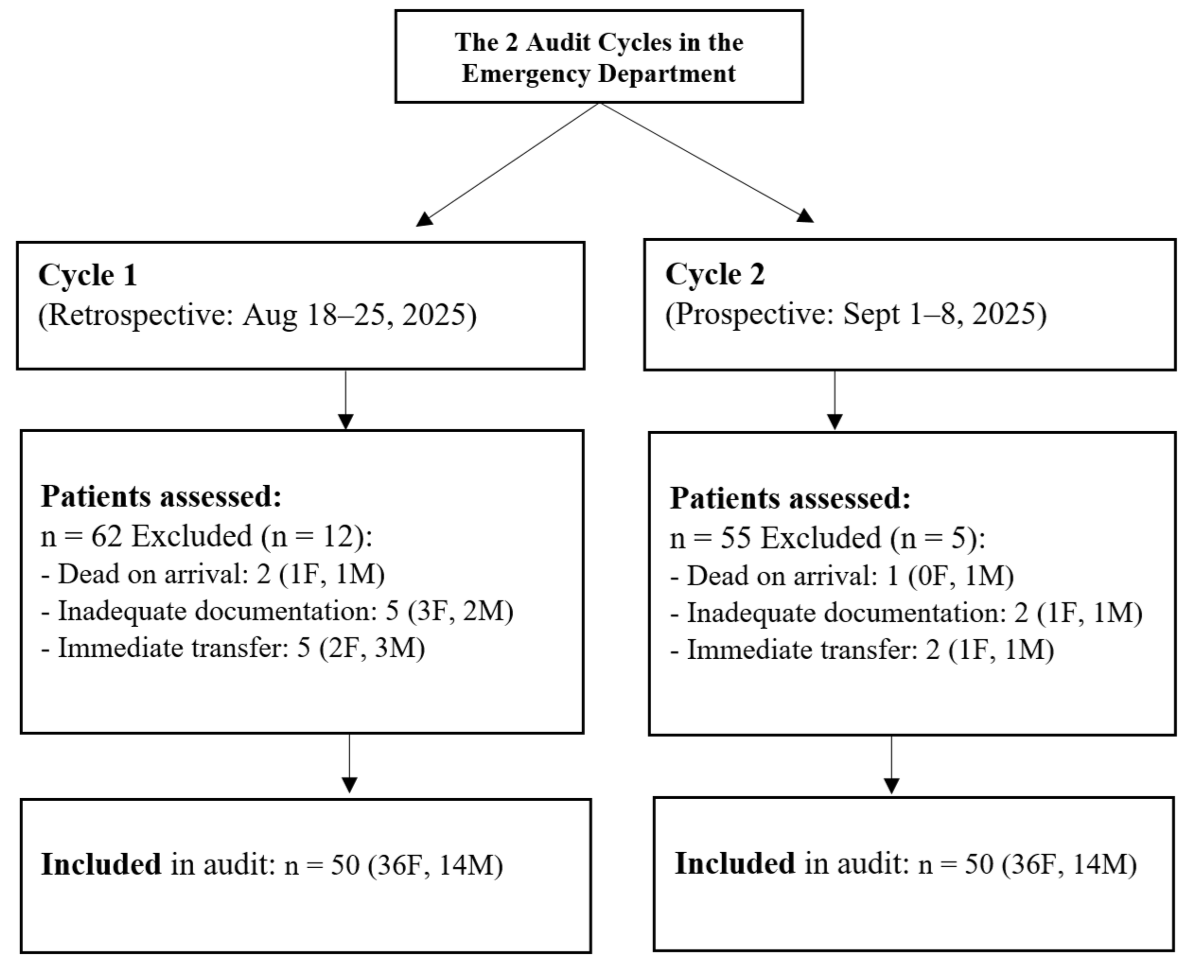
Cycle 1 was conducted retrospectively, using archived medical records of patients who had already been presented to the emergency department from August 18th to August 25th, 2025, while Cycle 2 was conducted prospectively from September 1st to September 8th, 2025.
Inclusion criteria covered almost all adult patients (≥ 18 years) presenting to the ED during the audit period. Exclusion criteria were clear: patients younger than 18 years, patients who were already dead on arrival, cases with improper documentation preventing reliable data extraction, and patients transferred immediately to another facility before triage could be completed.
The sample comprised patients from diverse sociodemographic backgrounds, ensuring a realistic representation of cases. This design enabled the audit to identify existing gaps in practice in Cycle 1 and then evaluate the impact of targeted interventions during prospective reauditing in Cycle 2.
Root Cause Analysis
Following Cycle 1, a structured root cause analysis was conducted using the 5 Whys technique, an iterative method for drilling down from a surface-level problem to its underlying system cause through five successive “why” questions. The analysis was facilitated by the audit data collection lead, in coordination with the hospital’s Quality Office, and involved all 12 emergency physicians who performed triage during the audit period. After narrowing down the problem to incomplete vital sign documentation, the team came up with the following series of questions: (1) Why were vital signs incomplete? Because, for example, respiratory rate and oxygen saturation were rarely recorded. (2) Why were these parameters not recorded? Because pulse oximeters and timing devices were unavailable at triage stations. (3) Why were these tools unavailable? Because the department possessed only two functional oximeters for three triage bays, with no fixed assignment. (4) Why was equipment allocation insufficient? Because no formal inventory or preventive maintenance protocol existed for triage monitoring devices. (5) Why was such a protocol absent? Because equipment management had never been incorporated into the Emergency Department’s quality assurance processes
Data & Statistical Analysis
Data were analyzed using JASP version 0.19.2. Categorical variables were summarized as frequencies and percentages, while continuous data were summarized as means or medians. Between-cycle comparisons were performed using chi-square or Fisher’s exact tests, as appropriate, with absolute risk differences and the same 95% confidence intervals reported to reflect statistical precision (). The primary outcome was completion of all six core vital signs within 15 minutes; NEWS2 calculation, documentation, and escalation were secondary outcomes to avoid multiple testing bias.
Ethics Approval/IRB Statement
The Directorate of Health Affairs in Beheira, Egypt, gave the green light for this clinical audit. Besides that, the local ethical committee at Mansoura National University gave its clearance for the same with an official approval (no. 1908/25). The audit adhered to the ethical principles outlined in the Declaration of Helsinki and followed the guidelines of Good Clinical Practice (GCP). The Quality Office of ShubraKhit Central Hospital looked after institutional governance and supervision.
Results
Descriptive Analyses
A total of 100 acute patients were analyzed across two audit cycles (50 per cycle). The sex distribution was identical between cycles, with 36 females (72%) and 14 males (28%) in each, as shown in Figure 2. The median age increased from 36.5 years (mean 38.5) in Cycle 1 to 46 years (mean 46.3) in Cycle 2.
In Cycle 1, vital sign documentation was profoundly deficient. Only one patient (2%) had a complete set of the six core vital signs recorded. Systolic blood pressure was the most frequently documented parameter (82%), while critical signs such as respiratory rate and oxygen saturation were recorded in only 4% of cases. Consequently, the NEWS2 score was calculated by a specialized physician in only a single case (2%) and was not formally documented in any of the others. The root cause analysis for the failures identified in Cycle 1 revealed two primary issues. Firstly, the cause of incorrect clinical escalation was 100% due to a lack of awareness of the NEWS2 standards and escalation protocol among the clinicians. Secondly, the failure to perform NEWS2 was caused by the inability to complete vital signs, which was attributed predominantly to a lack of instruments (96% of cases), with lack of knowledge and time being minor factors (2% each).
The authors, with the assistance of the hospital’s Quality Office, implemented a targeted intervention to address the audit findings. This included educational seminars and posters to strengthen the NEWS2 protocols, procure the required equipment, and promote a supportive environment for clinicians. Intervention fidelity was monitored through attendance logs and a 5-item pre- and post-knowledge check. All 28 emergency department staff (100% of clinicians involved in triage) attended at least one session across all shifts; mean knowledge scores improved from 1.2/5 to 4.6/5. Posters were displayed in all clinical areas, and the Quality Office confirmed equipment availability before Cycle 2.
Subsequently, the reaudit demonstrated a transformation in practice. All six core vital signs were recorded for all 50 patients (100%) in Cycle 2. The NEWS2 score was successfully calculated in 48 cases (96%) and formally documented in the medical record in 47 cases (94%), primarily due to inexperience and documentation oversight among junior staff.
The assessment of vital signs and first triage was performed solely by physicians in both cycles. Timeliness of care was already high in the auditing cycle, with nearly all vital signs (98%) recorded within 15 minutes and all patients receiving a senior review within 30 minutes of triage. The reaudit showed a further improvement in the efficiency of vital sign recording, achieving this within the 15-minute window for 100% of cases, while maintaining a rapid time to senior review (<30 minutes).
Comparative and Statistical Analyses
The improvement between cycles was statistically significant for all key process measures. The compliance rate for calculating NEWS2 increased by 94 percentage points (p < 0.0001). In Cycle 1, no patient had a documented NEWS2 score; thus, escalation decisions were based solely on clinical impression, with only 2 of 50 cases (4%) receiving timely senior review for apparent deterioration. In Cycle 2, among the 9 patients with a NEWS2 score of 5 or higher, appropriate escalation (senior review within 30 minutes and documented action) occurred in 8 cases (88.9%). A shift in patient disposition was observed, though not all changes reached statistical significance, as shown in Table 2. In Cycle 2, the distribution of initial NEWS2 scores among the 48 calculated cases was varied, with 9 patients (18.8%) scoring 5 or higher, triggering the escalation protocol. This protocol was followed appropriately in 8 of these 9 cases (88.9%).
| Metric | Cycle 1 (n=50) | Cycle 2 (n=50) | ARD% (95% CI) | p-value* |
|---|---|---|---|---|
| Individual Vital Signs | ||||
| Systolic BP | 82% (41) | 100% (50) | +18% (9–27) | 0.002 |
| Heart Rate | 8% (4) | 100% (50) | +92% (84–100) | <0.0001 |
| Respiratory Rate | 4% (2) | 100% (50) | +96% (89–100) | <0.0001 |
| O2 Saturation | 4% (2) | 100% (50) | +96% (89–100) | <0.0001 |
| Temperature | 2% (1) | 100% (50) | +98% (92–100) | <0.0001 |
| AVPU | 4% (2) | 100% (50) | +96% (89–100) | <0.0001 |
| Supplemental O2 | 4% (2) | 100% (50) | +96% (89–100) | <0.0001 |
| Composite Measures | ||||
| All 6 Vital Signs | 2% (1) | 100% (50) | +98% (92–100) | <0.0001 |
| No Vital Signs Recorded | 18% (9) | 0% (0) | -18% (–28 to –8) | 0.001 |
| Patient Disposition | ||||
| Discharged | 54% (27) | 58% (29) | +4% (–12 to 20) | 0.68 |
| Ward Admission | 44% (22) | 26% (13) | -18% (–34 to –2) | 0.06 |
| ICU Admission | 2% (1) | 10% (5) | +8% (–1 to 17) | 0.09 |
| Transferred | 0% | 6% (3) | +6% (0 to 13) | 0.08 |
ARD, Absolute Risk Difference; SpO2, Oxygen Saturation; AVPU, Level of Consciousness Scale (Alert, Voice, Pain, Unresponsive); ICU, Intensive Care Unit; n, number of patients; p-values calculated using the Chi-Squared test. *Fisher’s exact test for metrics with small counts; otherwise χ². Statistical significance: p < 0.05.
Table 2 reveals that the intervention was associated with statistical significance and near-perfect compliance in vital sign documentation, confirming that the root cause was effectively addressed. The observed shifts in patient disposition are not statistically significant. Absolute Risk Difference (ARD) and 95% CI were calculated to quantify effect magnitude and precision.
Discussion
ShubraKhit Central Hospital is a public, 200-bed secondary care facility serving a predominantly rural population, with an estimated annual ED volume of 25,000–30,000 adult visits. Resources are constrained, with limited monitoring equipment and no electronic early warning system in place. Therefore, while our low-cost, education-plus-equipment intervention proved effective here, findings may not generalize to: (1) tertiary urban hospitals with nurse-led triage and electronic health records; (2) settings where basic monitoring equipment is consistently available; or (3) facilities lacking institutional support from a dedicated Quality Office to drive and sustain change.
This audit demonstrates the observed impact of a targeted, multimodal intervention on adherence to early warning score protocols. Cycle 1 findings revealed critical systemic failures, with near-complete non-compliance in NEWS2 documentation, which is highly consistent with studies that identify inadequate resources and training as primary barriers to the implementation of track-and-trigger systems [4). The specific root causes, a lack of equipment (96%) and a lack of awareness of the protocol (100%), provided a clear roadmap for intervention.
The re-auditing results show a statistically significant improvement in 96% NEWS2 calculation and 100% vital sign compliance, associated with the implementation of the guidelines. The small proportion of non-compliant cases in Cycle 2 was largely attributable to documentation lapses and inexperience among junior physicians, rather than systemic barriers. This suggests that while structural gaps (e.g., equipment, training) were effectively resolved, sustained compliance requires ongoing supervision and embedding of protocol discipline into routine practice—particularly for less experienced staff. However, this aligns with the established quality improvement principles that emphasize addressing the root causes through a combination of education, resource provision, systemic support, and ongoing supervision [12].
Additionally, the observed increase in ICU admissions (from 2% to 10%) and decrease in ward admissions (from 44% to 26%) occurred concurrently with the implementation of the intervention. Given the non-randomized, short two-cycle design, these disposition changes may reflect case-mix differences, temporal effects, or documentation bias rather than a confirmed causal effect. However, they suggest that a more precise assessment of patient acuity may be associated with a more appropriate disposition [13].
The rapid rise from 2–4% to nearly 100% compliance within one week raises concerns about Hawthorne effects, temporary resource influx, or documentation artifacts. To verify the results, pre-specified data quality checks—including double-entry verification and spot-checks—were conducted. Sensitivity analyses excluding the first 24–48 hours post-intervention confirmed that the improvements were sustained and not solely due to immediate observation or reporting bias.
Consistent with guidance from the Royal College of Physicians (RCP) and NHS England on the National Early Warning Score 2 (NEWS2), these findings must be interpreted within the local context [14]. Observed improvements should therefore be understood as context-specific and may not generalize to other settings.
The effectiveness of our intervention hinged on a rigorously conducted root cause analysis (RCA) using the 5 Whys technique—a lean, iterative method recommended for identifying system-level failures in clinical quality improvement (Institute for Healthcare Improvement, 2023 We found that incomplete vital sign documentation and absent NEWS2 escalation are mainly due to shortage of equipment and lack of training at the institution and not because of individual error. Thus, we ensured that interventions targeted the underlying system issues rather than the symptoms. On the other hand, this study adheres to SQUIRE 2.0 reporting standards for quality improvement, explicitly describing available resources, staff allocation, and environmental constraints to enhance transparency and support the interpretation of results in light of local operational realities [15].
Despite nurses’ training and availability, triage remained exclusively physician-led—a practice that aligns with evidence that physicians often view themselves as sole decision-makers in emergency care, thereby reinforcing a hierarchical structure that marginalizes nursing input, according to Gregoriou et al. [16]. This may bias timeliness and throughput metrics, limiting generalizability [17]. Therefore, future audit cycles should evaluate nurse-led vital signs collection to optimize workflow and external validity. Best practice often involves nursing-led vital signs collection to free physician time for specialized, complex decision-making [18].
Limitations
This audit has limitations that should certainly be acknowledged. It did not intuitively assess the long-term resilience of the observed improvements, considering the cycle durations or their direct impact on patients’ clinical outcomes. Furthermore, the single-hospital setting can limit the generalizability of our findings. Short cycles and a single pre- and post-snapshot reduce sustainability assessment, and potential Hawthorne or documentation bias may have affected results. Moreover, we cannot exclude the influence of secular trends, such as seasonal shifts in patient acuity or the publicity effect of the audit itself. However, hospital records confirm no concurrent changes in ED staffing, policy, or other quality initiatives during the study period. Misclassification is possible regarding who recorded vital signs or back-charting, and no adjustment was made for case mix. Some assumptions may have been violated, and the identical sex split across cycles warrants verification. Plans for a third cycle, spanning 3–6 months, with SPC monitoring, will potentially strengthen the clinical evidence base and assess the extensive clinical implications of implementing structured and updated vital signs monitoring and escalation guidelines.
Conclusions
This audit revealed concerning gaps in vital signs measurement and escalation during triage and emergency care in a typical Egyptian central hospital, often due to limited resources and a lack of awareness and knowledge of the latest guidelines. Targeted interventions significantly improved adherence, and the National Early Warning Score 2 (NEWS2) demonstrated a fast, practical, and efficient method for early risk detection within this particular setting. To sustain these improvements, we have integrated NEWS2 documentation into the ED onboarding orientation for all new physicians, established monthly spot audits by the Quality Office, and scheduled biannual refresher training. A third audit cycle is planned for March 2026 to assess the sustainability over the six months. While long-term resilience was not evaluated, embedding NEWS2 into routine emergency practice at this site might have contributed to safer and higher-quality patient emergency care. However, going beyond broad generalizations requires continuous measurement and multicenter evaluation.
Conflicts of Interest
The authors declare no conflicts of interest related to this work.
Funding Source
This audit was conducted as part of routine quality improvement at ShubraKhit Central Hospital and received no external funding. The hospital’s quality improvement budget covered the costs of equipment.
Acknowledgments
We express our sincere gratitude to the staff of the Emergency Department and triage nurses at ShubraKhit Central Hospital for their invaluable assistance and support during the study. We would also like to thank the hospital’s Quality Office for facilitating our adherence to ethical and procedural standards during data collection and reporting.
Institutional Review Board (IRB)
This work was undertaken as a clinical audit of routine care at ShubraKhit Central Hospital, under the oversight of the hospital’s Quality Office. As a quality-improvement audit rather than research involving new interventions, it did not require review by an institutional review board or research ethics committee.
Informed Consent
Before the start of the study’s second cycle, written consent was obtained formally from all patients involved. They were completely free to decide whether to participate, and the privacy of patient information was strictly maintained throughout the audit process.
Large Language Model
We have employed an advanced Large Language Model (LLM) to enhance and refine a few sentences. This process focused solely on improving the text’s clarity and style, without generating or adding any new information to the content.
Authors Contribution
AA conceived and designed the audit. MD collected and entered the data. AT performed the statistical analysis. AmT supervised the audit process. All authors reviewed and approved the final manuscript.
Data Availability
The data used to support this clinical audit can be obtained from the corresponding author upon request. However, access to them is limited to safeguard patient confidentiality in accordance with the institution’s data protection policy.
References
- Elliott M., Endacott R.. The clinical neglect of vital signs' assessment: an emerging patient safety issue?. Contemp Nurse. 2022;58(4):249-252. doi:10.1080/10376178.2022.2109494 PMID: 35924342
- Wangdi S., Guragai K., Namgay P., Dorji J., Wangchuk K.. Improving initial vital signs assessment and documentation in the emergency department of regional hospital, Bhutan: quality improvement project. BMJ Open Qual. 2025;13(Suppl 1). doi:10.1136/bmjoq-2024-003151 PMID: 40447295 PMCID: PMC12131496
- Hope J., Dall'Ora C., Redfern O., Darbyshire J. L., Griffiths P.. Why vital signs observations are delayed and interrupted on acute hospital wards: A multisite observational study. Int J Nurs Stud. 2025;164:105018. doi:10.1016/j.ijnurstu.2025.105018 PMID: 39946865
- Petersen J. A., Rasmussen L. S., Rydahl-Hansen S.. Barriers and facilitating factors related to use of early warning score among acute care nurses: a qualitative study. BMC Emerg Med. 2017;17(1):36. doi:10.1186/s12873-017-0147-0 PMID: 29191159 PMCID: PMC5710111
- Williams B.. The National Early Warning Score: from concept to NHS implementation. Clin Med (Lond). 2022;22(6):499-505. doi:10.7861/clinmed.2022-news-concept PMID: 36427887 PMCID: PMC9761416
- Welch J., Dean J., Hartin J.. Using NEWS2: an essential component of reliable clinical assessment. Clin Med (Lond). 2022;22(6):509-513. doi:10.7861/clinmed.2022-0435 PMID: 36427875 PMCID: PMC9761428
- El Sayed Ahmed Nader, El Said Kamel Amr Mohamed, Elhadari Ghada, Moussa Basant Elsayed. Comparing the Prognostic Value of the Latest Version of the National Early Warning Score (NEWS-2) and the Quick Sequential Organ Failure Assessment Score (qSOFA) in the Prediction of the Mortality Rate of Septic Patients. ARCADEs of MEDICINE. 2025. doi:10.21608/arcmed.2025.375056.1112
- Badr M. N., Khalil N. S., Mukhtar A. M.. Effect of National Early Warning Scoring System Implementation on Cardiopulmonary Arrest, Unplanned ICU Admission, Emergency Surgery, and Acute Kidney Injury in an Emergency Hospital, Egypt. J Multidiscip Healthc. 2021;14:1431-1442. doi:10.2147/JMDH.S312395 PMID: 34163171 PMCID: PMC8214550
- Tavare A., Pullyblank A., Redfern E., Collen A., Barker R. O., Gibson A.. NEWS2 in out-of-hospital settings, the ambulance and the emergency department. Clin Med (Lond). 2022;22(6):525-529. doi:10.7861/clinmed.2022-news-ooh PMID: 36427884 PMCID: PMC9761413
- Aziz Mamdouh Eman, Shehata Mohamed Hanan, Abdallah Abdelatief Dalia. Assessment of nurses' performance regarding the implementation of patient safety measures in intensive care units. Egyptian Journal of Health Care. 2020;11(1):82-100.
- University Hospitals Bristol NHS Foundation Trust. How To Guides. 2025.
- Hanania Hannah L., Hanania Alexander N.. Quality improvement. Translational Radiation Oncology. 2023:639-645. doi:10.1016/b978-0-323-88423-5.00062-5
- Farenden S., Gamble D., Welch J.. Impact of implementation of the National Early Warning Score on patients and staff. Br J Hosp Med (Lond). 2017;78(3):132-136. doi:10.12968/hmed.2017.78.3.132 PMID: 28277766
- NHS England. Resources to support the safe adoption of the revised National Early Warning Score (NEWS2). 2025.
- SQUIRE. SQUIRE 2.0 Guidelines. 2025.
- Gregoriou P. L., Charalambous A., Rousou E., Papastavrou E., Merkouris A.. Attitudes of Physicians and Nurses Toward Interprofessional Collaboration: a Systematic Literature Review. Mater Sociomed. 2025;37(1):64-73. doi:10.5455/msm.2025.37.64-73 PMID: 40098756 PMCID: PMC11910901
- Onal E. G., Knier K., Hunt A. W., Knudsen J. M., Nestler D. M., Campbell R. L., Thompson K. M., Sunga K. L., Walker L. E., Madsen B. E., Sadosty A. T., McGregor A. J., Mullan A. F., Jeffery M. M., Bellamkonda V. R.. Comparison of emergency department throughput and process times between male and female patients: A retrospective cohort investigation by the Reducing Disparities Increasing Equity in Emergency Medicine Study Group. J Am Coll Emerg Physicians Open. 2022;3(5):e12792. doi:10.1002/emp2.12792 PMID: 36187504 PMCID: PMC9512773
- Ouellet S., Gallani M. C., Fontaine G., Mercier E., Lapierre A., Severino F., Gelinas C., Berube M.. Strategies to improve the quality of nurse triage in emergency departments: A systematic review. Int Emerg Nurs. 2025;81:101639. doi:10.1016/j.ienj.2025.101639 PMID: 40532318
- Royal College of Physicians (RCP). NHS England approves use of National Early Warning Score (NEWS) 2 to improve detection of acutely ill patients. 2025.