Effectiveness of Alcohol Gel-Based Antiseptics Against Multidrug-Resistant Bacteria: An in vitro Experimental Study
Sacha Krolow e SilvaⒾ1, Larissa Britto de DeusⒾ2, Leonardo da Silva BittencourtⒾ3,4,5
- 1Graduate Program in Biological Sciences: Biochemistry, Federal University of Rio Grande do Sul (UFRGS), Porto Alegre, Brazil
- 2Cesuca University Center, Porto Alegre, Brazil
- 3Department of Morphological and Physiological Sciences, Federal University of Rio Grande do Sul (UFRGS), Porto Alegre, Brazil
- 4School of Public Health of Rio Grande do Sul (ESP/RS), Porto Alegre, Brazil
- 5State School of Professional Health Education, Hospital de Clínicas de Porto Alegre (EPS/HCPA), Porto Alegre, Brazil
Abstract
Background: Since the 19th century, asepsis has revolutionized public health, and hand hygiene remains a cornerstone of infection control, particularly in healthcare settings with high exposure to resistant microorganisms. This study aimed to evaluate the antimicrobial efficacy of four commercial alcohol-gel brands (A, B, C, and D) against standard ATCC strains of Staphylococcus aureus, Escherichia coli, Pseudomonas aeruginosa, and Enterococcus faecalis, which are prevalent in clinical environments.
Methods: The disk-diffusion method was employed on Müeller-Hinton agar, using sterile disks impregnated with each gel sample. Following a 24-hour incubation at 35°C, the resulting halo zones were measured.
Results: Significant variability was observed among the brands. Brand C exhibited the highest antimicrobial activity, particularly against P. aeruginosa (11.10 mm), with an overall mean inhibitory activity of 9.8 mm. Brand B demonstrated broad efficacy (mean 9.2 mm), while Brand A showed moderate activity with higher variability (mean 7.9 mm). Brand D demonstrated minimal to no inhibitory activity in the disk-diffusion assay compared to the other tested products (mean 4.3 mm). These differences were statistically significant across all tested bacteria.
Conclusions: These findings indicate that alcohol concentration is not the sole determinant of antimicrobial performance. Formulation factors—such as humectants, polymers, and viscosity—substantially impact efficacy. The composition of an alcohol-based hand sanitizer directly governs its antimicrobial power. The study reinforces the importance of selecting validated products, adhering to hygiene protocols, and conducting microbiological surveillance to prevent healthcare-associated infections.
Keywords: Antiseptics, Hand hygiene preparations, Hand hygiene, Standard bacterial strains, Healthcare-related infections
Article information
Introduction
Asepsis, the absence of infectious agents in environments through preventive actions that inhibit the entry and spread of pathogens, began to change the reality of healthcare in the 19th century: in 1846, Ignatius Philip Semmelweis reduced mortality from puerperal sepsis through hand washing; in 1865, Joseph Lister introduced phenol as an antiseptic to reduce post-operative infections; and during the Crimean War (1854-1855), Florence Nightingale promoted hygiene reforms and nurse training to reduce hospital infections [1,2,3]. Today, hand hygiene remains a fundamental measure to prevent the transmission of diseases, especially in healthcare environments with high exposure to resistant microorganisms. Human skin harbors both a resident microbiota, which is difficult to remove and generally harmless, and a transient microbiota, which is easily eliminated with proper hygiene [4]. The use of soap and water reduces the microbial load and stops transmission, while alcohol-based antiseptics are often used in the healthcare sector due to their bactericidal and bacteriostatic properties [5,6].
Sanitizers, especially 70% alcohol gel, which were already being studied for infection control, became extremely popular during the coronavirus pandemic (SARS-CoV-2), where the demand for hand sanitizers grew dramatically, by more than 60% in the first year and more than 120% in the second year [7,8]. Even so, studies carried out in hospitals during the pandemic have shown that pedal-operated hand sanitizer dispensers, combined with behavioral nudges, in hand hygiene practices had low visitor adherence, especially after critical contacts, such as exposure to respiratory fluids as well as many health professionals having insufficient knowledge about asepsis before invasive procedures [9,10].
Aqueous solutions of ethanol and n-propanol, at concentrations comparable to those found in commercial disinfectants (60-90% alcohol) [11], destabilize viral membranes, such as SARS-CoV-2, and can cause structural disintegration and inactivation of the respiratory syncytial virus in suspension tests, reaching reductions of more than 3log10 in 30 seconds of contact, regardless of the format, whether gel or foam [12]. These results reinforce the use of alcohol-based sanitizers as a preventative measure for virus transmission, especially in the absence of soap and water.
Staphylococcus aureus (ATCC 25923) is a coagulase-positive, hemolytic bacterium from the Micrococcaceae family, which produces various cytolytic toxins (, , , , and leukocidin), enterotoxins (A to E) associated with foodborne infections, as well as enzymes related to its virulence. It is an opportunistic pathogen in community and hospital environments, often resistant to penicillin and, in some strains, to methicillin (oxacillin), as is the case with methicillin-resistant Staphylococcus aureus (MRSA), whose mortality rate in Brazil can vary between 40% and 80%, especially in intensive care units (ICUs) [13]. Enterococcus faecalis (ATCC 29212), from the Streptococcaceae family, is found in the human intestine and female genital tract, and is responsible for urinary tract infections, intra-abdominal abscesses, endocarditis, and meningitis. It represents between 85% and 90% of Enterococcus species. Although generally less resistant, strains with resistance to vancomycin have been detected in Brazil since 1996 due to alterations in the cell wall precursors that prevent the antibiotic from binding [13].
Escherichia coli (ATCC 25922), belonging to the Enterobacteriaceae family, is a common fermenting bacterium in the human intestine and is generally non-pathogenic. However, it is often associated with septicemia, meningitis, and enteritis, which gives it clinical relevance (Rey, 2003). Since 2011, there has been an increase in cases of E. coli infection in Europe. Between 2007 and 2016, it was responsible, along with Salmonella spp. and S. aureus, for around 90.5% of cases of food-borne illness, with new records as recently as 2024 [14,15,16]. Pseudomonas aeruginosa (ATCC 27853), of the Pseudomonadaceae family, is often found in immunocompromised or hospitalized patients, due to its low nutritional requirements and ability to colonize hospital environments. Although it is not the most common microorganism in these places, its clinical importance lies in its high resistance to various antimicrobials [17,18].
Considering the findings and the importance of access to sanitized products for the general public, this study sought to test the efficacy of antiseptics purchased in the regular trade and used by health professionals in hospitals and laboratories, as well as by ordinary people, against strains of S. aureus (ATCC 25923), E. coli (ATCC 25922), P. aeruginosa (ATCC 27853), and E. faecalis (ATCC 29212), which are considered common in hospital and laboratory environments.
Methods
Antiseptics
The antiseptics were purchased from a pharmacy and are referred to as brands A, B, C, and D. Their chemical compositions are described below as presented on the label.
Antimicrobial activity
In the experiments, 48 plates containing NEWPROV 140x15mm Müeller-Hinton Agar, described for testing antimicrobial susceptibility by the disk-diffusion method, were used to seed the bacteria. The different alcohol brands were placed on the plates using sterile 6.30mm antibiotic-free disks from Cefar Diagnóstica Ltda. Laboratório de Pesquisa e Desenvolvimento de Produtos para Diagnósticos.
Standard strains identified for quality control, as those from the American Type Culture Collection (ATCC), were used in this study. The reference strains were obtained from a reliable source. The bacterial strains used in this work were: Staphylococcus aureus, Escherichia coli, Pseudomonas aeruginosa, and Enterococcus faecalis. The inoculum was prepared using the Direct Colony Suspension Method in a 0.9% saline solution from pre-selected isolated colonies on a 24-hour agar plate. The suspension was adjusted so that its turbidity was on the McFarland scale of 0.5 (1 × 10⁸ CFU/mL) and checked on a densitometer.
The bacterial suspension was seeded according to the Kirby & Bauer methodology described in the Clinical and Laboratory Standards Institute (CLSI 2013, as described in the Antibiogram Manual prepared by Laborclin’s Technical Sector team in 2013 [19,20]:
The sterile disks were placed on a sterilized watch glass, where 1ml of each brand of alcohol-gel was pipetted above the disk and allowed to absorb [21]. After the disks absorbed the alcohol-gel by capillary action, ensuring complete wetting without over-saturation, they were carefully positioned in the appropriately labelled sections of the inoculated agar plates. The lids were promptly replaced to reduce the risk of contamination and prevent evaporation. The same procedure was carried out for the four brands for each of the bacteria evaluated.
Each Müeller-Hinton agar plate measured 140 × 15 mm (2100 mm²) and was used to test a single bacterial strain. On each plate, four sterile disks of 6.30 mm diameter containing the alcohol-gel samples (one per brand) were placed at the vertices of a square, approximately 2.0 cm from the plate edge, with a minimum spacing of 24 mm between disks. A sterile disk with water was positioned at the center as a negative control. Each disk was surrounded by roughly 389 mm² of agar free of antibacterial agents, allowing uniform diffusion and minimizing edge effects. Since it is conducted in a laboratory environment, we use routine hospital antibiograms as a positive control to confirm the effectiveness of ATCC strains.
After the procedure, the plates were identified with the name of the bacteria and letters representing the brands of each antiseptic, then they were incubated at 35ºC for 24 hours. After the incubation period, the halos were read as a measure of antibacterial activity using a 15.0 cm graduated ruler. Measurements were performed independently and separately by two authors [SKS and LBD], and any discrepancies were discussed and resolved to ensure consistency with a third author [LSB]. Positive readings were those in which a halo of inhibited bacterial growth could be observed around the disks submerged in the antiseptic.
In this study, sterile water applied to a disk at the assay center was used as the negative control, ensuring that any observed halo of inhibition zones could be attributed solely to the antiseptic gels rather than to procedural artifacts. As a positive control, routine hospital antibiograms were used to verify the expected susceptibility profile of ATCC strains. They served as a biological quality control to confirm the reliability of the experimental system, although they did not represent a conventional antiseptic reference. Nonetheless, for the scope of the present comparative analysis, the sterile water disk was considered adequate to establish the antimicrobial activity of the tested products. The experiment sought to demonstrate the initial effect/immediate activity of alcohol-gel, being performed in triplicate at the critical time (24h). And for exploratory purposes, it was observed after 48 hours to see if the effect of the described activity of alcohol-gel remained. Results are expressed as mean values ± standard errors, reflecting the average antimicrobial activity observed across the replicates for each treatment and bacterial strain.
Statistical analysis
Statistical analyses were performed in R. For repeated measurements on the same disks/plates, linear mixed-effects models will be used with time as a fixed effect and plate/disk as a random effect. For independent measurements, ANOVA or non-parametric tests (Kruskal-Wallis/Mann-Whitney) will be applied. Results are expressed as mean ± standard error (SE) or 95% CI (when n>1), with p-values adjusted for multiple comparisons (Bonferroni or Holm) for three independent experiments. Statistical significance was set at p<0.05.
Results
After incubation for 24 hours, the diameters of halos were measured and then interpreted in relation to the positive and negative controls. The experiments were repeated three times, and each seeded plate was arranged with four disks representing the four alcohol-gel samples. Therefore, the values obtained from the halos were divided by the total number of disks in the agar, excluding the sterile disk, which served as a control. In this study, three independent experiments were conducted to verify whether the results obtained in experiment 1 would be consistent and thus reduce variability. The results are detailed in (Supplementary Table 1).
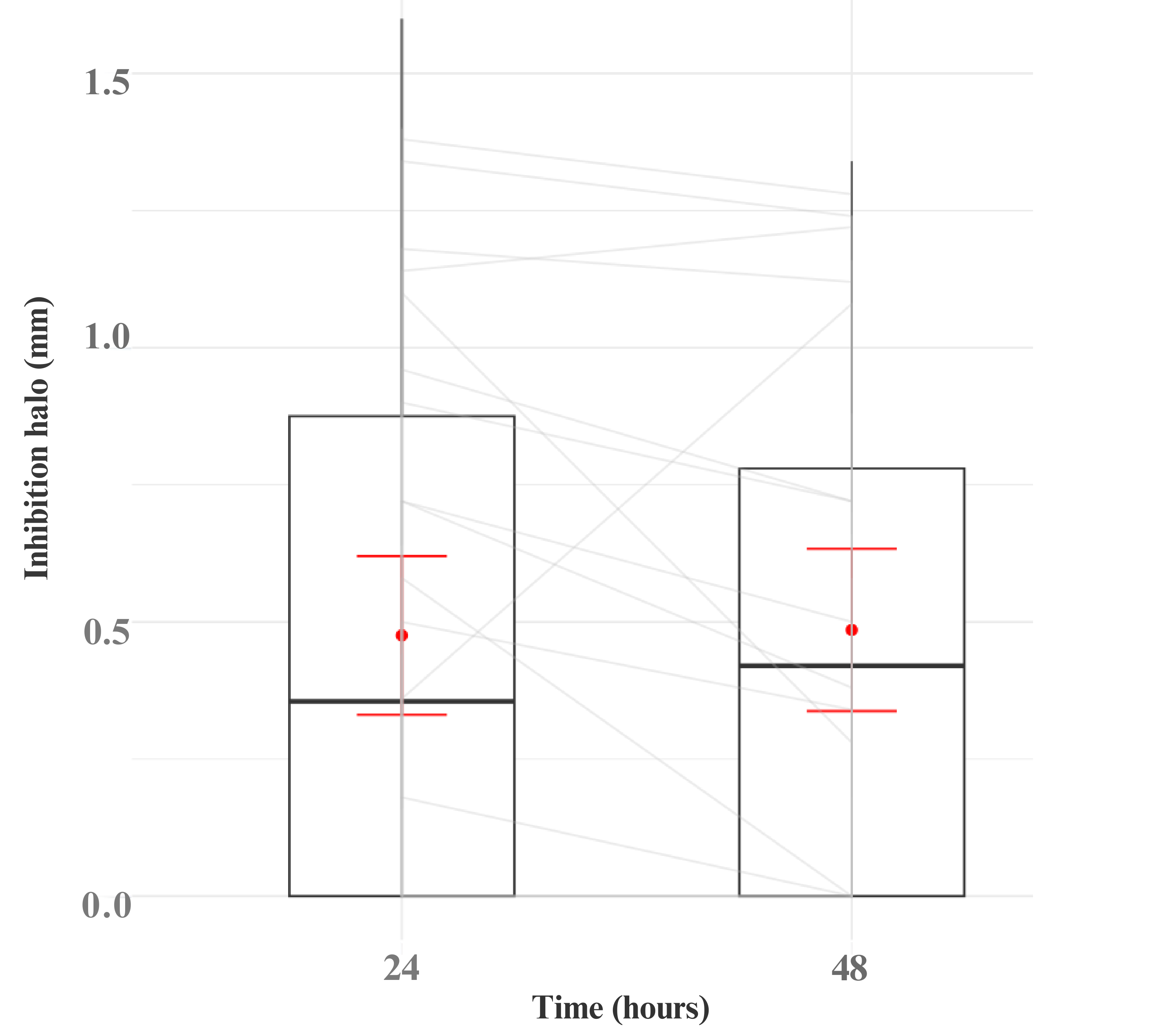
The effective sample size was 46 observations for 24 h and 41 observations for 48 h. Atypical growth of resistant colonies was observed in the area of the discs, which were marked as R* and excluded from the analysis to avoid bias. Sixteen paired disks (same plate ID) were identified between the two times, allowing points to be connected in the graphs and the random effect to be included in the mixed model (Figure 1).
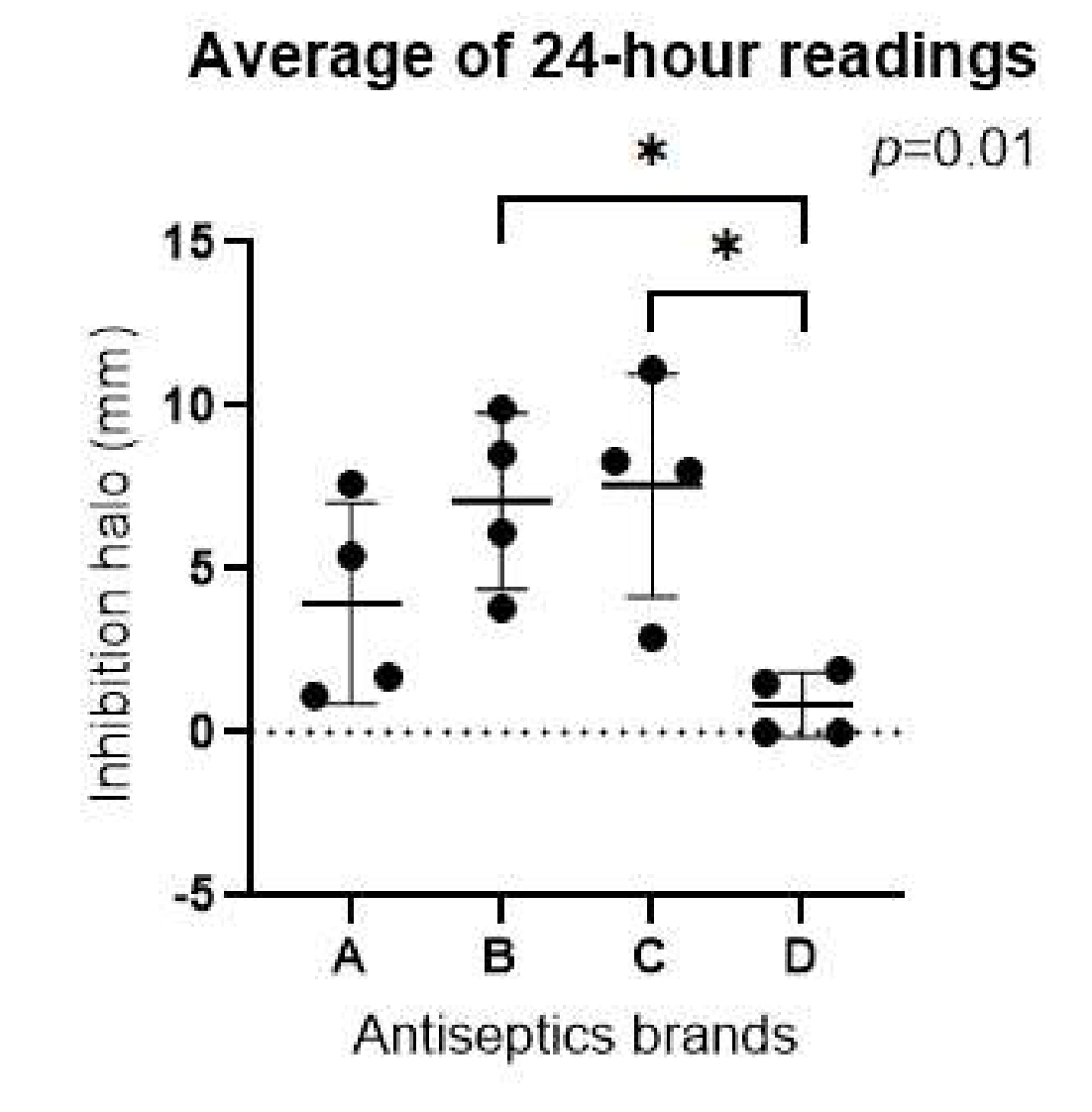
After 24 hours, the average halos (mm) were calculated for each antiseptic gel brand, considering the combined mean values against Staphylococcus aureus, Escherichia coli, Pseudomonas aeruginosa, and Enterococcus faecalis. The overall descriptive statistics showed very close means between times: 24h = 0.466 (95% CI 0.276–0.657) and 48h = 0.448 (95% CI 0.253–0.644). The normality test indicated a significant deviation from normality in the overall 24h set (W = 0.866, p < 0.001). However, only Brand A showed strong non-normality in the analysis by brand, while the others did not reject normality within the current sample limits. When brands were compared, one-way ANOVA indicated significant differences (F = 5.308; p = 0.0147), with Tukey’s test revealing lower efficacy of Brand D compared with Brands B (p = 0.034) and C (p = 0.026) (Figure 2). In contrast, species-specific analyses showed no significant differences among brands after adjustment: E. faecalis (p = 0.127), E. coli (p = 0.240), S. aureus (p = 0.098), and P. aeruginosa (p = 0.122) (Supplementary Table 1).
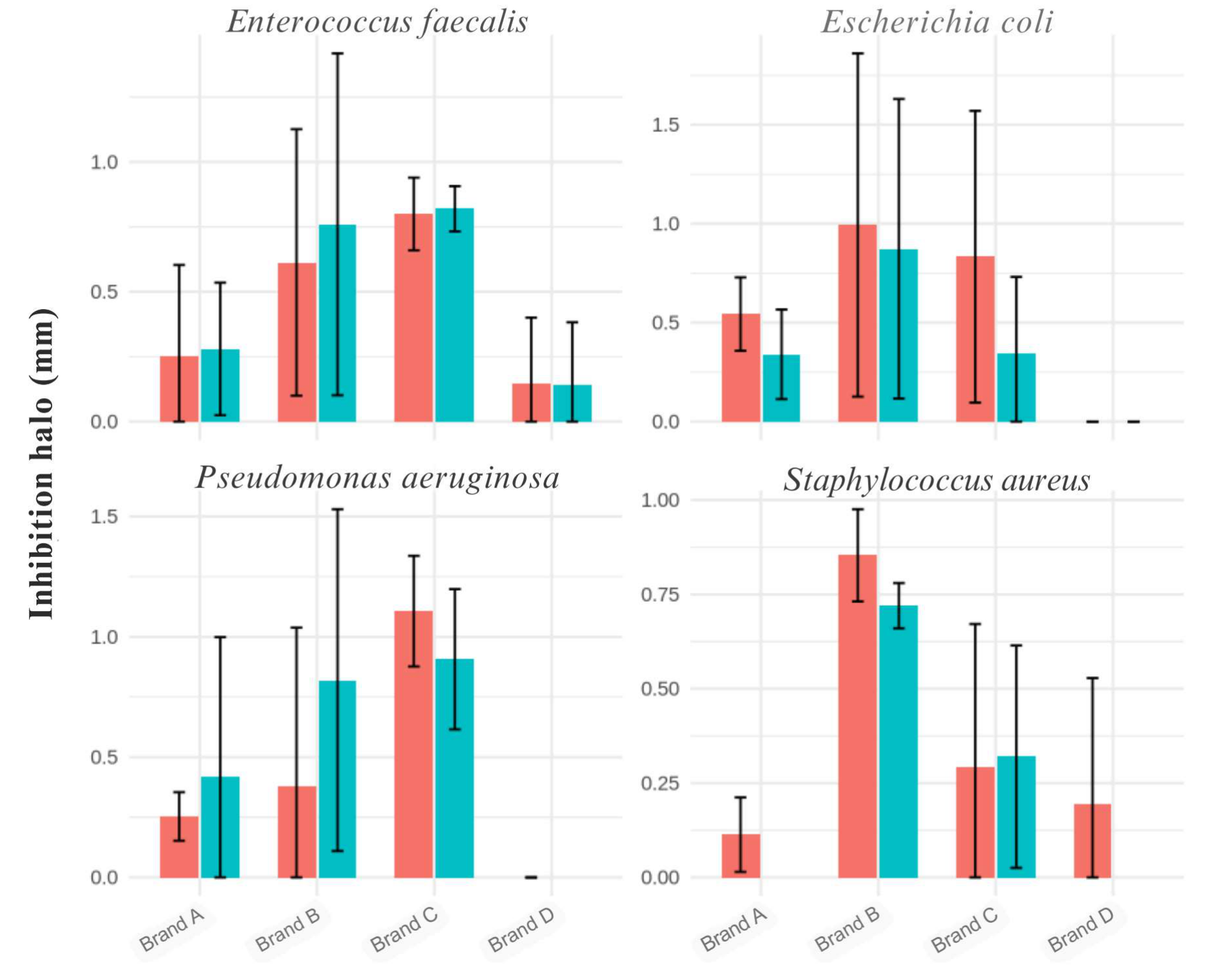
For Enterococcus faecalis, the Kruskal–Wallis test was applied, yielding a p-value of 0.127, an effect size () of 0.269, and Levene’s test indicated homogeneity of variances (p = 0.630). For Escherichia coli, one-way ANOVA was used, resulting in a p-value of 0.240, an effect size () of 0.392, and a non-significant Levene’s test (p = 0.477). For Staphylococcus aureus, the Kruskal–Wallis test showed a p-value of 0.098, with an effect size () of 0.300, and Levene’s p-value of 0.734. Finally, for Pseudomonas aeruginosa, the Kruskal–Wallis test produced a p-value of 0.122, an effect size () of 0.279, and Levene’s test was also non-significant (p = 0.652) (Supplementary Table 1).
Head of the pairwise post-hoc (Supplementary Table 2) results indicated that, for Enterococcus faecalis (Kruskal–Wallis, Dunn’s test with BH adjustment), none of the pairwise comparisons reached significance after correction, with the closest contrast being C–D (p.adj = 0.152). For Escherichia coli (ANOVA, Tukey HSD), all pairwise comparisons were non-significant, with adjusted p-values ranging from 0.229 to 0.986. In Staphylococcus aureus (Kruskal–Wallis, Dunn’s test with BH adjustment), the contrasts A–B (p.adj = 0.129) and B–D (p.adj = 0.145) approached significance but did not remain significant after adjustment. Finally, for Pseudomonas aeruginosa (Kruskal–Wallis, Dunn’s test with BH adjustment), the contrast C–D yielded the lowest adjusted p-value (p.adj = 0.125), though still above the conventional significance threshold.
The REML-adjusted mixed linear model, considering time as a fixed effect and plate ID as a random effect, indicated no significant effect of time (Intercept = 0.466 ± 0.092, p < 0.001; 48h effect = -0.018 ± 0.084, p = 0.832). The marginal estimates were 24h = 0.466 ± 0.092 and 48h = 0.448 ± 0.095, with a Holm-adjusted difference of 0.018 (p = 0.833). An ANOVA of independent measures also confirmed no significant difference (F(1,85) = 0.009, p = 0.923).
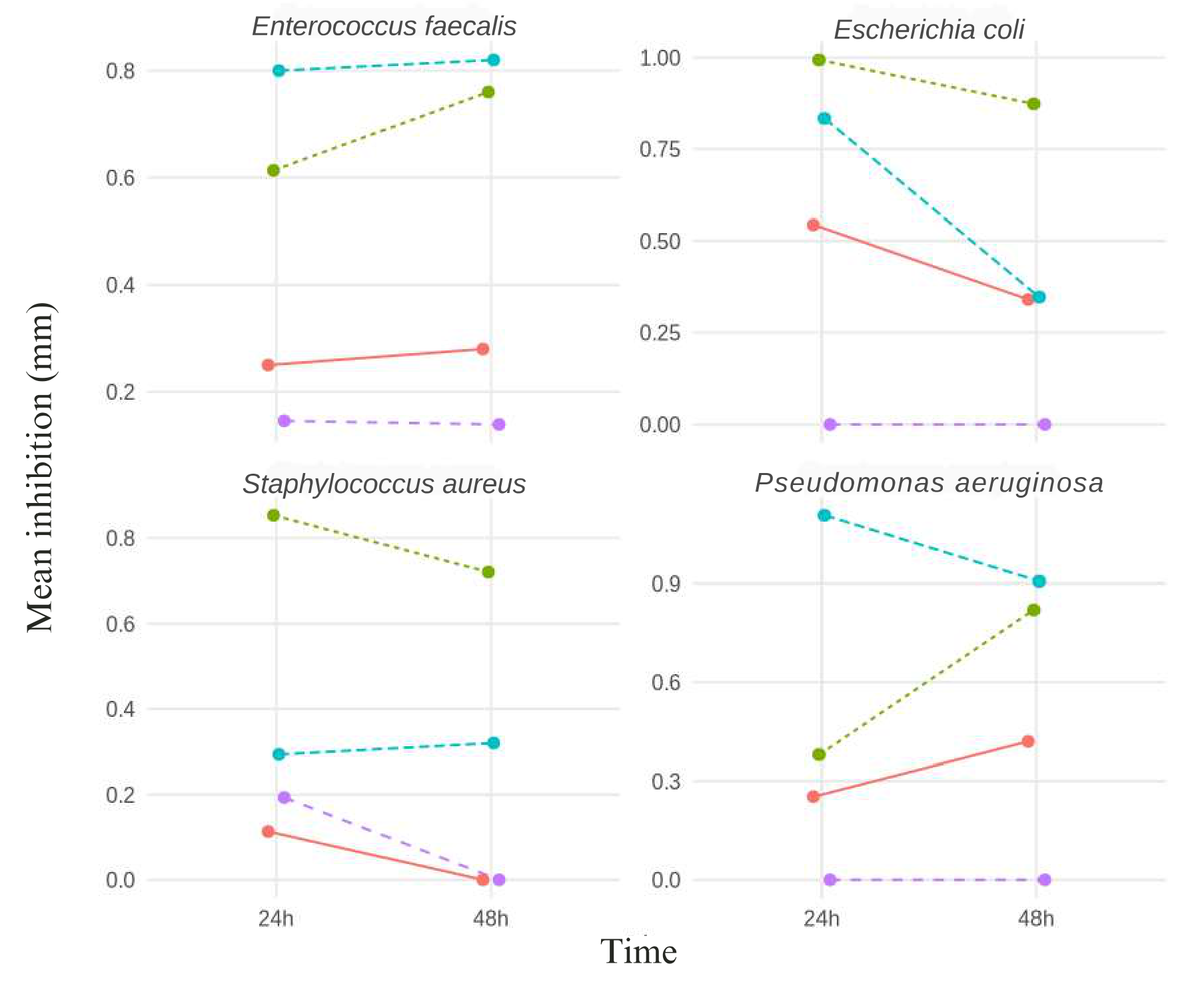
The analysis of deltas (halos 48h – halos 24h) by bacterium and brand showed small variations and no consistent trend: Enterococcus faecalis ranged from -0.007 to 0.147; Escherichia coli showed reductions from -0.487 to -0.120; Pseudomonas aeruginosa ranged from -0.200 to 0.440; and Staphylococcus aureus from -0.193 to 0.027. These results suggest variability between brands and individual replicates, but do not indicate a systematic effect of time (Figure 3). The ranking of effectiveness by bacteria remained relatively consistent: Brand C was most effective against E. faecalis and P. aeruginosa; Brand B was most effective against E. coli and S. aureus; while Brand D consistently demonstrated minimal to no inhibitory activity in the disk-diffusion assay compared to the other tested brands (Figure 4).
Discussion
The ASTM E1174 (American Society for Testing and Materials) standard is an American method for evaluating antiseptic hand wash formulations for healthcare professionals. At the same time, EN 1500 (EuroNorm) establishes criteria for rub-in hygienic disinfectants, using the reduction of transient microbial flora under controlled experimental conditions as a reference. Both use gram-negative bacteria as marker organisms, yet they still do not align with the practical everyday use of alcoholic hand preparations [22]. Despite the high concentrations, conducting this experiment with clinically relevant pathogenic strains enabled a direct comparison of the effectiveness of alcohol gel with that of antimicrobials used clinically. Thus, the methodological choice sought not only to approximate the results of situations encountered in healthcare settings, where the easy spread of microorganisms among patients and healthcare professionals represents a constant risk of cross-contamination, but also to provide an objective comparative parameter between the activity of routinely used antiseptics and the response to pathogens of clinical interest. The evaluation of antimicrobial activity using alcohol gel has already been described for its simplicity and cost-effectiveness. However, there have been reports of variations in halo reading due to how the drop spreads across the culture medium.
The antiseptic’s action is naturally limited as its concentration decreases with distance from the disc, making chemical neutralization unnecessary. Furthermore, since the active ingredient is a volatile alcohol, its concentration significantly decreases during the 24-hour incubation period due to evaporation, further limiting the potential for artificially enlarged halos. The main objective of our study was to compare the intrinsic antimicrobial activity of the product formulations under identical conditions. Since all products were subjected to the same physical principles of diffusion and evaporation, the relative comparison of the resulting inhibition zones remains valid and straightforward for measuring their in vitro efficacy.
The detailed experimental design further supports the robustness of the methodology. Halos were measured after 24 hours, and the experiments were repeated three times with five disk replicates per gel, ensuring sufficient sampling and minimizing random variability. Atypical growth of resistant colonies occasionally observed above the discs (marked as R*) was carefully excluded from the statistical analyses to avoid bias, resulting in an effective sample size of 46 observations at 24 h and 41 at 48 h. Although infrequent, these occurrences highlight the potential emergence of resistant subpopulations under certain conditions and should be explored in future studies. Importantly, the use of paired disks allowed the incorporation of random effects into mixed models, further strengthening statistical validity. Despite minor differences across bacteria and brands, the consistent halos of activity against these bacteria between 24 and 48 hours, along with stable brand performance rankings, indicate that excluding R* data did not compromise the study’s conclusions. Overall, these results reinforce confidence in the findings while ensuring transparency in experimental handling, variability, and data interpretation.
Considering the concentration of bacteria would be higher than that found on the surface of the hand, since the inoculum used was in the range of 1 × 10⁸ CFU/mL, which is associated with a site of infection (sepsis) in the patient [20], the alcohol gel brands proved to be effective against the bacterial strains. For the analysis and discussion of the results, since there is no reference standard in the literature, alcohol gel is not considered an antibiotic but a prophylactic. Halos were only described if they demonstrated minimal activity against the bacteria.
Analyzing the results, possible aspects could be linked to the action of alcohol gel in inhibiting bacterial growth, such as: the presence of ethanol, commonly used in hand sanitizers for its effectiveness in inactivating viruses and bacteria, and propanol, another variant of alcohol that is also effective against pathogens [23]. Alcohol in gel form doesn’t spread in the culture medium. Still, it can inhibit bacterial growth because its consistency increases the contact time with the contaminated surface by slowing down evaporation [24]. Cosmetic additives or emollients in alcohol improve skin tolerance and adherence to use by professionals, without interfering with the product’s action [23].
Brand C was the most effective antiseptic, showing the largest halo, especially against Pseudomonas aeruginosa, likely due to an optimized alcohol concentration and synergistic ingredients. Brand A showed consistent, though lower, antimicrobial activity, with borderline statistical significance suggesting possible variability in formulation. Brand B achieved high effectiveness against E. coli and S. aureus, indicating that small differences in composition can influence efficacy. In contrast, Brand D showed poor performance, failing to inhibit key pathogens, which raises concerns about its use and highlights the importance of strict quality control and efficacy testing.
The presence of ethanol and/or propanol is a key factor in the action of antiseptic gels, as both alcohols are capable of denaturing proteins and disrupting microbial membranes, particularly at concentrations above 60% [23,25]. The gel form prolongs contact time with the skin or surface, potentially increasing antimicrobial activity [24]. Moreover, the inclusion of cosmetic agents or emollients can promote user adherence without compromising efficacy, a crucial factor for routine use by healthcare professionals.
Although all brands claim to contain 70% ethyl alcohol, significant variability in antibacterial efficacy was observed, suggesting that other components of the formulation strongly influence the results. Additives such as glycerin—present in Brands A, B, and C—act as humectants and improve skin tolerability, but several pieces of evidence indicate that they may reduce alcohol diffusion or form physical barriers, decreasing halos in vitro. For example, Suchomel et al. (2017) demonstrated that glycerin in alcohol-based formulations decreases bactericidal activity, particularly with regard to prolonged effects, compared with formulations without glycerin or with alternative humectants. Similar results were also reported by Menegueti et al. (2019) [26,27].
Other critical factors include the type and concentration of polymers (carbopol, carbomer, TR1 acrylic polymer), which determine the gel’s viscosity and affect the evaporation rate and the diffusion of alcohol through the medium. More viscous formulations can keep alcohol on the surface longer, but they can also hinder its effective release, thereby inhibiting bacterial growth on agar plates [28]. In addition, neutralizers or pH-adjusting agents, such as triethanolamine and aminomethyl propanol, can alter the gel’s acidity, influencing alcohol stability and bacterial susceptibility. However, some studies indicate that within moderate ranges, pH does not have a predominant effect [29].
In this sense, the presence of humectants, polymer formulation, viscosity, and pH are variables that modify practical effectiveness. For clinical or personal hygiene applications, it is recommended to evaluate not only the alcohol content but also the complete formulation, including additives, to ensure consistent antimicrobial performance [30].
In recent years, the rise in hospital infections from multidrug-resistant microorganisms, along with the pandemic, has underscored the vulnerability of healthcare workers, who are more susceptible to pathogen contamination through direct contact with infected patients or contaminated surfaces. In epidemiology, it is considered that “the hands of healthcare workers are the main source of outbreaks of healthcare-related infections” and are a critical factor in transmission between infected and healthy patients [31].
Currently, alcoholic formulations are widely used for hand sanitizing because they promote microbial reduction, are easy to apply, and cause less irritation than water, which can remove the skin’s hydrolipidic barrier [32,33,34]. Alcohols denature and coagulate proteins when in concentrations of more than 60% and are more effective at reducing hand microbes than ordinary soaps or antiseptics, even in the presence of small amounts of proteinaceous material [35,25]. However, hand washing with soap and water remains essential in cases of extreme contamination or visible dirt [36]. In addition, excessive use of alcohol-based sanitizers can cause skin cracks [37], increasing the risk of infections and toxicity, and potentially selecting resistant strains, such as Staphylococcus epidermidis, which can form biofilms [38]. It is therefore essential to select products that guarantee efficacy, safety, and compatibility with users’ skin.
The agar-based halo assay provides a controlled, standardized measure of minimal or no inhibitory activity in the disk-diffusion assay compared to the other tested products. Yet, it does not replicate the dynamics of skin colonization, contact time, or the variable microbial load encountered in clinical practice. The use of high inoculum concentrations—above those typically found on healthcare workers’ hands—further complicates extrapolation to daily-use scenarios. Future studies should include clinical isolates, employ complementary methodologies, such as in vivo or simulated hand-contamination models, and explicitly address how experimental conditions may limit the generalizability of the findings. This would strengthen the discussion and provide clearer guidance on the applicability of results to infection prevention and control in healthcare environments.
The methodology used in this study was robust and appropriate for evaluating the efficacy of antiseptic gels. To ensure the accuracy and reliability of results, experiments were conducted in triplicate, and cross-contamination was avoided by using different strains on different days. Statistical analyses, including ANOVA, Kruskal–Wallis, and mixed-effects models, allowed rigorous comparison among brands and assessment of incubation time effects.
Nevertheless, the use of standard laboratory strains may not fully reflect the resistance patterns of clinical isolates, limiting direct extrapolation to real-world hospital settings. Despite this, the experimental design and statistical rigor provide a solid foundation for interpreting the relative antimicrobial performance of the gels, while highlighting the need for further studies with clinical strains to confirm applicability in healthcare environments.
Limitations
A primary limitation of this investigation is the use of the disk-diffusion method. We acknowledge that this is not a standard protocol for determining the clinical efficacy of hand rubs, for which methodologies like EN 1500 or ASTM E1174 are the established gold standards. Consequently, our results cannot be directly extrapolated to clinical performance, as we lack established breakpoints from standards organizations (e.g., CLSI) to classify an antiseptic as "susceptible" or "resistant" based on inhibition zone diameters. However, the objective of this study was not to validate clinical efficacy, but rather to conduct an exploratory in vitro screening to compare the antimicrobial activity of four commercially available alcohol-gel formulations under controlled laboratory conditions. The disk-diffusion method was chosen as a simple, accessible, and cost-effective screening tool to provide an objective comparative parameter between the activity of these products against pathogens of clinical interest. It is used for preliminary evaluations of antiseptics; although not a clinical standard, it has been documented in the literature for similar screening purposes.
A second, and perhaps more significant, finding emerged from the atypical results observed during the study. The data points marked as "R*" in Table 1, which denote "atypical growth of resistant colonies observed within the inhibition zone," were almost exclusively associated with Brand D. This consistent pattern strongly suggests that the observation was not due to a random breach in our sterile technique or procedural contamination. Instead, we interpret this as a critical finding related to the intrinsic characteristics of Brand D. We hypothesize that the product either contained low-level microbial contamination from the manufacturing process or had an inadequate preservative system, which was insufficient to inhibit the growth of certain alcohol-tolerant microorganisms in the formula. Therefore, what could be initially dismissed as a methodological flaw is, in fact, a significant finding regarding the quality control of commercial antiseptic products. The possibility that a commercially sold alcohol gel may harbor viable, alcohol-resistant organisms is a serious concern with direct public health implications, underscoring the importance of rigorous quality assurance in producing these essential healthcare products.
Conclusions
The results of this study demonstrate that the antimicrobial efficacy of alcohol-based hand sanitizers is strongly influenced by their overall formulation, not just alcohol concentration. Brand C exhibited the most consistent and robust activity against the bacterial strains of this study, particularly against Pseudomonas aeruginosa, suggesting an optimized combination of alcohol and synergistic excipients. Brand B showed selective efficacy against certain strains, while Brand A displayed moderate activity with greater variability. Brand D failed to inhibit key pathogens, highlighting the need for careful quality control and formulation assessment.
These findings underscore the critical role of hand hygiene in healthcare settings. While alcohol content is essential, factors such as humectants, polymer composition, viscosity, and pH significantly modulate practical antimicrobial performance. The study confirms the bacteriostatic potential of selected alcohol gels against Staphylococcus aureus, Escherichia coli, Pseudomonas aeruginosa, and Enterococcus faecalis. However, it also emphasizes the need for further investigations, including additional pathogens, vehicle-only controls, and clinical or simulated hand models, to fully evaluate product efficacy under real-world conditions.
Conflicts of Interest
The authors declare that there are no conflicts of interest related to this work. None of the authors has any collaboration, consultancy, or employment relationship with the companies or laboratories that manufacture the tested brands.
This research was conducted exclusively for exploratory and academic purposes, without external financial support or commercial involvement. The study design, data collection, analysis, and interpretation were carried out independently by the authors.
Funding Source
The authors declare that no specific grant or funding was received for this research from any public, commercial, or not-for-profit funding agency.
Acknowledgments
None.
Institutional Review Board (IRB)
According to CNS Resolution Nº 466/2012, which regulates research involving human subjects, and Law Nº 11,794/2008/CONCEA, which regulates animal research, this study does not fall under situations requiring submission to a Research Ethics Committee. The research was conducted exclusively in vitro using reference microorganisms (ATCC strains, laboratory strains, and routine hospital isolates) and did not involve human participants, identifiable personal data, or animals. Therefore, institutional ethical approval was not necessary. The ethical oversight of research in Brazil is conducted by the CEP/CONEP system, whose jurisdiction is strictly limited to studies involving human subjects, including the use of identifiable data or human-derived biological materials. As our work employed only standardized bacterial strains in vitro, it is not classified as “research involving human beings” and is exempt from CEP/CONEP review.
Large Language Model
During the preparation of this manuscript, the authors used ChatGPT (OpenAI) and DeepL Translate to assist with English language editing and translation. The authors reviewed and revised all tool-assisted text and take full responsibility for the content of the final manuscript.
Authors Contribution
All authors did the conceptualization. SKS and LBD performed data curation. SKS and LBD carried out formal analysis. SKS and LBD developed the methodology. LSB provided supervision. LSB completed validation. SKS and LBD wrote the original draft, and LSB conducted the review and editing.
Data Availability
The data generated and analyzed during this study are not publicly available because they consist of raw laboratory measurements obtained from in vitro disk-diffusion assays conducted exclusively for this research. All relevant data supporting the findings of this study are contained within the article and its supplementary materials. Additional details or anonymized datasets may be made available by the corresponding author upon reasonable request for academic and research purposes.
References
- Fontana R. T.. [Hospital infection and the historical evolution of infection]. Rev Bras Enferm. 2006;59(5):703-6. doi:10.1590/s0034-71672006000500021 PMID: 17340720
- Rey L.. Dictionary of Medical and Health Technical Terms. 2003.
- Moura M. E., Campelo S. M., de Brito F. C., Batista O. M., de Araujo T. M., Oliveira A. D.. [Nosocomial infection: study of prevalence at a public teaching hospital]. Rev Bras Enferm. 2007;60(4):416-21. doi:10.1590/s0034-71672007000400011 PMID: 18041525
- Portal de Boas Práticas em Saúde da Mulher, da Criança e do Adolescente. Hand hygiene as a strategy for preventing healthcare-associated infections (HAIs) and emergence of multidrug-resistant bacteria. 2018.
- Cruz A. F. D., Abreu A. O., Souza P. A., Deveza B., Medeiros C. T., Sousa V. S., Sabagh B. P., Villas Boas M. H. S.. Adaptation and validation of a method for evaluating the bactericidal activity of ethyl alcohol in gel format 70% (w/w). J Microbiol Methods. 2022;193:106402. doi:10.1016/j.mimet.2021.106402 PMID: 34973997
- Gold N. A., et al. Alcohol Sanitizer. StatPearls. 2023.
- Berardi A., Perinelli D. R., Merchant H. A., Bisharat L., Basheti I. A., Bonacucina G., Cespi M., Palmieri G. F.. Hand sanitisers amid CoViD-19: A critical review of alcohol-based products on the market and formulation approaches to respond to increasing demand. Int J Pharm. 2020;584:119431. doi:10.1016/j.ijpharm.2020.119431 PMID: 32461194 PMCID: PMC7229736
- Rocha V. F. D., da Silva E. N., Azevedo J., Ribeiro M. T., Reis M. G., Barros T. F., Reis J. N.. The impact of COVID-19 on microbiological profile and antibiotic consumption in ICU: a retrospective study in an infectious disease hospital in Brazil. Braz J Infect Dis. 2024;28(1):103705. doi:10.1016/j.bjid.2023.103705 PMID: 38065221 PMCID: PMC10764251
- Kalingamudali Y. T., Jalini P., Jayamaha A., Jayaratne D. L.. Knowledge, attitudes, and practices on the usage of antiseptics prior to invasive medical procedures: Evidence from Sri Lankan Healthcare Professionals. SAGE Open Med. 2023;11:20503121231199654. doi:10.1177/20503121231199654 PMID: 37750100 PMCID: PMC10518135
- Wichaidit W., Naknual S., Kleangkert N., Liabsuetrakul T.. Installation of pedal-operated alcohol gel dispensers with behavioral nudges and changes in hand hygiene behaviors during the COVID-19 pandemic: A hospital-based quasi-experimental study. J Public Health Res. 2020;9(4):1863. doi:10.4081/jphr.2020.1863 PMID: 33150146 PMCID: PMC7607228
- Leslie R. A., Zhou S. S., Macinga D. R.. Inactivation of SARS-CoV-2 by commercially available alcohol-based hand sanitizers. Am J Infect Control. 2021;49(3):401-402. doi:10.1016/j.ajic.2020.08.020 PMID: 32818578 PMCID: PMC7431409
- Eslami H., Das S., Zhou T., Müller-Plathe F.. How Alcoholic Disinfectants Affect Coronavirus Model Membranes: Membrane Fluidity, Permeability, and Disintegration. J Phys Chem B. 2020;124(46):10374-10385. doi:10.1021/acs.jpcb.0c08296 PMID: 33172260
- Nunes G. F.. Bacterial resistance in hospital settings: a review.
- FoodSafetyBrazil.org. Foodborne outbreaks in Brazil: data updated in December 2016. 2017.
- FoodSafetyBrazil.org. Escherichia coli O157:H7 - understand the outbreak in the US and actions taken. 2024.
- World Health Organization (WHO). E. coli. 2016.
- Centers for Disease Control and Prevention (CDC). Pseudomonas aeruginosa in Healthcare Settings. 2014.
- Garcia-Dominguez C., Martin P., Santos-Hurtado I., Blanco J., Blanco M. T., Gomez-Garcia A. C.. Susceptibility of Pseudomonas aeruginosa to anti-pseudomonal antibiotics in a general hospital in Spain from 1989 to 1992. J Antimicrob Chemother. 1994;33(5):1057-9. doi:10.1093/jac/33.5.1057 PMID: 7993468
- Brazil. National Health Surveillance Agency (ANVISA) - Ministry of Health. Resolution no. 485, August 21, 2008.
- Sociedade Brasileira de Patologia Clínica/Medicina Laboratorial. Recomendações da Sociedade Brasileira de Patologia Clínica/Medicina Laboratorial: Boas práticas em Microbiologia Clínica. 2015.
- ASTA. Science ASSIST Standard Operating Procedure: Susceptibility testing of antiseptics and disinfectants. 2023.
- Arbogast J. W., Okeke B., Brill F., Bradley T., Fraise A., Wilkinson M., Macinga D.. Advancement of the standard in vivo hand rub test methods: a critical comparison of the health care personnel handwash (ASTM E1174) and the hygiene handrub (EN1500). BMC Proceedings. 2011;5(S6). doi:10.1186/1753-6561-5-s6-p269
- Golin A. P., Choi D., Ghahary A.. Hand sanitizers: A review of ingredients, mechanisms of action, modes of delivery, and efficacy against coronaviruses. Am J Infect Control. 2020;48(9):1062-1067. doi:10.1016/j.ajic.2020.06.182 PMID: 32565272 PMCID: PMC7301780
- Bloomfield Sally F., Aiello Allison E., Cookson Barry, O'Boyle Carol, Larson Elaine L.. The effectiveness of hand hygiene procedures in reducing the risks of infections in home and community settings including handwashing and alcohol-based hand sanitizers. American Journal of Infection Control. 2007;35(10):S27-S64. doi:10.1016/j.ajic.2007.07.001
- Kawagoe J. Y.. Higiene das mãos: comparação da eficácia antimicrobiana do álcool – formulação gel e líquida – nas mãos com matéria orgânica. 2004.
- Menegueti M. G., Laus A. M., Ciol M. A., Auxiliadora-Martins M., Basile-Filho A., Gir E., Pires D., Pittet D., Bellissimo-Rodrigues F.. Glycerol content within the WHO ethanol-based handrub formulation: balancing tolerability with antimicrobial efficacy. Antimicrob Resist Infect Control. 2019;8:109. doi:10.1186/s13756-019-0553-z PMID: 31285821 PMCID: PMC6591802
- Suchomel M., Weinlich M., Kundi M.. Influence of glycerol and an alternative humectant on the immediate and 3-hours bactericidal efficacies of two isopropanol-based antiseptics in laboratory experiments in vivo according to EN 12791. Antimicrob Resist Infect Control. 2017;6:72. doi:10.1186/s13756-017-0229-5 PMID: 28670452 PMCID: PMC5488408
- d'Angelo I., Provenzano R., Florio E., Pagliuca C., Mantova G., Scaglione E., Vitiello M., Colicchio R., Salvatore P., Ungaro F., Quaglia F., Miro A.. Alcohol-Based Hand Sanitizers: Does Gelling Agent Really Matter?. Gels. 2022;8(2). doi:10.3390/gels8020087 PMID: 35200468 PMCID: PMC8871833
- Zhou Y., Yan H., Zhou Q., Feng R., Zhai B.. Impact of COVID-19 control measures on Legionella pneumophila infections in children in Henan, China. J Infect. 2023;87(1):85-87. doi:10.1016/j.jinf.2023.04.020 PMID: 37116618 PMCID: PMC10131741
- Thaddeus NzekweIfeanyi, Francis EgbunaChukwuemeka, Jane OkparaOgonna, Obumneme AgubataChukwuma, Okechukwu EsimoneCharles. Effects of some common additives on the antimicrobial activities of alcohol-based hand sanitizers. Asian Pacific Journal of Tropical Medicine. 2018;11(3). doi:10.4103/1995-7645.228437
- Brazil. National Health Surveillance Agency (ANVISA). Module 10: Clinical Microbiology Manual.
- Chopin-Doroteo M., Krotzsch E.. Soap or alcohol-based products? The effect of hand hygiene on skin characteristics during the COVID-19 pandemic. J Cosmet Dermatol. 2023;22(2):347-353. doi:10.1111/jocd.15523 PMID: 36409429
- Loveday H. P., Wilson J. A., Pratt R. J., Golsorkhi M., Tingle A., Bak A., Browne J., Prieto J., Wilcox M., Health U. K. Department of. epic3: national evidence-based guidelines for preventing healthcare-associated infections in NHS hospitals in England. J Hosp Infect. 2014;86 Suppl 1:S1-70. doi:10.1016/S0195-6701(13)60012-2 PMID: 24330862 PMCID: PMC7114876
- Pratt R. J., Pellowe C. M., Wilson J. A., Loveday H. P., Harper P. J., Jones S. R., McDougall C., Wilcox M. H.. epic2: National evidence-based guidelines for preventing healthcare-associated infections in NHS hospitals in England. J Hosp Infect. 2007;65 Suppl 1:S1-64. doi:10.1016/S0195-6701(07)60002-4 PMID: 17307562 PMCID: PMC7134414
- Brazil. National Health Surveillance Agency (ANVISA) - Ministry of Health. Resolution no. 485, August 21, 2008.
- Andrade Denise, Beraldo Carolina C., Watanabe Evandro, Oliveira Bruna A., Ito Izabel Y.. Atividade Antimicrobiana in Vitro Do Álcool Gel a 70% Frente Às BactÉrias Hospitalares E Da Comunidade. Medicina (Ribeirão Preto). 2007;40(2):250-254. doi:10.11606/issn.2176-7262.v40i2p250-254
- Alhalwani A., Husain A., Saemaldahar A., Makhdoum F., Alhakami M., Ashi R., Wali R., Alsharif S., Khan M. A., Jastaniah N., Fasfous I.. The impact of alcohol hand sanitizer use on skin health between healthcare worker: Cross-sectional study. Skin Res Technol. 2024;30(1):e13527. doi:10.1111/srt.13527 PMID: 38186055 PMCID: PMC10772474
- Lopez-Gigosos R. M., Mariscal-Lopez E., Gutierrez-Bedmar M., Mariscal A.. Effect of Long-Term Use of Alcohol-Containing Handwashing Gels on the Biofilm-Forming Capacity of Staphylococcus epidermidis. Int J Environ Res Public Health. 2023;20(6). doi:10.3390/ijerph20065037 PMID: 36981945 PMCID: PMC10049709