A Systematic Review and Meta-Analysis of Liver Transplant Outcomes in Lean Versus Non-Lean Metabolic Dysfunction-Associated Steatotic Liver Disease Patients
Manesh Kumar Gangwani1, Omar IrfanⒾ1,2*, Muhammad Aziz3, Fnu PriyankaⒾ1, Dushyant Singh DahiyaⒾ4, Umar Hayat5, Fouad Jaber6, Hassam Ali7, Sumant Inamdar8, Mauricio Garcia Saenz de Sicilia8
- 1Department of Medicine, University of Toledo Medical Center, Toledo, Ohio, USA
- 2Independent Consultant, Milton, Ontario, Canada
- 3Division of Gastroenterology and Hepatology, Bon Secours Mercy Health, Toledo, Ohio, USA
- 4Department of Medicine, Central Michigan University College of Medicine, Saginaw, Michigan, USA
- 5Department of Internal Medicine, Geisinger Valley Hospital, Wilkes-Barre, Pennsylvania, USA
- 6Department of Internal Medicine, University of Missouri-Kansas City, Kansas City, Missouri, USA
- 7Department of Gastroenterology and Hepatology, Eastern Carolina University, Greenville, North Carolina, USA
- 8Department of Gastroenterology and Hepatology, University of Arkansas for Medical Sciences, Arkansas, USA
Abstract
Introduction: Metabolic dysfunction-associated steatotic liver disease (MASLD) is a prevalent hepatic disease with metabolic dysfunction-associated steatohepatitis (MASH) as its severe necro-inflammatory subtype. At present, it is the second leading cause of liver transplant. A systematic literature review (SLR) was conducted to assess the effect of lean vs non-lean BMI on clinical outcomes after transplant in MASLD patients.
Methods: A systematic search of PubMed, Cochrane Library, and Google Scholar databases was executed. Review Manager 5.4.1 was used for statistical analyses. A random-effects model was used with the results reported as Odds Ratio (OR) and 95% confidence interval (CI). A narrative approach was used where it was not feasible to conduct a meta-analysis.
Results: Eleven observational studies were included in the SLR. Pooled results from three studies showed no significant difference in mortality between lean and non-lean patients at 1 year (OR= 0.78, p= 0.76), 2 years (OR= 0.83, p= 0.24), and 5 years (OR= 1.07, p= 0.51) post-transplant. There was also no significant relation of lean and non-lean BMI in graft survival, observed over 30 days (OR= 1.34, p= 0.27), 1 year (OR= 0.75, p= 0.25), 2 years (OR= 1.20, p= 0.45), and 5 years (OR= 1.07, p= 0.60) post-transplant. Qualitative analysis suggested morbid obesity is linked with higher waitlist dropout in MASH patients.
Conclusion: The qualitative analysis of eight studies indicates a trend towards poorer outcomes in the non-lean group. There is a need for further investigations to comprehensively examine the factors influencing the relationship between BMI and post-transplant outcomes.
Keywords: Liver Transplant, Graft Survival, Metabolic dysfunction-associated steatotic liver disease (MASLD), Non-alcoholic fatty liver disease (NAFLD), Lean MASLD
Article information
Introduction
Metabolic dysfunction-associated steatotic liver disease (MASLD) is a prevalent hepatic condition characterized by a build-up of macrovesicular steatosis in 5% of hepatocytes, occurring without significant alcohol or drug consumption [1]. A recent review of 72 records described the overall prevalence of MASLD worldwide increased significantly over time, from 25.5% before 2006 to 37.8% in 2016 or later [2]. Given the prevalence estimate, MASLD stands as the primary cause of chronic liver disease worldwide [3]. MASLD shares metabolic risk factors, including type 2 diabetes mellitus, obesity, and hypercholesterolemia, with metabolic syndrome [1]. Diagnosis involves identifying steatosis on ultrasound, often prompted by elevated liver transaminases [1]. Management of MASLD focuses on addressing modifiable risk factors such as blood pressure, body mass index (BMI), cholesterol, and blood sugar levels, with weight reduction being notably associated with decreased fibrosis among patients [4].
Metabolic dysfunction-associated steatohepatitis (MASH) is defined as a severe necro-inflammatory subtype of MASLD, which involves hepatic steatosis accompanied by inflammation and hepatocellular ballooning, which can progress to hepatocellular carcinoma (HCC) [5]. MASH frequently leads to complicated liver cirrhosis or failure, making liver transplantation the primary treatment option and a preventive measure against HCC [6]. MASH has an estimated global prevalence of 5.27% [6] and is currently the second leading indication for liver transplantation [7,8].
Although obesity can predispose individuals to various clinical comorbidities and post-operative complications, the impact of obesity on survival and transplantation outcomes in liver transplant patients remains uncertain. The American Society of Transplantation describes morbid obesity (BMI 40 kg/m) as a potential contraindication for liver transplant due to the heightened risk of post-transplant complications. A previous study conducted by Barone et al. assessed post-transplant outcomes in obese patients [9], which observed that a BMI 40 was linked to a greater risk of mortality, while a BMI 30 led to significantly more post-transplant complications [9]. When comparing outcomes in MASH versus non-MASH patients, a meta-analysis by Wang et al. comparing post-transplant outcomes, survival, and mortality rates in liver transplant patients with and without MASH reported similar mortality rates at 1, 3, and 5 years between the two groups, with cardiovascular complications being more common in the MASH group [10]. Another study published in 2022 concluded no significant difference in post-transplant survival between the MASH and non-MASH groups. However, the MASH group exhibited higher sepsis-related mortality and better graft survival [11].
Given the current conflicting data and lack of consensus on the impact of obesity on liver transplant patients, our systematic literature review (SLR) and meta-analysis aim to compare post-transplant outcomes in lean and non-lean MASLD patients who underwent liver transplantation.
Methods
Data sources and search strategy
A SLR and meta-analysis following the Preferred Reporting Items for Systematic Reviews and Meta-Analyses (PRISMA) guidelines [12] was conducted. PubMed, Cochrane Library, and Google Scholar were searched from inception to April 22, 2023. To update the search for any potential new relevant publications, hand searching was performed on November 30, 2024, to identify any additional studies published since the last search date. The search strategy comprised both older and newer terminologies for the disease, including Non alcoholic fatty liver disease (NAFLD), Non-alcoholic fatty steatohepatitis (NASH), MASH, and MAFLD. The search string used was: (NAFLD OR nonalcoholic fatty liver disease OR NASH OR MASLD OR MASH OR non-alcoholic Steatohepatitis OR non-alcoholic cirrhosis) AND (transplant* OR post-transplant*) AND (lean OR BMI OR obese). Additionally, we cross-referenced any identified SLRs to ensure comprehensive coverage.
Eligibility criteria
The eligibility criteria were formulated using the PECO framework: P (Patients): nonalcoholic fatty liver disease patients or non-alcoholic steatohepatitis patients who underwent transplantation; E (Exposure): BMI 25 kg/m pre-transplantation; C (Control): BMI 25 kg/m pre-transplantation; O (Outcome): mortality and graft survival/loss. Lean was defined as BMI 25 kg/m, and non-lean was defined as BMI 25 kg/m [13].
Screening, data extraction, and quality assessment of studies
Two independent reviewers conducted electronic database searches. The retrieved studies were exported to EndNote Reference Library version 20.0.1 software for screening after deduplication. The screening was conducted in duplicate by two reviewers (FP and UH) at the title/abstract and full text stages. Any disagreements or conflicts were resolved through discussion or by a third reviewer (MKG), if needed. Two reviewers (FJ and DSD) independently extracted data and further assessed the risk of bias in the included studies. The variables extracted included study author names, year of publication, study duration, country of origin, total number of patients, BMI, male proportions, mean age, and outcomes reported.
The Newcastle-Ottawa Scale (NOS) was used to assess the quality of cohort studies. NOS score of 1-5 was considered at high risk of bias, 6-7 indicated moderate risk, and scores greater than 7 were considered low risk of bias Table 1.
| Selection (Maximum 4) | Comparability(Maximum 2) | Outcome (Maximum 3) | |||||||
|---|---|---|---|---|---|---|---|---|---|
| Study | Representativeness of the Exposed Cohort | Selection of the Non-Exposed Cohort | Ascertainment of Exposure | Demonstration That Outcome of Interest Was Not Present at Start of Study | Comparability of Cohorts on the Basis of the Design or Analysis | Assessment of Outcome | Was Follow-Up Long Enough for Outcomes to Occur | Adequacy of Follow Up of Cohorts | Total Score |
| Malik et al. | 1 | 1 | 1 | 1 | 2 | 1 | 1 | 1 | 9 |
| Leonard et al. | 1 | 1 | 1 | 1 | 2 | 1 | 1 | 1 | 9 |
| Heuer et al. | 1 | 1 | 1 | 1 | 2 | 1 | 1 | 1 | 9 |
| Kenedy et al. | 1 | 1 | 1 | 1 | 2 | 1 | 1 | 1 | 9 |
| Conzen et al. | 1 | 1 | 1 | 1 | 2 | 1 | 1 | 1 | 9 |
| Kardashian et al. | 1 | 1 | 1 | 1 | 2 | 1 | 1 | 1 | 9 |
| Halder et al. | 1 | 1 | 1 | 1 | 2 | 1 | 1 | 1 | 9 |
| Eshraghian et al. | 1 | 1 | 1 | 1 | 2 | 1 | 1 | 1 | 9 |
| Satapathy et al. | 1 | 1 | 1 | 1 | 2 | 1 | 1 | 1 | 9 |
| Qazi-Arisar et al. | 1 | 1 | 1 | 1 | 2 | 1 | 1 | 1 | 9 |
Statistical analysis
All statistical analyses were performed using Review Manager (version 5.4.1; Copenhagen: The Nordic Cochrane Centre, The Cochrane Collaboration, 2020). The extracted data were pooled using a random-effects model. Odds ratios (OR) with corresponding 95% confidence intervals (CI) were calculated to analyze the results. The chi-square test was used to assess any subgroup differences. Heterogeneity was evaluated using the Higgins et al. scale: I² = 25–60% (moderate), 50–90% (substantial), and 75–100% (considerable heterogeneity) [14]. A p-value < 0.05 was considered statistically significant. A qualitative synthesis was performed on studies that met the inclusion criteria but did not provide data suitable for quantitative analysis.
Results
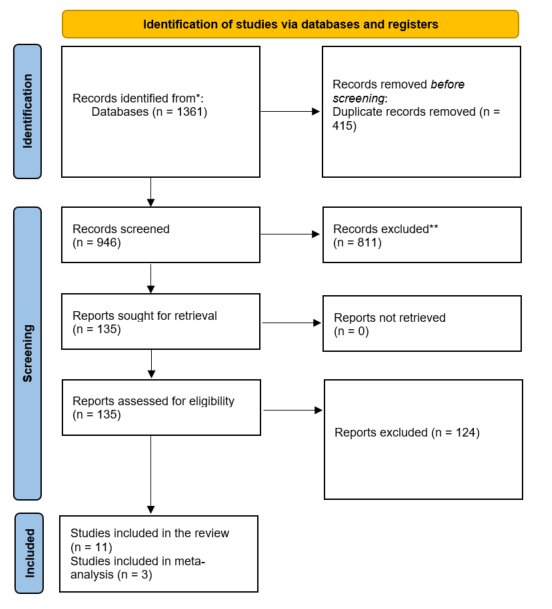
The comprehensive search of electronic databases yielded a total of 1,361 records. After removing duplicates, 946 records underwent title and abstract screening. Out of these, 135 records underwent eligibility assessment based on full-text. Finally, 11 studies [15,16,17,18,19,20,21,22,23,24] were selected for inclusion in the SLR, with evidence from eight studies [18,19,20,21,22,23,24,25] synthesized qualitatively and three [15,16,17] feasible to be included in meta-analysis. The PRISMA flowchart illustrating the study selection process is shown in Figure 1.
The selected studies, comprising 18,783 patients, were all observational studies. Table 2 provides an overview of the baseline characteristics of the included articles [15,16,17,18,19,20,21,22,23,24,25]. These studies were conducted in various geographical regions, including six in the USA, two in Iran, and one each in Europe, Canada, and Germany. The mean age of the patients was 50.8 years.
| Study | Year | Study design | Duration | Country | Total patients (n) | BMI <25 kg/m 2 (n) | BMI 25 kg/m 2 (n) | Male (%) | Mean Age (years) | Qualitative or Quantitative | Outcomes reported | Risk of Bias |
|---|---|---|---|---|---|---|---|---|---|---|---|---|
| Malik et al. | 2009 | Cohort | July 1997-June 2008 | USA | 98 | N/A* | N/A* | 44.9 | 59.8 | Qualitative | Mortality | Low Risk |
| Leonard et al. | 2008 | Cohort | April 1990-June 1994 | USA | 1313 | 628 | 685 | 60.4 | 50.8 | Quantitative | Patient mortality, Graft survival | Low Risk |
| Heuer et al. | 2012 | Cohort | Oct 2007-Jan 2011 | Germany | 40 | 4 | 36 | 60 | N/A* | Qualitative | Mortality, Graft failure | Low Risk |
| Kenedy et al. | 2012 | Cohort | 1999-2009 | USA | 129 | N/A* | N/A* | 47 | 57 | Qualitative | Patient survival | Low Risk |
| Conzen et al. | 2015 | Cohort | Jan 2002-Dec 2012 | USA | 785 | 219 | 566 | 67.2 | N/A* | Quantitative | Patient mortality, Graft survival | Low Risk |
| Kardashian et al. | 2018 | Cohort | March 2002-Dec 2013 | USA | 10001 | N/A* | N/A* | 66.3 | N/A* | Qualitative | Waitlist dropout | Low Risk |
| Halder et al. | 2019 | Cohort | Jan 2002-Dec 2016 | Europe | 2741 | N/A* | N/A* | 71.1 | N/A* | Qualitative | Patient survival | Low Risk |
| Eshraghian et al. | 2020 | Cohort | July 2012-Oct 2018 | Iran | 310 | 246 | 64 | 42 | 32.64 | Qualitative | Prevalence | Low Risk |
| Eshraghian et al. | 2020 | Cohort | March 2010-March 2017 | Iran | 462 | N/A* | N/A* | 65.5 | 46.9 | Qualitative | Graft rejection | Low Risk |
| Satapathy et al. | 2020 | Cohort | Jan 2002-June 2013 | USA | 2728 | 278 | 2450 | 54.3 | 57.9 | Qualitative | Patient survival and Graft loss | Low Risk |
| Qazi-Arisar et al. | 2022 | Cohort | Nov 2012-May 2019 | Canada | 176 | 54 | 122 | 53.9 | N/A* | Quantitative | Patient mortality, Graft survival | Low Risk |
N/A*= Not Available
Publication Bias and Quality Assessment
Due to the limited number of articles available for quantitative analysis, it was impossible to assess publication bias. However, all the included studies demonstrated a low risk of bias, as assessed by the NOS, as shown in Table 1.
Quantitative Analysis
Only three studies [15,16,17] were feasible to be included in the meta-analysis. Eight studies [18,19,20,21,22,23,24,25] could not be included in the quantitative analysis due to heterogeneity of analysis parameters, outcome endpoints, and different BMI cutoffs to classify lean and non-lean patients.
Patient Mortality
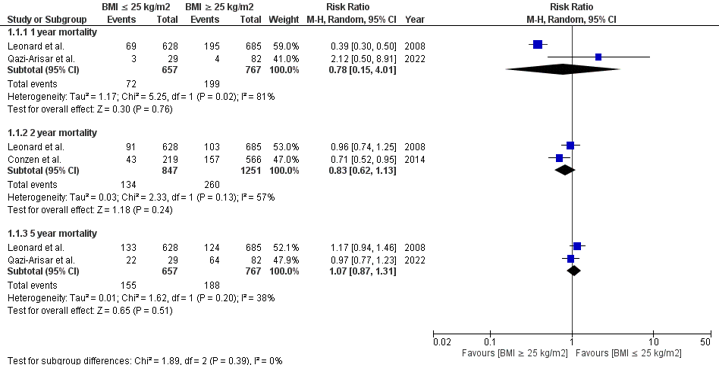
Three studies were included in the quantitative analysis to evaluate patient mortality based on pre-transplant BMI [15,16,17]. No significant difference was observed in mortality between lean and non-lean patients at 1 year (OR= 0.78 [CI 0.15, 4.01]; p= 0.76; I²= 81%), 2 years (OR= 0.83 [CI 0.62, 1.13]; p= 0.24; I²= 57%), and 5 years (OR= 1.07 [CI 0.87, 1.31]; p= 0.51; I²= 38%) post-transplant Figure 2.
Graft Survival
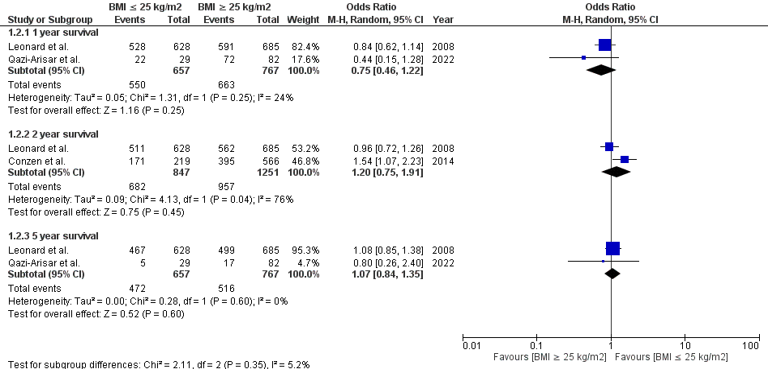
Three studies were included in the quantitative analysis to assess graft survival based on pre-transplant BMI [15,16,17]. The results showed no statistically significant relationship of BMI with graft survival at 30 days (OR= 1.34 [CI 0.79, 2.26]; p= 0.27), 1 year (OR= 0.75 [CI 0.46, 1.22]; p= 0.25; I²= 24%), 2 years (OR= 1.20 [CI 0.75, 1.91]; p= 0.45; I²= 76%), and 5 years (OR= 1.07 [CI 0.84, 1.35]; p= 0.60; I²= 0%) post-transplantation Figure 3.
Qualitative Analysis
Eight studies were included in the qualitative analysis, which examined the impact of BMI on clinical outcomes [18,19,20,21,22,23,24,25]. The studies provided varied outcomes assessing the association between BMI and post-transplant outcomes. Eshraghian et al. [25] found an increased risk of hepatic steatosis after liver transplant in patients with a higher BMI. Haldar et al. [19] observed that high BMI (>40 kg/m) independently predicted death in patients transplanted for NASH without HCC. Kardashian et al. [20] reported that morbid obesity was significantly linked to waitlist dropout in MASH patients with and without ascites (hazard ratio (HR) = 1.27 [1.20, 1.36]). Heur et al. [22] observed that sustained obesity and features of the metabolic syndrome in patients were associated with worse 1-year mortality. Kennedy et al. [23] noted worse survival in the high-risk cohort (age >60 years, BMI >30 kg/m, and the presence of both diabetes and hypertension). Meanwhile, Satapathy et al. [21] described lean NASH patients to have lower graft and patient loss at 10 years follow-up than their obese counterparts. A sub-analysis from Malik et al. [24] revealed that patients transplanted for NASH cirrhosis who died within the first year post-transplant were older (60 years), more obese (BMI 30 kg/m), and had pre-transplant DM and HTN. Eshragian et al. [18] observed a higher BMI to be marginally associated with NASH occurrence in non-obese compared to those without NASH (P=0.05). BMI-related results in these studies were often available without complete raw data, and with variable follow-up durations and outcomes; therefore, they could not be added to the meta-analysis.
Discussion
The current SLR and meta-analysis evaluated the role of BMI in post-transplant outcomes in patients with MASLD who underwent liver transplantation. Our analysis included both quantitative and qualitative evidence synthesis. The quantitative analysis did not find a significant association between long-term mortality rates and graft survival when comparing lean and non-lean patients [15,16,17]. While the qualitative analysis of eight studies observed a trend towards poorer outcomes in the non-lean patients [18,19,20,21,22,23,24,25], statistical association could not be assessed. These findings align with previous studies that have shown a relationship between obesity and poorer outcomes following liver transplantation. Evidence in the literature is mixed regarding any differences in outcomes between lean and non-lean patients. One of the initial studies conducted by Nair et al. served as the basis for the American Association for the Study of Liver guidelines in 2005, which contraindicated liver transplantation for morbidly obese individuals. Subsequent studies, such as those by Beckmann et al., further supported this association, showing worse survival and graft survival rates in patients with a pre-transplant BMI higher than 30 kg/m [26,27]. However, variations in study populations and primary causes of transplantation introduced heterogeneity in the results.
Interestingly, when accounting for concomitant comorbidities, studies have not consistently established an independent link between obesity and liver transplantation outcomes. Wong et al. demonstrated that when diabetes was considered, the survival rates between obese and non-obese patients were similar [3]. Additionally, some studies reported improved survival rates in patients with moderately elevated BMI, highlighting the potential confounding effect of being underweight on post-transplant survival [28,29].
To explain the heterogeneity observed in study results, further analysis is needed regarding the definition of BMI and its relationship to MASLD/MASH patients. The use of BMI as an estimate of body adiposity has limitations, as it does not account for variations in body composition. In MASLD/MASH patients, ascites or volume overload may lead to overestimating body weight [26,30]. Moreover, racial disparities in BMI cutoffs, particularly in the Asian population, may contribute to discrepancies in outcomes among liver transplant patients [31].
Furthermore, post-transplant mortality in MASLD patients can result from various factors, including disease recurrence, allograft rejection, progression to MASH cirrhosis or HCC, and metabolic syndrome [17,32]. Higher BMI is associated with an increased risk of cardiovascular incidents and metabolic symptoms, which may confound the association between high BMI and survival [33,34].
Our study also did not find a statistically significant association between BMI and graft survival. However, graft survival is multifactorial and depends on factors such as compliance with immunosuppressive therapy [35]. Previous studies have reported conflicting results, with some suggesting that obesity significantly impacts graft survival while others have found no significant differences [15,17,29]. The inconsistency in results can be attributed to variations in the definition of obesity and the inclusion of fluid overload rather than true obesity in some studies.
It is worth mentioning that some studies have associated BMI with HCC, potentially due to pro-inflammatory cytokine production by adipose tissue [17,36,37,38]. However, the mechanism underlying this association remains unclear.
Strengths and Limitations
Our study’s strengths include searching multiple databases to ensure comprehensive coverage and the inclusion of several studies with larger sample sizes and longer follow-up periods. Furthermore, while previously published meta-analyses do not determine the transplant outcomes regarding BMI in MASLD patients or MASH patients, we specifically focused on both subgroups, which consist of a substantial number of liver transplant patients.
The findings of this review require cautious interpretation due to some limitations. Firstly, only three studies were included in the quantitative analysis due to a lack of studies reporting sufficient raw data and heterogeneity in BMI classifications, outcome endpoints, and their durations, limiting the feasibility of producing pooled estimates. Furthermore, the low number of studies and the limited sample size in the quantitative analysis may underestimate the important effects that could have emerged better in larger and uniform datasets, reduce the statistical power of the pooled estimates, and limit the generalizability of findings. This limitation stresses the urgent need for future research to adopt standardized BMI classifications and outcome definitions. Secondly, all included studies were observational, which may introduce potential selection, reporting, and confounding biases that are inherent to non-randomized study designs. Thirdly, normal weight and underweight patients were pooled as "lean" (BMI ≤ 25 kg/m) and all overweight and obese patients grouped as "non-lean" (BMI 25 kg/m), potentially obscuring important differences within these groups. Lastly, the quantitative analysis focused primarily on mortality and graft survival, not extensively analyzing other important post-transplant outcomes such as length of hospital stay, complications, quality of life, or disease recurrence, which can be critical for understanding transplant success in these patients.
Future research requires focusing on a few critical areas, including conducting larger, multicenter, international studies to gather representative data on MASLD patients across various racial and geographical backgrounds. Investigating any pathophysiological mechanisms driving MASLD progression in lean versus non-lean patients, which can include metabolic and genetic factors that may potentially influence liver transplant outcomes, and moving beyond BMI-based classifications to include other analyses of body composition (e.g., muscle mass, fat distribution) and their effect on post-transplant outcomes should be considered. Prospective multicentric studies with standardized BMI classifications can be conducted for appropriate comparability across studies. Additionally, future analyses can stratify outcomes by the different categories of BMI and control for confounding comorbidities. A shared data registry with uniform definitions, follow-up durations, and outcomes can facilitate pooled analyses of a larger cohort of patient data across multiple centers. Although the quantitative analysis from three studies did not identify any relation of BMI with post-transplant outcomes, transplant centers can move beyond BMI when assessing the candidacy of MASLD patients for liver transplant. The clinical assessment and decision-making can incorporate additional clinical factors, including metabolic health, other comorbid conditions, and functional status [39].
Conclusions
In conclusion, the quantitative analysis did not demonstrate a significant impact of BMI on post-transplant outcomes in MASLD patients. However, the qualitative analysis indicated a trend towards an association between higher BMI and poor post-transplant outcomes, although statistical conclusions could not be definitively drawn. Our study is useful as it plays a pivotal role in presenting and summarizing all the available evidence, highlighting the existing dichotomy in the literature, and its potential causes. It also emphasizes the need for future investigations to consider key parameters that may influence the relationship of BMI with post-transplant outcomes.
Conflicts of Interest
The authors declare no conflict of interest.
Funding Source
This research received no external funding.
Acknowledgments
None
Institutional Review Board (IRB)
None
Large Language Model
None
Authors Contribution
Author contributions: MGSDS and MKG conceptualized the study design and objectives. MA, FP, DSD, UH, FJ, HA, and SI conducted the literature search, study screening, selection, and data extraction. MKG, OI, and MA designed the data extraction template, extracted data, and carried out data analysis. OI, MA, FP, DSD, UH, FJ, HA, and SI drafted the initial manuscript. MKG, SI, and MGSDS critically reviewed and revised the final manuscript. MGSDS is the guarantor, and the manuscript has been critically reviewed. All authors approve the final manuscript as submitted for publication.
Data Availability
All studies used in the research are available in various databases.
References
- Friedman S. L., Neuschwander-Tetri B. A., Rinella M., Sanyal A. J.. Mechanisms of NAFLD development and therapeutic strategies. Nat Med. 2018;24(7):908-922. doi:10.1038/s41591-018-0104-9 PMID: 29967350 PMCID: PMC6553468
- Riazi K., Azhari H., Charette J. H., Underwood F. E., King J. A., Afshar E. E., Swain M. G., Congly S. E., Kaplan G. G., Shaheen A. A.. The prevalence and incidence of NAFLD worldwide: a systematic review and meta-analysis. Lancet Gastroenterol Hepatol. 2022;7(9):851-861. doi:10.1016/S2468-1253(22)00165-0 PMID: 35798021
- Younossi Z. M., Koenig A. B., Abdelatif D., Fazel Y., Henry L., Wymer M.. Global epidemiology of nonalcoholic fatty liver disease-Meta-analytic assessment of prevalence, incidence, and outcomes. Hepatology. 2016;64(1):73-84. doi:10.1002/hep.28431 PMID: 26707365
- Vilar-Gomez E., Martinez-Perez Y., Calzadilla-Bertot L., Torres-Gonzalez A., Gra-Oramas B., Gonzalez-Fabian L., Friedman S. L., Diago M., Romero-Gomez M.. Weight Loss Through Lifestyle Modification Significantly Reduces Features of Nonalcoholic Steatohepatitis. Gastroenterology. 2015;149(2):367-78 e5; quiz e14-5. doi:10.1053/j.gastro.2015.04.005 PMID: 25865049
- Llovet J. M., Willoughby C. E., Singal A. G., Greten T. F., Heikenwalder M., El-Serag H. B., Finn R. S., Friedman S. L.. Nonalcoholic steatohepatitis-related hepatocellular carcinoma: pathogenesis and treatment. Nat Rev Gastroenterol Hepatol. 2023;20(8):487-503. doi:10.1038/s41575-023-00754-7 PMID: 36932227 PMCID: PMC12165718
- Younossi Z. M., Golabi P., Paik J. M., Henry A., Van Dongen C., Henry L.. The global epidemiology of nonalcoholic fatty liver disease (NAFLD) and nonalcoholic steatohepatitis (NASH): a systematic review. Hepatology. 2023;77(4):1335-1347. doi:10.1097/HEP.0000000000000004 PMID: 36626630 PMCID: PMC10026948
- Kim W. R., Lake J. R., Smith J. M., Schladt D. P., Skeans M. A., Harper A. M., Wainright J. L., Snyder J. J., Israni A. K., Kasiske B. L.. OPTN/SRTR 2016 Annual Data Report: Liver. Am J Transplant. 2018;18 Suppl 1:172-253. doi:10.1111/ajt.14559 PMID: 29292603
- Younossi Z., Stepanova M., Ong J. P., Jacobson I. M., Bugianesi E., Duseja A., Eguchi Y., Wong V. W., Negro F., Yilmaz Y., Romero-Gomez M., George J., Ahmed A., Wong R., Younossi I., Ziayee M., Afendy A., Global Nonalcoholic Steatohepatitis Council. Nonalcoholic Steatohepatitis Is the Fastest Growing Cause of Hepatocellular Carcinoma in Liver Transplant Candidates. Clin Gastroenterol Hepatol. 2019;17(4):748-755 e3. doi:10.1016/j.cgh.2018.05.057 PMID: 29908364
- Barone M., Viggiani M. T., Losurdo G., Principi M., Leandro G., Di Leo A.. Systematic review with meta-analysis: post-operative complications and mortality risk in liver transplant candidates with obesity. Aliment Pharmacol Ther. 2017;46(3):236-245. doi:10.1111/apt.14139 PMID: 28488418
- Wang X., Li J., Riaz D. R., Shi G., Liu C., Dai Y.. Outcomes of liver transplantation for nonalcoholic steatohepatitis: a systematic review and meta-analysis. Clin Gastroenterol Hepatol. 2014;12(3):394-402 e1. doi:10.1016/j.cgh.2013.09.023 PMID: 24076414
- Zhou G. P., Jiang Y. Z., Sun L. Y., Zhu Z. J.. Clinical evidence of outcomes following liver transplantation in patients with nonalcoholic steatohepatitis: An updated meta-analysis and systematic review. Int J Surg. 2022;104:106752. doi:10.1016/j.ijsu.2022.106752 PMID: 35803515
- Hutton B., Salanti G., Caldwell D. M., Chaimani A., Schmid C. H., Cameron C., Ioannidis J. P., Straus S., Thorlund K., Jansen J. P., Mulrow C., Catala-Lopez F., Gotzsche P. C., Dickersin K., Boutron I., Altman D. G., Moher D.. The PRISMA extension statement for reporting of systematic reviews incorporating network meta-analyses of health care interventions: checklist and explanations. Ann Intern Med. 2015;162(11):777-84. doi:10.7326/M14-2385 PMID: 26030634
- Kuchay M. S., Martinez-Montoro J. I., Choudhary N. S., Fernandez-Garcia J. C., Ramos-Molina B.. Non-Alcoholic Fatty Liver Disease in Lean and Non-Obese Individuals: Current and Future Challenges. Biomedicines. 2021;9(10). doi:10.3390/biomedicines9101346 PMID: 34680463 PMCID: PMC8533092
- Cumpston M., Li T., Page M. J., Chandler J., Welch V. A., Higgins J. P., Thomas J.. Updated guidance for trusted systematic reviews: a new edition of the Cochrane Handbook for Systematic Reviews of Interventions. Cochrane Database Syst Rev. 2019;10(10):ED000142. doi:10.1002/14651858.ED000142 PMID: 31643080 PMCID: PMC10284251
- Qazi-Arisar F. A., Uchila R., Chen C., Yang C., Chen S. Y., Karnam R. S., Azhie A., Xu W., Galvin Z., Selzner N., Lilly L., Bhat M.. Divergent trajectories of lean vs obese non-alcoholic steatohepatitis patients from listing to post-transplant: A retrospective cohort study. World J Gastroenterol. 2022;28(26):3218-3231. doi:10.3748/wjg.v28.i26.3218 PMID: 36051335 PMCID: PMC9331521
- Leonard J., Heimbach J. K., Malinchoc M., Watt K., Charlton M.. The impact of obesity on long-term outcomes in liver transplant recipients-results of the NIDDK liver transplant database. Am J Transplant. 2008;8(3):667-72. doi:10.1111/j.1600-6143.2007.02100.x PMID: 18294163
- Conzen K. D., Vachharajani N., Collins K. M., Anderson C. D., Lin Y., Wellen J. R., Shenoy S., Lowell J. A., Doyle M. B., Chapman W. C.. Morbid obesity in liver transplant recipients adversely affects longterm graft and patient survival in a single-institution analysis. HPB (Oxford). 2015;17(3):251-7. doi:10.1111/hpb.12340 PMID: 25322849 PMCID: PMC4333787
- Eshraghian A., Nikeghbalian S., Geramizadeh B., Kazemi K., Shamsaeefar A., Malek-Hosseini S. A.. Characterization of biopsy proven non-alcoholic fatty liver disease in healthy non-obese and lean population of living liver donors: The impact of uric acid. Clin Res Hepatol Gastroenterol. 2020;44(4):572-578. doi:10.1016/j.clinre.2019.09.002 PMID: 31611031
- Haldar D., Kern B., Hodson J., Armstrong M. J., Adam R., Berlakovich G., Fritz J., Feurstein B., Popp W., Karam V., Muiesan P., O'Grady J., Jamieson N., Wigmore S. J., Pirenne J., Malek-Hosseini S. A., Hidalgo E., Tokat Y., Paul A., Pratschke J., Bartels M., Trunecka P., Settmacher U., Pinzani M., Duvoux C., Newsome P. N., Schneeberger S., European Liver and Intestine Transplant Association. Outcomes of liver transplantation for non-alcoholic steatohepatitis: A European Liver Transplant Registry study. J Hepatol. 2019;71(2):313-322. doi:10.1016/j.jhep.2019.04.011 PMID: 31071367 PMCID: PMC6656693
- Kardashian A. A., Dodge J. L., Roberts J., Brandman D.. Weighing the risks: Morbid obesity and diabetes are associated with increased risk of death on the liver transplant waiting list. Liver Int. 2018;38(3):553-563. doi:10.1111/liv.13523 PMID: 28727287
- Satapathy S. K., Jiang Y., Agbim U., Wu C., Bernstein D. E., Teperman L. W., Kedia S. K., Aithal G. P., Bhamidimarri K. R., Duseja A., Maiwall R., Maliakkal B., Jalal P., Patel K., Puri P., Ravinuthala R., Wong V. W., Abdelmalek M. F., Ahmed A., Thuluvath P. J., Singal A. K., Global Nafld Consortium. Posttransplant Outcome of Lean Compared With Obese Nonalcoholic Steatohepatitis in the United States: The Obesity Paradox. Liver Transpl. 2020;26(1):68-79. doi:10.1002/lt.25672 PMID: 31665561
- Heuer M., Kaiser G. M., Kahraman A., Banysch M., Saner F. H., Mathe Z., Gerken G., Paul A., Canbay A., Treckmann J. W.. Liver transplantation in nonalcoholic steatohepatitis is associated with high mortality and post-transplant complications: a single-center experience. Digestion. 2012;86(2):107-13. doi:10.1159/000339344 PMID: 22846254
- Kennedy C., Redden D., Gray S., Eckhoff D., Massoud O., McGuire B., Alkurdi B., Bloomer J., DuBay D. A.. Equivalent survival following liver transplantation in patients with non-alcoholic steatohepatitis compared with patients with other liver diseases. HPB (Oxford). 2012;14(9):625-34. doi:10.1111/j.1477-2574.2012.00497.x PMID: 22882200 PMCID: PMC3461389
- Malik S. M., deVera M. E., Fontes P., Shaikh O., Ahmad J.. Outcome after liver transplantation for NASH cirrhosis. Am J Transplant. 2009;9(4):782-93. doi:10.1111/j.1600-6143.2009.02590.x PMID: 19344467
- Eshraghian A., Nikeghbalian S., Kazemi K., Shamsaeefar A., Geramizadeh B., Malek-Hosseini S. A.. Non-alcoholic fatty liver disease after liver transplantation in patients with non-alcoholic steatohepatitis and cryptogenic cirrhosis: the impact of pre-transplant graft steatosis. HPB (Oxford). 2020;22(4):521-528. doi:10.1016/j.hpb.2019.07.015 PMID: 31431413
- Moctezuma-Velazquez C., Marquez-Guillen E., Torre A.. Obesity in the Liver Transplant Setting. Nutrients. 2019;11(11). doi:10.3390/nu11112552 PMID: 31652761 PMCID: PMC6893648
- Beckmann S., Drent G., Ruppar T., Nikolic N., De Geest S.. Body Weight Parameters are Related to Morbidity and Mortality After Liver Transplantation: A Systematic Review and Meta-analysis. Transplantation. 2019;103(11):2287-2303. doi:10.1097/TP.0000000000002811 PMID: 31283679
- Orci L. A., Majno P. E., Berney T., Morel P., Mentha G., Toso C.. The impact of wait list body mass index changes on the outcome after liver transplantation. Transpl Int. 2013;26(2):170-6. doi:10.1111/tri.12017 PMID: 23199077
- Rustgi V. K., Marino G., Rustgi S., Halpern M. T., Johnson L. B., Tolleris C., Taddei T. H.. Impact of body mass index on graft failure and overall survival following liver transplant. Clin Transplant. 2004;18(6):634-7. doi:10.1111/j.1399-0012.2004.00141.x PMID: 15516235
- Lee D. U., Bahadur A., Ponder R., Lee K. J., Fan G. H., Chou H., Lominadze Z.. The causes of death in patients with nonalcoholic steatohepatitis following liver transplantation stratified using pre-liver transplant BMI. Hepatol Int. 2023;17(6):1393-1415. doi:10.1007/s12072-023-10529-6 PMID: 37160862 PMCID: PMC10767727
- Jih J., Mukherjea A., Vittinghoff E., Nguyen T. T., Tsoh J. Y., Fukuoka Y., Bender M. S., Tseng W., Kanaya A. M.. Using appropriate body mass index cut points for overweight and obesity among Asian Americans. Prev Med. 2014;65:1-6. doi:10.1016/j.ypmed.2014.04.010 PMID: 24736092 PMCID: PMC4217157
- Coelho J. C., Parolin M. B., Matias J. E., Jorge F. M., Canan Junior L. W.. [Cause of late death in liver transplant recipients]. Rev Assoc Med Bras (1992). 2003;49(2):177-80. doi:10.1590/s0104-42302003000200037 PMID: 12886396
- Yalamanchili K., Saadeh S., Klintmalm G. B., Jennings L. W., Davis G. L.. Nonalcoholic fatty liver disease after liver transplantation for cryptogenic cirrhosis or nonalcoholic fatty liver disease. Liver Transpl. 2010;16(4):431-9. doi:10.1002/lt.22004 PMID: 20373454
- Dumortier J., Giostra E., Belbouab S., Morard I., Guillaud O., Spahr L., Boillot O., Rubbia-Brandt L., Scoazec J. Y., Hadengue A.. Non-alcoholic fatty liver disease in liver transplant recipients: another story of "seed and soil". Am J Gastroenterol. 2010;105(3):613-20. doi:10.1038/ajg.2009.717 PMID: 20040915
- Burra P., Germani G., Gnoato F., Lazzaro S., Russo F. P., Cillo U., Senzolo M.. Adherence in liver transplant recipients. Liver Transpl. 2011;17(7):760-70. doi:10.1002/lt.22294 PMID: 21384527
- Grat K., Pacho R., Grat M., Krawczyk M., Zieniewicz K., Rowinski O.. Impact of Body Composition on the Risk of Hepatocellular Carcinoma Recurrence After Liver Transplantation. J Clin Med. 2019;8(10). doi:10.3390/jcm8101672 PMID: 31614892 PMCID: PMC6832484
- El-Domiaty N., Saliba F., Karam V., Sobesky R., Ibrahim W., Vibert E., Pittau G., Amer K., Saeed M. A., Shawky J. A., Cherqui D., Adam R., Samuel D.. Impact of body mass index on hepatocellular carcinoma recurrence after liver transplantation through long-term follow-up. Hepatobiliary Surg Nutr. 2021;10(5):598-609. doi:10.21037/hbsn.2020.04.01 PMID: 34760964 PMCID: PMC8527412
- Siegel A. B., Lim E. A., Wang S., Brubaker W., Rodriguez R. D., Goyal A., Jacobson J. S., Hershman D. L., Verna E. C., Zaretsky J., Halazun K., Dove L., Brown Jr., R. S., Neugut A. I., Kato T., Remotti H., Coppleson Y. J., Emond J. C.. Diabetes, body mass index, and outcomes in hepatocellular carcinoma patients undergoing liver transplantation. Transplantation. 2012;94(5):539-43. doi:10.1097/TP.0b013e31825c58ea PMID: 22864187 PMCID: PMC3605709
- Zhang Z., Zhang L., Jiang W., Du T., Yuan G.. Non-obese NAFLD had no better cardio-metabolic risk profile than obese NAFLD in type 2 diabetic patients. Cardiovasc Diabetol. 2022;21(1):210. doi:10.1186/s12933-022-01648-9 PMID: 36242001 PMCID: PMC9569122