Long-Term Mortality Trends in Atrial Fibrillation and Renal Disease in the United States, 1999–2023: A Retrospective Analysis
Mohamed Fawzi HemidaⒾ1, Alyaa Ahmed IbrahimⒾ1, Muhammad Raza SarfrazⒾ2, Anika GoelⒾ3, Mirna HusseinⒾ1, Mohammad Rayyan FaisalⒾ4, Mahmoud TablawyⒾ5*, Krish PatelⒾ6, Noha HammadⒾ7, Maryam SaghirⒾ8, Eshal SaghirⒾ4, Aamer AhmadⒾ9, Muhammad Faizan AliⒾ10, Amro AliⒾ11, Ahmad M. AbdelkhalekⒾ12, Raheel AhmedⒾ13
- 1Faculty of Medicine, Alexandria University, Alexandria, Egypt
- 2Department of Medicine, Allied Hospital, Faisalabad Medical University, Faisalabad, Pakistan
- 3Department of Medicine, Kakatiya Medical College, Warangal, Telangana, India
- 4Department of Medicine, Dow University of Health Sciences, Karachi, Pakistan
- 5Faculty of Medicine, Al-Azhar University, Cairo, Egypt
- 6Department of Medicine, C. U. Shah Medical College, Surendranagar, Gujarat, India
- 7Faculty of Medicine, Port-Said University, Port-Said, Egypt
- 8Department of Medicine, Jinnah Sindh Medical University, Karachi, Pakistan
- 9Department of Internal Medicine, Lady Reading Hospital, Peshawar, Pakistan
- 10Department of Medicine, Jinnah Postgraduate Medical Center, Karachi, Pakistan
- 11Department of Internal Medicine, Community Regional Medical Center, Department of Medicine, California, USA
- 12Department of Internal Medicine, Northwestern Medicine McHenry Hospital/Rosalind Franklin University, Chicago, USA
- 13National Heart and Lung Institute, Imperial College London, London, England
Abstract
Background: The coexistence of atrial fibrillation (AF) and renal disease is a significant contributor to mortality and morbidity. However, comprehensive national mortality trends for AF among older adults with renal disease, including demographic and geographic variations, remain largely unexamined.
Methods: We performed a retrospective analysis of U.S. adult deaths (≥65 years) from 1999 to 2023 using the CDC WONDER Multiple Cause of Death database. Deaths were included when AF and kidney disease appeared in any mention field of the death certificate, regardless of the underlying cause of death. We calculated crude and age-adjusted mortality rates (CMR, AAMR) per 100,000 population, and temporal trends were assessed using Joinpoint regression to estimate annual percent change (APC) and average annual percent change (AAPC).
Results: A total of 372,652 deaths were attributed to both AF and renal disease in older adults. The national AAMR increased more than threefold, from 16.67 in 1999 to 54.45 per 100,000 in 2023 (AAPC: 5.10; p < 0.001). Men had higher absolute mortality, but women experienced a slightly steeper increase in AAMR. Non-Hispanic White individuals had the highest absolute mortality, while all racial/ethnic groups showed significant increases. The South reported the most deaths, the Northeast had the highest AAMR, and non-metropolitan areas consistently showed higher AAMR than metropolitan areas. Most deaths occurred in medical facilities (54.55
Conclusions: Mortality from AF and renal disease has substantially risen over the past 25 years, with marked disparities by sex, race/ethnicity, geography, and urbanization.
Keywords: Atrial Fibrillation, Chronic kidney disease, Age-adjusted mortality, Joinpoint regression, Health disparities
Article information
Introduction
Renal disease and atrial fibrillation (AF) significantly contribute to a major health burden, as their coexistence is one of the most significant causes of mortality and morbidity [1,2]. Renal disease, which includes acute kidney injury (AKI), chronic kidney disease (CKD), renal insufficiency, and other unspecified renal disorders, poses a substantial health strain. The incidence of newly diagnosed AKI has increased from 80 to 242 cases per 1,000 patient years between 2007 and 2022 [3]. AKI alone represents a growing clinical challenge, and CKD affects over 35.5 million U.S. adults (≈ 14% of the adult population) as of 2023 [4]. Meanwhile, in 2021, AF was recorded on 232,030 death certificates and was the primary cause of death in 28,037 cases [5]. Therefore, AF and renal diseases have a high prevalence, especially in older adults [1].
Renal disease and AF have a bidirectional relationship. Patients with renal diseases are susceptible to developing AF due to fluid retention [6]. Also, these patients are further predisposed to AF by structural heart alterations, such as left atrial enlargement and fibrosis, and by electrolyte imbalances, such as elevated potassium or calcium levels, which can interfere with normal myocardial conduction and cause arrhythmias [7]. These are proposed mechanisms rather than mechanisms proven by mortality data. Because our analysis is based on death certificate data, the biological pathway linking renal disease and AF cannot be directly adjudicated. However, the onset of AF in patients with renal disease deteriorates renal outcomes through progressive organ damage, renal hypoperfusion, and thromboembolic events. This vicious cycle, in which each illness makes the others worse, results in a faster rate of clinical deterioration and an earlier death.
There are disparities in renal disease burden and AF-related mortality among U.S. racial/ethnic groups and by geography. For example, non-Hispanic (NH) Black adults bear a higher CKD burden relative to NH White adults [8,9]. Because our study examines mortality mentions in the national death certificate database, rather than diagnosis or disease-detection rates, we focus on disparities in mortality rather than differential AF detection.
Long-term national trends in both AF and renal disease-related mortality among adults remain inadequately described. Most available evidence is limited to hospital-based cohorts or selected populations, and it lacks a comprehensive examination of demographic, geographic, and temporal variations across the United States. Our study aims to close this gap by using the Centers for Disease Control and Prevention (CDC) Wide-ranging Online Data for Epidemiologic Research (WONDER) Multiple Cause-of-Death database to assess trends in AF and renal disease mortality among patients 65 or older in the United States between 1999 and 2023.
Methods
Study Design and Population
We conducted a retrospective analysis using death-certificate data from the CDC WONDER Multiple Cause of Death database for U.S. adults aged ≥ 65 years from 1999 to 2023. Deaths were included when AF (ICD-10 I48) and renal disease (ICD-10 N17, N18, N19, N28.9) appeared in any-mention (multiple-cause) fields of the death certificate, regardless of the underlying cause of death. These ICD-10 codes have been previously used to identify AF and renal disease in administrative databases [10,11]. The primary kidney-disease definition included N17, N18, N19, and N28.9 to capture acute and chronic renal conditions, as well as unspecified renal disorders, commonly recorded on death certificates. Older adults were defined as individuals aged 65 years or older at the time of death, consistent with prior studies [12]. Similar investigations using the Multiple Cause-of-Death public-use files have been published previously [10,13]. Institutional review board approval was not required for this study, as it used de-identified public-use data provided by the government and adhered to the Strengthening the Reporting of Observational Studies in Epidemiology (STROBE) guidelines for reporting [14].
Data Abstraction
Data on population size and demographics, including sex, age, race, region, and state, were extracted. Place of Death was categorized into medical facilities, hospice, home, and nursing home/long-term care facilities. Racial and ethnic categories were classified as NH White, NH Black or African American, Hispanic or Latino, NH American Indian or Alaskan Native, and NH Asian or Pacific Islander. The National Center for Health Statistics Urban-Rural Classification Scheme was used to classify the population by urban (population ≥ 50,000) and rural (population < 50,000) counties, per the 2013 U.S. Census classification. [15] Regions were stratified into Northeast, Midwest, South, and West according to the U.S. Census Bureau definitions [16].
Data Quality and Completeness
Preliminary data exploration revealed substantial suppression of mortality counts in certain demographic strata, driven by small cell sizes (<10 deaths), potentially contributing to instability in rate estimates for these subgroups. CDC WONDER applies suppression to protect confidentiality; therefore, suppressed values were excluded from subgroup-specific analyses and included only in aggregated analyses where suppression was automatically resolved, and no imputation was performed. To maintain consistency across the study period, we used NCHS bridged-race population estimates for both mortality numerators and denominators, with age-adjusted mortality rates calculated using census-based and postcensal estimates standardized to the 2000 U.S. standard population. Deaths with unknown or missing demographic characteristics were included in overall analyses but excluded from subgroup-specific estimates (e.g., race- and sex-stratified analyses), following CDC WONDER reporting conventions.
Statistical Analysis
Crude and age-adjusted mortality rates (CMRs and AAMRs) with 95% CIs per 100,000 U.S. residents aged 65 years and older were extracted by year, sex, race/ethnicity, and state from 1999 to 2023, and urban-rural status was calculated for 1999-2020. The 2000 U.S. standard population was used to maintain consistency with CDC WONDER default settings and facilitate comparison with other published mortality studies [17]. Urban–rural analyses were limited to 1999–2020; 2021–2023 urban–rural rates were not available. CMR was determined by dividing the number of AF and renal disease patients by the corresponding U.S. population of that year. To quantify national annual trends in AF and renal disease-related mortality, the Joinpoint Regression Program (Joinpoint V 5.4.0, National Cancer Institute) was used to determine the annual percent change (APC) with 95% CI in AAMR. This method allows identification of significant changes in AAMR over time by fitting log-linear regression models where temporal variation occurred. Statistical significance was assessed using Monte Carlo permutation tests. The Average Annual Percent Change (AAPC) was calculated to summarize the overall trend across the entire study period. Results are presented with 95% CI, with p < 0.05 deemed statistically significant.
Results
Overall Mortality Trends
Throughout the study period, from 1999 to 2023, a total of 372,652 deaths occurred in which both AF and renal disease were co-mentioned on the death certificate. Place-of-death data were available for 372,646 cases. The majority of deaths occurred in medical facilities (54.55%), followed by nursing homes/long-term care facilities (20.30%), decedent’s residence (17.09%), and hospice settings (4.93%). A small proportion (0.14%) of deaths occurred in unspecified locations, while the remaining (2.99%) occurred in other locations (Supplemental Tables 1, 2).
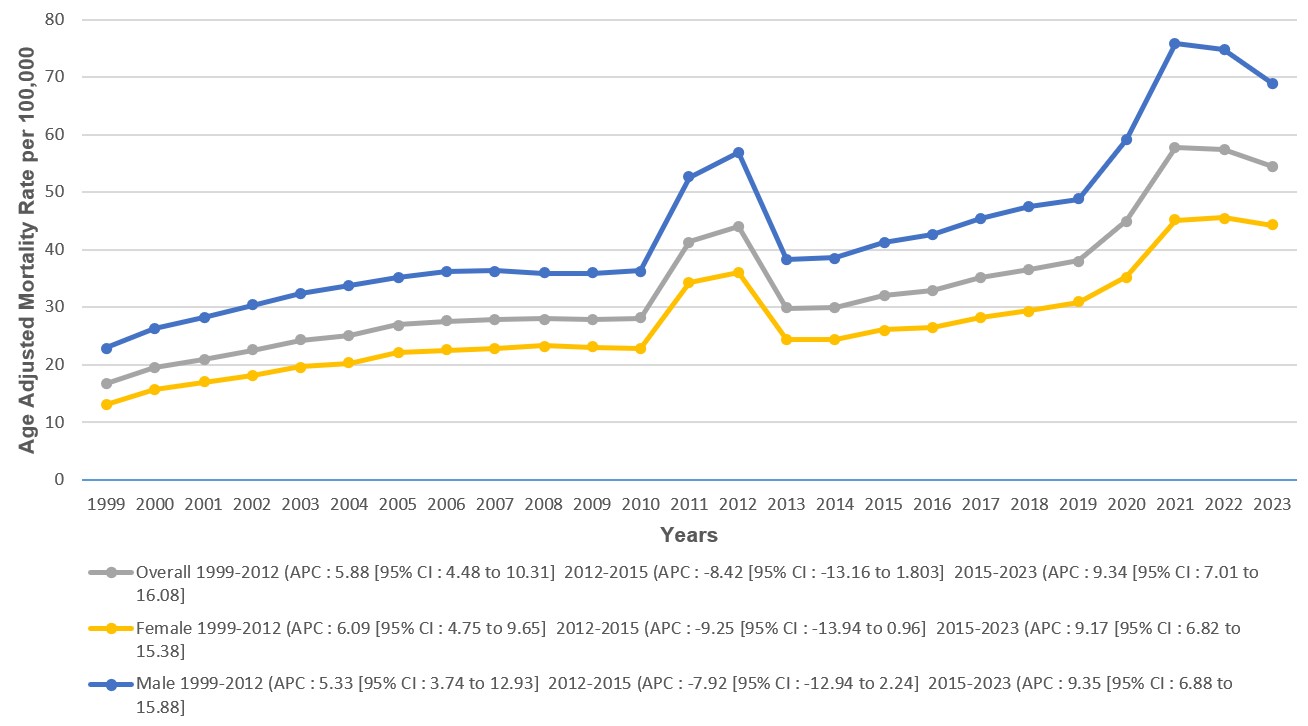
The AAMR showed a significant increase overall, from 16.67 (95% CI: 16.23-17.10) in 1999 to 54.45 (95% CI: 53.82-55.08) in 2023, with an AAPC of 5.10 (95% CI: 4.51 to 6.30; p < 0.001). From 1999-2012, AAMR exhibited a significant increases, from 16.67 to 44.07 (APC: 5.88; 95% CI: 4.49 to 10.32; p = 0.002), which was followed by a subsequent non-significant decline to 32.1 in 2015 (APC: -8.43; 95% CI: -13.17 to 1.80; p = 0.13), and then a significant increase to 54.45 in 2023 (APC: 9.35; 95% CI: 7.01 to 16.08; p = 0.002) (Supplemental Tables 3, 4) and Figure 1.
Gender Trends
Overall, men (deaths: 188,630, AAMR: 43.21) showed higher mortality rates than women (deaths: 184,022, AAMR: 26.85). However, women exhibited a greater AAPC of 5.04 (95% CI: 4.49 to 6.15; p < 0.001) than men, with an AAPC of 4.88 (95% CI: 4.22 to 6.19; p < 0.001). In 1999, the AAMR for men was 23.01 (95% CI: 22.14-23.88) compared to 13.16 (95% CI: 12.69-13.64) in women. These values increased to 68.92 (95% CI: 67.80–70.04) and 44.24 (95% CI: 43.50–44.99) by the year 2023.
AAMR for women showed a marked increase, from 13.16 in 1999 to 36.0 in 2012 (APC: 6.10; 95% CI: 4.75 to 9.66; p = 0.004), followed by a non-significant decline to 26.1 in 2015 (APC: -9.25; 95% CI: -13.94 to 0.96; p = 0.08), and then a significant increase to 44.24 in 2023 (APC: 9.17; 95% CI: 6.83 to 15.38; p = 0.001). In men, AAMR saw a sharp yet significant increase from 23.01 in 1999 to 56.9 in 2012 (APC: 5.33; 95% CI: 3.75 to 12.93; p = 0.003), followed by a steady yet non-significant drop to 41.22 in 2015 (APC: -7.93; 95% CI: -12.95 to 2.24; p = 0.18), and a significant surge to 68.92 in 2023 (APC: 9.35; 95% CI: 6.88 to 15.88; p = 0.007) (Supplemental Tables 1-4) and Figure 1.
Racial Trends
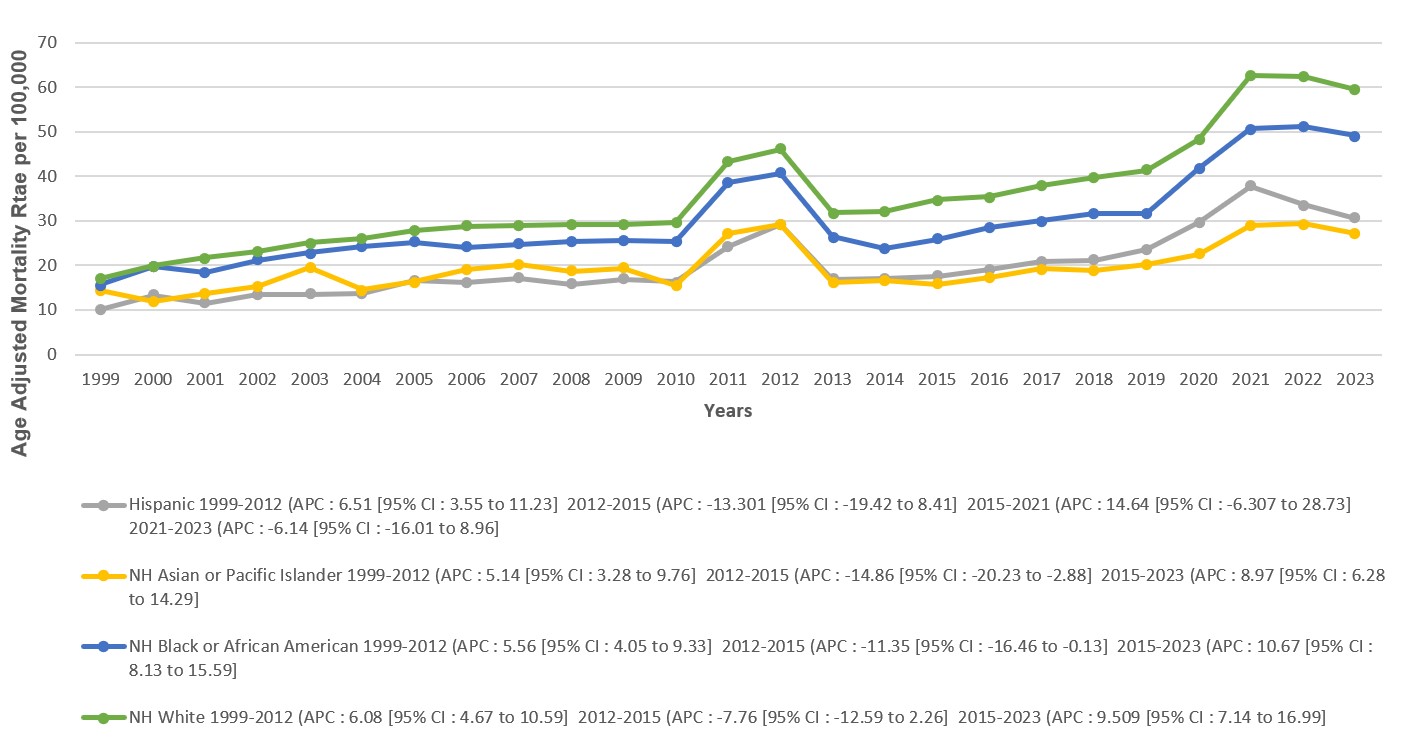
NH White individuals accounted for the highest number of deaths (319,700), followed by NH Black/African American individuals (27,666), Hispanic/Latino (15,744), and NH Asian/Pacific Islander (8,134). Consequently, NH White individuals demonstrated the greatest overall AAMR of 35.30, followed by NH Black/African American individuals (29.72), Hispanic/Latino individuals (19.83), and NH Asian/Pacific Islander individuals (19.49).
All races observed a significant increase in AAMR between 1999 and 2023; 17.12 to 59.63 (AAPC: 5.35; 95% CI: 4.77 to 6.57; p < 0.001) among NH White individuals, 15.71 to 49.1 (AAPC: 4.93; 95% CI: 4.30 to 6.09; p < 0.001) among NH Black/African American individuals, 10.05 to 30.53 (AAPC: 4.63; 95% CI: 3.76 to 6.21; p < 0.001) among Hispanic/Latino individuals, and 14.31 to 27.18 (AAPC: 3.63; 95% CI: 2.88 to 5.16; p < 0.001) among NH Asian/Pacific Islander individuals.
In brief, NH Asian/Pacific Islander individuals experienced a significant increase in AAMR from 14.31 in 1999 to 29.24 in 2012 (APC: 5.14; 95% CI: 3.28 to 9.76; p = 0.004), followed by a significant reduction to 15.72 in 2015 (APC: -14.86; 95% CI: -20.24 to -2.88; p = 0.008), and a sharp upward trend to 27.18 in 2023 (APC: 8.98; 95% CI: 6.29 to 14.29; p = 0.001). NH Black/African American individuals demonstrated a significant surge in AAMR throughout the study period, initially from 15.71 in 1999 to 40.61 in 2012 (APC: 5.56; 95% CI: 4.05 to 9.34; p < 0.001), followed by a significant decline, reaching 25.92 in 2015 (APC: -11.35; 95% CI: -16.46 to -0.14; p = 0.04), and a sharp yet significant rise to 49.10 in 2023 (APC: 10.68; 95% CI: 8.14 to 15.59; p = 0.004).
Hispanic/Latino individuals saw an initial significant incline in AAMR from 10.05 in 1999 to 29.28 in 2012 (APC: 6.52; 95% CI: 3.56 to 11.23; p = 0.02), followed by a non-significant drop to 17.58 in 2015 (APC: -13.30; 95% CI: -19.42 to 8.41; p = 0.07), a non-significant increase to 37.8 (APC: 14.64; 95% CI: -6.31 to 28.73; p = 0.06), and a non-significant decline to 30.53 in 2023 (APC: -6.15; 95% CI: -16.01 to 8.96; p = 0.37). NH White individuals experienced a significant rise from 17.12 in 1999 to 46.05 in 2012 (APC: 6.08; 95% CI: 4.68 to 10.60; p = 0.003), a non-significant decline to 34.81 in 2015 (APC: -7.77; 95% CI: -12.59 to 2.27; p = 0.17), and a significant surge in AAMR, reaching 59.63 in 2023 (APC: 9.51; 95% CI: 7.14 to 16.99; p = 0.003) (Supplemental Tables 1, 3, 5) and Figure 2.
Regional Trends
The Southern region reported the highest number of deaths (128,801), followed by the Midwest (90,671), the West (83,902), and the Northeast (69,278). Overall, AAMRs were highest in the Northeast (40.00), followed by the Midwest (35.89), the West (34.75), and the South (31.58). All regions demonstrated an overall increase in AAMR between 1999 and 2023. In the Northeast, AAMR increased from 17.61 to 48.97 (AAPC: 4.18; 95% CI: 3.61 to 5.38; p < 0.0001), while the Midwest saw a rise from 19.09 to 55.54 (AAPC: 4.81; 95% CI: 4.25 to 5.89; p < 0.001). The South saw an increase from 14.27 to 54.68 (AAPC: 5.61; 95% CI: 4.94 to 7.31; p < 0.001) over the same period. The West experienced an increase from 16.79 to 56.47 (AAPC: 5.52; 95% CI: 4.86 to 6.91; p < 0.001).
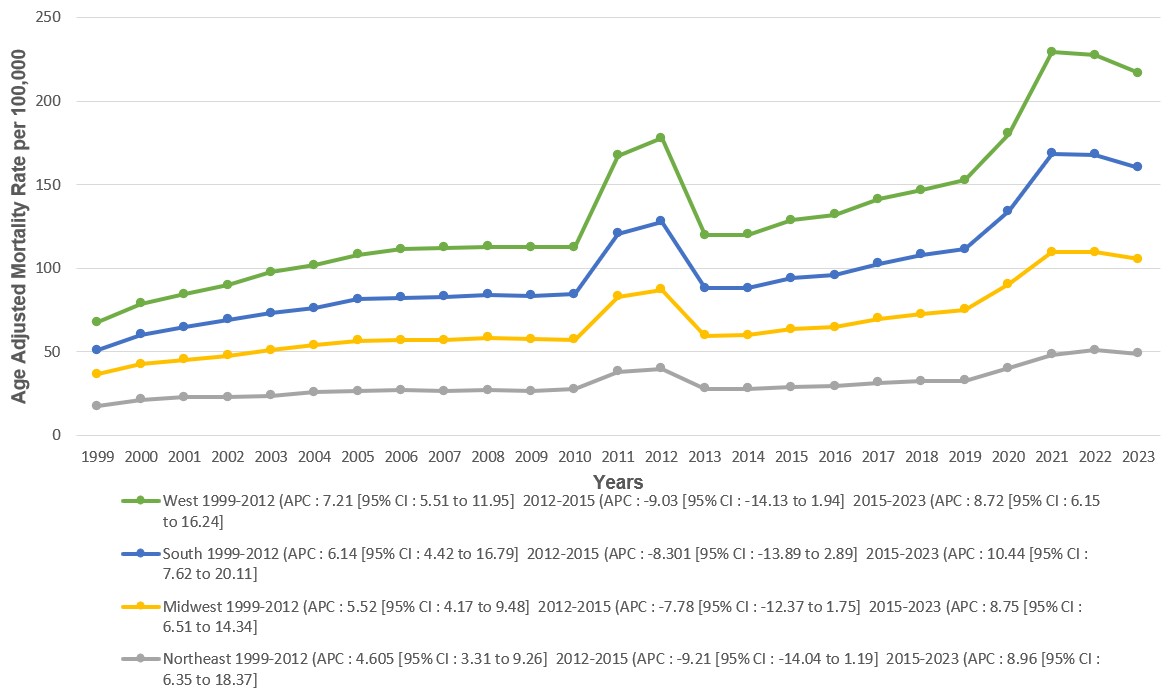
AAMR in the Northeast saw an initial, significant incline, from 17.61 in 1999 to 39.99 in 2012 (APC: 4.61; 95% CI: 3.31 to 9.26; p = 003), followed by a non-significant drop to 28.82 in 2015 (APC: -9.22; 95% CI: -14.05 to 1.19; p = 0.10), and a significant surge, reaching 48.97 in 2023 (APC: 8.96; 95% CI: 6.36 to 18.37; p = 0.005). In the Midwest, AAMR rose sharply and significantly from 19.09 in 1999 to 47.09 in 2012 (APC: 5.52; 95% CI: 4.17 to 9.49; p = 0.002), followed by a non-significant decline to 34.63 in 2015 (APC: -7.78; 95% CI: -12.38 to 1.75; p = 0.14), and a significant rise to 55.54 in 2023 (APC: 8.76; 95% CI: 6.51 to 14.34; p = 0.002).
In the Southern region, AAMR rose significantly from 14.27 in 1999 to 40.9 in 2012 (APC: 6.14; 95% CI: 4.43 to 16.79; p = 0.005), followed by a non-significant drop, reaching 30.71 in 2015 (APC: -8.30; 95% CI: -13.89 to 2.90; p = 0.22), and a significant surge to 54.68 in 2023 (APC: 10.45; 95% CI: 7.63 to 20.12; p = 0.009). The Western region experienced a marked increase in AAMR from 16.79 in 1999 to 49.70 in 2012 (APC: 7.21; 95% CI: 5.51 to 11.96; p = 0.006), followed by a non-significant reduction to 34.49 in 2015 (APC: -9.03; 95% CI: -14.14 to 1.95; p = 0.13), and a significant rise to 56.47 in 2023 (APC: 8.72; 95% CI: 6.16 to 16.24; p = 0.002) (Supplemental Tables 3, 6) and Figure 3.
Stratified by Urbanization
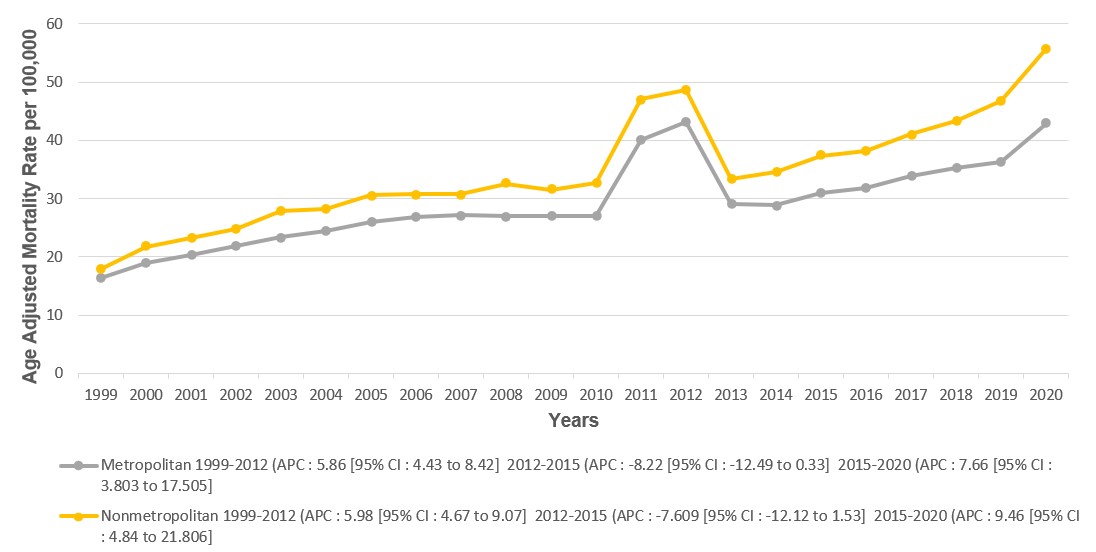
Between 1999 and 2020, metropolitan areas accounted for more deaths (226,486) than non-metropolitan areas (58,353). From 1999 to 2020, both metropolitan and non-metropolitan areas showed an increase in AAMR. AAMR in metropolitan areas rose from 16.35 to 42.89 (AAPC: 4.14; 95% CI: 3.48 to 5.19; p < 0.001), compared to non-metropolitan areas, which increased from 17.95 to 55.66 (AAPC: 4.73; 95% CI: 4.01 to 5.92; p < 0.001). The overall AAMR remained higher in non-metropolitan areas (34.51) relative to metropolitan areas (29.05).
Segmented trend analysis (1999-2020) showed that metropolitan regions experienced a significant increase in AAMR from 16.35 in 1999 to 43.11 in 2012 (APC: 5.86; 95% CI: 4.43 to 8.42; p = 0.010), followed by a non-significant decrease to 30.99 in 2015 (APC: -8.22; 95% CI: -12.49 to 0.33; p = 0.05), and a significant rise to 42.89 in 2020 (APC: 7.66; 95% CI: 3.80 to 17.51; p = 0.001). In non-metropolitan areas, AAMR rose significantly from 17.95 in 1999 to 48.68 in 2012 (APC: 5.98; 95% CI: 4.67 to 9.08; p = 0.012), followed by a non-significant drop to 37.34 in 2015 (APC: -7.61; 95% CI: -12.12 to 1.53; p = 0.09), and a significant surge, reaching 55.66 in 2020 (APC: 9.46; 95% CI: 4.85 to 21.81; p < 0.001) (Supplemental Tables 3, 7) and Figure 4.
Discussion
This 25-year nationwide study has shown a dramatic increase in mortality with the co-occurrence of AF and renal disease mentioned on the death certificate in the United States. The AAMR increased by more than 3 times over the 25 years of this study. Overall, males had higher AAMR than females; however, females showed a steeper increase in AAMR over the same period. There were race-related patterns in mortality, with mortality being highest for NH Whites, yet steeply increasing AAMR trends were noted among Black, Hispanic, and Asian individuals as well. Increases in AAMR were highest in the Northeast, while more deaths occurred in the South. Non-metropolitan areas had higher AAMR than metropolitan areas for the entire period. Most of the deaths occurred in medical facilities; hospice had the lowest proportion of deaths. Across all subgroups, a recurring pattern of a sharp rise until 2012, followed by a temporary dip and a subsequent surge post-2015, was consistently observed, underscoring a growing and disproportionate mortality burden in this dual-disease population.
A sex-stratified analysis reveals a paradoxical yet well-established phenomenon: men have higher AAMRs, but the increase in AAMR is steeper in women. In the literature, it is recognized that AF in women has historically been underdiagnosed, and it tends to have a higher stroke risk, more symptomatic burden, and potentially delayed rhythm control therapy [18,19,20,21]. This may help contextualize the observed steeper rise in mortality among women, suggesting potential gaps in recognition and management of AF in this subgroup that warrant further study. The present findings parallel reports that suggest a diagnostic gap in AF and renal disease care, especially for CKD, based on gender. There was a notable difference in the timing of the mortality peak: women had an earlier peak (1999 - 2012) than men (1999 - 2012), suggesting earlier progression or poorer health-seeking behavior [22,23]. The second phase of acceleration (2015 -2023) aligns with national principal trends of diminishing gains in cardiovascular mortality, particularly affecting women with comorbidities [24].
Racial differences in AAMR were observed, with NH White people having the highest AF-associated renal mortality consistently over time, followed by NH Black and Hispanic people. Nonetheless, the steepest increases in AAMR were observed across all races, especially among NH Black and Hispanic people in the 2015 or later timeframe. These patterns may reflect broader structural and healthcare disparities that influence disease recognition, documentation, and outcomes, though mechanistic explanations remain speculative and untested in this dataset [25,26]. AF has been historically underreported in Black individuals because of diagnostic bias and lower AF awareness. Still, new, larger population-based cohort studies demonstrate an increasing presentation with worse outcomes in Black renal disease cohorts [27,28,26]. Additionally, the variation in Hispanic and Asian/Pacific Islander AAMRs—evidenced by a collateral rise, decline, and resurgence—likely signifies instability within the health system.
Geographically, the Southern U.S. reported the most deaths, while the Northeast had the highest AAMR. The Northeast’s higher AAMR may reflect underlying demographic age structure, regional differences in healthcare utilization, or variation in death certificate reporting practices. Meanwhile, the trends in the Midwest and the West were more intermediate. Interestingly, all regions showed a decline in 2012–2015, followed by a pickup that most likely coincides with national shifts in ICD coding practice and evolving renal disease management guidelines. The sharp AAMR increase in the West may also reflect regional variation in ICD-10 coding accuracy, cardiology workforce availability, or adoption of state-level quality initiatives that influence disease documentation [29,30,31].
As shown, although the absolute deaths occurred in metropolitan regions, AAMRs were significantly higher in non-metropolitan regions. It is important to note that urbanization data in CDC WONDER is available only through 2020; thus, urban–rural comparisons do not extend into the post-pandemic era. Fewer specialists, delayed presentation of conditions, and a greater burden of comorbidities among rural populations may explain some of the differences [32,33,34]. While telehealth expansion during COVID-19 was intended to reduce rural care disparities, our data extend only through 2020 and do not capture pandemic-era implementation or its effects on AF care delivery. Therefore, any telehealth-related inferences must be interpreted with caution [35]. Interpretation of mortality trends after 2019 should be approached cautiously, given the potential influence of COVID-era disruptions in death certification and coding practices. During 2020–2021, competing mortality risks, strained healthcare access, and changes in cause-of-death attribution may have impacted the observed data. Additionally, shifts in ICD-10 coding guidance and COVID comorbidity reporting could artifactually influence the attribution of AF or renal disease.
The place-of-death analyses demonstrated that over half of the renal deaths attributed to AF were in medical facilities and fewer at home, or through hospice, which may reflect limited access to palliative care pathways. However, under-recording of hospice enrollment and selection effects in documentation likely contribute as well [36,37]. However, low hospice utilization may also reflect structural and clinical constraints beyond access barriers. Prognostication in AF with CKD is often uncertain, complicating eligibility for hospice, which requires a six-month life expectancy. Medicare regulations discourage concurrent dialysis and hospice care, limiting enrollment for ESRD patients who choose to continue dialysis. Additionally, many patients receive palliative care in nursing homes without a formal hospice designation. Thus, the low hospice proportion may partly reflect systemic limitations in eligibility and care models. Past research shows that patients with AF and CKD frequently miss out on hospice referrals because they are often too complicated based on medication and unplanned rehospitalization needs [38,39]. This highlights the need for early discussions at the end-of-life, particularly as slowing, progressive kidney disease is common in older adults who are also experiencing overall declining functional status.
Strengths and Limitations
This analysis used 25 years of nationally representative mortality data, providing a complete, stratified, geographically contextualized understanding of AF-related renal mortality, unlike previous studies that have either explored CKD or AF in isolation. This dual-disease perspective, including all the renal diseases along with AF, has unearthed rich, real-world mortality patterns across gender, race, region, and urbanization. The level of detail from the joinpoint regression has yielded valuable insights into inflection points that would be obscured in linear analyses. In addition, this research fills important epidemiologic gaps by reporting underrecognized disparities in minority and rural populations with renal diseases and CVD, highlighting how systemic inequities may intersect with disease-specific risk.
As a retrospective review of the data available from CDC WONDER, this research is limited to the inherent limitations of death certificate reporting, the potential for misclassifying individuals based on their death records, and the absence of patient-level clinical detail (e.g., disease trajectory, type of AF (paroxysmal vs permanent), and treatment variables (e.g., dialysis, anticoagulation). The research design cannot establish causation due to its ecological and retrospective nature, nor can it account for competing risks from other cardiovascular comorbidities. Urbanization data was only available until 2020, and race/ethnicity classification may lack granularity to account for multiracial populations. In addition, the study protocol did not examine intermediate outcomes, such as hospitalization or arrhythmia burden, that might enable a richer mechanistic understanding of the renal disease’s implications for mortality in CVD populations. The study protocol was vulnerable to the ecological fallacy, and results cannot substitute longitudinal cohort or randomized trial data. Still, these findings represent an exciting first step towards further prospective study and targeted interventions.
Another limitation is the inability to differentiate between AKI, CKD, and ESRD using the ICD-10 codes, which introduces heterogeneity within the renal population. Changes in dialysis practices—such as expanded access, revised initiation thresholds, increased use of home and peritoneal dialysis, and conservative kidney management—have evolved significantly over 25 years and may confound temporal trends in mortality. These shifting practices may influence both disease trajectory and how renal disease is recorded on death certificates, affecting the interpretation of AF-related mortality patterns.
Additional limitations include the inability to differentiate between the underlying cause and any-mention coding of AF and renal disease, which could influence the interpretation of mortality attribution. Race and ethnicity data on death certificates are subject to misclassification, especially among Hispanic, Asian, and multiracial individuals. The ICD-10 code N28.9, included in this study, is a non-specific renal diagnostic code and may lack clinical precision. The dataset relies on bridged-race methodology, which may obscure within-group heterogeneity. Importantly, treatment-related variables such as anticoagulation use, dialysis modality, or rhythm control strategies are unmeasured, and COVID-era deaths may not be directly comparable due to shifts in coding and care patterns during the pandemic.
Clinical implications and future directions
The steady rise in mortality due to AF and renal disease suggests the need for a unified care model that addresses the seamless transition of patient care from nephrologists to cardiologists, that addresses early diagnosis, anticoagulation appropriateness, and rhythm control focused on symptoms [40,41]. Palliative care integration for late-stage renal disease with AF should also be prioritized to align end-of-life care and access to hospice better, and patients should be fast-tracked to guidelines that recognize the complexities of AF across all renal disease populations, particularly when considering bleeding risks and the burden of any underlying arrhythmia [42,43]. Future research should explore the impact of emerging therapies—such as non-vitamin K antagonist oral anticoagulants in CKD or catheter ablation strategies in ESRD—on outcomes in this high-risk population, as these treatments could modify risk but are not captured in mortality data [44]. Finally, qualitative research exploring barriers to hospice access and to shared decision-making in patients with AF and renal disease is needed to improve health equity [45,46].
Secular Trends in Detection and Documentation
When interpreting the observed rise in AF mortality, it is important to consider secular changes in diagnostic and documentation practices throughout the study period. After the shift to ICD-10 coding around 1999, there were numerous Centers for Medicare & Medicaid Services (CMS) initiatives in the 2011-2012 time frame aimed at increasing chronic comorbidity capture for reimbursement and risk adjustment, and some of the changes observed during this period may be due to those efforts [47]. Detection of AF also significantly improved during the study period due to the introduction of electronic health record (EHR)- triggered alerts and alerts from implantable cardiac monitors, point-of-care ECGs, and consumer-use wearables. These innovations led to improved detection sensitivity, and detection rather than increased incidence may have contributed to the perceived increase in morbidity and severity [48]. CKD detection and staging also changed during the study window due to standardized CKD staging (KDIGO 2002 and 2012 updates) and earlier detection, increasing the likelihood that renal disease would be identified as a contributing cause on death certificates [49]. Lastly, a national effort to improve death certificate completion and education of physicians regarding completing the death certificate and documenting “coexisting conditions” such as AF and CKD, may have improved the identification of these conditions as being present at the time of death. Overall, these secular changes in practice indicate that some of the rise in atrial fibrillation-associated renal mortality in the United States may be due to improvements in identification and documentation rather than to increased biological or epidemiological factors.
Conclusions
Using a 25-year national dataset, we have demonstrated a concerning rise in AF and renal disease mortality in elderly individuals, with notable disparities based on sex, race, geography, and urbanization. The persistence of adverse mortality trends underscores a growing epidemiological burden among older adults with coexisting AF and renal disease. These findings call for targeted, prospective studies, particularly those linked to clinical registries, to better understand treatment patterns, disease trajectories, and opportunities for equitable intervention in this high-risk population.
Conflicts of Interest
The authors declare no competing interests that could have influenced the objectivity or outcome of this research.
Funding Source
No financial support was received for the study.
Acknowledgments
None.
Institutional Review Board (IRB)
No ethical approval was required for the study.
Large Language Model
None.
Authors Contribution
MFH and AAI contributed to conceptualization, writing-original draft, and writing-review & editing. MRS, AG, and MH contributed to formal analysis and writing-original draft. MRF contributed to data curation and writing-original draft. MT contributed to formal analysis. KP contributed to data extraction and data curation. NH, MS, and ES contributed to writing-original draft. AA and MFA contributed to writing-review & editing. AA contributed to writing-review & editing. AMA and RA contributed to writing-review & editing, validation, and supervision.
Data Availability
The data that support the findings of this study are openly available in CDC‐WONDER at https://wonder.cdc.gov/. The data supporting the findings of this study were obtained from the CDC WONDER online database (Centers for Disease Control and Prevention Wide‐ranging Online Data for Epidemiologic Research). Further inquiries can be directed to the corresponding author.
References
- Chen T. H., Chu Y. C., Ou S. M., Tarng D. C.. Associations of atrial fibrillation with renal function decline in patients with chronic kidney disease. Heart. 2022;108(6):438-444. doi:10.1136/heartjnl-2021-319297 PMID: 34193464
- Lau Y. C., Proietti M., Guiducci E., Blann A. D., Lip G. Y. H.. Atrial Fibrillation and Thromboembolism in Patients With Chronic Kidney Disease. J Am Coll Cardiol. 2016;68(13):1452-1464. doi:10.1016/j.jacc.2016.06.057 PMID: 27659468
- Centers for Disease Control and Prevention. CDC Surveillance System: Trends in Incidence Rate of Acute Kidney Injury by Diagnosis Code.
- Centers for Disease Control and Prevention. Chronic Kidney Disease in the United States, 2023. 2024.
- Centers for Disease Control and Prevention. About atrial fibrillation. 2024.
- Kiuchi M. G.. Atrial fibrillation and chronic kidney disease: A bad combination. Kidney Res Clin Pract. 2018;37(2):103-105. doi:10.23876/j.krcp.2018.37.2.103 PMID: 29971204 PMCID: PMC6027811
- Thomas L., Abhayaratna W. P.. Left Atrial Reverse Remodeling: Mechanisms, Evaluation, and Clinical Significance. JACC Cardiovasc Imaging. 2017;10(1):65-77. doi:10.1016/j.jcmg.2016.11.003 PMID: 28057220
- Chu C. D., Powe N. R., McCulloch C. E., Crews D. C., Han Y., Bragg-Gresham J. L., Saran R., Koyama A., Burrows N. R., Tuot D. S., Centers for Disease Control and Prevention Chronic Kidney Disease Surveillance Team. Trends in Chronic Kidney Disease Care in the US by Race and Ethnicity, 2012-2019. JAMA Netw Open. 2021;4(9):e2127014. doi:10.1001/jamanetworkopen.2021.27014 PMID: 34570204 PMCID: PMC8477264
- Miller C. E., Vasan R. S.. The southern rural health and mortality penalty: A review of regional health inequities in the United States. Soc Sci Med. 2021;268:113443. doi:10.1016/j.socscimed.2020.113443 PMID: 33137680 PMCID: PMC7755690
- Ahmad O., Farooqi H. A., Ahmed I., Jamil A., Nabi R., Ullah I., Khan A. W., Ahmed R., Alam M., Cortese B., Mamas M. A.. Temporal Trends in Mortality Related to Stroke and Atrial Fibrillation in the United States: A 21-Year Retrospective Analysis of CDC-WONDER Database. Clin Cardiol. 2024;47(12):e70058. doi:10.1002/clc.70058 PMID: 39679968 PMCID: PMC11648035
- Faheem M. S. B., Masood M. B., Rehman A., Cheema S., Mughal Hmka, Ahmed F., Abbasi M. A., Ali S. I., Rashid I.. Mortality trends of renal diseases due to hypertension in adults: an analysis of gender, race, place of death, and geographical disparities in the United States from 1999 to 2020. Int Urol Nephrol. 2025;57(9):2995-3008. doi:10.1007/s11255-025-04493-3 PMID: 40183882
- Hemida Mohamed Fawzi, Ibrahim Alyaa Ahmed, Goel Anika, Hussein Mirna, Patel Krish, Sarfraz Muhammad Raza, Alkasabrah Omar Y., Saghir Maryam, Karmani Komal, Saghir Eshal, Shahriar Zahin, Fawzi Safeya, Bahnasy Ahmed, Ali Muhammad Faizan, Ali Amro, Abdelkhalek Ahmad M., Ahmed Raheel. Twenty-Five Years of Angina–Related Mortality in Elderly Adults Aged ≥ 65 Years: A Retrospective Cohort Study Using Real-World Data from the USA. ASIDE Internal Medicine. 2025;2(3):33-42. doi:10.71079/aside.Im.110925248
- Hemida M. F., Ibrahim A. A., Shahriar Z., Khalid M., Zeeshan N., Qaisi W., Hussein M., Sarfraz M. R., Rabie O. M., Saghir M., Saghir E., Jalal A. A., Alagamy M., Tabasum P., Ahmed R.. Mortality trends in multiple sclerosis and cardiovascular disease in adults in the United States: A 25-year mortality perspective. Mult Scler Relat Disord. 2025;105:106861. doi:10.1016/j.msard.2025.106861 PMID: 41308235
- von Elm E., Altman D. G., Egger M., Pocock S. J., Gotzsche P. C., Vandenbroucke J. P., STROBE Initiative. The Strengthening the Reporting of Observational Studies in Epidemiology (STROBE) statement: guidelines for reporting observational studies. J Clin Epidemiol. 2008;61(4):344-9. doi:10.1016/j.jclinepi.2007.11.008 PMID: 18313558
- Aggarwal R., Chiu N., Loccoh E. C., Kazi D. S., Yeh R. W., Wadhera R. K.. Rural-Urban Disparities: Diabetes, Hypertension, Heart Disease, and Stroke Mortality Among Black and White Adults, 1999-2018. J Am Coll Cardiol. 2021;77(11):1480-1481. doi:10.1016/j.jacc.2021.01.032 PMID: 33736831 PMCID: PMC8210746
- Ingram D. D., Franco S. J.. 2013 NCHS Urban-Rural Classification Scheme for Counties. Vital Health Stat 2. 2014:1-73. PMID: 24776070
- Anderson R. N., Rosenberg H. M.. Age standardization of death rates: implementation of the year 2000 standard. Natl Vital Stat Rep. 1998;47(3):1-16, 20. PMID: 9796247
- Ko D., Rahman F., Martins M. A., Hylek E. M., Ellinor P. T., Schnabel R. B., Benjamin E. J., Christophersen I. E.. Atrial fibrillation in women: treatment. Nat Rev Cardiol. 2017;14(2):113-124. doi:10.1038/nrcardio.2016.171 PMID: 27786235 PMCID: PMC5520636
- Passman R. S.. Sex, Symptoms, and Atrial Fibrillation. JAMA Cardiol. 2016;1(3):292-3. doi:10.1001/jamacardio.2016.0545 PMID: 27438107
- Prabakaran S., Gongora Nieto M. C., Lundberg G.. Atrial Fibrillation in Women: Risks and Management. J Womens Health (Larchmt). 2018;27(1):107-114. doi:10.1089/jwh.2016.6282 PMID: 29028452
- Volgman A. S., Benjamin E. J., Curtis A. B., Fang M. C., Lindley K. J., Naccarelli G. V., Pepine C. J., Quesada O., Vaseghi M., Waldo A. L., Wenger N. K., Russo A. M., American College of Cardiology Committee on Cardiovascular Disease in Women. Women and atrial fibrillation. J Cardiovasc Electrophysiol. 2021;32(10):2793-2807. doi:10.1111/jce.14838 PMID: 33332669 PMCID: PMC8281363
- Carrero J. J., Hecking M., Chesnaye N. C., Jager K. J.. Sex and gender disparities in the epidemiology and outcomes of chronic kidney disease. Nat Rev Nephrol. 2018;14(3):151-164. doi:10.1038/nrneph.2017.181 PMID: 29355169
- Swartling O., Yang Y., Clase C. M., Fu E. L., Hecking M., Hodlmoser S., Trolle-Lagerros Y., Evans M., Carrero J. J.. Sex Differences in the Recognition, Monitoring, and Management of CKD in Health Care: An Observational Cohort Study. J Am Soc Nephrol. 2022;33(10):1903-1914. doi:10.1681/ASN.2022030373 PMID: 35906075 PMCID: PMC9528319
- Lindley K. J.. Call for Action to Address Increasing Maternal Cardiovascular Mortality in the United States: Strategies for Improving Maternal Cardiovascular Care. Circulation. 2022;145(7):502-504. doi:10.1161/CIRCULATIONAHA.122.058772 PMID: 35157515
- Jackson Ii L. R., Friedman D. J., Francis D. M., Maccioni S., Thomas V. C., Coplan P., Khanna R., Wong C., Rahai N., Piccini J. P.. Race and Ethnic and Sex Differences in Rhythm Control Treatment of Incident Atrial Fibrillation. Clinicoecon Outcomes Res. 2023;15:387-395. doi:10.2147/CEOR.S402344 PMID: 37273820 PMCID: PMC10237629
- Nanda A., Kabra R.. Racial Differences in Atrial Fibrillation Epidemiology, Management, and Outcomes. Curr Treat Options Cardiovasc Med. 2019;21(12):85. doi:10.1007/s11936-019-0793-5 PMID: 31820122
- Ayinde H., Markson F., Ogbenna U. K., Jackson L., 2nd. Addressing racial differences in the management of atrial fibrillation: Focus on black patients. J Natl Med Assoc. 2024;116(5):490-498. doi:10.1016/j.jnma.2023.11.007 PMID: 38114334
- Baber U., Howard V. J., Halperin J. L., Soliman E. Z., Zhang X., McClellan W., Warnock D. G., Muntner P.. Association of chronic kidney disease with atrial fibrillation among adults in the United States: REasons for Geographic and Racial Differences in Stroke (REGARDS) Study. Circ Arrhythm Electrophysiol. 2011;4(1):26-32. doi:10.1161/CIRCEP.110.957100 PMID: 21076159 PMCID: PMC3049935
- Deering T. F., Reiffel J. A., Solomon A. J., Tamirisa K. P.. Chapter 1: The Evolving Atrial Fibrillation Landscape: Importance of Early Diagnosis and Treatment. Am J Cardiol. 2023;205 Suppl 1:S4-S6. doi:10.1016/j.amjcard.2023.08.027 PMID: 37777297
- Lip G. Y., Kakar P., Watson T.. Atrial fibrillation–the growing epidemic. Heart. 2007;93(5):542-3. doi:10.1136/hrt.2006.110791 PMID: 17435064 PMCID: PMC1955544
- Otto C. M.. Heartbeat: Healthcare approaches to reducing adverse outcomes in patients with atrial fibrillation. Heart. 2017;103(24):1925-1927. doi:10.1136/heartjnl-2017-312538 PMID: 29180520
- Brod C., Groth N., Rudeck M., Artang R., Rioux M., Benziger C.. Oral anticoagulation use in non-valvular atrial fibrillation patients in rural setting. Am J Med Open. 2023;9:100026. doi:10.1016/j.ajmo.2022.100026 PMID: 39035056 PMCID: PMC11256238
- Deguchi I., Osada T., Arai N., Takahashi S.. Differences in oral anticoagulant prescriptions between specialists and non-specialists in patients with cardioembolic stroke caused by non-valvular atrial fibrillation. Heart Vessels. 2022;37(5):867-874. doi:10.1007/s00380-021-01984-y PMID: 34797401
- Norby F. L., Lutsey P. L., Shippee N. D., Chen L. Y., Henning-Smith C., Alonso A., Walker R. F., Folsom A. R.. Direct Oral Anticoagulants and Warfarin for Atrial Fibrillation Treatment: Rural and Urban Trends in Medicare Beneficiaries. Am J Cardiovasc Drugs. 2022;22(2):207-217. doi:10.1007/s40256-021-00502-9 PMID: 34633646 PMCID: PMC9833644
- Bin Abdul Baten R., Zohora F. T., Siddiqui M. U. H.. Disparities in telehealth utilization between US rural and urban areas during the COVID-19 pandemic. J Rural Health. 2025;41(1):e12910. doi:10.1111/jrh.12910 PMID: 39722428
- Brown E. A.. Epidemiology of renal palliative care. J Palliat Med. 2007;10(6):1248-52. doi:10.1089/jpm.2007.0033 PMID: 18095800
- Holley J. L.. Palliative care in end-stage renal disease: focus on advance care planning, hospice referral, and bereavement. Semin Dial. 2005;18(2):154-6. doi:10.1111/j.1525-139X.2005.18208.x PMID: 15771661
- Sturgill D., Bear A.. Unique palliative care needs of patients with advanced chronic kidney disease - the scope of the problem and several solutions. Clin Med (Lond). 2019;19(1):26-29. doi:10.7861/clinmedicine.19-1-26 PMID: 30651241 PMCID: PMC6399628
- Tapoi L., Ureche C., Sascau R., Badarau S., Covic A.. Atrial fibrillation and chronic kidney disease conundrum: an update. J Nephrol. 2019;32(6):909-917. doi:10.1007/s40620-019-00630-1 PMID: 31321745
- Law Mandy M., Wong Michael C. G., Morton Joseph B.. Atrial Fibrillation: More Than a Subclinical Problem in Patients on Hemodialysis. Kidney International Reports. 2022;7(2):141-143. doi:10.1016/j.ekir.2021.11.023
- Mark P. B., Vecchio L. D., Valdivielso J. M., Malyszko J.. Same rhythm, different song-approaches to atrial fibrillation management by cardiologists and nephrologists. Clin Kidney J. 2021;14(1):9-13. doi:10.1093/ckj/sfaa146 PMID: 33564401 PMCID: PMC7857826
- Khanna Smriti, Khanna Umesh. Palliative Care in Advanced Kidney Disease: The Approach for a Nephrologist. Indian Journal of Kidney Diseases. 2024;3(3):74-77. doi:10.4103/ijkd.ijkd_15_24
- Lam D. Y., Scherer J. S., Brown M., Grubbs V., Schell J. O.. A Conceptual Framework of Palliative Care across the Continuum of Advanced Kidney Disease. Clin J Am Soc Nephrol. 2019;14(4):635-641. doi:10.2215/CJN.09330818 PMID: 30728167 PMCID: PMC6450347
- Kee Youn Kyung, Jeon Hee Jung, Oh Jieun, Yoo Tae-Hyn, Kang Dongwoo, lee Jungkuk, Shin Dong Ho. 2022. doi:10.21203/rs.3.rs-1706182/v1
- O'Riordan J., Noble H., Kane P. M., Smyth A.. Advance care plan barriers in older patients with end-stage renal disease: a qualitative nephrologist interview study. BMJ Support Palliat Care. 2020;10(4):e39. doi:10.1136/bmjspcare-2018-001759 PMID: 31239255
- Shi Y., Li W., Duan F., Pu S., Peng H., Ha M., Luo Y.. Factors promoting shared decision-making in renal replacement therapy for patients with end-stage kidney disease: systematic review and qualitative meta-synthesis. Int Urol Nephrol. 2022;54(3):553-574. doi:10.1007/s11255-021-02913-8 PMID: 34159522 PMCID: PMC8831292
- Jain V., Rao B., Quintero E., Shah A. D., Merchant F. M., El-Chami M. F., Bhatia N., Westerman S., Lloyd M. S.. Trends and Disparities in Atrial Fibrillation and Stroke Related Mortality in the United States from 1999 to 2020. Pacing Clin Electrophysiol. 2025;48(2):280-283. doi:10.1111/pace.15111 PMID: 39603815
- Santala O. E., Lipponen J. A., Jantti H., Rissanen T. T., Tarvainen M. P., Valiaho E. S., Rantula O. A., Naukkarinen N. S., Hartikainen J. E. K., Martikainen T. J., Halonen J.. Novel Technologies in the Detection of Atrial Fibrillation: Review of Literature and Comparison of Different Novel Technologies for Screening of Atrial Fibrillation. Cardiol Rev. 2024;32(5):440-447. doi:10.1097/CRD.0000000000000526 PMID: 36946975 PMCID: PMC11296284
- Kovesdy C. P.. Epidemiology of chronic kidney disease: an update 2022. Kidney Int Suppl (2011). 2022;12(1):7-11. doi:10.1016/j.kisu.2021.11.003 PMID: 35529086 PMCID: PMC9073222