Cardiogenic Shock and Sepsis-Related Mortality in the United States, 1999-2025: National Trends, Disparities, and Forecasts to 2040
Karim Othman AbdelnaimⒾ1, Alaa EldeebⒾ2, Alyaa Ahmed IbrahimⒾ2, Raveen MujeebⒾ3, Mohammad Rayyan FaisalⒾ3, Amro AliⒾ4*, Salem QuppⒾ5, Bassam HegazyⒾ2, Amr IbrahimⒾ6, Ibtissam ElGhazzaniⒾ7, Mohamed ZabadyⒾ2, Sihame ElGhazzaniⒾ7, Walid BechibchiⒾ8, Ilhame ElGhazzaniⒾ9, Mahdi AhmedⒾ10, Abdelrhman H. MohamedⒾ11, Mohamed Fawzi HemidaⒾ2
- 1Faculty of Medicine, Ain Shams University, Cairo, Egypt
- 2Faculty of Medicine, Alexandria University, Alexandria, Egypt
- 3Department of Medicine, Dow University of Health Sciences, Karachi, Pakistan
- 4Department of Medicine, Community Regional Medical Center, Fresno, CA, USA
- 5Faculty of Medicine, Al-Quds University, Jerusalem, Palestine
- 6Faculty of Medicine, Monoufia University, Monoufia, Egypt
- 7Faculty of Medicine of Tunis, University of Tunis, Tunis, Tunisia
- 8Faculty of Medicine, University of Constantine 3, Constantine, Algeria
- 9Faculty of Medicine, University of Sfax, Sfax, Tunisia
- 10Faculty of Medicine, Kafr El Sheikh University, Kafr El Sheikh, Egypt
- 11Faculty of Medicine, Luxor University, Luxor, Egypt
Abstract
Background: Cardiogenic shock (CS) complicated by sepsis is a life-threatening condition marked by circulatory collapse and systemic inflammation, with persistently high mortality despite critical care advances. National trends and disparities remain unclear. This study aimed to evaluate temporal mortality trends from 1999 to 2025 and project rates through 2040.
Methods: We conducted a population-based study using U.S. mortality data (1999–2025) from the CDC WONDER database. Deaths among adults aged ≥25 years with CS and sepsis were identified using ICD-10 codes. Age-adjusted mortality rates (AAMRs) per 100,000 were calculated. Joinpoint regression estimated annual percent change (APC) and average annual percent change (AAPC). Forecasting models projected mortality trends through 2040.
Results: From 1999 to 2025, 71,726 deaths occurred; 97.09% in medical facilities. Overall, AAMR rose from 0.65 to 2.16 (AAPC 5.01%, p < 0.001) and is projected to reach 3.62 by 2040. Men had higher mortality than women (2025: 2.78 vs 1.65; AAPC 5.06% vs 4.91%). In 2025, AAMR was 3.75 among NH Black individuals, 1.98 among NH White individuals, and 2.01 among Hispanic individuals. Adults ≥65 years had the highest CMR (7.50 in 2025; AAPC 4.63%), with the largest relative increase in ages 25–44 (AAPC 7.19%).
Conclusion: CS with sepsis mortality increased significantly from 1999 to 2025, particularly among men, NH Black individuals, and adults ≥65 years. Although recent trends have stabilized, projections indicate continued increases through 2040, highlighting persistent and widening demographic disparities in the mortality burden.
Keywords: Cardiogenic shock, Sepsis, Mortality trends, Age-adjusted mortality rate, Health disparities
Article information
Introduction
Cardiogenic shock (CS) is a severe and life-threatening syndrome that arises from a primary cardiovascular disorder. It leads to tissue hypoperfusion with potential progression to multi-organ failure and death. CS has an early mortality rate of more than 50% [1,2]. Sepsis, as defined by the Third International Consensus (Sepsis-3), is a life-threatening organ dysfunction that arises from a dysregulated immune response to an infection [3]. It affects nearly 1.7 million adults in the United States, making it one of the leading causes of death [4].
The relationship between CS and sepsis is bidirectional. CS can precipitate sepsis through impaired immune function and intestinal ischemia, leading to bacterial translocation [5]. Sepsis can frequently be found in patients with cardiogenic shock, with 15-20% of CS patients having it. This was found to significantly increase mortality [2]. One study from the Mayo Clinic has reported that 15% of all shock patients in the Cardiac Intensive Care Unit (CICU) from 2007 to 2018 had concurrent CS and sepsis, with this group of patients exhibiting higher severity, more advanced shock, and poorer survival [6].
Sepsis can contribute to CS and myocardial dysfunction through various mechanisms, including acute changes in loading conditions, myocardial ischemia, and the toxic effects of proinflammatory cytokines on the myocardium, coronary microcirculation, and endothelium [5,7]. An analysis of the National Inpatient Sample (NIS), which is a nationwide repository of hospital inpatient discharge data in the U.S., reported an estimated 5 million sepsis hospitalizations in the period between 2017 and 2019. Of those, one million had septic shock. Within these patients, cardiogenic shock was identified in 0.3% of patients with sepsis and 4.6% of those with septic shock. The presence of CS was associated with an increase in in-hospital mortality [8].
Despite the clinical significance of this interaction, national data describing trends and demographic disparities remain limited. Given the constraints of available datasets, we focused our analysis on mortality trends and disparities in CS and sepsis across demographic factors in the United States from 1999 to 2025. Specifically, we examined deaths in which both CS and sepsis were listed, as these provide a population-level proxy for the co-occurrence of these critical conditions.
Methods
Study Design and Population
We conducted a retrospective analysis using death certificate data retrieved from the Centers for Disease Control and Prevention Wide-Ranging Online Data for Epidemiologic Research (CDC WONDER) database. Data for adults aged 25 and older from 1999 to 2025 were analyzed to assess mortality from CS and sepsis in the U.S. This age cutoff has been used to define adults in a previous study [9]. Restricting to ≥25 improves robustness and reliability of estimates. The International Statistical Classification of Diseases and Related Health Problems-10th Revision (ICD-10) was used as follows: R57.0 for CS and A40-41 for sepsis. Deaths were included if CS and sepsis were listed anywhere on the death certificate, either as underlying causes or contributing causes of death. This comprehensive approach ensures the capture of all deaths where both conditions played documented roles, regardless of their position on the death certificate. Institutional review board approval was not required for this study because it used de-identified public-use data provided by the government and adhered to the STROBE (Strengthening the Reporting of Observational Studies in Epidemiology) guidelines for reporting [10].
Data Abstraction
Data on population size and demographics, including sex, age, and race, were extracted. The place of death was categorized into medical facilities, hospice, home, and nursing home/long-term care facilities. Racial and ethnic categories were classified as non-Hispanic (NH) Black or African American, NH White, and Hispanic or Latino. NH American Indian or Alaska Native and NH Asian or Pacific Islander were excluded from the trend analysis due to small numbers and data suppression. In accordance with CDC-WONDER database policies, death counts <10 are suppressed to protect confidentiality. Consequently, suppressed data were treated as missing and excluded from analysis. Age groups were divided into 3 groups: (25 – 44, 45 – 64, and ≥65 years).
Data suppression due to counts <10 did not affect any of the final analytical strata (sex, including racial/ethnic groups, and age groups) presented in this study; suppression exclusively applied to the NH American Indian or Alaskan Native and NH Asian or Pacific Islander categories, which were consequently excluded from the trend analysis.
Statistical Analysis
Crude mortality rates (CMRs) and age-adjusted mortality rates (AAMRs) per 100,000 population from 1999 to 2025 by year, sex, and race. Population denominators were derived from U.S. Census Bureau estimates (bridged-race population estimates for 1999 – 2020 and single-race estimates for 2021 – 2025, as dictated by the respective CDC WONDER archives). Age adjustment was performed using the direct standardization method, weighted to the year 2000 U.S. standard population [11]. Furthermore, 95% confidence intervals (CIs) for mortality rates were automatically generated by the CDC WONDER system; this system calculates CIs using a standard normal distribution for death counts of 100 or more, and the Tiwari modification of the gamma distribution for death counts fewer than 100. This standard was used in a previously published paper with the same study design [12]. CMRs were determined by dividing the number of CS and sepsis-related mortalities by the corresponding U.S. population of that year. It’s worth mentioning that CMRs were used exclusively for age-specific analyses, as age adjustment would mask true differences between age groups. For all other variables, AAMRs were calculated to ensure comparability across populations with differing age structures. The Joinpoint Regression Program (Joinpoint V 5.4.0.0, National Cancer Institute) was used to determine the average annual percent change (AAPC) and the annual percent change (APC) with 95% CI in AAMR to quantify national annual trends in CS and sepsis-related mortality. Joinpoint regression, a segmented regression technique, was used to identify points of trend change (join points) by fitting log-linear models and using permutation tests to select the optimal number of join points, thereby ensuring model fit [13]. This method assumes independent observations; we acknowledge that mortality rates across consecutive years may be temporally autocorrelated, which could affect standard errors and the detection of joinpoints. This method allows identification of significant changes in AAMR over time by fitting log-linear regression models where temporal variation occurred. APCs were considered increasing or decreasing if the slope describing the change in mortality differed significantly from zero using two-tailed t-tests. A value of p < 0.05 was considered statistically significant.
Time Series Forecasting and Mortality Projections
Time series models were used to forecast the projected values of AAMRs for CS and mortality rates for sepsis in the United States, using data from 1999 to 2025, and projections for 2026 to 2040. The performance of the models was compared and evaluated for the autoregressive integrated moving average (ARIMA) and exponential smoothing state space (ETS) models. The performance was evaluated based on root mean squared error (RMSE), mean error (ME), and the autocorrelation of residuals at lag 1 (ACF1). In addition, residual diagnostics were performed to evaluate model performance and determine whether the residuals were randomly distributed and normally distributed around zero.
For sex-specific data, the ARIMA model performed better than the ETS model, with lower prediction error and minimal residual autocorrelation. The residuals of the ARIMA model were also randomly distributed and normally distributed around zero. On the other hand, for race- and age-specific data, the ETS models performed better on residual diagnostics, with residuals that were randomly distributed and normally distributed around zero, compared to the ARIMA models.
Results
From 1999 to 2025, 71,726 deaths were reported among adults aged 25 years and older in the United States with CS and sepsis. A minor limitation of our aggregate dataset is a single-death discrepancy between the total overall mortality count (71,726) and the place-of-death sub-stratification (71,725), which is likely due to incomplete categorization on the original death certificate. The majority of deaths occurred in medical facilities (97.09%), followed by nursing homes or long-term care facilities (0.95%), hospice facilities (0.83%), the decedent’s home (0.61%), and other locations (0.34%). For 0.18%, the place of death was unknown (Supplementary Table 1).
Overall Trends
Over the study period, the overall AAMR increased from 0.65 (95% CI: 0.61 to 0.69) in 1999 to 2.16 (95% CI: 2.11 to 2.22) in 2025, with an AAPC of 5.01 (95% CI: 4.64 to 5.43; p < 0.001). The mean AAMR was 1.08 (95% CI: 1.04 to 1.12). The projected mean AAMR is expected to increase to 3.02 (95% CI: 1.74 to 4.30) by 2040.
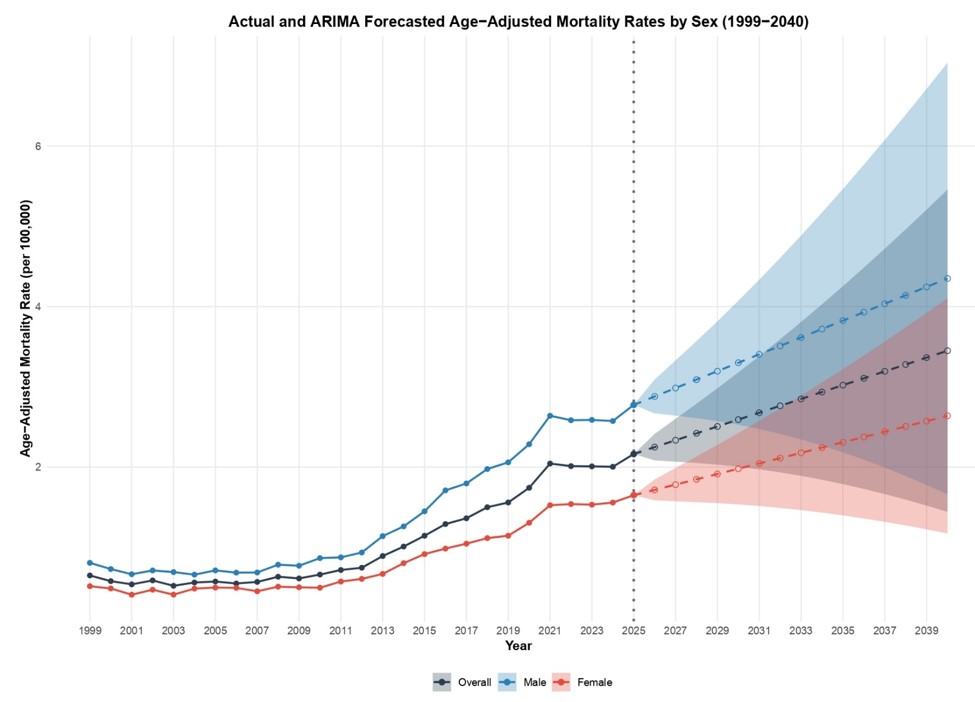
The AAMR trend demonstrated an initial period of stability from 1999 to 2008 (APC: -0.62; 95% CI: -2.58 to 1.09; p = 0.470). This was followed by a significant rise from 2008 to 2021 (APC: 10.23; 95% CI: 9.55 to 11.24; p < 0.001). From 2021 to 2025, the rate showed a slight non-significant increase (APC: 1.52; 95% CI: -1.74 to 3.79; p = 0.209). Forecasts suggest that the overall AAMR for cardiogenic shock with sepsis will rise to 3.62 (95% CI: 1.27 to 5.97) by 2040 Figure 1 and (Supplementary Tables 2 and 5).
Sex-Stratified Trends
During the study period, 41,020 deaths were reported among men and 30,706 among women. Mortality was consistently higher in men than in women. Among men, the AAMR increased from 0.81 (95% CI: 0.74 to 0.87) in 1999 to 2.78 (95% CI: 2.68 to 2.87) in 2025, with a mean AAMR of 1.39 (95% CI: 1.31 to 1.46). Among women, the AAMR rose from 0.52 (95% CI: 0.47 to 0.56) in 1999 to 1.65 (95% CI: 1.59 to 1.72) in 2025, with a mean AAMR of 0.84 (95% CI: 0.79 to 0.89) in females. The trend for both men and women increased from 1999 to 2025 [AAPC: Men: 5.06 (95% CI: 4.70 to 5.48; p < 0.001); AAPC: Women: 4.91 (95% CI: 4.51 to 5.37; p < 0.001)].
Among men, the AAMR showed a non-significant decline from 1999 to 2006 (APC: -1.66; 95% CI: -7.41 to 0.61; p = 0.102), followed by a significant increase from 2006 to 2012 (APC: 6.17; 95% CI: 1.04 to 9.72; p = 0.032). A significant steep rise was observed between 2012 and 2016 (APC: 14.93; 95% CI: 11.63 to 19.15; p < 0.001). Mortality continued to rise significantly from 2016 to 2021 (APC: 8.71; 95% CI: 6.24 to 10.70; p = 0.002), followed by a non-significant increase from 2021 to 2025 (APC: 1.67; 95% CI: -0.93 to 3.23; p =) 0.125). Among women, the AAMR remained relatively stable from 1999 to 2009 (APC: 0.37; 95% CI: -1.70 to 2.02; p = 0.679). A marked increase occurred between 2009 and 2021 (APC: 9.78; 95% CI: 8.93 to 11.36; p < 0.001). From 2021 to 2025, mortality increased modestly but not significantly (APC: 2.30; 95% CI: -1.53 to 4.92; p = 0.169). Projections suggest that the AAMR is expected to reach 2.77 (95% CI: 1.06 to 4.48) among women, and 4.56 (95% CI: 1.41 to 7.71) among men by 2040 Figure 1 and (Supplementary Tables 2 and 5).
Race/Ethnicity Trends
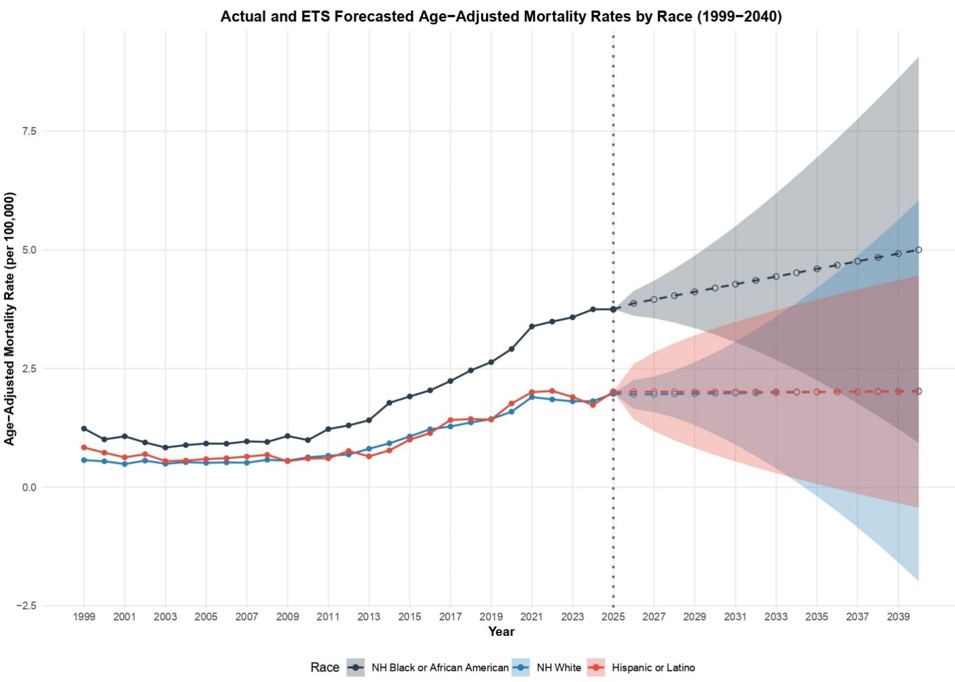
From 1999 to 2025, the AAMR increased across all racial/ethnic groups, rising from 1.24 (95% CI: 1.06 to 1.41) to 3.75 (95% CI: 3.53 to 3.98) among NH Black, 0.57 (95% CI: 0.53 to 0.61) to 1.98 (95% CI: 1.92 to 2.04) among NH White, and 0.84 (95% CI: 0.65 to 1.06) to 2.01 (95% CI: 1.86 to 2.18) among Hispanic. The highest mean AAMR was observed among NH Black (AAMR: 1.84; 95% CI: 1.67 to 2.01), followed by Hispanic (AAMR: 1.05; 95% CI: 0.91 to 1.21) and NH White (AAMR: 1.00; 95% CI: 0.95 to 1.04).
Distinct trends were observed among these groups, with NH White population experiencing the greatest increment, followed by NH Black and Hispanics [NH White: AAPC: 4.96 (95% CI: 4.42 to 5.63; p < 0.001); NH Black: AAPC: 4.53 (95% CI: 4.16 to 4.92; p < 0.001); Hispanic: AAPC: 3.77 (95% CI: 3.09 to 4.64; p < 0.001)].
Among NH Black individuals, the trend showed a significant decline from 1999 to 2003 (APC: -8.44; 95% CI: -13.70 to -4.84; p < 0.001), followed by a significant increase from 2003 to 2010 (APC: 3.63; 95% CI: 0.95 to 6.31; p = 0.014), a sharp rise from 2010 to 2021 (APC: 10.79; 95% CI: 10.13 to 11.85; p < 0.001), and a further significant increase from 2021 to 2025 (APC: 3.25; 95% CI: 0.96 to 4.99; p = 0.012). Among NH White individuals, the AAMR trend remained stable between 1999 and 2008 (APC: -0.46; 95% CI: -4.37 to 2.06; p = 0.657). A significant rise was observed from 2008 to 2021 (APC: 10.16; 95% CI: 9.31 to 12.14; p < 0.001). From 2021 to 2025, mortality increased slightly but not significantly (APC: 1.06; 95% CI: -3.63 to 4.07; p = 0.410). Among Hispanic individuals, the trend showed a slight non-significant decline from 1999 to 2010 (APC: -2.30; 95% CI: -5.59 to 0.41; p = 0.092). Mortality then increased sharply between 2010 and 2021 (APC: 12.17; 95% CI: 10.57 to 15.24; p < 0.001), and remained relatively stable from 2021 to 2025 (APC: -1.13; 95% CI: -6.11 to 2.51; p = 0.514). The projected AAMR is expected to reach 2.01 (95% CI: -0.62 to 4.65) among Hispanics, 5.16 (95% CI: 0.33 to 10.00) among NH Black individuals, and 2.04 (95% CI: -2.84 to 6.93) among NH Whites Figure 2 and (Supplementary Tables 3 and 6).
Age-Specific Trends
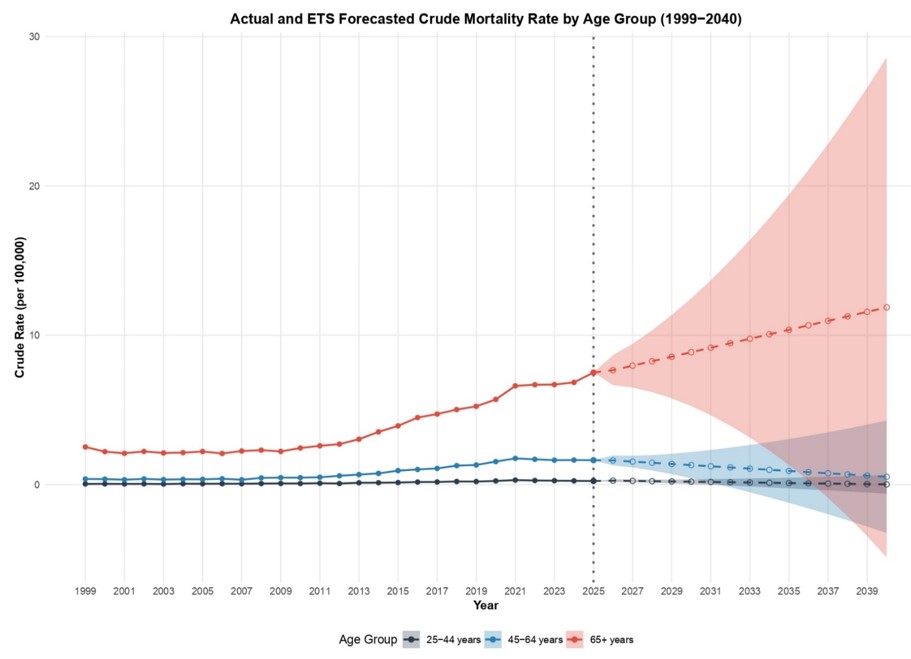
The CMR increased across all age groups between 1999 to 2025, from 0.04 (95% CI: 0.03 to 0.05) to 0.24 (95% CI: 0.21 to 0.27) among adults aged 25-44 years, from 0.37 (95% CI: 0.32 to 0.42) to 1.63 (95% CI: 1.54 to 1.72) among those aged 45-64 years and from 2.52 (95% CI: 2.35 to 2.68) to 7.50 (95% CI: 7.28 to 7.72) among adults aged 65+ years. Adults aged 65+ years had the highest CMR (3.78; 95% CI: 3.61 to 3.95), followed by those aged 45-64 years (0.83; 95% CI: 0.77 to 0.89) and those aged 25-44 years (0.13; 95% CI: 0.11 to 0.15).
Notable trends were observed among all age groups, with adults aged 25-44 years experiencing the largest relative increase, followed by those aged 45-64 years, and 65+ years [25-44 years: AAPC: 7.19 (95% CI: 6.28 to 8.29; p < 0.001); 45-64 years: AAPC: 5.93 (95% CI: 5.41 to 6.65; p < 0.001); 65+ years: AAPC: 4.63 (95% CI: 4.21 to 5.18; p < 0.001)].
Among adults aged 25-44 years, the CMR increased from 1999 to 2007 with a non-significant trend (APC: 3.84; 95% CI: -9.68 to 8.63; p = 0.327). A significant rise occurred between 2007 and 2021 (APC: 12.68; 95% CI: 11.45 to 15.99; p < 0.001), followed by a non-significant decline from 2021 to 2025 (APC: -4.10; 95% CI: -10.03 to 0.20; p = 0.067). For adults aged 45-64 years, mortality remained stable from 1999 to 2007 (APC: -0.43; 95% CI: -4.81 to 2.58; p = 0.737). A substantial increase occurred from 2007 to 2021 (APC: 12.09; 95% CI: 11.33 to 13.35; p < 0.001). A slight non-significant decline occurred between 2021 and 2025 (APC: -1.61; 95% CI: -4.91 to 1.47; p = 0.204). Among adults aged 65+ years, the trend remained stable from 1999 to 2009 (APC: -0.12; 95% CI: -2.74 to 1.69; p = 0.869). A marked significant increase was observed between 2009 and 2021 (APC: 9.38; 95% CI: 8.59 to 11.67; p < 0.001). From 2021 to 2025, rates continued to increase but not significantly (APC: 2.88; 95% CI: -1.65 to 5.49; p = 0.090). Projections indicate that by 2040, the CMR is anticipated to reach -0.02 (95% CI: -0.77 to 0.72) among adults aged 25-44 years, 0.36 (95% CI: -4.16 to 4.89) among adults aged 45-64 years, and 12.46 (95% CI: -8.04 to 32.97) among adults aged 65+ years Figure 3 and (Supplementary Tables 4 and 7).
Discussion
This study provides a comprehensive national analysis of mortality trends associated with CS and sepsis in the United States from 1999 to 2025. Overall mortality increased substantially over the study period, with a marked acceleration after 2008 and a projected continued rise through 2040. Mortality was consistently higher among men compared to women. Racial disparities were evident, with NH Black individuals experiencing the highest mortality rates, while all racial/ethnic groups demonstrated increasing trends. Age-stratified analyses revealed the greatest relative increase among younger adults, although absolute mortality remained highest among individuals aged 65 years and older. Most deaths occurred in medical facilities.
The coexistence of CS and sepsis represents a severe and increasingly recognized clinical entity associated with markedly elevated mortality. Prior studies have shown that CS complicating sepsis significantly worsens outcomes, with mortality rates exceeding 40% in contemporary cohorts [5,6]. Mechanistically, sepsis-induced myocardial dysfunction is mediated by inflammatory cytokines, nitric oxide dysregulation, and mitochondrial impairment, leading to reversible but profound cardiac depression [14,15,16]. In parallel, patients with CS are highly susceptible to secondary infections due to invasive interventions and prolonged intensive care exposure, creating a bidirectional relationship that amplifies mortality risk [5,17].
The marked increase in mortality after 2008 observed in this study is consistent with evolving epidemiological trends in both sepsis and CS. Large population-based analyses suggest that the apparent rise in sepsis incidence is partly attributable to improved recognition and coding practices, particularly following updated sepsis definitions [18,3]. However, true increases in disease burden, driven by aging populations, multimorbidity, and improved survival following acute cardiovascular events, also play a substantial role [19,20]. Furthermore, increasing clinical complexity, including mixed shock states and multi-organ failure, has been associated with worse outcomes despite advances in critical care [21,22].
Sex disparities in CS and sepsis outcomes are increasingly reported. Meta-analyses indicate that women with CS may experience higher adjusted mortality and are less likely to receive mechanical circulatory support compared to men, potentially due to biological differences, later presentation, and differential treatment patterns [23,24]. Similar disparities have been observed in acute myocardial infarction complicated by CS, where women had less revascularization and higher in-hospital mortality than men [25]. In sepsis populations, sex‐based differences in clinical outcomes have been documented, with some studies showing higher in-hospital mortality among males, greater severity of organ dysfunction, and higher rates of invasive support among men [26].
Racial and ethnic disparities in critical illness outcomes are well documented. National analyses have shown that mortality associated with combined CS and sepsis is consistently higher among NH Black individuals compared with other groups [27]. Similar patterns have been observed in stand-alone CS cohorts, where NH Black and Hispanic patients with STEMI and CS had higher adjusted odds of mortality and were less likely to receive invasive procedures compared with NH White men [25].
Sepsis mortality also exhibits racial disparities. Historical sepsis data indicate higher age-adjusted mortality among Black and American Indian populations compared with NH White and Asian groups. However, some trend analyses suggest that racial mortality trajectories may vary by state and over time [28,29].
Age is a strong determinant of mortality in both CS and sepsis. Older adults (≥65 years) have the highest absolute mortality rates, reflecting cumulative comorbidity burden, immunosenescence, and increased vulnerability to both myocardial and infectious insults. Epidemiologic studies have consistently shown that age is among the strongest predictors of mortality in shock states and sepsis, with worse outcomes among elderly, multimorbid patients [30].
The COVID-19 pandemic profoundly affected U.S. mortality patterns, with marked increases in sepsis and cardiovascular mortality during 2020 – 2021. Pandemic-related disruptions likely delayed care for acute cardiac conditions, increased infection risks, and strained critical care resources, all of which may have contributed to elevated cardiogenic shock and sepsis-related mortality rates. National sepsis mortality data show significant increases in AAMR during this period, supporting the pandemic’s impact on broader mortality trends [30].
Clinical and Policy Implications
Building on our findings, the observed mortality trends underscore the need to evaluate targeted strategies for the early recognition and management of CS complicated by sepsis. For instance, future clinical studies should investigate whether targeted echocardiographic assessment might improve outcomes in high-risk demographic groups, such as adults ≥65 years, men, and NH Black patients presenting with sepsis and hypotension. Furthermore, the rising mortality burden highlights the potential value of evaluating bundled care approaches that integrate early fluid resuscitation, vasopressor titration, and timely mechanical support initiation. Additionally, future research could explore whether machine learning models that use vital signs, lab trends, and comorbidity profiles are useful for predicting high-risk patients and guiding escalation of care. Prospective studies are required to determine if evaluating and implementing these measures can effectively improve outcomes and mitigate the observed demographic disparities.
Strengths
This study leverages a comprehensive, nationally representative dataset spanning multiple decades, enabling robust analysis of long-term mortality trends across demographic groups. The use of AAMRs enhances comparability over time and between subgroups. Stratification by sex, race/ethnicity, and age provides valuable insights into disparities that are essential for targeted public health interventions. Furthermore, forecasting extends the utility of findings by projecting future mortality trajectories, which is critical for policy planning and resource allocation.
Limitations
Our analysis is limited by reliance on death certificate data, which may be subject to misclassification or inaccuracies in cause-of-death coding. Changes in sepsis definitions and coding practices over the study period can introduce bias in trend estimations. The lack of individual clinical data prevents adjustment for severity, comorbidities, and in-hospital management strategies (e.g., revascularization, vasopressors, mechanical support). We could not differentiate primary CS complicated by sepsis from primary sepsis with secondary cardiogenic dysfunction. Similarly, unmeasured confounders such as socioeconomic status, insurance, and healthcare delivery factors may contribute to the observed disparities but are not captured in this dataset. Our study includes multiple subgroup analyses by sex, age group, and race/ethnicity. We did not apply formal adjustments for multiple comparisons, as the analyses were primarily descriptive and hypothesis-generating. Consequently, the potential for inflated Type I error should be considered when interpreting differences across subgroups. Observed increases in mortality from CS and sepsis may reflect improved recognition and documentation rather than true increases in incidence. Changes in coding practices, the introduction of Sepsis-3 definitions (2016), Medicare SEP-1 quality measures (2015), broader adoption of electronic health records, and heightened attention during the COVID-19 era may have increased the likelihood that both conditions were recorded on death certificates. Our study cannot distinguish true changes in incidence from documentation effects.
Moreover, a methodological limitation of our forecasting analysis is the presence of negative lower confidence bounds in certain long-term projections, notably for the 25 – 44 age group by 2040. The standard ARIMA and ETS models used in this study do not inherently constrain predictions to be strictly positive. Because mortality rates cannot mathematically fall below zero, these specific lower bounds represent a statistical artifact caused by the expanding variance over a 15-year forecast horizon, rather than a biologically plausible scenario. Despite this limitation regarding the uncertainty intervals, the point estimates and the overall projected upward trajectories remain robust and provide a valuable assessment of future demographic trends.
Furthermore, our analysis relied on the inclusion of CS and sepsis as either an underlying or contributing cause of death (any mention) to capture the broadest population-level burden. We did not perform a sensitivity analysis restricting the data strictly to the underlying cause of death (UCD), nor did we mandate the presence of specific ICD-10 codes for severe sepsis (e.g., R65.2). We acknowledge that lacking a UCD restriction or a severe sepsis code requirement limits the clinical specificity of our cohort. Consequently, our mortality estimates reflect the overall epidemiological burden of these co-occurring critical conditions, which may include patients for whom they were present but not the primary driver of mortality.
Additionally, a minor limitation of our aggregate dataset is a single-death discrepancy between the total overall mortality count (71,726) and the place-of-death sub-stratification (71,725), which is likely due to incomplete categorization on the original death certificate.
Conclusion
This national analysis demonstrates a marked and sustained increase in mortality related to CS complicated by sepsis among U.S. adults between 1999 and 2025. Age-adjusted mortality rates more than tripled during the study period, with the steepest rise occurring between 2008 and 2021. Mortality remained consistently higher among men compared with women and was disproportionately elevated among NH Black individuals. Although older adults (≥65 years) bore the highest absolute mortality burden, younger adults experienced the greatest relative increases over time. Forecasting models project continued growth in mortality rates through 2040, particularly among men and the NH Black populations. These findings highlight a worsening national mortality trajectory with persistent demographic disparities, underscoring the need for targeted surveillance and intervention strategies.
Conflicts of Interest
The authors declare no competing interests that could have influenced the objectivity or outcome of this research.
Funding Source
No financial support was received for the study.
Acknowledgments
None.
Institutional Review Board (IRB)
No ethical approval was required for the study.
Large Language Model
No artificial intelligence (AI) tools or large language models were used in the design, analysis, interpretation, or writing of this manuscript.
Authors Contribution
KOA and MFH contributed to the conceptualization of the study, while AE, AAI, and RM were responsible for data collection. MRF and AA performed the statistical analysis, and SQ, BH, and AI contributed to the interpretation of results. IE, MZ, SE, WB, IE, MA, and AM assisted in drafting the manuscript, while MFH supervised the study. All authors reviewed and approved the final manuscript.
Data Availability
Mortality data were obtained from the CDC WONDER Multiple Cause of Death database https://wonder.cdc.gov/. To ensure reproducibility, we queried deaths among adults aged ≥25 years from 1999–2025 listing R57.0 (cardiogenic shock) and A40–A41 (sepsis) as any mention (underlying or multiple cause of death). Analyses were stratified by sex, age group (25–44, 45–64, ≥65 years), and race/ethnicity (Non-Hispanic White, Non-Hispanic Black, Hispanic). All query parameters are described here to allow exact replication of the data extraction.
References
- Delmas C., Roubille F., Lamblin N., Bonello L., Leurent G., Levy B., Elbaz M., Danchin N., Champion S., Lim P., Schneider F., Cariou A., Khachab H., Bourenne J., Seronde M. F., Schurtz G., Harbaoui B., Vanzetto G., Quentin C., Delabranche X., Aissaoui N., Combaret N., Manzo-Silberman S., Tomasevic D., Marchandot B., Lattuca B., Henry P., Gerbaud E., Bonnefoy E., Puymirat E.. Baseline characteristics, management, and predictors of early mortality in cardiogenic shock: insights from the FRENSHOCK registry. ESC Heart Fail. 2022;9(1):408-419. doi:10.1002/ehf2.13734 PMID: 34973047 PMCID: PMC8788015
- Jung R. G., Stotts C., Gupta A., Prosperi-Porta G., Dhaliwal S., Motazedian P., Abdel-Razek O., Di Santo P., Parlow S., Belley-Cote E., Tran A., van Diepen S., Harel-Sterling L., Goyal V., Lepage-Ratte M. F., Mathew R., Jentzer J. C., Price S., Naidu S. S., Basir M. B., Kapur N. K., Thiele H., Ramirez F. D., Wells G., Rochwerg B., Fernando S. M., Hibbert B.. Prognostic Factors Associated with Mortality in Cardiogenic Shock - A Systematic Review and Meta-Analysis. NEJM Evid. 2024;3(11):EVIDoa2300323. doi:10.1056/EVIDoa2300323 PMID: 39437131
- Singer M., Deutschman C. S., Seymour C. W., Shankar-Hari M., Annane D., Bauer M., Bellomo R., Bernard G. R., Chiche J. D., Coopersmith C. M., Hotchkiss R. S., Levy M. M., Marshall J. C., Martin G. S., Opal S. M., Rubenfeld G. D., van der Poll T., Vincent J. L., Angus D. C.. The Third International Consensus Definitions for Sepsis and Septic Shock (Sepsis-3). JAMA. 2016;315(8):801-10. doi:10.1001/jama.2016.0287 PMID: 26903338 PMCID: PMC4968574
- Rhee C., Dantes R., Epstein L., Murphy D. J., Seymour C. W., Iwashyna T. J., Kadri S. S., Angus D. C., Danner R. L., Fiore A. E., Jernigan J. A., Martin G. S., Septimus E., Warren D. K., Karcz A., Chan C., Menchaca J. T., Wang R., Gruber S., Klompas M., Program C. D. C. Prevention Epicenter. Incidence and Trends of Sepsis in US Hospitals Using Clinical vs Claims Data, 2009-2014. JAMA. 2017;318(13):1241-1249. doi:10.1001/jama.2017.13836 PMID: 28903154 PMCID: PMC5710396
- Cherbi M., Merdji H., Labbe V., Bonnefoy E., Lamblin N., Roubille F., Levy B., Lim P., Khachab H., Schurtz G., Harbaoui B., Vanzetto G., Combaret N., Marchandot B., Lattuca B., Biendel-Picquet C., Leurent G., Gerbaud E., Puymirat E., Bonello L., Delmas C.. Cardiogenic shock and infection: A lethal combination. Arch Cardiovasc Dis. 2024;117(8-9):470-479. doi:10.1016/j.acvd.2024.04.005 PMID: 39048471
- Jentzer J. C., Ahmed A. M., Vallabhajosyula S., Burstein B., Tabi M., Barsness G. W., Murphy J. G., Best P. J., Bell M. R.. Shock in the cardiac intensive care unit: Changes in epidemiology and prognosis over time. Am Heart J. 2021;232:94-104. doi:10.1016/j.ahj.2020.10.054 PMID: 33257304
- Sato R., Hasegawa D., Guo S., Nuqali A. E., Moreno J. E. P.. Sepsis-induced cardiogenic shock: controversies and evidence gaps in diagnosis and management. J Intensive Care. 2025;13(1):1. doi:10.1186/s40560-024-00770-y PMID: 39748440 PMCID: PMC11694368
- Sato R., Hasegawa D., Nishida K., Dugar S.. Cardiogenic shock complicating sepsis and septic shock: A national inpatient sample analysis. Med Intensiva (Engl Ed). 2023;47(9):547-551. doi:10.1016/j.medine.2023.05.005 PMID: 37270337
- Hemida M. F., Ibrahim A. A., Zeeshan N., Faisal M. R., Patel K., Hussein M., Dessouky A. K., Saghir M., Saghir E., Sarfraz M. R., Shahriar Z., Kadour M. A. H., Elbanna A. F., Rahma Dawelbait M. A., Ali M. F., Abdelkhalek A. M., Sayed R., Ali K.. Trends and disparities in aortic dissection mortality in the united states: a retrospective analysis. BMC Cardiovasc Disord. 2026;26(1):66. doi:10.1186/s12872-025-05446-5 PMID: 41572202 PMCID: PMC12825201
- von Elm E., Altman D. G., Egger M., Pocock S. J., Gotzsche P. C., Vandenbroucke J. P., STROBE Initiative. The Strengthening the Reporting of Observational Studies in Epidemiology (STROBE) statement: guidelines for reporting observational studies. J Clin Epidemiol. 2008;61(4):344-9. doi:10.1016/j.jclinepi.2007.11.008 PMID: 18313558
- Anderson R. N., Rosenberg H. M.. Age standardization of death rates: implementation of the year 2000 standard. Natl Vital Stat Rep. 1998;47(3):1-16, 20. PMID: 9796247
- Hemida M. F., Ibrahim A. A., Shahriar Z., Khalid M., Zeeshan N., Qaisi W., Hussein M., Sarfraz M. R., Rabie O. M., Saghir M., Saghir E., Jalal A. A., Alagamy M., Tabasum P., Ahmed R.. Mortality trends in multiple sclerosis and cardiovascular disease in adults in the United States: A 25-year mortality perspective. Mult Scler Relat Disord. 2026;105:106861. doi:10.1016/j.msard.2025.106861 PMID: 41308235
- National Cancer Institute. Joinpoint trend analysis software [Internet]. 2025.
- Liu C., Liu H., Li Y., Zeng Y., Wang X., Mou Y., Liao B., Wan J.. Combatting sepsis-induced myocardial dysfunction: emerging mechanisms and immunomodulatory breakthroughs. Front Immunol. 2025;16:1643048. doi:10.3389/fimmu.2025.1643048 PMID: 41256846 PMCID: PMC12620270
- Padureanu V., Caragea D. C., Pirscoveanu D. F. V., Dop D., Munteanu A. C., Radulescu D., Popa D. G., Fortofoiu D., Dragoescu A. N., Padureanu R.. Association Between Myocardial Dysfunction and Septic Shock. Int J Mol Sci. 2026;27(6). doi:10.3390/ijms27062552 PMID: 41898416 PMCID: PMC13026803
- Tartavoulle T., Fowler L.. Cardiogenic Shock in the Septic Patient: Early Identification and Evidence-Based Management. Crit Care Nurs Clin North Am. 2018;30(3):379-387. doi:10.1016/j.cnc.2018.05.006 PMID: 30098741
- Kosaraju A., Pendela V. S., Hai O.. Cardiogenic Shock. 2026.
- Seymour C. W., Liu V. X., Iwashyna T. J., Brunkhorst F. M., Rea T. D., Scherag A., Rubenfeld G., Kahn J. M., Shankar-Hari M., Singer M., Deutschman C. S., Escobar G. J., Angus D. C.. Assessment of Clinical Criteria for Sepsis: For the Third International Consensus Definitions for Sepsis and Septic Shock (Sepsis-3). JAMA. 2016;315(8):762-74. doi:10.1001/jama.2016.0288 PMID: 26903335 PMCID: PMC5433435
- Benjamin E. J., Virani S. S., Callaway C. W., Chamberlain A. M., Chang A. R., Cheng S., Chiuve S. E., Cushman M., Delling F. N., Deo R., de Ferranti S. D., Ferguson J. F., Fornage M., Gillespie C., Isasi C. R., Jimenez M. C., Jordan L. C., Judd S. E., Lackland D., Lichtman J. H., Lisabeth L., Liu S., Longenecker C. T., Lutsey P. L., Mackey J. S., Matchar D. B., Matsushita K., Mussolino M. E., Nasir K., O'Flaherty M., Palaniappan L. P., Pandey A., Pandey D. K., Reeves M. J., Ritchey M. D., Rodriguez C. J., Roth G. A., Rosamond W. D., Sampson U. K. A., Satou G. M., Shah S. H., Spartano N. L., Tirschwell D. L., Tsao C. W., Voeks J. H., Willey J. Z., Wilkins J. T., Wu J. H., Alger H. M., Wong S. S., Muntner P., American Heart Association Council on Epidemiology and Prevention Statistics Committee and Stroke Statistics Subcommittee. Heart Disease and Stroke Statistics-2018 Update: A Report From the American Heart Association. Circulation. 2018;137(12):e67-e492. doi:10.1161/CIR.0000000000000558 PMID: 29386200
- Dunlay S. M., Chamberlain A. M.. Multimorbidity in Older Patients with Cardiovascular Disease. Curr Cardiovasc Risk Rep. 2016;10. doi:10.1007/s12170-016-0491-8 PMID: 27274775 PMCID: PMC4889124
- Asim M., Amin F., El-Menyar A.. Multiple organ dysfunction syndrome: Contemporary insights on the clinicopathological spectrum. Qatar Med J. 2020;2020(1):22. doi:10.5339/qmj.2020.22 PMID: 33628712 PMCID: PMC7884906
- Basodan N., Al Mehmadi A. E., Al Mehmadi A. E., Aldawood S. M., Hawsawi A., Fatini F., Mulla Z. M., Nawwab W., Alshareef A., Almhmadi A. H., Ahmed A., Bokhari A., Alzahrani A. G.. Septic Shock: Management and Outcomes. Cureus. 2022;14(12):e32158. doi:10.7759/cureus.32158 PMID: 36601152 PMCID: PMC9807186
- Fisher T., Hill N., Kalakoutas A., Lahlou A., Rathod K., Proudfoot A., Warren A.. Sex differences in treatments and outcomes of patients with cardiogenic shock: a systematic review and epidemiological meta-analysis. Crit Care. 2024;28(1):192. doi:10.1186/s13054-024-04973-5 PMID: 38845019 PMCID: PMC11157877
- Takla A., Mostafa M. R., Eid M. M., Abuelazm M., Hassan A. R., Katamesh B., Mahmoud A., Abusnina W., Belal M., Ziada A. R., Paul T. K., Goldsweig A. M.. Sex difference in outcomes and management of cardiogenic shock: A systematic review and meta-analysis. Curr Probl Cardiol. 2024;49(11):102777. doi:10.1016/j.cpcardiol.2024.102777 PMID: 39103132
- Ya'qoub L., Lemor A., Dabbagh M., O'Neill W., Khandelwal A., Martinez S. C., Ibrahim N. E., Grines C., Voeltz M., Basir M. B.. Racial, Ethnic, and Sex Disparities in Patients With STEMI and Cardiogenic Shock. JACC Cardiovasc Interv. 2021;14(6):653-660. doi:10.1016/j.jcin.2021.01.003 PMID: 33736772
- Zhao H., Yang B., Dai H., Li C., Ruan H., Li Y.. Sex Differences in Sepsis-Related Acute Respiratory Distress Syndrome and Other Short-Term Outcomes among Critically Ill Patients with Sepsis: A Retrospective Study in China. Shock. 2025;63(5):733-742. doi:10.1097/SHK.0000000000002555 PMID: 39965585 PMCID: PMC12039918
- Hemida Mohamed Fawzi, Saghir Maryam, Ibrahim Alyaa Ahmed, Ishtiaq Saniya, Mohamed Ahmed, Faisal Mohammad Rayyan, Sajjad Maha, Saghir Eshal, Mohamed Abdelrhman Hassan, Kholeif Zeyad. TCT-291 Cardiogenic Shock and Septicemia: National Trends in Co-Occurrence, Mortality, and Critical Care Outcomes in the U.S. (1999–2023). Jacc. 2025;86(17). doi:10.1016/j.jacc.2025.09.390
- Melamed A., Sorvillo F. J.. The burden of sepsis-associated mortality in the United States from 1999 to 2005: an analysis of multiple-cause-of-death data. Crit Care. 2009;13(1):R28. doi:10.1186/cc7733 PMID: 19250547 PMCID: PMC2688146
- Oud L., Garza J.. Trajectories of State-Level Sepsis-Related Mortality by Race and Ethnicity Group in the United States. J Clin Med. 2024;13(10). doi:10.3390/jcm13102848 PMID: 38792390 PMCID: PMC11122657
- Morrissey R., Lee J., Baral N., Tauseef A., Sood A., Mirza M., Jabbar A. B. A.. Demographic and regional trends of sepsis mortality in the United States, 1999-2022. BMC Infect Dis. 2025;25(1):504. doi:10.1186/s12879-025-10921-7 PMID: 40211200 PMCID: PMC11987265